A Bleeding Woman Crawled Into His Barn at Midnight Clutching a Satchel. Inside Was Proof That the Lawman Hunting Her Had Murdered His Wife.
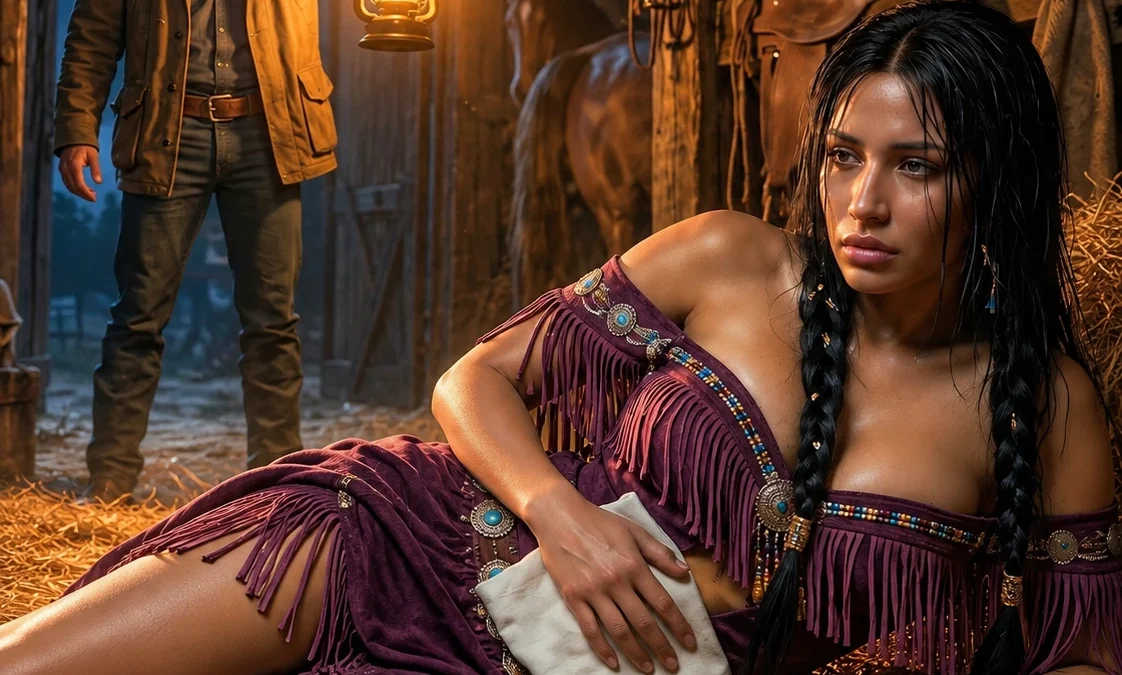
🔥 A Bleeding Woman Crawled Into His Barn at Midnight Clutching a Satchel. Inside Was Proof That the Lawman Hunting Her Had Murdered His Wife. 😱
Part 1
The Chinati Mountains. A cold night in March, 1886.
A bleeding woman crawled toward the only lit window for miles, carrying a secret that could hang the lawman hunting her.
She did not know the man behind that light. She knew only that the truth inside her canvas satchel could destroy Deputy Silas Rourke, and that she had come too far, and lost too much, to die quietly in the frost. 🌙
Holt Bracken had been alone on his high desert ranch for two years, ever since he buried his wife, Grace, under the cottonwood behind the springhouse. He had stopped expecting the supper table to need two plates.
He was thirty-four that spring, broad through the shoulders from ranch work, quiet the way men get quiet when the person they used to share a day with is gone. He kept forty head of cattle, six horses, a barn he had built with his own hands the year he married, and a silence in the house so complete that he sometimes talked to the dog just to hear a voice answer back.
He had let Grace’s garden go to seed the first winter without her. He regretted it the second. That spring he was trying to coax the beds back to life with a stubbornness that had less to do with vegetables than with not wanting one more thing on this land to finish dying.
That night he was in the barn, checking a mare due to foal within the week, when a gunshot cracked somewhere past the north fence line.
One shot. Then nothing. The kind of nothing that follows a bullet finding its mark.
He set down the lantern and counted the seconds, the way a man does when he doesn’t yet know whether trouble is riding toward him or away. Nothing came. He told himself it was a rider shooting at a coyote, and went back to running his hand along the mare’s flank.
Twenty minutes later, he heard something else.
A sound low to the ground. Dragging. Uneven. A ragged breath that carried across the barn floor from the open door behind him.
He turned with the lantern raised and found a woman collapsed behind the water barrel. One hand was pressed hard against her shoulder, blood black in the lamplight, soaking through a torn sleeve. The other hand gripped the strap of a canvas satchel as though letting go of it mattered more than living.
She was young, dark-haired, her face drawn tight with the exhaustion of someone who has been running on will alone for longer than her body could bear. Straw clung to her skirt. A long scrape ran down one forearm where she had gone down hard on rock in the dark.
She looked at him the way a person looks at the last decision they have left to make.
She did not let go of the satchel.
He set the lantern down slowly, the way he would approach a spooked horse. He kept his voice low and even, hands open where she could see them. Her dark eyes tracked him with the wary precision of an animal that has learned, hard, what happens when it trusts the wrong stranger. Her gaze flicked to the rifle leaning by the stall door, then back, measuring the distance. Measuring what kind of man he was.
He crouched an arm’s length away and asked, quietly, who had done this to her.
She studied him a long moment. Then, in careful English learned young at a mission school she did not care to name, she gave him a name.
“Deputy Silas Rourke.”
If Rourke found her in this barn, she said, he would kill them both and burn the barn down after. Every death near that man turned out, on paper, to be an accident.
Holt asked why she hadn’t simply let the satchel go somewhere back along the arroyo and spared herself the weight.
She looked at him with an exhaustion too complete to leave room for anger. Letting go was exactly what the men chasing her wanted, she said. A paper trail buried in the brush was as good to them as a paper trail burned.
He didn’t press again. There are answers that close a question clean instead of opening ten more.
He banked the barn’s second lantern low and told her to sleep if sleep would come.
That was the first time Holt heard the name that would define the next month of his life. And he did not yet know that it belonged to the same man, wearing the same badge, who three years earlier had put a bullet through his wife Grace on the Terlingua road and ruled it an accidental discharge before the county judge.
A finding nobody with sense in that country had ever fully believed. 😨
Her name was Chenoa. She was Mescalero, born into a family that had lived in these desert mountains longer than any fence line or county line had existed to divide them.
She gave him little that first night beyond the necessary facts. She had been shot near the arroyo two miles east. She had walked, then crawled, toward the only light she could see across the flats. And the satchel could not leave her hands. Not for cleaning. Not for sleep. Not for anything short of her own death.
He carried her to the tack room and laid an old quilt over the workbench. He boiled water on the kitchen stove, tore clean cloth from a shirt he no longer wore, and explained plainly that the bullet had gone clean through and he would have to pack the wound before it turned.
She did not flinch, though the muscle in her jaw jumped beneath her skin. Once, when his fingers found the worst of the torn flesh at her shoulder blade, her free hand closed hard around a fold of the quilt and stayed that way until he was done.
Then she reached into a pouch at her belt and pulled out a twist of dried leaf. Yerba de la víbora, she explained. Snakeweed, chewed and packed against a wound to slow the poison in the blood. She pressed it into his palm and showed him how with two fingers and a small motion of her chin.
It was the first thing they built together, before either of them had shared anything true.
By the time the wound was bound, the eastern sky had gone the color of ash. And Holt understood he had a decision in front of him that he could not undo by morning.
A wounded Apache woman with a stolen Army satchel and a county deputy hunting her was not a small thing to shelter. Not in a county where Rourke’s badge carried more weight than most judges’ gavels.
He thought of the empty house up the rise. The two years of silence. And the particular relief, one he was almost ashamed to name, of having a reason to move through a day with a purpose larger than keeping cattle fed.
He told her she could stay in the tack room until she was strong enough to travel, and that he would ask no more of her than she was willing to give.
She looked at him for a long moment. The wariness in her face was not gone, but it had softened at the edges.
“Ashoge,” she said. Thank you.
Then her eyes closed, and Holt sat by the workbench until full daylight, rifle across his knees, watching the door.
In the gray hour before sunup, he saddled his horse and rode out to the arroyo she had named, telling himself he was only checking the fence line. He found the sign easily. A scuff of boot heels where she had gone down. A dark stain on a flat rock. And farther back, the hoofprints of three shod horses that had turned and ridden hard toward town rather than follow her trail into the brush.
The men chasing her had either lost her in the dark or decided a wounded woman on foot wasn’t worth finishing by lamplight.
Holt rode the rest of the fence line slower than he needed to, turning one question over in his mind. What kind of woman carries a bullet three miles rather than let go of a satchel?
And what kind of man had made her do it?
The days that followed settled into a rhythm neither of them planned. Chenoa slept through most of the first two, waking only for water and the willow-bark tea Holt brewed to bring down her fever. By the third day she sat upright by the kitchen hearth, watching him work with the sharp patience of someone who had survived on observation rather than trust.
By the fourth evening, over a low fire, they began trading the stories neither had said aloud in a long time.
Holt told her about Grace. How she had come west from Georgia at nineteen. How she had laid the hearthstones of this very fireplace herself, because a house wasn’t a home until a woman had put her hands in the mortar. How she sang off-key while she baked, so the whole cabin smelled of bread and bad singing on Sunday mornings.
Then he walked her through the Terlingua road. Through the inquest, where Deputy Silas Rourke swore to an accidental discharge. Through the tax collector who had ridden with Rourke that day, and who later confided, quietly, to no one who could do anything about it, that the shot had come level and deliberate, from twenty feet, with no wagon lurch to explain it.
That same tax collector had taken a post in El Paso soon after. Paid for, by all appearances, with money that had no business changing hands.
Chenoa listened without interrupting, turning a piece of kindling in her hands. And when it was her turn, she gave her story back slowly, the way a person hands over something kept locked away because putting it into words makes it real again.
Her brother Istee had been a horse-breaker, known across three counties for gentling animals other men had given up on. Rourke had framed him for a killing he had no part in. He produced a paper knife Istee had sold to a trader years before, engraved with initials that weren’t even his, and used it as proof in a courtroom that had already decided on its verdict.
“They hanged my brother that winter,” she said, her voice gone flat and careful. “On evidence a child could have seen through.”
Holt said nothing.
And then she told him what was inside the satchel.
Part 2
“Three hundred and forty dollars,” Chenoa said.
It was an Army payroll fund, she explained, meant to carry Istee’s widow and her two children through the winter after his death. Rourke had quietly diverted it into his own pocket while filing paperwork that claimed it had never existed.
She had learned of it from a freight clerk in Alpine who owed her family a debt of his own and didn’t dare raise his voice above a whisper. And she had gone back for that money herself, alone, in the dark. Because no one else in that county was ever going to go looking for justice on her brother’s behalf. And because a widow with two children could not afford to wait on a system that had already shown what it thought her family was worth.
That was what the satchel held.
Not stolen Army gold, as Rourke would later claim to anyone who would listen. Recovered evidence. Payroll ledgers with Rourke’s own hand in the margins. Letters naming the tax collector and the sum he had been paid to keep quiet. And the money itself. Enough, together, to prove exactly where it had gone and who had taken it.
She had watched the strongbox for two weeks from the ridge above Rourke’s line shack, memorizing when the hired men rode out and when the shack sat empty. She had very nearly made it clean away before a ranch hand returning early spotted her climbing out the rear window and put a bullet in her shoulder as she ran for the brush.
Holt fed another piece of wood into the fire, mostly to have something to do with his hands.
A woman who had walked three miles bleeding rather than surrender that proof had already shown him everything he needed to know about her.
That night, Chenoa asked him plainly whether he blamed himself for Grace’s death. For not riding the Terlingua road with her that afternoon instead of staying back to mend fence.
He turned the question over a long while.
“Every day for the better part of a year,” he said at last, watching the fire. “Some days still.”
She didn’t offer comfort exactly. She told him that her family held no belief in blame laid on the living for what the dead had chosen to risk. That Istee had known the danger of going after that money as well as she had. That carrying his death as her own failure would have been, in her mother’s words, a second theft on top of the first. 💔
It didn’t unmake the year Holt had spent blaming himself. But it gave him, for the first time, another way to hold the same grief. One that didn’t leave him quite so alone inside it.
Something passed between them that night that was not yet trust, not fully, but no longer simple wariness. It was the understanding of two people who have each buried someone at the hands of the same man, and are only beginning to realize they might not have to carry that weight alone.
In the days after, their evenings widened past grief into smaller, gentler territory. She asked how he came to ranching, and he told her about his father’s failed cotton land in East Texas, the drought that drove the family west when he was sixteen, and an old vaquero named Refugio who had taken pity on a green boy who didn’t know a lariat from a lead rope.
She laughed, a short, surprised sound that seemed to catch her as much as it caught him. Then she told him about her mother, a woman known through three settlements for her beadwork, abalone shell traded up from the Pacific coast through generations of hands. The patterns marked a family’s lineage the way a brand marked cattle.
She still had her mother’s unfinished belt in her pack, she admitted. Half the pattern done. She hadn’t been able to finish it since the illness took her, because finishing it felt like admitting there would be no more lessons.
Holt offered no easy comfort. He only pointed out, gently, that Grace’s garden had sat half-tended the same way, for much the same reason. Maybe some unfinished things were allowed to stay that way until a person was ready. 🌿
During those same days, he built a false floor in the root cellar. He worked fence boards and old barrel staves into a shallow crawl space behind the potato bins, deep enough for a person to lie flat and breathe quiet for an hour, hidden beneath a rug and a barrel of seed corn.
He built it without being asked.
Chenoa watched from the doorway, arms crossed. She pointed out that he didn’t have to do this. He could ride to Alpine and let the law sort out a stranger’s trouble through proper channels.
Holt kept sawing. “The law in this county wears Rourke’s badge same as anyone’s. I’d rather trust a hole in my own floor than a judge who already let one killing go as an accident.”
She didn’t argue. She handed him nails instead, kneeling beside him in the cellar dust, and for a while they worked in a quiet that had stopped feeling like caution and started feeling like companionship.
That night, he pressed something into her palm without a word. A small break-top Smith & Wesson that had sat in a bedroom drawer, unused, since the day Grace died. He had cleaned and loaded it for the first time in two years.
Grace’s pistol.
The first search came on the fifth day.
Chenoa heard the riders before Holt did. Four horses, coming up the ranch road at an easy pace that didn’t match the urgency of what they were hunting. She was down through the false floor, the rug rolled back over her, before the second knock landed on the door. She lay flat in the dark with her hand on Grace’s pistol.
Rourke stood on the porch with two hired men behind him. Lean. Sun-cured. A badge that had seen better polish. Eyes that moved past Holt’s shoulder into the house with the unhurried thoroughness of a man who enjoyed making people wait.
He was looking for an Apache woman, he said. Armed and dangerous. Wanted for theft of Army property.
Holt answered flat and even, the same tone he would use to quote a buyer the price of beef.
Rourke’s eyes lingered on the fresh sawdust by the cellar door a moment too long. Holt’s pulse picked up, though nothing in his posture moved.
Then Rourke walked through the kitchen, the bedroom, the barn, and ran a boot heel across the rug over the cellar door without pausing. Close enough that Chenoa, lying beneath the boards with her breath held tight, could hear the leather creak two feet above her face. 😰
He found nothing.
On the porch, he left Holt with a warning. Harboring a fugitive carried its own rope. And a lonely man out here might be tempted toward company he shouldn’t keep.
Holt gave him nothing but a level stare. He did not exhale until the dust of their horses had settled a half mile down the road.
When Chenoa came up from beneath the floor, she was pale and shaking. Not from fear exactly. From the strain of holding stillness against every instinct that pulls a person toward running. Holt found himself reaching for her before he had decided to, steadying her by the shoulders until her breathing slowed to match his own.
Neither of them named what that was.
The weeks after were the gentlest either of them had known in a long time. As her shoulder healed, Chenoa took on more ranch work alongside Holt. She rode fence with him in the mornings. She broke a young gelding he had been putting off for a season, because Grace used to be the one with patience for green horses and he had never found it in himself since.
Watching her work the animal, low-voiced and unhurried, standing motionless for twenty minutes until the gelding’s ears finally came forward, Holt understood for the first time in two years what it felt like to want to stay and watch rather than find some chore to busy his hands.
There were moments neither of them named but both of them carried. A hand brushing his while passing a plate, neither pulling away as quickly as courtesy required. A morning when he caught her humming over the mending, the first sound of contentment that house had held in two years, and stood in the doorway a full minute just listening.
“Don’t stop on my account,” he told her, the first compliment he had risked since Grace. 💛
But the danger had not passed. Only paused.
Nine days after the first search, Rourke came again. On a gray morning. With four hired riders instead of two. No warrant. And none of his earlier patience.
He rode straight to the porch and ordered Holt aside. A ranch hand had seen a woman matching Chenoa’s description gathering herbs along the fence line at dusk, he said. Holt could produce her, or be charged as an accessory to theft of federal property. A charge that would see him hanged same as any Apache.
Holt held his ground on the steps. He said Rourke had no warrant and no standing to search a man’s home on a hired hand’s secondhand say-so.
Rourke’s men fanned out without waiting for a reply. Two toward the barn. Two holding near the house, rifles resting easy across their saddle horns. Holt understood, watching them move, that this was no longer a search. It was a closing net.
“Last chance to hand her over clean, Bracken,” Rourke said, resting one hand near his hip. “Otherwise I burn this place to the timbers looking for her. And I’ve got four men who’ll swear whatever I ask them to swear about how it started.”
Beneath the floor, in the dark, Chenoa gripped Grace’s pistol and pressed her ear to a crack in the boards. She listened to the voices above her shift from procedure into threat.
And she made the same decision she had made three nights before she crawled into that barn. She was done lying flat and waiting to learn whether someone else’s mercy would decide her fate.
She waited only until she heard the two riders near the barn dismount and head for the tack room.
Then she was moving.
Part 3
She went up through a gap in the cellar’s outer wall that Holt had shown her the week before, a second way out should the first ever be found. Out through the springhouse. Up the outside ladder and into the barn loft before either rider thought to look up.
On the porch, Holt watched Rourke’s hand drift toward the grip of his revolver as he climbed the steps.
And Holt asked him the question he had carried for three years. He asked it flat and clear enough for every hired man in the yard to hear.
“What exactly did the threatening movement on the Terlingua road look like? The one you swore under oath justified putting a bullet through an unarmed woman driving a wagon home from town with nothing in her hands but the reins?”
Rourke’s face changed.
Whatever answer he might have given died in his throat. In its place came the fury of a guilty man caught by his own history in front of witnesses he could not silence. His hand closed hard around the revolver, thumb finding the hammer.
The shot that ended it did not come from Holt.
It came from the loft window above the barn door. A single clean report cracked across the yard and echoed off the foothills behind the house. Deputy Silas Rourke folded backward off the porch steps into the dirt before his gun had cleared its holster.
Dead before he landed. 😱
Chenoa stood in the loft opening with Grace’s small pistol still raised, smoke curling from the barrel in the cold morning air. Her face was set in a calm that would only break hours later, once it was over and there was no longer any need to hold it.
In the second before she pulled the trigger, she had thought with startling clarity of her brother’s face. Of her mother’s unfinished belt. Of every reason she had earned the right to end this herself.
The hired riders wheeled toward the barn, rifles rising. Holt moved then, drawing and firing twice into the dirt at their horses’ feet. Close enough to scatter the animals without striking a man.
“The deputy’s dead by his own reach for his weapon!” he shouted. “There’s nothing here worth dying for on a dead man’s account. Ride while riding’s still a choice!”
Two riders broke and ran without looking back. The other two hesitated only a moment. They looked at Rourke motionless in the dirt, his badge catching the gray light. Then they followed.
Within a minute, the yard held only Holt, the body, and Chenoa climbing down the loft ladder with the pistol loose in her trembling hand. The silence was so complete that Holt would later say it was louder than the coyote’s scream through the wall that other night.
He crossed the yard and reached her before her legs gave out. He caught her, held her upright against him while the calm she had carried through the shot finally broke apart into shaking.
He said nothing for a long while. There was nothing worth saying to a woman who had just fired the shot that both of them had understood, somewhere past words, was always going to fall to her hand and no one else’s. 💔
The county sheriff rode out from Alpine two days later to close the matter. He closed it exactly as it deserved. An armed deputy. No warrant. Four men advancing on a private home. A man reaching for his weapon before witnesses, against a rancher with a lawful wounded guest under his roof.
Self-defense, the sheriff wrote in his report. He rode away without pressing too many hard questions about who exactly had fired from the loft. By then, the ledgers Chenoa had carried out of Rourke’s line shack were already sitting on his desk, in Rourke’s own damning hand. And no one left in that county was inclined to look a gift explanation in the mouth. Least of all a sheriff who would have to answer for it if the truth came out worse than the version already written down.
In the first days of April, once her shoulder had healed enough for the ride, Chenoa and Holt traveled two days north to the settlement where Istee’s widow had taken her two children after the hanging. They stayed the first night at a way station, where Chenoa slept easier than Holt had ever seen her sleep.
They mailed the satchel by registered post from the settlement’s small post office. The full three hundred and forty dollars, intact, along with the ledgers that cleared Istee’s name for whoever cared to read them properly.
Chenoa did not sign the parcel. She did not go to the widow’s door.
But she and Holt rode close enough past the small adobe house on the settlement’s edge that she could see smoke rising steady from the chimney and, briefly, two children playing in the yard with a dog.
Riding on, she told Holt her reasoning. Some gifts were better left without an author. The widow deserved the money and the cleared name without the added weight of gratitude owed alongside them. And seeing the children fed and the chimney smoking was payment enough for the risk. 🏠
Weeks later, a single careful page arrived at Holt’s ranch by a roundabout hand, thanking whoever had sent it, not knowing who that was. It was written in a careful schoolgirl’s hand that Chenoa took to be Istee’s widow, teaching herself letters in the evenings the way her brother once had.
Chenoa read it twice by the fire and kept most of it to herself. She said only that it was enough, and folded it into the same pack that still held her mother’s unfinished belt.
On the ride home from the settlement, she was quieter than Holt had seen her since the first days in the tack room. When he finally asked what sat on her, she admitted it wasn’t grief anymore. It was something closer to the strange weightlessness of a debt finally paid. Her brother’s name cleared. His widow provided for. The account with Rourke settled in the only currency that mattered in the end.
She had not let herself imagine what came after finishing that task, she said. For months, finishing it was the only shape her life had held. Now she found herself looking at the open country ahead and not knowing, for the first time in a long while, what she was riding toward.
Only that she was in no hurry to find out alone.
On the second night of that quiet ride home, through open country turning green with the season’s first rain, they made camp beside a shallow creek. Holt sat across the small fire, turning a twig over in his hands the way she so often did with kindling. He worked his way plainly toward the thing he had been circling for weeks.
The spare room up at the house had been empty two years. He wasn’t asking her to stay in it as a guest much longer. Not the way things had gone between them these last weeks. And if she wanted a place that was hers by right and not by his charity, it was there for the asking. He would build her whatever she needed. A workbench. Shelves for her herbs. Whatever she wanted.
“That’s as plain as I know how to put it,” he finished.
Then he went quiet, because he had run out of the courage it took to say more. He watched the fire instead of her face.
Chenoa sat with it a long while, long enough that Holt began to think he had misjudged the moment entirely and started rehearsing some graceful way to take the offer back.
Then she lifted her eyes to his and gave him a single word, plain as his own offer.
“Yes.”
She reached across the fire and took his hand.
They sat that way a long while under a sky gone thick with stars, needing very little else between them. For the first time in years, neither of them felt any need to fill the quiet. 🌌
They married that spring, in the kitchen where Grace used to bake. The room still smelled faintly of the last loaf Chenoa had pulled from the oven that morning out of a nervousness she wouldn’t fully own, though Holt caught her twice checking bread that didn’t need checking.
She wore her mother’s abalone-shell beadwork, finished at last. She had sat up three nights that week completing the belt’s final rows by lamplight. When Holt noticed, she told him that some things, it turned out, only needed the right season to be finished in. Not put off forever. 💍
The pattern marked a lineage that had survived a hanging, a bullet, and a corrupt man’s badge. That afternoon, it stood in a rancher’s kitchen, witnessed by the handful of neighbors who rode out for it. The same neighbors who had raised no questions when word got round of a wounded Apache woman living out at the Bracken place, and had decided, in their own quiet frontier way, that it was none of their business how a man chose to build his life back up.
There was no minister in that stretch of country, so a circuit judge who owed Holt a favor from an old cattle dispute stood in for one, keeping the words brief and plain. They stood at the same hearth Grace had laid stone by stone with her own hands. Neither Holt nor Chenoa found that strange. It seemed fitting, as though the house itself had been waiting patiently to be lived in fully again.
Chenoa gave her vow in Mescalero first, low enough that only Holt caught the words. Her voice was steadier than it had been in the barn that first bleeding night. Then she said it again in English, for the room.
Holt would say afterward that he had understood the first one before she ever translated it, the way a person understands weather coming before the first drop falls.
By summer, the spare room that had sat empty for two years had become Chenoa’s workroom, hung with half-mended bridles and a shelf of drying herbs she kept for the whole county’s use. Word had spread quickly of the Apache woman on Bracken’s ranch who knew how to pack a wound properly, read a fever right, and never charged a struggling family more than they could spare.
Neighbors who would once have crossed the road rather than approach her now rode out for salves and advice. And Chenoa treated each of them with the same careful, unhurried attention she had once given a stranger’s bullet wound on a workbench in the dark. 🌿
The cabin no longer sounded, in the evenings, like a house with only one person breathing in it. There was mending on the table most nights, and low talk by the fire that didn’t always need to be about grief anymore. Sometimes it was only about the weather, or the gelding’s progress, or a neighbor’s gossip. Ordinary talk that felt, to both of them, like the rarest kind of luxury.
Out in the corral, the gelding had finally stopped flinching at a raised hand, the way some wounds, given enough patient work and enough time, eventually close all the way.
Some things take longer than they should to come right. A wrongful hanging that could never be undone. A wife lost on a road three years gone. A brother’s name cleared too late for him to hear it cleared himself.
But some things, given a barn door left open on a cold night and two people willing to trust a stranger’s silence over a badge’s noise, come right after all. In their own slow season, the way spring comes to high desert country. Not all at once. Never without cost. But steady, and certain, and worth every cold month spent waiting for it to arrive. 🌅
This story is entirely fictional and created for entertainment purposes only. It does not represent any organization or individual, nor does it encourage inappropriate behavior. The content was generated with AI assistance.








