A Broke Drifter With $16 and a Horse Inherited a Ranch… But the Lawyer Warned Him: “It Comes With FOUR Apache Sisters, and You Can’t Make Them Leave”
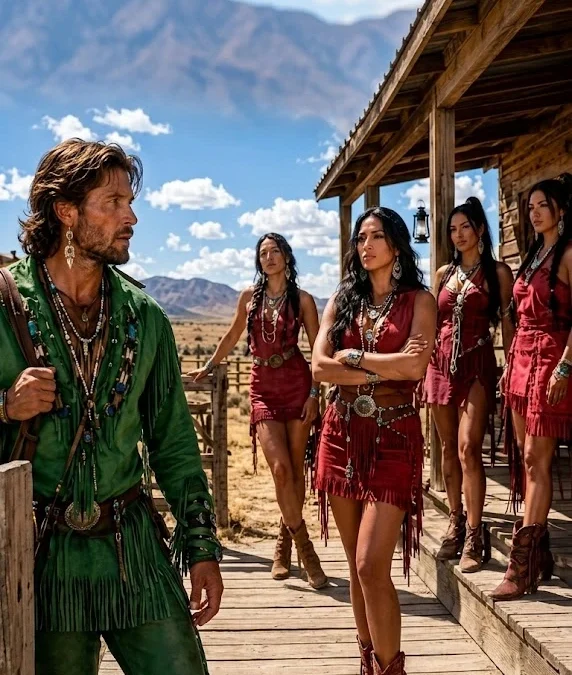
😱 A Broke Drifter With $16 and a Horse Inherited a Ranch… But the Lawyer Warned Him: “It Comes With FOUR Apache Sisters, and You Can’t Make Them Leave”
PART 1
The deed was folded three times and smelled like cedar. The lawyer never once looked me in the eye as he slid it across the desk, like he couldn’t stand to watch my face while he explained what it meant.
“Cass Elmo Whitfield,” he said, “you are now the owner of the Arroyo Largo.” He cleared his throat the way men do when they haven’t finished saying something. “Along with its… obligations.”
“What obligations?”
He spoke slowly, like he’d practiced it. My uncle, Dearborn Whitfield, had made an arrangement with an Apache man named Taza. Both men had died the same month last winter. Under the deal, Taza’s four daughters would work the ranch, and in exchange they could live on it, in a house Dearborn built for them in the northeast corner.
The arrangement had no end date. It only said: as long as it’s needed.
“And if I don’t want the ranch?”
For the first time, the lawyer looked straight at me. “You’re forty-nine years old, Mr. Whitfield. You’ve got sixteen dollars and a horse.”
The deed was in my coat pocket before I stepped out into the cold November street. 🍂
Let me tell you who I was before that day.
For more than twenty years, I was a surveyor’s hand. I ran chain and drove stakes and read the ground for other men, men too busy buying land to stand on it. I could find water by the dip of the soil. I set corners on land that became towns, ranches, cemeteries. I watched other men build lives on what I measured.
I never built one for myself.
I had a wife once. Her name was Calla. She died of fever eleven years before that lawyer slid me the deed. We had a little house in Amarillo with a kitchen garden she was fussy about and a porch where we sat every evening the weather allowed.
After she was gone, I couldn’t stay. Her shape was in every room. Funny how a person weighs more after they’re gone than they ever did while they were here. 💔
So I sold the house cheap and kept moving, because moving hurt less than standing still somewhere that still held her.
I’d met Uncle Dearborn exactly once, when I was twelve. A thick man in good boots who shook my hand, gave my father a bottle of rye, and never came back. The lawyer’s letter took three weeks to find me in a surveying camp outside Tascosa. I read it three times sitting in the dust before I believed it was meant for me.
So when I first rode onto the Arroyo Largo under a gray sky, wind smelling of dead grass and cold stone, I wasn’t a man coming home.
I was a man arriving at a problem someone had handed him.
The main house was sturdy adobe and timber. A creek cut through the pasture, slow and shallow but alive. And up on a rise to the northeast stood a long, low house with smoke rising from its chimney.
Four sisters. I didn’t know their names or their ages. I didn’t know what “as long as it’s needed” really meant.
That first night, I built a fire and read the deed until I knew every word.
In the morning, I heard boots on the porch. My hand went to my rifle before the knock came.
One knock. Just one.
“Come in.”
The eldest stepped through first. Maybe thirty, about my height, black hair braided over one shoulder, a small scar beside her left eye. Her face had seen a lot of weather and decided not to be bothered by it.
Behind her came three more. A thin, quick-eyed one. A serious younger one trying hard to look grown. And the youngest, maybe sixteen, who stayed in the doorway.
“You are the new owner,” the eldest said. Not a question. Her English was better than some men’s I’d worked with.
“Yes.”
“My name is Natacha. My sisters are Dah, Hura, and Ama.” Each one looked at me as her name was spoken. “We came to see if you had come to put us off.”
“Not today,” I said.
Something flickered in her face. “Then we will get back to work.”
And they left. The youngest closed the door behind her without a sound.
The first weeks weren’t easy, for any of us.
The cattle had been sold after Dearborn died to pay debts. What I inherited was land, buildings, and a small flock of sheep the sisters had been running alone for six months.
So I walked the property the way I’d walked a thousand acres, reading the story the ground was telling. New fence posts on the east line, set deep. A kitchen garden put carefully to bed for winter. A smokehouse. Neatly stacked firewood. Pastures rotated so the grass could recover.
That’s what hit me. With no money, no credit, and no help, those four women had kept this ranch alive. The place wasn’t failing.
They had kept it going.
On the third morning, Natacha brought me a list in careful handwriting. Fence posts, 12 needed. Wagon wheel, left rear, cracked rim. Two ewes not eating.
“How long has the rim been cracked?”
“Since August.”
“That’s five months on a cracked rim.”
She didn’t blink. “We had no credit at the smithy.”
That afternoon I rode into Dorado, a small town that ran on everybody’s business. Men stared at me like they’d already decided something. The blacksmith, Gantry, snorted when I named the ranch. Dearborn had died owing him forty dollars.
I paid it. I didn’t have much, but I paid it, and ordered the rim and the posts.
When I told Natacha, she pulled the waxed thread from her teeth. “You paid his debt.”
“It was my debt by then.”
On Christmas Eve, I carried a haunch of meat to their door. Natacha looked at it, then at me. “Will you come in?”
Their house smelled of piñon smoke and dried chilies. Ama had baked a sweet flat cake with pecans. Dah fired questions at me like she’d been saving them for weeks. Hura said little and watched everything. Natacha refilled my cup twice without asking, and once our eyes met over the lamp, and she didn’t look away.
I did. 🕯️
Walking home through the cold, I thought: there are worse obligations than this.
Then February came. And so did a man named Harker.
He rode in with two men and a paper in Dearborn’s handwriting, an intent to sell the ranch to him. Unsigned.
“This is an intent,” I said. “Not a sale.”
Harker’s gaze drifted to the northeast rise, to the sisters’ roof. “That property comes with a complication. You’d be better off selling and being free of it.”
“It’s not for sale.”
One of his men, a younger one, kept staring at the sisters’ house in a way I didn’t like. Harker tipped his hat and promised to come back.
That evening I told Natacha everything. She listened, arms folded, until I finished.
Then she said quietly:
“Harker’s men have already come through the south pasture. Twice this month. At night.” 😨
👇 Part 2 is in the comments! Can’t find it? Leave any word below and I’ll send it to you privately. ❤️
PART 2
“Harker’s men have already come through the south pasture. Twice this month. At night.” I stared at her. “Why didn’t you tell me?” She held my gaze steady. “We didn’t know yet who you were.” It stung, but I understood. They’d survived five months alone after two deaths, with no credit, no standing in town, and no man they could rely on. They’d been watching to see what kind of man I was. You can’t blame a person for that.
So I moved my bunk to the north side of the house and left the shutters cracked. In the first week of March, I heard hooves near the fence line in the dead of night. I walked out into the cold without a lamp and without firing a shot. I just stood at the fence. About thirty yards out, a rider stopped, a black shape against the stars. We stared at each other a long while. Then he turned and rode away.
Next morning I went to Marshal Pruitt in Dorado. He wasn’t a man I’d trust with anything important, but he was the law that existed, so I used him. Twenty years of surveying meant I could give him exact dates and compass bearings for every intrusion. He wrote it down and said he’d “speak to Harker.”
Three weeks later, Harker came back. Same two men, plus a new one: big, bored, wearing his gun low. “Marshal Pruitt sends your regards,” Harker said with a thin smile. “My offer stands.” He named his price. I didn’t even consider it. “You have three minutes to get off my property.” The big man smiled down at his saddle horn like I’d told a joke. Then I felt something behind me. I hadn’t heard anyone come out of the house, but I knew someone was there, maybe ten feet back to my right. I didn’t turn around. I kept my eyes locked on Harker. The wind went still. The big man’s hand drifted closer to his gun. Harker’s men shifted in their saddles, waiting for his signal. My heart was pounding, but my voice came out flat and calm. “Two minutes.” Harker’s eyes slid past my shoulder, toward whoever was standing behind me. He looked for a long, long time. And then his face changed completely… 😱
👍 Want Part 3? LIKE this post and comment “HOME” below! Once we hit enough comments, I’ll post the ending right here. 🔥
PART 3
…the practiced authority drained right out of it.
Harker pulled his horse around without another word. His men followed. The big one went last, and he looked back twice.
When they were past the gate, Natacha stepped up beside me. She was holding the old Spencer carbine that usually hung over their door. Not pointed at anyone. Just held easy, the way someone holds a thing they know how to use.
“You didn’t count down from two,” she said.
“No.”
“Smart.”
A laugh rose in my chest and went back down. “You could have stayed inside.”
She looked at me sideways. “So could you.” 🔥
Spring came slow and cold, then all at once, the way it does out there. The hills turned green in a week.
All through April I set the new posts along the fence line, and Dah worked beside me while the others had the sheep up on the north pasture. She drove a post without needing to be shown, and she talked while she worked. I didn’t mind.
She told me about their father, Taza. A man who saw what was coming and prepared for it. He sent her and Natacha to the mission school, which they hated but endured. He learned English, traded in it, and became known for his excellent horses.
“He made the arrangement with Dearborn because he trusted his word,” she said, driving another post with three clean strikes. “And because a piece of paper is better than no paper when it says the land is yours to use.”
“Sounds like a practical man.”
“He was. So was Dearborn. My father said the best men keep their word even when it costs more than they expected.” Another strike. “When Dearborn knew he was dying, he sent word to tell us the paper was in his desk, and that it meant exactly what it said.”
“Did you know him well?”
“Better than most. He ate at our table. Natacha liked him.” She said it simply, just a fact. “She understood the arrangement best. When he died, she was the one who decided we would stay.”
“She could have gone.”
“She thought about it,” Dah said.
I didn’t say anything to that.
In May came lambing. I’d never lambed in my life. Natacha told me what to do the same way she’d tell anyone, no fuss about what I did or didn’t know. For three nights, all five of us lived in the barn, taking turns sleeping in the hay.
When the first lamb stood up shaking on brand-new legs, Ama pressed both hands over her mouth, eyes shining, making the sound children make when something wonderful happens. Quiet Hura put an arm around her, and they watched the ewe clean her baby. 🐑
Natacha knelt, ran her hand over the lamb’s back, and looked up at me. “Good.”
One word. But in the lamplight her face was softer than she usually allowed.
We lost one that night, a stillborn that came wrong. I carried it out and buried it. When I came back, Natacha was already with the next ewe. There was nothing to say. I washed my hands and helped. That’s how the work was. You did what was needed.
Then in June, a rider brought a letter from a law office in Santa Fe. A creditor of Dearborn’s estate, a man named Folger, had filed a claim against the ranch. There would be a hearing.
I found Natacha tying up bean poles and handed it to her without a word. She read it. Her face didn’t change.
“Harker has a friend in Santa Fe.”
“Probably.”
She turned back to the beans. “What will you do?”
“Go to Santa Fe and deal with it.”
She pulled a knot tight. “And if you can’t?”
“Then I’ll find another way.”
She turned and looked straight at me, the way she looked at everything, right at the center of it. “When do you go?”
“Week’s end.”
She nodded and went back to work.
I rode to Santa Fe alone. Two nights camped under the stars, and for the first time I truly thought about what had happened to me.
For eleven years after Calla, I’d woken up only because camp life required it. Purpose by obligation. But on the Arroyo Largo, I woke up with a reason. Not because four capable women were helpless. They weren’t. But because four strong people with no one in their corner needed a man who’d stand at the gate and say two minutes.
I thought about Natacha handing me that letter without panic. What will you do? And if you can’t? She’d watched me for six months, made her judgment, and trusted me with the answer.
I couldn’t remember the last time anyone had trusted me that plainly.
Lying in my bedroll, watching Scorpius rise over the mesa, I thought about that word the lawyer used. Obligation. Like it was a weight. A problem to manage.
It wasn’t. Not anymore. Somewhere between the cracked wagon rim and the lambing and two minutes at the gate, it had become home. I hadn’t meant for it to happen. But there it was. ✨
In Santa Fe, my lawyer was a thin man named Beckwith with a better coat than his office deserved. He studied my papers a long time.
“This claim is manufactured,” he finally said. “Good news: manufactured claims leave traces.”
By the next morning he’d found them. Folger was a real freighter, but the debt he’d claimed had already been paid, and a receipt proved it. Harker had gambled that the receipt was buried with Dearborn.
It wasn’t. The executor of Dearborn’s estate had it.
The hearing lasted forty minutes. A gray, careful judge read every page, peered over his spectacles, and dismissed the claim.
Outside on the plaza, Beckwith shook my hand. “Harker will try another angle.”
“Let him.”
He studied me. “Most men in a land fight are scared. You’re not.”
“I’ve got things worth fighting for.”
Four days later, I topped the ridge above the arroyo at dusk and saw lamplight in both houses, small and warm in the dark. I sat my horse there a moment. Then I rode down.
Natacha was on her porch with a shawl and a lamp. She lifted it to see me, and when she saw it was me, she lowered it.
“Dismissed,” I said. “The claim was dismissed.”
She was quiet a moment. “Come in.”
Dah, Hura, and Ama were at the table playing a game with smooth stones that Ama was winning. “Well?” Ama demanded.
“It’s over. We won.”
Ama made that same sound from the lambing, hands over her mouth. Dah said something in Apache, and Hura actually smiled, and it changed her whole face. Natacha poured me coffee, and I sat in the chair that had somehow, over the winter, become mine. Ama leaned against my arm for a second, the way young people do once they’ve decided you’re safe.
I looked at the lamp and thought: So this is what it looks like. A house with people in it. 🏡
Harker made one last move in July. Not legal this time. His men cut our south fence three nights running and drove stray cattle through, trying to start a war between me and our southern neighbors, the Aldridges.
Aldridge came over furious, a big red-faced man with a handlebar mustache. I listened to his whole complaint, then rode out with him and showed him the cut wire and the boot prints.
“Someone’s doing this on purpose,” I said. “It isn’t me. And it wasn’t the cattle’s idea.”
He looked at the wire a long time. “Dearborn wouldn’t have let this go three nights.”
“Neither will I.”
We fixed the fence together. The next night, I was waiting in the dark before midnight. At two in the morning, two of Harker’s men crept up with wire cutters. I let them get close enough that stopping them was certain, then fired twice into the ground.
They ran. One dropped his cutters.
I carried those cutters to Marshal Pruitt and told him that if his “looking into it” didn’t produce results, the matter was going straight to Beckwith in Santa Fe.
The fence was never cut again.
In August, the Aldridges came for supper. All of us around the big table in the main house: the Aldridges, me, and the four sisters. It was the first time anyone from Dorado had sat down with the sisters like it was the most natural thing in the world. Clara Aldridge, a formidable woman, talked winter feed with Natacha, asked Ama about the stone game, and told Dah her English was better than her husband’s.
Over coffee, Aldridge looked around the table and said quietly, “You’ve done all right here.”
“The ranch does most of it.”
“I don’t mean the ranch.”
I knew what he meant.
After they left, Natacha and I sat on the porch while her sisters washed up inside. The summer stars hung thick and low. The creek murmured below.
“Clara Aldridge is a decent woman,” she said. “People will talk less now.”
“People talk about what they’re not used to. Then they get used to it.”
“Is that what you believe?”
“It’s what I’ve seen.”
She was quiet. “Dah says you’ve decided to stay.”
“Did Dah have an opinion about it?”
“She said good.”
I looked at the stars. “What do you say?”
She didn’t answer right away. She never did when something mattered. She held the question like you’d feel the weight of something before lifting it.
“I say you have made this a different place than it was.”
“You did that. You kept it going five months before I ever came.”
“We kept it alive,” she said. “You made it something worth fighting for.”
I didn’t know what to say. So I just sat with it.
“When I gave you that letter in June,” she said softly, “I knew you would come back.”
“How?”
“Because it was yours. You just hadn’t understood it yet.”
She wasn’t looking at the stars anymore. She was looking at me, steady, the way she looked at things she’d already decided about. I felt it like a warm hand pressed flat against my chest.
“Natacha,” I said. Just her name.
She didn’t look away.
I reached across the porch boards and laid my hand over hers on the rail. She turned her hand over and held mine.
Not a small thing. The most real thing that had happened to me in eleven years. ❤️
We sat like that a long time without talking. The creek below. The stars above. Her sisters’ voices drifting from the house behind us.
For twenty years, I kept moving because stopping hurt. I stayed ahead of the stillness because the stillness still had Calla in it. Then a lawyer slid a deed across a desk and said, here is your obligation. What he was really handing me, without knowing it, was a reason to stop.
I didn’t know a thing about sheep when I came. Nothing about Apache ways, or how to read land the way the sisters did, as something living, with a temper and a long memory. But I knew how to work, how to be straight with people, and how to stand at a gate when something worth protecting was behind it.
Turned out that was enough to start.
The Arroyo Largo is a going concern now. Wool, not cattle. The sisters know sheep better than anyone. Aldridge has become something close to a friend. Clara and Natacha trade seeds every spring and compare preserves every fall. There are still a few men in Dorado who look sideways when I come to town with the sisters. But fewer every year, and they keep their looks to themselves.
Last September, a storm knocked down part of the east fence. Natacha, Dah, and I went out to mend it. Dah was telling a story about a gray mare their father once sold, a horse so clever she learned to open the gate latch herself. Natacha was laughing, a full, bright laugh I didn’t hear often and never got tired of.
I held a post steady. Dah drove it in, then stopped and looked at me in that precise way of hers.
“You’re happy,” she said.
It wasn’t a question. I didn’t treat it like one.
“Yes.”
She nodded once, satisfied, and moved on to the next post.
Natacha glanced at me sidelong. The laugh had faded into something quieter, something older. She reached out and rested her hand flat against my back, right between my shoulder blades, and left it there while I set the post.
The eastern hills were turning gold. The creek ran higher than it had in July. Over the rise, the sheep drifted white across the north pasture.
I drove the post. She took her hand back, picked up the wire, and we kept going. 🌄
That’s the whole of it. An obligation that turned into a home. And a woman who watched long enough to know exactly what she was choosing, and then chose it, straight and clear and sure, the way she did everything.
A man could do a lot worse than being known that well.
THE END.
Disclaimer: This story is entirely fictional and created for entertainment purposes only. It does not represent any organization or individual, nor does it encourage inappropriate behavior. The content was generated with AI assistance.








