A Couple Vanished Into a Florida Spring and Four Years Later Two Skeletons Were Found Lying Side by Side in a 22-Inch Cave Niche. Whoever Put Them There Knew Those Tunnels Better Than Anyone Alive…
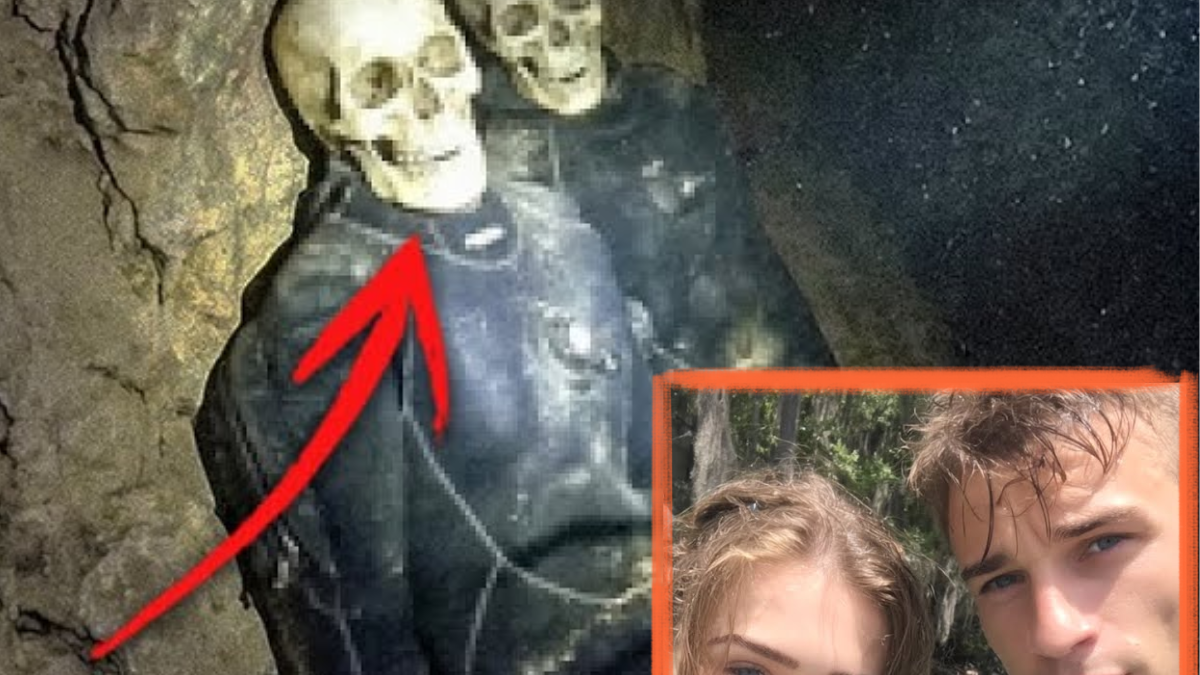
A Couple Vanished Into a Florida Spring and Four Years Later Two Skeletons Were Found Lying Side by Side in a 22-Inch Cave Niche. Whoever Put Them There Knew Those Tunnels Better Than Anyone Alive…
Part 1
The air over Gilchrist County hung so thick on the morning of June 12, 2012, it felt almost solid. By noon the temperature had crossed ninety degrees. 🌙
Twenty-two-year-old Hannah Mayer stepped out of a silver SUV at the edge of Ginnie Springs with her fiancé, Aaron Norman, twenty-six. Hannah was a biology student who had spent four years studying freshwater springs. To her, this trip was not a vacation. It was a chance to see the hidden tunnels of the Santa Fe River with her own eyes. Her mother would later tell detectives that her daughter planned everything. Every route. Every backup. Every safeguard.
Aaron, a manager in his father’s construction company, was in a hurry. A park technician remembered the way he spoke, abruptly, drumming his fingers while the permits were processed. Hannah leaned over a map of the cave system, tracing the passages with a fingertip.
Around noon, they loaded their gear onto a cart and walked toward the Devil’s Eye. The water was crystal clear, a constant seventy-two degrees. Their plan was simple. Dive, surface, and be back at their rented villa by eight, where friends were already cooking dinner.
Eight o’clock came. Then nine. Aaron’s phone, which he never turned off because of work, went straight to silence.
At half past nine, the friends drove to the park. Under the Spanish moss, in the moonlight, they found Aaron’s SUV alone in the lot. Through the glass they could see two phones, two wallets, and a change of dry clothes. One of them called 911 with shaking hands. 💔
Deputies found two pairs of sneakers and two travel bags neatly stacked on a wooden pier. Whoever left them had meant to come back. At dawn, rescue divers descended into the Devil’s Eye. At twenty feet, right at the cave mouth, one of them saw something bright. Hannah’s mask. The strap was torn. Deep scratches ran across the lens. Beside it on the rock lay a single black fin.
The searchers assumed panic, or a collision with the cave wall, or a regulator failure. Maybe the current had pulled the couple into the maze.
For seven days, divers crawled through limestone tunnels where silt turned visibility to zero. Underwater drones with high-definition cameras swept the passages. They found nothing. Hannah’s mother never left the riverbank. “My daughter was too experienced to make this mistake,” she told every officer who would listen. “Please. Look at who else was there.”
Deputies found no signs of a struggle on the shore, and no strange footprints near the car. On June 20, after more than five hundred feet of the most dangerous passages had been searched, the operation was called off. The sheriff’s report said there was no chance of finding them alive. Hannah and Aaron were declared missing, and the case was filed away as a tragic accident.
Over four years the story hardened into legend, one of those dark tales told to visitors around evening bonfires at the park.
Then, on June 16, 2016, three teenagers, among them Tyler Clark and Aiden Ross, slipped into the cave system with bright LED lights and minimal gear. They were hunting for photographs no one had taken before. They pushed into a remote section almost no one dared enter, a corridor no wider than twenty inches in places.
Three hundred and fifty feet from the main channel, at fifty feet of depth, Tyler’s beam swept across a small cavern. In the far corner, wedged into a limestone hollow, sat two dark shapes.
They looked like rocks. They were not.
As the boys drifted closer, they saw black neoprene wetsuits. The suits had held their shape perfectly, as if two people were simply waiting there in the dark. Then the lights caught something white through a torn seam. Bone.
The teenagers fled the cave and called 911. 😨
Detective Michael Miller led the recovery, and he would later write that nothing in his career had been harder. Divers had to work one at a time, easing the bodies through narrow cracks while the silt closed in. By three the next afternoon, both suits were on the surface.
Investigators noticed it immediately. The bodies were lying parallel to each other, side by side, carefully placed in a natural niche. Drowning victims did not end up like that. It looked less like an accident and more like a burial.
DNA matched the samples Hannah’s and Aaron’s parents had given four years earlier. The missing couple had finally been found.
Then a forensic specialist went over the photographs one more time and noticed what was missing from the scene.
The weight belts. Every diver wears one. And somebody had taken both of theirs. 😱
Part 2
The weight belts. Every diver wears one. And somebody had taken both of theirs.
The case that had been closed as a tragic accident was reopened. Detectives pulled every file from 2012, the car, the park’s gate footage, the belongings on the pier. Aaron’s father hired a private investigator and told reporters he had never believed his careful, certified son had simply made a mistake. 🕯️
On June 21, a team of cave divers and a state hydrologist returned to the cavern. What they measured changed everything. The entrance to that dead-end passage was only twenty-two inches wide. Two adults could not have drifted in together by accident. The hydrologist added that the river’s flow in this section pushed water away from the walls and toward the main channel, not into the dead ends. The 2012 theory that the current had carried them there was finished.
Detective Miller wrote that the position of the skeletons was anatomically unnatural. Someone had arranged them.
Then the medical examiner delivered the findings that made the room go quiet. There were no diatoms in either victim’s lungs. They had not been breathing when water entered their airways. Both skulls bore identical depressed fractures in the parietal bone, smooth-edged and geometric, made by a heavy blunt object. Aaron’s left fifth, sixth, and seventh ribs were broken by a blow from the front.
And the regulators, once thought to be corroded by time, told their own story. Under the microscope, the valves showed fine scratches and deformations. Someone had tampered with them with a thin metal tool before the tanks ever went underwater.
Hannah and Aaron had started the dive with air that would fail them at depth. Hypoxia. Disorientation. Helplessness. And then a heavy wrench or lever, the kind used to secure tanks at a fill station.
On the inside of Hannah’s wetsuit, the lab found a dark smear of high-viscosity technical lubricant, the kind amateur divers do not carry.
The prosecutor changed the charge to aggravated murder. 💔
Detectives looked first at the family. Aaron’s older brother, Steven Norman, thirty, had inherited half of a multimillion-dollar construction company after their father’s death in December 2011. A former company lawyer described months of bitter fighting. Aaron wanted outside investors. Steven, buried in debt, wanted to sell assets. Two weeks before the trip, the company secretary heard Steven threaten his brother with lawsuits if he did not sign a waiver.
Steven had no alibi for the key hours of June 12. He said he was at a construction site thirty miles away, but the phone records and gas station cameras could not confirm it. Within days of Aaron’s disappearance, he gained sole control of the company’s accounts and paid off mortgages worth more than $800,000.
It looked like a motive carved in stone. But there was nothing placing Steven in the water, or at the Devil’s Eye.
So forensic scientist Elizabeth Ward went back to the gear. Under an electron microscope, in the teeth of the zipper on the back of Hannah’s wetsuit, she found three microscopic fibers that did not belong to her.
Bright orange. Polyester and nylon, built to survive chlorinated water. The pigment code matched a single kind of industrial workwear.
Detective Miller made calls. On July 25, the answer came back. That exact fabric was used for exactly one uniform in the region. The technical staff at the Blue Depth Resort dive center, the place where Hannah and Aaron had rented their tanks and had their equipment checked on the morning they vanished.
Someone in an orange uniform had stood directly behind Hannah and touched her gear.
Blue Depth had replaced nearly ninety percent of its staff in four years. Detectives rebuilt the list from tax records and social media. The duty schedule for June 12 held seven names.
And one of them had quit his job only eight weeks after the couple disappeared. 😱
Part 3
Former administrator Katherine Hall remembered the morning clearly. At 11:30, Aaron Norman had stormed at the counter, checking his expensive watch, snapping at staff over a ten-minute delay. But the scene that stayed in people’s minds took place at the compressor station.
A former waiter, Jeffrey Baker, had been serving the summer terrace nearby. He watched Aaron, holding two cylinders, scream at a young technician in an orange T-shirt. Aaron claimed technical grease was smeared on the valves and could stain his suit. Baker remembered the words, shouted across the whole area. The staff were trash, Aaron said, with no room for error. Their only job was to serve people like him without fail.
Hannah stood a few feet away. She did not intervene. She quietly checked the seal on her mask.
The technician was twenty-four-year-old Brian Walker. Colleagues described him as reserved, proud, with a fragile ego. A senior instructor, Steven Wolf, said Walker was devoted to his craft. He knew every branch of the Ginnie cave system, and he often explored the most dangerous sections alone, where visibility was zero.
After the insult, Wolf recalled, Walker went silent for two hours. He kept preparing equipment, but his movements turned sharp, and his eyes kept returning to the couple. It was Walker who personally helped Hannah into her suit, zipped it up her back, and settled her heavy cylinders on her shoulders. Close contact. Exactly where the orange fibers had caught. 🌙
Walker resigned eight weeks after the disappearance, saying he wanted a new career. In 2012, he had told investigators he remembered no conflict.
On September 15, 2016, Detective Miller’s team found him in Savannah, Georgia, working as a mechanic in a small garage. In his first interview, Walker was calm. Thousands of customers had passed through his hands, he said. He did not remember these two.
Then deputies searched his home and garage. In a metal box among his tools was a notebook of cave diagrams drawn with astonishing precision. One page showed the remote sector, with a narrow depression marked in blue ink as “the vault.” The coordinates matched the spot where the skeletons were found, to within inches. Beside it, wrapped in an oily rag, lay a heavy adjustable wrench. At the lab, the shape of its striking surface matched the fractures in both skulls and in Aaron’s ribs.
A portable navigation unit from his desk delivered the final blow. Technicians recovered its archived track for June 12, 2012. At 8:45 that evening, four hours after Walker’s shift ended, the device had been at the entrance of the Devil’s Eye. He had told investigators he was at home in another county.
Confronted with the orange fibers and the testimony of his coworkers, Walker changed course. He admitted he had drawn the map, saying it was professional interest. He claimed he had returned that evening for forgotten belongings and spotted Aaron’s SUV. Hour by hour, his story began to include details only a man fifty feet underwater at the moment the air failed could know, how sound carries inside the cave, how fast a diver loses all sense of direction when the light goes out. A faint smile crossed his face when he spoke of the helplessness of rich tourists.
In October 2016, under the weight of the evidence, Brian Walker signed a full confession. 😨
During a reenactment that lasted more than eight hours, he described it with the flat precision of an engineer. The plan had come to him the moment Aaron humiliated him. While supposedly checking their regulators for leaks, he used a thin steel needle, the kind used to clean injectors, to deform the internal valve in both of them. At thirty feet, as the water pressure rose, the valves would begin to choke off oxygen. Divers often mistake that for a panic attack.
When the couple vanished beneath the Devil’s Eye, he donned his own equipment from the office and followed. Using his knowledge of the currents, he stayed in the shadows of rock formations and switched off his light whenever they looked back. At fifty feet, in a remote cavern, Hannah and Aaron realized that their air was failing. Walker waited until they were completely disoriented, watching their frantic movements in the dark for several minutes.
Then he struck each of them twice with a heavy wrench, using the water’s inertia to add force. He said he wanted the last thing they saw to be a man in an orange uniform, someone they thought was beneath them.
He dragged their bodies into the narrow alcove he called the vault and removed their weight belts, fifteen pounds each, so they would not float up and be found. He laid them side by side. 💔
The trial opened in May 2017, and for the families it was an ordeal. Prosecutors showed more than two hundred slides, the navigation coordinates, the microscopic fibers in the zipper, the matching wrench. An underwater engineer testified that the valve damage was identical in both regulators and could not have occurred by chance.
On May 17, 2017, the Alachua County judge told Walker his crime was unprecedented in its insidiousness, because he had turned nature itself and the helplessness of his victims into a weapon. Brian Walker was found guilty of two counts of first-degree premeditated murder and sentenced to life in a maximum-security prison without any possibility of release. He showed no reaction. He only looked once, briefly, at Aaron’s parents in the courtroom.
And Steven Norman? Nothing tied him to the dive. The conflict, the debts, the missing alibi, the mortgages paid off in the weeks after Aaron disappeared, all of it was real. But investigators found no evidence that he had anything to do with the murders. His brother’s death had delivered what his arguments never could. It remained a cruel coincidence that the family would live with.
Hannah’s mother, who had stood on that riverbank for seven days refusing to leave, had said all along that her daughter would never make such a mistake. She had been right. She had asked them to look at who else was there. For four years, no one had.
The case changed the park. The Florida diving authorities required independent equipment inspections, and video surveillance was extended to every technical area where tanks were filled and regulators checked.
Five years later, a small plaque with Hannah’s and Aaron’s names was set on the bank of the Santa Fe River, a quiet warning that water always holds the truth, even if it takes four long years to reveal it. In the county archives, the file remains an example of how one microscopic fiber, caught in the teeth of a zipper at the bottom of a cave, can speak louder than a killer’s silence and the dark water that tried to hide him. 🕯️
This story is entirely fictional and created for entertainment purposes only. It does not represent any organization or individual, nor does it encourage inappropriate behavior. The content was generated with AI assistance.








