A COWBOY SAW AN APACHE WOMAN HIDING HER TORN DRESS—WHAT HE LEFT ON A ROCK CHANGED BOTH THEIR LIVES
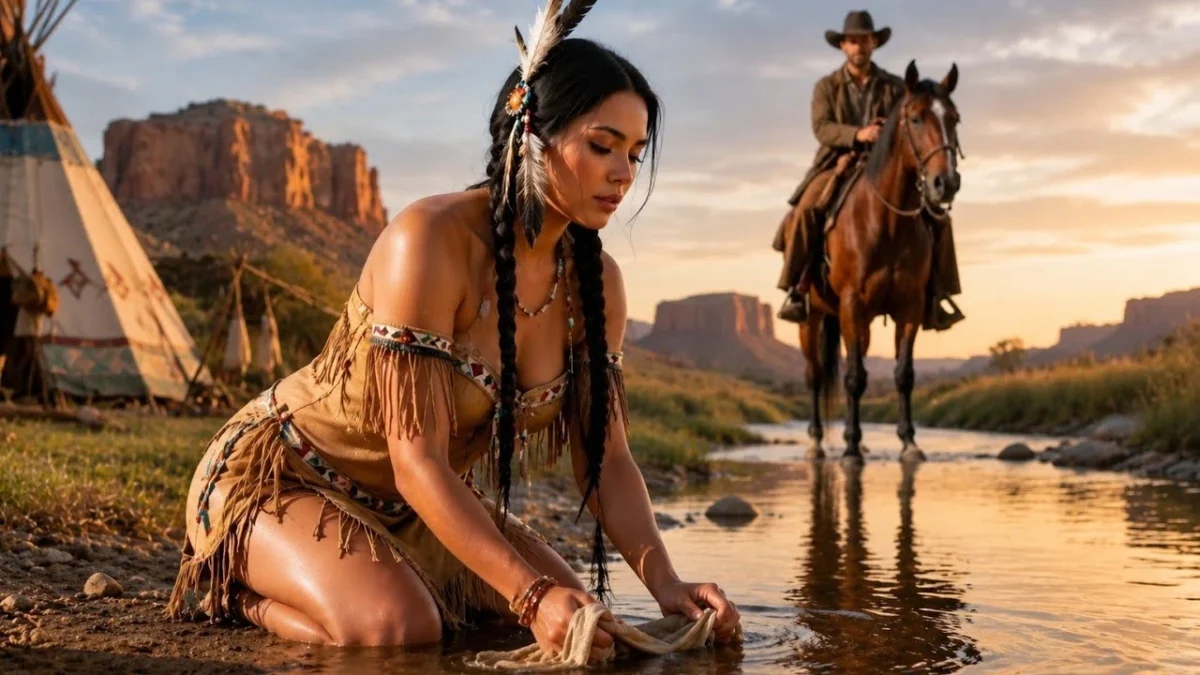
A COWBOY SAW AN APACHE WOMAN HIDING HER TORN DRESS—WHAT HE LEFT ON A ROCK CHANGED BOTH THEIR LIVES
Part 1
The afternoon sun burned gold across the Arizona desert as Ethan Walker guided his tired horse along the Salt River.
He had spent most of the day delivering cattle to a ranch several miles away, and every muscle in his body begged for rest. Dust covered his boots. Sweat darkened the collar of his shirt. His horse moved with the slow, deliberate steps of an animal that had traveled too far beneath an unforgiving sky.
Still, Ethan preferred this route home.
The river was different from the cattle trails.
Cottonwood trees whispered in the warm breeze. Birds skimmed over the shining water, and the steady current softened the harsh silence of the frontier. Out here, Ethan could almost forget how quickly suspicion could turn strangers into enemies.
He slowed his horse near the water.
That was when he saw her.
A young Apache woman knelt alone beside the river, carefully washing clothes against a smooth stone.
Ethan stopped.
He didn’t call out.
He didn’t ride closer.
Years on the frontier had taught him that a stranger approaching too quickly could mean danger, especially to someone who had learned to expect fear or hostility before kindness.
So he remained at a respectful distance.
The woman seemed not to notice him at first.
She dipped a garment into the cold water, scrubbed it carefully against the stone, then rinsed it. Her movements were patient and practiced.
But there was something about her that troubled Ethan.
She looked young, yet exhaustion seemed written into her face.
Then she stood.
And Ethan noticed her dress.
The deerskin garment had once been beautifully made, but now it was nearly falling apart.
Long tears ran through the leather. Rough stitches held some sections together. Narrow strips of old hide reinforced others. Different shades of patches showed that it had been repaired again and again.
It wasn’t simply worn.
It looked as though the dress had survived every mile of a difficult life with her. Pasted text
Then another horse sounded somewhere along the distant trail.
The woman’s reaction made Ethan’s chest tighten.
She immediately turned away.
Her arms crossed over the worst tears in the dress.
Her head lowered.
She wasn’t hiding herself because she had done something wrong.
She was trying to protect what little dignity she still possessed.
Ethan looked away.
Suddenly the torn garment wasn’t just clothing.
It told a story.
A story of someone who had learned to repair instead of replace. Someone who survived because survival came before comfort.
Ethan slowly reached toward his saddlebag.
Inside were several things he carried on long rides: food, herbs for small injuries, a sewing kit, and pieces of strong cloth left over from repairing saddle blankets.
His first instinct was to walk over and hand them to her.
Then he stopped.
A gift could become another kind of humiliation if given carelessly.
Worse, approaching her might make her believe he expected something in return.
So Ethan dismounted.
He walked only as far as a flat stone near the river.
The Apache woman watched him now.
Her body had become completely still.
Ethan placed the folded cloth on the rock.
Then the needles.
Thread.
Bread wrapped in clean fabric.
Dried meat.
And the small pouch of herbs.
He arranged everything carefully before stepping backward.
The woman stared at him.
Ethan touched the brim of his hat.
“No payment,” he said quietly.
She didn’t answer.
He glanced toward the torn dress, then back toward her eyes.
“Everyone deserves a little dignity.”
And that was all.
No questions.
No demand for gratitude.
No attempt to learn her name.
Ethan mounted his horse and rode away.
For several moments, the woman didn’t move.
She watched him disappear between the cottonwoods.
Only when the sound of his horse faded did she approach the stone.
Her fingers touched the folded fabric first.
Then the sewing supplies.
Then the food.
Something changed in her expression.
She pressed the cloth against her chest and stared down the empty trail.
She had no way of knowing that Ethan Walker’s simple act would soon change both of their lives.
That night, Ethan tried to forget the encounter.
He couldn’t.
The image of the woman covering the tears in her dress stayed with him.
By sunrise, he had made a decision.
He saddled his horse.
“I just want to know she has enough,” he muttered.
Then he rode back toward the Salt River.
Morning painted the cliffs in shades of amber and gold.
As Ethan approached the same bend in the river, his hand tightened around the reins.
Someone was waiting beside the water.
Her.
But she looked different.
The dress was still old, yet the worst tears were gone.
The fabric Ethan had left had been skillfully worked into the damaged sections, preserving the original design instead of covering it. The repairs didn’t make the dress look new.
They made it look stronger.
The woman smiled.
Yesterday there had been caution in her eyes.
Today there was trust.
She placed one hand over her heart.
“My name is Ayana.”
Ethan removed his hat.
“Ethan Walker.”
Ayana looked down at her repaired sleeve.
“Yesterday, you saw what I needed,” she said. “But you did not make me ashamed of needing it.”
Ethan said nothing.
Ayana’s fingers moved across one of the old seams.
Then her voice changed.
“This dress belonged to my mother.”
Ethan looked at it again.
Suddenly every patch meant something different.
“She made it herself,” Ayana continued. “Before she died, she told me to wear it when I needed courage.”
Her eyes glistened.
“People have told me to throw it away. They see something old.”
She touched the stitching.
“I see her hands.”
Ethan swallowed.
Now he understood.
He hadn’t helped repair a dress.
He had helped preserve the last physical connection between a daughter and her mother.
“The strongest things aren’t always the things that were never damaged,” Ethan said quietly. “Sometimes they’re the things someone cared enough to repair.”
Ayana blinked away tears.
Then—
hoofbeats thundered from the hills.
Ethan turned.
One rider appeared on the ridge.
Then another.
Then another.
Several Apache horsemen descended toward the river.
Ethan remained still.
Ayana stepped in front of him and spoke rapidly in her own language.
The riders stopped.
An older man with gray in his hair studied Ethan for a long moment.
Then he dismounted.
He reached into a leather pouch attached to his saddle.
Ethan expected words.
Instead, the elder removed a small carved wooden token.
He walked directly toward Ethan.
And when Ethan saw the symbols carved into it, he realized the gift he’d left on that rock had set something far bigger in motion than he could possibly understand.
Find Part 2 in the comments—or leave ANY WORD and I will send it to you privately. 👇
Part 2
And when Ethan saw the symbols carved into it, he realized the gift he’d left on that rock had set something far bigger in motion than he could possibly understand.
The elder stopped before him.
For several uncomfortable seconds, nobody spoke.
Ethan kept his hands visible.
Then Ayana said softly, “This is my uncle.”
The older man’s expression remained serious.
“My niece told us about yesterday.”
Ethan glanced at Ayana.
The elder continued. “You saw someone who needed help. You gave what you had without demanding payment, loyalty, or gratitude.”
He placed the carved token in Ethan’s palm.
“Actions like that are remembered after words are forgotten.”
Ethan studied the small piece of wood. The craftsmanship was beautiful, but he didn’t understand its significance.
“What does it mean?”
Ayana’s uncle closed Ethan’s fingers around it.
“Friendship. Trust.”
Ethan looked up.
The elder explained that families who recognized the carving would understand that Ethan came as a friend rather than an enemy. It was not money. It was not a reward that could be spent.
It was something more difficult to earn.
Trust.
Ethan tried to return it.
“I didn’t help her for this.”
“I know,” the elder answered.
That was precisely why he wanted Ethan to keep it.
Ayana smiled.
For the first time, Ethan understood that yesterday’s encounter hadn’t merely been between a cowboy and a woman beside a river.
Two people raised in different worlds had looked past everything they had been taught to fear.
And for a moment, that seemed enough.
But Ayana suddenly turned toward the ridge.
Another sound carried through the morning air.
Hoofbeats.
These weren’t coming from her uncle’s riders.
The elder’s expression changed.
Ethan saw Ayana tense.
Across the river, several mounted figures emerged from behind the cottonwoods.
Ethan recognized two of them from cattle country.
Ranch hands.
One pointed toward the Apache riders.
The peaceful silence vanished.
“Stay here,” Ethan said.
Ayana caught his arm.
“Do not make fear stronger.”
Those words stopped him.
Ethan looked at the carved token in his palm.
Then at the approaching ranchers.
Then at Ayana’s uncle.
One wrong movement could destroy everything that had happened beside this river.
The riders came closer.
One ranch hand reached toward his holster.
Ayana’s uncle’s men immediately became alert.
Ethan stepped directly between them.
“Nobody draws.”
The rancher stared at him.
“Walker, move.”
“No.”
“Ethan…”
“I said nobody draws.”
The man’s hand hovered over his weapon.
Behind Ethan, Ayana whispered something to her uncle.
Ethan raised the wooden token where everyone could see it.
And the rancher’s face changed.
“What in God’s name is that?”
Before Ethan could answer, Ayana stepped beside him.
Not behind him.
Beside him.
And what she said next silenced every man on the riverbank.
LIKE this post or COMMENT the word “BRIDGE” if you want Part 3. When there are enough comments, I’ll post the complete ending. ❤️
Part 3
Ayana looked directly at the armed ranchers.
“He is not standing with us against you,” she said calmly.
Her English was measured, but clear.
“He is standing between fear and a mistake.”
Nobody moved.
The river continued flowing behind them as if human anger meant nothing to it.
The ranch hand who had reached toward his holster narrowed his eyes.
His name was Caleb Mercer, a man Ethan knew from several cattle drives. Caleb wasn’t cruel by nature, but he’d spent years hearing stories about raids, stolen livestock and bloodshed. Like many men on the frontier, he had learned to treat uncertainty as danger.
“What happened here, Walker?” Caleb asked.
“Nothing that requires a gun.”
Caleb looked past him.
Several Apache riders remained mounted.
“Doesn’t look like nothing.”
Ethan’s voice hardened.
“That’s because you’re seeing riders before you’re seeing people.”
Caleb’s jaw tightened.
“And you’re suddenly their spokesman?”
“No.”
Ethan glanced at Ayana.
“Nobody needs me to speak for them.”
That answer seemed to surprise everyone.
Ayana’s uncle stepped forward.
He spoke briefly to his niece.
Ayana translated.
“My uncle says you came expecting danger.”
Caleb answered, “A group of armed riders near cattle country tends to do that.”
Ayana translated his words.
Her uncle listened.
Then responded.
“He says they came because I told them what happened yesterday.”
Caleb looked confused.
“What happened yesterday?”
Ethan didn’t answer immediately.
Ayana did.
She touched the repaired section of her dress.
“Your friend gave me cloth.”
Caleb stared at her.
“Cloth?”
“And food. Needles. Thread.”
The absurd simplicity of it seemed to drain some of the tension from the riverbank.
Caleb looked at Ethan.
“That’s what this is about?”
“That’s how it started.”
Ayana’s uncle gestured toward the token in Ethan’s hand.
Ayana explained its meaning.
When she finished, Caleb slowly lowered his hand away from his holster.
One of the ranchers behind him did the same.
Then another.
Ethan finally exhaled.
Nobody had realized he’d been holding his breath.
But the danger wasn’t over.
Not really.
Because weapons were only the visible part of the problem.
Suspicion remained.
History remained.
Fear remained.
And none of those things disappeared simply because men lowered their hands.
Caleb dismounted.
He walked toward Ethan.
“Let me see it.”
Ethan hesitated before handing him the wooden token.
Caleb turned it over.
The carving was intricate—symbols cut carefully into the wood by someone whose hands understood both patience and meaning.
“What’s it worth?”
“Nothing.”
Caleb frowned.
Ethan continued.
“And everything.”
Ayana almost smiled.
Caleb handed it back.
“I don’t understand.”
“Neither did I.”
Ethan slipped the token carefully into his pocket.
“Maybe that’s part of the problem. We decide what something means before we understand it.”
Ayana looked toward the river.
“Like an old dress.”
Her words struck Ethan harder than she probably intended.
Yesterday, he had seen torn leather and imagined poverty.
He hadn’t been entirely wrong.
But he hadn’t been entirely right either.
The dress was worn because Ayana had little.
Yet she also wore it because it contained something no new garment could replace.
Her mother’s memory.
Her family’s story.
Her courage.
A thing could be damaged and still be precious.
Perhaps people could be misunderstood in the same way.
Caleb looked at the patched dress.
“Your mother made that?”
Ayana nodded.
“She died several years ago.”
“I’m sorry.”
Ayana studied him.
Then she simply said, “Thank you.”
Two words.
Nothing dramatic happened afterward.
No grand agreement was signed.
No enemy suddenly became a lifelong friend.
Instead, something more believable happened.
People began talking.
Carefully.
Awkwardly.
Sometimes through Ayana.
Sometimes with gestures when words failed.
Caleb explained that ranchers had recently lost cattle and feared more theft.
Ayana’s uncle explained that Apache families traveling through the region had themselves encountered suspicion and hostility.
Neither side agreed about everything.
But neither side reached for a weapon again.
And that mattered.
As the sun climbed higher, the tension slowly loosened.
Eventually, Ayana’s uncle approached Ethan.
He touched the pocket containing the wooden token.
“Keep it.”
Ethan nodded.
“I will.”
The elder looked toward his niece.
Then he said something that Ayana did not immediately translate.
“What did he say?” Ethan asked.
She smiled.
“He said gifts reveal the giver.”
Ethan scratched his jaw.
“I’m not sure I like the sound of that.”
Ayana laughed.
It was the first time he’d heard her laugh.
The sound was light and unexpected.
“What did my gift reveal?” Ethan asked.
Ayana considered the question.
“That you knew when to walk away.”
Ethan frowned.
“That’s it?”
“Yesterday, you could have approached me. You could have demanded thanks. You could have stayed to watch me open what you left.”
She looked into his eyes.
“But you gave me the choice to accept your kindness alone.”
Ethan suddenly understood.
The food had mattered.
The cloth had mattered.
But perhaps the distance he’d given her had mattered too.
Kindness without respect could become another form of control.
Real kindness left room for dignity.
“I didn’t think of it that way,” he admitted.
“That may be why it mattered.”
By midday, the groups prepared to leave.
Caleb mounted his horse.
Before turning away, he looked toward Ayana’s uncle.
The older man nodded once.
Caleb returned the gesture.
It wasn’t friendship.
Not yet.
But it wasn’t hostility either.
Sometimes peace began with something smaller than friendship.
Sometimes it began when two people simply decided not to become enemies.
The Apache riders departed toward the hills.
The ranchers headed back toward cattle country.
Soon only Ethan and Ayana remained beside the river.
Just as they had the day before.
Except nothing felt the same.
Ethan walked toward the flat stone where he had placed the supplies.
“You know,” he said, “yesterday I thought I’d never see you again.”
“So did I.”
“Then why were you waiting here this morning?”
Ayana looked toward the flowing water.
“I wanted you to know what you gave me had not been wasted.”
She touched the repaired dress.
Ethan smiled.
“I can see that.”
Ayana shook her head.
“Not the cloth.”
He looked at her.
“The reminder.”
“What reminder?”
“That being treated with kindness once can make you brave enough to offer trust once more.”
Ethan had no answer.
For a man who usually knew exactly what to say around horses, cattle and difficult ranchers, he suddenly found himself defeated by one quiet sentence.
Ayana smiled.
Then she reached into a small pouch.
“I have something for you.”
Ethan immediately protested.
“You don’t owe me anything.”
“I know.”
Those words echoed the elder’s earlier answer.
Ayana removed a narrow strip of carefully worked leather.
At its center was a simple stitched pattern.
She held it toward him.
“My mother taught me this design.”
Ethan didn’t take it immediately.
“I can’t.”
“Why?”
“Because your mother’s work means something to you.”
Ayana nodded.
“That is why I want you to have it.”
Slowly, Ethan accepted the strip.
“What does the pattern mean?”
Ayana looked toward the river.
“Remember the road that brought you here.”
Ethan ran his thumb across the stitching.
Then he smiled.
“That’s something I probably need reminding of.”
They parted that afternoon.
But it wasn’t the end.
Over the months that followed, Ethan traveled the Salt River route whenever his work allowed.
Sometimes Ayana was there.
Sometimes she wasn’t.
When they met, they talked.
She taught him words from her language.
He taught her ridiculous cattle expressions that made her laugh.
They spoke about family.
About grief.
About the strange ways people carried those they’d lost.
Ethan learned that Ayana was far stronger than he’d first understood.
She wasn’t simply someone who had needed his help.
She knew plants and their uses better than most frontier doctors Ethan had met. She could read weather from clouds he barely noticed. She could repair leather, track animals, and recognize subtle changes in the landscape.
And Ayana learned that Ethan wasn’t simply the cowboy who had left supplies on a stone.
He carried losses of his own.
Years earlier, he’d lost his younger brother in an accident during a cattle drive.
Ethan had rarely spoken about it.
One evening beside the river, he finally did.
“I was supposed to be watching him.”
Ayana remained silent.
“I spent years thinking that if I’d been faster…”
She interrupted gently.
“You would have changed what happened?”
“Yes.”
“Can you know that?”
Ethan stared at the water.
“No.”
“Then perhaps you have punished yourself for a life you imagined you could control.”
Ethan looked at her.
Nobody had ever said it that way.
He reached unconsciously toward the leather strip she’d given him.
Remember the road that brought you here.
“I suppose we both carry things,” he said.
Ayana touched her mother’s dress.
“Everyone does.”
Seasons passed.
The dress changed.
More patches appeared.
But Ayana never discarded it.
Ethan noticed something remarkable.
Every repair became part of its beauty.
Old leather met new cloth.
Traditional stitching crossed practical patches.
What should have looked broken instead looked like a record of survival.
Years later, Ethan would remember that dress whenever someone dismissed another person because of appearance, poverty, culture or circumstance.
He remembered how wrong first impressions could be.
He remembered a frightened young woman covering torn leather with her arms.
He remembered an elder extending trust.
He remembered Caleb slowly moving his hand away from his gun.
Most of all, he remembered the ordinary bundle he’d placed on a stone.
At the time, it had seemed almost embarrassingly small.
A little cloth.
Needles.
Thread.
Bread.
Dried meat.
Herbs.
Nothing heroic.
Nothing worthy of legend.
Yet small acts don’t always remain small.
One kindness gave Ayana enough material to preserve her mother’s dress.
That preservation gave her a reason to return.
Her return brought Ethan face-to-face with her family.
That meeting created a moment of trust.
And when fear arrived on horseback, that trust became just strong enough to stop hands from reaching for weapons.
Not forever.
Not everywhere.
But there.
On that morning.
Beside that river.
Years afterward, when Ethan’s hair had begun turning gray, he still carried two objects in a small wooden box.
The carved token from Ayana’s uncle.
And the stitched leather strip Ayana had given him.
Someone once asked him why he guarded two objects worth almost nothing.
Ethan smiled.
“Because you’re measuring them wrong.”
The person laughed.
“Then what are they worth?”
Ethan looked toward the distant Salt River.
For a moment he could almost see that afternoon again.
A tired horse.
A young woman kneeling beside the water.
A torn dress.
A flat stone.
And a decision that had taken less than a minute.
“They remind me,” Ethan said, “that sometimes the smallest thing you give someone becomes the reason they believe in people again.”
He paused.
“And if you’re fortunate, their trust changes you too.”
Far away, the river continued moving through the Arizona landscape, just as it had long before Ethan or Ayana were born and would long after they were gone.
Water didn’t care which side of the river someone came from.
It simply flowed between them.
Perhaps that was the lesson Ethan carried for the rest of his life.
We spend so much time looking at what separates people that we forget bridges rarely appear fully built.
They begin with one piece.
One choice.
One person willing to cross part of the distance.
For Ethan Walker, that bridge began with a torn dress.
For Ayana, it began with a stranger who noticed her struggle without turning her pain into humiliation.
And for everyone standing beside the Salt River that morning, it began when compassion proved stronger—if only for one important moment—than fear.
Sometimes changing someone’s life doesn’t require wealth.
Sometimes it doesn’t require power.
Sometimes it requires noticing.
Respecting.
And leaving a little cloth on a stone without asking for anything in return. ❤️
Disclaimer: This story is entirely fictional and created for entertainment purposes only. It does not represent any organization or individual, nor does it encourage inappropriate behavior. The content was generated with AI assistance.








