A Dying Duke’s Son Offered a Village Fiddler Marriage If She’d Sit by His Father’s Bed. Then She Found a Secret Column of Numbers in His Desk, and Every Night Something Creaked Behind the Door
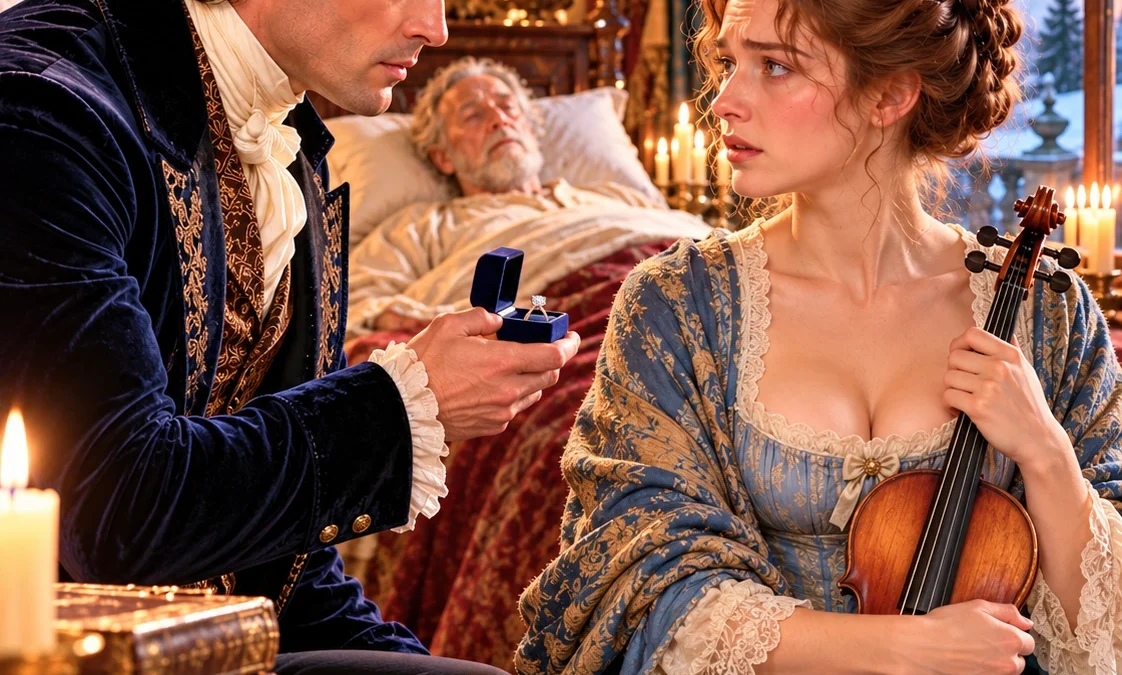
A Dying Duke’s Son Offered a Village Fiddler Marriage If She’d Sit by His Father’s Bed. Then She Found a Secret Column of Numbers in His Desk, and Every Night Something Creaked Behind the Door 😱🎻
Part 1
The codicil was dated the thirtieth of October, 1821.
It was witnessed by a footman and a dairy maid at Ella Holme, on the shore of Ullswater. It said that Henry Thirlsby, fifth Duke of Ellersdale, left the house, its six farms, and eighteen thousand pounds to his only son on one condition.
The son must be a married man on the day his father died.
Esther Fell read that page on the ninth of November, standing in the doorway of a farmhouse where a woman had died that morning. She was certain she understood it. She thought it was the price of her.
She was wrong. And before that winter was over, she would stand up before the whole dale and say so. 🎻
The knock came at a quarter to four at How Farm in Martindale. Esther went down because she was the only one in the house who was not family. She had sat with old Agnes Birkett for six nights, singing the old songs Agnes had danced to as a girl. Before dawn, in the middle of a verse, Agnes had stopped breathing, as quietly as a candle goes out when the wax is done.
She expected the curate. Instead, a tall, fair man of about thirty-two stood on the step in a black riding coat, a groom and two horses waiting at the gate.
“Miss Fell? My name is Thirlsby. Lord Kentmere. My father is the Duke of Ellersdale, at Ella Holme across the water.”
He was not yet a duke. He would be soon enough. That was the whole trouble.
“Dr. Nicholson of Penrith says my father is dying. Weeks, not months. He has sent away two nurses since Michaelmas. He says they spoke to him as if he were a parcel. Dr. Nicholson also says that when someone is dying in this dale, people send for you.” He paused. “I want you to sit with my father until the end. And in return, I will marry you.”
Upstairs, Agnes Birkett’s daughter was crying.
“My lord,” Esther said very low, “if that is a joke, it is a cruel one.”
“I never joke. My father does. You will like him.” He took a folded paper from his coat. “This is why it must be marriage, and why it must be soon.”
She read it twice. “If you are not married when he dies, all of this goes elsewhere.”
“To a cousin in Bath who has never seen the place and means to sell it. You would have my name, a home, and three hundred a year for life, whatever becomes of me. You need never play for your supper in a barn again.”
He knew that, too. Since her father’s death two winters ago, Esther had played the fiddle at Merry Neets for a shilling and a hot meal. She had taught farmers’ children their dances at sixpence a lesson. She had one room above the smithy at Patterdale, eleven shillings, and the winter coming.
She did not beg, and she did not thank him. She asked the only question that mattered.
“Why can you not sit with him yourself?”
Something in his face went very still. 😶
“That is the part I am not going to tell you.”
“Then I should like to hear it before I answer.”
“You will not hear it before. You may never hear it after. That is the whole of my offer, Miss Fell.”
She ought to have shut the door. She knew that later. But she looked past him at the gray lake and the fells going dark behind it, and thought of an old man over there, lying awake with nobody to talk to who did not speak to him like a parcel. She had sat with her own father until the end. She knew what those nights were like when you had to sit them alone.
“Yes,” she said.
They were married four days later, by license, in the little chapel at Patterdale, with the smith and his wife for witnesses. That same evening, Esther crossed the threshold of Ella Holme as the Marchioness of Kentmere, in her one good gray gown, carrying her father’s fiddle in its wooden case.
It was a handsome house of gray stone, built for a bride in 1785, with tall windows looking straight down the water. It was also the quietest house she had ever been in. Doors were closed softly. Nobody whistled in the stable yard. And at the end of the long ground-floor passage stood a pair of double doors that nobody opened at all.
“The music room, my lady,” said the housekeeper. “Shut since her Grace died.”
The Duke lay on the first floor, at the south end, so he could see the lake from his bed. He was seventy-six, small and thin, with white hair standing up like thistledown and black eyes that were the only part of him still quick.
“So. You’re the fiddler. And my son has married you. Poor girl.” He pointed a thin finger. “Sit. Not there. That is where the nurse from Carlisle sat. She read me the whole book of Job. I told her I had heard how it ends.” He waved away a cough like a fly. “Can you play cribbage badly? Excellent. I shall win. And you will talk to me. Not about my soul. Tell me about the dale. Who is courting, who is quarreling, whose cow got into whose oats. And if you cheat at cards, tell me afterward so I can admire it.”
She talked. She told him about the curate at Martindale who preached an hour against dancing and was seen dancing at the Howtown Merry Neet. The Duke laughed, a dry little crackle, and declared the curate a sound man after all. At midnight, when he grew drowsy, she sang to him very low.
And once, just before he slept, he turned his head on the pillow and said, without looking at her, “Is he…?”
Then stopped.
“Your Grace?”
“Nothing. Deal the cards.” 🃏
She saw it for the first time on the second morning. She had come out at seven, stiff and tired, to fetch water from the landing, and her husband was walking along the passage toward his father’s door. He did not see her in the window corner. He stopped before the door, lifted his hand to the brass handle, and held it there, an inch away. He stood like that for as long as it takes to say the Lord’s Prayer slowly.
Then he took his hand back, turned, and went downstairs.
He did it the next morning, and the next. And every afternoon, when Dr. Nicholson’s gig came up the drive, her husband waited at the foot of the stairs. He never asked whether his father was sleeping or eating or in pain. He asked one question only, in a flat, hard voice.
“How long?”
Esther watched him from the landing and thought she knew what she was seeing. A man who could not bear to look at his father. A man who wanted only to know the time.
She would be wrong about it for forty-eight days. 💔
The first person at Ella Holme to be kind to Esther was also the first to hurt her.
Lady Susan Ridge was the Duke’s widowed sister, sixty-eight, round and pink and anxious. She brought hot chocolate every morning and showed Esther which stairs creaked. And on the third morning, she sat on the end of Esther’s bed, twisting her rings, and said, “My dear, may I tell you something I oughtn’t?”
“You have seen that Lawrence does not go in to his father. I want you to understand why. Twelve years ago, in the autumn of 1809, they quarreled. A dreadful quarrel. I was on the stairs and heard the end of it. Lawrence was twenty. He said to his father, I will come back to this house when you are dead, and not one day before. Then he left, and he never wrote. Not one letter in twelve years. Not when his father fell ill at Michaelmas.”
She laid her soft hand on Esther’s.
“Then on the thirtieth of October, my brother had his lawyer draw up that codicil. Mr. Gascoigne wrote to Lawrence in London the same day. And on the sixth of November, Lawrence was standing at our door. Twelve years he could not come home. Seven days once there was money in it. I do not say it to be unkind. I love the boy. But I could not let you think it was his father he came back for.”
Esther said nothing at all.
“And he has no need of the money. That is what I cannot make out. His mother left him four thousand a year.” Lady Susan sighed. “Dr. Nicholson told me yesterday he does not think my brother will see Candlemas.”
Candlemas was the second of February.
That night, when the Duke slept, Esther took out the thing she valued most after her fiddle: her father’s tune book, a fat little volume in brown calf, crowded with tunes in two hands, his and hers. Every tune was written down with the name of whoever had sung it to them first. On a clean page, she wrote Ella Holme. And beneath it, the days to Candlemas.
Her father had always said a silent house was a sick house. Folk can bear nearly anything if there is a tune in it, he used to say. It is the quiet that kills them.
So Esther set out to make a noise. 🎶
She began with the servants, every one from some parish in Westmorland or Cumberland, every parish with its songs. At first they were shy. But the second housemaid knew a verse about a drover that made the footman laugh. The dairy maid knew a lullaby from Mardale. And the coachman, after a pint of ale and a great deal of coaxing, sang a long and very rude song about a parson’s pig.
She wrote them all down. The Parson’s Pig, from Thomas Airey, coachman, who begs it may not be sung upstairs.
It was sung upstairs within the week. The Duke laughed so hard that Lady Susan came running.
Even the Duke’s own man, Abel Tyson, seventy, thin and bent as a hawthorn, who disapproved of everything, was caught three days later singing a deep, cracked bass in the dressing room while he brushed a coat. The Keswick Grammar. From Abel Tyson, who will deny it. And Abel, who could read, saw the page and denied it for the rest of his life.
The Duke ate more. He slept better. He won at cribbage, and when he lost, he accused her of cheating and was delighted when she admitted it. The maids hummed on the stairs.
And on the tenth night, very late, the Duke said something that changed everything.
“There was a song my wife used to sing. The Ferryman of Howtown. Do you know it?”
“I know the tune, Your Grace. And three verses.”
She sang them. A ferryman on Ullswater, rowing a girl across in a storm, the girl begging him to turn back, the ferryman telling her the far shore is nearer than the near one.
“There was another verse,” said the Duke when she stopped. “The best one. Caroline always sang it last. I could never keep words in my head, and now I cannot find it.” He opened his eyes. “Find it for me, fiddler.” 🥹
Esther looked for it as she had never looked for a song. She asked the servants. She asked Lady Susan, who cried and said she had never had an ear. She walked to Howtown to ask the old ferryman’s widow, who sang her eleven verses about an entirely different ferryman. She wrote down every scrap anybody gave her, and none of it was right.
But the hunt did something she had not expected. The whole dale heard what she was looking for, and why. And they began to come to Ella Holme. Old men with verses half remembered. Women with songs their mothers had sung. They stayed for tea in the servants’ hall, and Esther played, and the Duke lay upstairs with his window open a crack in December to hear.
“Open the music room,” he told her one morning. “I shut it. I will not die with it shut.”
She took down the shutters and let the winter light in over the lake. And on the fourth of December, he told her what he wanted most.
“On New Year’s Eve, in Caroline’s time, we had a merry meet in the hall. Every tenant on the estate. A fiddler dancing till two. I want one more.”
“Your Grace, Dr. Nicholson…”
“Dr. Nicholson can come. I will not die in a quiet house, fiddler.”
On the twelfth of December, he fell into a sleep so deep Abel could not rouse him. His breathing went slow and far away, and for an hour Lady Susan sat by the bed with her hand over her mouth.
Then the Duke opened his eyes, frowned at them all, and asked why nobody had set out the cribbage board.
At one in the morning, Esther went down to the music room, hands unsteady, and began to play the Ferryman very softly, for comfort.
“The string is flat,” said a voice from the doorway.
Her husband stood there in his shirt sleeves. In twenty-nine days, he had never once come into this room.
He took from his waistcoat a small steel tuning fork in a worn leather case. He struck it on the pianoforte and held it to the body of her fiddle, and a clear, pure note rang from the wood. She turned the peg until the string matched.
When she held out her hand to return the fork, he took the fork and her hand with it, and did not let go.
“Sing the third verse.”
She did not ask why. She sang it quietly, his hand round hers, the fire low. At the first line, his fingers were cold. At the second, they were not. At the third, he closed his eyes, and his face changed, the way a face changes when someone hears a voice they have not heard in years.
And at the fourth line, she felt him draw a breath as if he were about to sing the next line himself.
Then he went rigid, every part of him, as if he had heard a door bang in the dark. He let go so suddenly that her bow slid off the stool.
“Forgive me. It is very late. Good night.”
He was gone.
Esther sat by the fire a long time. Then she saw that he had left the fork on the lid of the pianoforte. The leather case was rubbed pale with years of carrying. On the lid, in faded gilt, were two letters: C.T.
After that night, she began to see things she had not wanted to see. His candle burned in the library until three in the morning. Abel, passing his bedroom at midnight, never found him in it. And every night when she began to sing, there came a creak from somewhere on the narrow back stair the servants used. It stopped when the Duke slept.
“Mice, my lady,” said Abel. “Big ones. Old house.”
And every night at ten, the Duke asked her the same question, never looking at her.
“Has he eaten?”
“Yes, Your Grace.”
“Good. Deal.”
Her heart nearly broke for the old man. A dying father asking whether his son had eaten, while the son stood outside his door each morning and would not turn the handle.
Then, on the twenty-seventh of December, she lifted the leather blotter on the library desk, searching for the lost verse in the Duchess’s old music books, and a half sheet of paper slid out.
It was in her husband’s hand. A column of numbers, going down the page. 78, 77, 76… And beside each number, one word, written very small.
No.
The same word, day after day, for forty-two days, except one. Beside the twelfth of December, the day the Duke had slept so deep they thought they had lost him, he had written a different word.
Almost.
The last number was thirty-seven. Today. And Esther knew what the numbers were, because she had the very same column at the top of a page in her own tune book.
They were the days to Candlemas. He was counting them, too. 😨
Part 2
Esther sat at the desk with the paper in her hand, and the whole case came together in her head, piece by piece, the way a tune does when you have heard enough of it.
He had not come home in twelve years. He had come in seven days when there was money in it. He had married the first woman who could keep his father company so the condition would be met. He never went into his father’s room. He asked the doctor one question: How long? And every night he wrote down the days that were left, and beside each, No. Not yet.
It was a terrible thing to believe of anyone. She wanted with all her heart for it to be false. Then she thought of an old man upstairs, asking every night if his son had eaten.
She put the paper back under the blotter exactly as she found it. That night, she wrote 37 days to Candlemas at the top of her page and pressed so hard that the pencil broke.
Two days later, at eleven at night, she went down to the library. She did not knock. He sat at the desk, as she had known he would be, and stood when she entered. She walked straight to him, lifted the blotter, took out the half sheet, and laid it on the leather.
“I found that two days ago. I am sorry. I did not mean to, but I did, and I have something to say about it.”
“Go on.”
So she said it all. The quarrel in 1809. The words in the hall. Twelve years without a letter. The codicil on the thirtieth of October and himself at the door on the sixth of November. She told him about the brass handle every morning, and his hand an inch from it. About Dr. Nicholson at the foot of the stairs, and how long.
She put her finger on the paper.
“Seventy-eight days to Candlemas, and every day since, you have written No, not yet. And on the twelfth of December, when he slept so deep we thought he had gone, you wrote Almost.” Her voice shook, and she made it stop. “I think you came home for this house and the eighteen thousand pounds. I think you married me so the paper would be satisfied and you would not have to go into that room yourself. And I think you are waiting for him to die. That is the part you would not tell me at the door. Isn’t it?”
He said nothing.
“Lawrence, if any of it is untrue, tell me which part.”
It was the first time she had said his name. She saw it go into him like a cold wind.
“None of it is untrue,” he said at last.
“Then it is so.”
“I did not say that.”
“Then what are you saying?”
She saw him nearly tell her. Something came up behind his eyes, hard, the way a man pushes on a heavy door from the inside. Then she watched him hold it shut.
“I am saying nothing. I have nothing to add.”
He did not defend himself. He stood behind the desk with that column of numbers between them and looked at her as if she had struck him, and he had known all along that she would. 💔
At the door, she stopped, without turning.
“He asks whether you have eaten. Every night at ten. I tell him yes. I do not know if it is true.”
Behind her, there was no sound at all. Then, very low:
“Tell him yes.”
She went up and played cribbage with the Duke until four in the morning, and lost every game, and did not cheat once.
She did not sleep that day, either. She sat in the music room with the fire and the tune book and the little tuning fork, and she did what her father had taught her when a tune would not come right. She went back to the beginning and played it through again, slowly, as if she had never heard it before.
Every fact was true. But a tune can have every note right and still be played in the wrong key.
Four thousand a year. She heard Lady Susan say it again. A man with four thousand pounds a year did not need eighteen thousand badly enough to marry a fiddler from above a smithy. And if he wanted his father to die, why had he gone looking for the one woman in the dale known for making the dying comfortable? Why not leave the old man with the nurse who read him Job?
She thought of that voice at the foot of the stairs. She had heard it as hard. It was not hard. It was flat, the way a voice goes flat when a man has asked the same question too many times and is afraid of the answer.
And she remembered the creak on the back stair. And that on the night of Almost, her husband had come into the music room for the very first time, a little after one, from the direction of the back stair. 🤔
She turned the tuning fork over. C.T. She thought of the moment he had closed his eyes at the fourth line, as if he knew what came next.
Esther stood up, took a candle, and went through the green baize door and up the narrow back stair, steep and dark and smelling of cold stone. At the top was a landing no bigger than a cupboard, and a plain door into the Duke’s dressing room, and beyond it a second door that always stood ajar. Beyond that, the Duke’s bed.
In the corner of the top step, against the wall, was a small hill of candle grease. Not a drop or two. A hill, built in layers night after night, the way grease builds in a church where the same candle is lit in the same place for weeks.
She sat down beside it and blew out her own candle and listened. She could hear the Duke breathing. She could hear Abel turning the pages of his Bible. If she had been singing in there, she would have heard every word.
He had been sitting here every night, two paces from his father’s bed, listening to her sing his father to sleep. Not going in.
No. I did not go in. Almost. I almost did.
She put her face in her hands. 😭
He found her there at five in the morning, on the last day of the year. She heard his step on the stair below, slow, and saw his candle come round the turn. He stopped. For a moment she thought he would go back down. Then he came up and sat on the step below her with his back against the wall, the way a man sits in a place he knows well.
“You found it.”
“I found the grease.” She held out the tuning fork. “And this, the night you left it. I should have given it back.”
He took it and did not open it. “It was my mother’s. She used it to tune her pianoforte. She gave it to me when I was eight. She said I sang flat.” Something that was almost a smile crossed his face and was gone. “I did.”
“Tell me. Not the money. The other part.”
He was quiet so long she thought he would not.
“When my mother died, my father shut the music room. He forbade singing in the house. I see now that he could not bear it. I was nineteen, and I saw nothing. A year later, on the day she died, I went down to the hall and sang her song, The Ferryman, all of it, loud, so he would hear. He came out of the library and said, Not in this house. Not ever again.”
“Lady Susan only heard the end.”
“I said, Then I will come back to this house when you are dead, and I will stand on your grave and sing it there. That was what I said to my father. And I went out, and I kept my word. Twelve years.”
Esther did not move.
“I meant to write. Every year, on her day, I sat down with the paper. And every year I thought, he will not open it. And if he does, he will think I want the house. So I never sent anything. Then, at the end of October, this came.”
He gave her a folded letter. It was from Mr. Gascoigne of Penrith, very short. My lord, his Grace is dying. He has made a codicil this day, a copy of which I enclose. He has not asked for you. He has expressly forbidden me to write to you. I am writing.
“I did not come for the codicil. I came because of the last three words. I was in the chaise within the hour. And when I got here, I walked up to his door, I put my hand out, and I heard myself say it. When you are dead. I had come back, exactly as I swore I would, exactly when I swore I would. I thought, if I walk in, he will look at me and think, there is the boy, come to collect. And if he turned his face to the wall, I would have nothing left. Not even the hope that he might not have.”
“So you sat here.”
“So I sat here. And I needed somebody to go in where I could not. I had heard about you in Penrith, from Nicholson. I married you for my father, and for my mother’s house, so it would not go to Bath and be sold.” He looked up at her. “And then you came, and took the covers off her pianoforte, and the whole dale began singing in my father’s kitchen, and I sat on this step every night and listened to you make him laugh. I wrote No every night because I was ashamed. And on the twelfth, when we nearly lost him, I had my hand on that door for an hour. Almost. And then I went down, and you were playing her song, and I could not bear it.”
“In the music room. At the end of the fourth line. You knew the next verse.”
“She made it up,” he said. “The last verse. She made it up for me when I was small, when I was frightened of the dark. Nobody else ever knew it but my father and me. And he cannot remember the words. You told me so yourself.” 💔
Esther looked at him sitting on the cold stair in the gray light, his mother’s tuning fork in his fist.
“May I?” she said, and held out her hand.
He looked at it a long moment. Then he took it, and this time he did not go stiff. This time he held on, and she felt him let go of something he had carried since he was twenty.
“You should have told me at the door. I would have married you anyway. I would have married you sooner.”
And she leaned down and kissed him there on the back stair, two paces from his father’s door. After a moment, slowly, as if not sure he was allowed, he kissed her back. 💛
When she drew away, she did not let go of his hand.
“Tonight is the merry meet.”
He shut his eyes.
“He asked me to find that verse before Candlemas. I have found it. Now you sing it.”
Part 3
The merry meet at Ella Holme began at eight o’clock on the last night of 1821, and every tenant on the estate came. They came by cart and on foot and by boat across the black water, in their best coats, with lanterns. The great hall had been swept, the long tables pushed back to the walls. There was beef and ale and a fire big enough to roast a sheep.
Dr. Nicholson came from Penrith, protesting. Mr. Gascoigne came with him. Lady Susan wore her best lace cap. Abel Tyson stood at the foot of the stairs in a new black coat and looked as if he disapproved of all of it. 🎉
At half past eight, four footmen carried the Duke of Ellersdale down the great staircase in a chair, wrapped in a fur-lined cloak, and set him by the fire. The whole hall stood.
“Sit down and stop gawping,” said the Duke. “I am not dead yet.”
They laughed. But the dale had been talking all winter, and Esther could hear it under the laughter. The Duke’s son had come home for the money. He had married the fiddler from Patterdale to satisfy a lawyer’s paper. He had not been near his father in seven weeks, and there he stood at the far end of the hall, by the door, alone, while his father sat by the fire.
Old Isaac Dawes from the home farm said it, not loudly, but loud enough. “Waiting for the will, that one.”
Esther stood with her fiddle in her hand. She had played in barns and inns and on village greens since she was twelve. She knew how to quiet a room full of farmers. She did not shout. She simply stood still in the middle of the floor until they looked at her.
“You have all heard a good deal about my husband this winter. I would like to tell you some of it again. Every word you have heard is true. But you have heard it in the wrong key.”
The hall went silent.
“It is true he has not set foot in his father’s room in forty-eight days. Here is what else is true. Every night of those forty-eight, while I sat with His Grace and sang to him, Lord Kentmere sat on the back stair outside his father’s door in the cold, with one candle, and listened until his father slept. Abel Tyson thought he was mice.”
A ripple of laughter. Abel went dark red.
“There is a hill of candle grease on the top step if you care to look. It is true he came home seven days after the codicil was written. He came because the lawyer’s letter said his father was dying. He has four thousand a year of his own. He did not need a penny of that eighteen thousand. He married me so his father would not be alone at night, because he could not make himself walk through that door. And he could not walk through it because twelve years ago, in this very hall, he said something to his father that he has been sorry for every day since. And he thought his father would never forgive it.”
She turned to the fire. “Your Grace, will you tell them why you wrote the codicil?”
The Duke looked at her a long moment with his quick black eyes. Then he looked down the hall at his son.
“Twelve years he has lived in lodgings in London with nobody,” he said, and his thin voice carried in the silence. “I did not want him coming home to an empty house when I am gone. And I wanted him home. I could not ask him. I am a proud old fool. So I paid a lawyer to ask him for me.” He coughed. “Cost me two guineas.”
Nobody laughed this time. Isaac Dawes looked at his boots. 😢
Esther lifted the fiddle to her chin. “His Grace asked me to find the last verse of the Ferryman. I have asked every one of you. Nobody in this dale knows it. Only two people ever did, and one was her Grace.”
She began to play. The old tune rose into the rafters, slow and sad and lovely, and the whole hall sang it with her, the three verses everybody knew. The ferryman on the black water. The girl asking him to turn back. The far shore nearer than the near. Old women sang with their eyes shut. Lady Susan sang out of tune with tears on her face.
At the fourth line of the third verse, Esther stopped playing and lowered the bow.
The whole hall went silent.
And from the door at the far end, a man’s voice began to sing alone. It was not a fine voice. It was a little flat. But every person in that hall heard every word.
Sleep now, my love, for the water is wide,
And the night is a boat with your father beside.
He walked the length of the hall as he sang, past the tenants and the servants and the long tables and the fire. And he came to the end of the last line kneeling beside his father’s chair. 🕯️
The Duke looked at him for a long time. Then he lifted one thin hand and laid it on his son’s fair head.
“You are flat,” said the Duke of Ellersdale. “You always were flat.”
And then his face crumpled like a child’s, and he put both arms around his son’s neck.
“Welcome home, Laurie. Welcome home.”
Somebody near the back began to clap, slowly, with great rough hands. It was Isaac Dawes. Then the whole hall was on its feet, and the noise went up into the old rafters and out the open door and down the dark lake toward Howtown. 😭
Esther put her fiddle to her chin and struck up The Drover’s Lass, because her father had always said that when people cry, you give them a reel. The merry meet at Ella Holme went on until two in the morning. The Duke stayed for all of it, and his son never once left his side.
Dr. Nicholson had said Candlemas. The Duke lived nine days past it. He said it was to annoy Dr. Nicholson.
Every one of those days, his son sat with him. They played cribbage, and the Duke cheated and admitted it, and Lawrence admired it. They talked about Caroline at last, for hours, the way two men talk who have kept the same thing locked up separately for twelve years. In the evenings, Esther played, and Abel sang bass in the dressing room and denied it.
The fifth Duke of Ellersdale died very early on the eleventh of February, 1822, with the window open a crack so he could hear the lake, his son’s hand in his, and his daughter-in-law playing the Ferryman very softly by the fire. He went as quietly as a candle goes out when the wax is done.
When the house woke, the servants called Lawrence Your Grace for the first time. He went down to the shore alone and stood there a long while. When he came back, Esther was waiting at the door. 💛
The eighteen thousand pounds built a schoolhouse at Patterdale with a good wooden floor and a fiddle on the wall, so the children of the dale could learn their letters in the morning and their dances in the afternoon. The music room at Ella Holme was never shut again. The sixth Duke and his Duchess had three children, and every one of them sang flat, and every one of them was tuned with a small steel fork in a worn leather case.
Many years later, when their younger daughter married, the Duchess gave her two things on the morning of her wedding. One was the old fiddle that had first come to Ella Holme in a wooden case. The other was the little tuning fork, and folded inside its case, a single sheet of paper dated the thirtieth of October, 1821.
“Your grandfather wrote that because he could not say what he meant. And I read it wrong for forty-eight days. If you take one thing from this house, my darling, take this. When someone you love cannot say a thing, sit on the stair awhile. And then go in.” 🎻
As for Lady Susan Ridge, she lived at Ella Holme until she was ninety, and the Duchess never once reproached her. She had told Esther what she believed was true because she could not bear to see a lonely young woman hurt. She had done it out of love, and she had very nearly kept a father and son apart for good. Some would call that kindness. Some would call it a story told before the end was known.
This story is entirely fictional and created for entertainment purposes only. It does not represent any organization or individual, nor does it encourage inappropriate behavior. The content was generated with AI assistance.








