A Dying Father Begged a Lonely Apache Widow for Work. She Named a Price No Man Expected: “I Want a Daughter.” What It Cost Her Nearly Hanged Her
A Dying Father Begged a Lonely Apache Widow for Work. She Named a Price No Man Expected: “I Want a Daughter.” What It Cost Her Nearly Hanged Her
PART 1
Rafe had carried his dying four-year-old sixty miles across New Mexico Territory, never guessing the widow who took them in would change both their lives forever, and put her own neck in a noose to do it. 🌵
May’s small body had gone slack against his back an hour before sundown, her breath a thin, wet rattle against his neck. By the time the ranch house rose out of the heat shimmer, he was no longer walking so much as falling forward, one boot in front of the other, praying the woman in the doorway would not turn him away before he reached the porch.
Three days before, he had walked out of the last watering hole he knew the name of with May tied to his back in a wrap made from his own shirt, so that both hands stayed free for whatever the trail decided to throw at them.
Nebraska had taken everything else first. A swarm of locusts stripped his wheat to bare dirt in a single afternoon. Then the fever carried off his wife, Sarah, before the following spring even broke. He had buried her himself, because there was no money left for a proper man to do it, and he had promised her grave, the way a man promises the dead things he cannot take back, that May would not follow her mother into that same cold ground.
He had been walking on that promise alone for a hundred and forty miles, and it was wearing thinner with every step. 💔
The ranch he walked toward had a history older than its fences. Nascha’s people had known this stretch of the Mogollon foothills for generations, long before any territorial line was drawn across a survey map. The deed her husband Chodi had filed with the county was, in her own mind, simply the paper the outside world required to acknowledge what her family had understood for a hundred years: that a spring belonged to whoever cared for it well enough to keep it running through a dry year.
She was already watching him come.
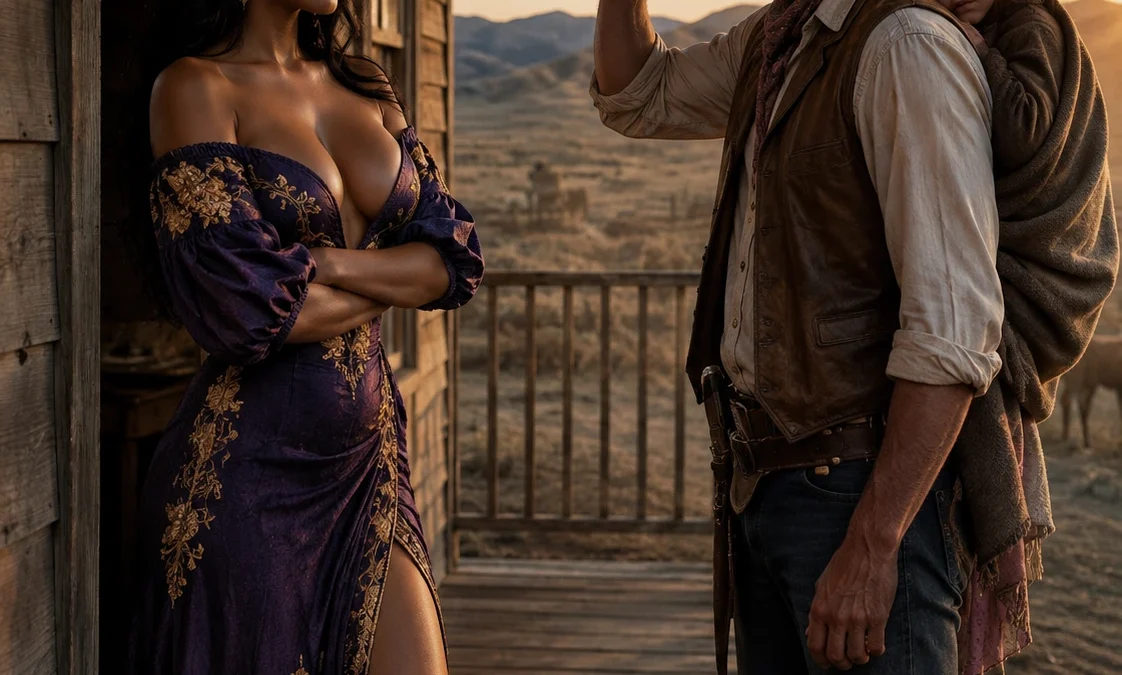
Nascha stood at the top of her steps with her arms folded and her weight set back on her heels, a woman built for standing her ground, dark hair braided close, under a sky gone the color of a bruise. She had heard drifters’ stories before. Sad ones, true ones, ones spun purely to get a boot in the door. Her face gave nothing away. Only her eyes moved, tracking the small hand fisted in his collar, the way his knees kept buckling and catching, like a man walking on the last thread of his own will.
Rafe stopped at the fence, because a man with nothing learns not to cross a threshold he has not been invited over.
“Ma’am. I am not here to bring trouble on you. My girl is burning up, and I have got nowhere left to walk.”
His voice had scraped itself down to gravel somewhere around mile fifty. Nascha’s gaze slid from his cracked lips to the child’s face, pressed sideways against his shoulder, lips gone the color of ash. She had buried enough of her own to know exactly what that color meant, and how little time it left a person to decide.
“Bring her to the well first.”
She was moving before the sentence finished. She pumped the handle herself, filled a tin cup, and pressed it into Rafe’s shaking hands without asking a single question about who he was. May’s lips parted for the water, a small mercy that made Rafe’s throat close up entirely.
“Fever three days. No money to my name. I can mend fence, break stock, dig, haul, whatever needs doing. I only need a corner to lay her down and a little milk to keep the life in her.”
Nascha studied him the way a person studies a horse they are thinking of buying. Hands, boots, the set of his shoulders, the particular exhaustion that comes only from carrying someone else’s weight instead of your own. She saw the calluses. She saw how he kept his body angled between his daughter and the sun, even now, even half dead himself.
“I do not need a hired man.”
Something in him collapsed before she finished the sentence. He turned, already bracing to walk back into the emptiness he had come from, one arm tightening around May as though he could shield her from disappointment the way he had shielded her from the sun.
“Wait.”
The word cut clean through the yard. Rafe stopped without turning, afraid that if he faced her and found nothing in her expression, his legs would give out for good.
Nascha came down off the last step and circled until she stood in front of him. “I did not say leave. I said I do not need a hired man. Those are not the same thing.” Her jaw was tight, the words costing her something she was not in the habit of spending. “I have a price. Not wages. A price for the roof and the milk and whatever medicine gets that fever broken before morning.”
Rafe waited, every nerve strung tight, ready to trade anything, his labor, his pride, ten years off the back end of his own life, to hear the terms.
“I want a daughter.” 😳
The words landed on him like a slap out of a clear sky. His arm clamped around May so hard she stirred and whimpered. For one wild, animal second he thought she meant to take his child, the way the county courts back in Nebraska had once threatened to take orphans from fathers too broke to keep them.
“I will not sell her.” Low and rough, every hair on his arms standing. “I do not care how bad off we are. She is mine.”
Nascha did not flinch. If anything, something in her face went stiller. “I am not asking you to sell me anything. I am asking you to stay, both of you. I want to love a child the way a mother loves one. Not own her, not replace her, not take her from you. Just love her. That is the whole of the cost, Rafe, and I will not ask it twice.”
He searched her face for the lie in it, the trap, the angle a desperate man learns to look for on instinct. He found instead a grief so old and so carefully buttoned down it took his breath, the way you can tell a wound runs deep by how still someone holds the arm around it.
“You lost someone.”
Her eyes went to the horizon, to the low blue hills where the light was dying fast. “Bring her inside,” was the only answer she gave. She turned toward the house without waiting to see if he would follow. 🕯️
The house smelled of piñon smoke and dried sage, swept clean, quiet as a held breath. Nascha laid May in a small bed beneath a blanket woven the deep red of desert earth, its pattern worked by hands that had clearly loved the making of it. She set a basin of cool water on the floorboards and began wringing cloths for May’s forehead with a tenderness that startled Rafe more than her hardness had.
That night the wind came down off the hills hard enough to rattle the shutters, and Nascha kept her vigil past midnight, past two, changing cloths, murmuring old low songs in a tongue Rafe did not know but felt in his chest anyway, the same songs her own mother had once sung over her. Twice May’s breathing thinned so faint that Nascha bent with her ear to the small chest, counting heartbeats, bargaining silently with whatever still listened after everything she had already lost.
In the barn, Rafe lay wide awake, thinking of Sarah, gone eight months now to a fever not unlike the one deciding his daughter’s fate. Near three in the morning, footsteps crossed the yard. Nascha stood in the doorway with a lantern, checking on him the same quiet way she had been checking on May all night. She said nothing. She only laid a second blanket over his shoulders, and left before he could find the words.
Dawn broke gold and quiet. He crossed to the house with his heart hammering so hard he could feel it in his teeth. He found Nascha in the kitchen with May propped against her arm, spooning broth between small, cracked lips.
The girl’s eyes were open. Clear. Fixed on the woman feeding her with the drowsy, trusting attention of a child who has decided, unprompted, that she is finally safe.
“Fever broke a little before sunup,” said Nascha, not looking away from May. “She will be weak a few days yet. But she will live.”
Rafe’s knees buckled, and he had to grip the doorframe to stay upright, months of holding himself together cracking open all at once. 😭
“Fix the north fence,” said Nascha, letting the quiet stretch. “That will do for a start.”
He worked like a man reborn. He rebuilt the corral and rode out to gather her scattered cattle from arroyos where two dry seasons had pushed them. He dug a new stock tank by hand and hit good water on the fourth day, and stood laughing out loud in the trench, the first laugh since Nebraska. Inside, Nascha taught May her letters with a stick in the swept dirt of the yard, braided her hair the way her own mother had braided hers, and sang her the old songs until the girl stopped waking from nightmares of the trail. One evening Rafe found his torn shirtsleeve mended in neat stitches. He never mentioned it. May began calling Nascha’s kitchen “our kitchen” without anyone teaching her to.
Then, six weeks in, a flash flood roared down a wash that had been bone dry an hour before, with May stranded on a shrinking spit of gravel. Rafe ran harder than he had ever run, waded in, and got both arms around her half a second before the gravel vanished. Nascha met them on the bank, soaked to the waist, and for one long, wordless moment the three of them simply held on to each other while the wash roared past.
Something shifted after that, quiet and permanent.
And then, on a Tuesday, the trouble arrived, riding four horses deep. 🐎
Emmett Voss ran the largest herd in the basin. He had wanted Nascha’s water since before her husband died in the winter drought. He reined in at her gate with a smile that did not reach his eyes.
“Didn’t figure you’d still be squatting out here, Nascha. Heard you took in a stray. Man and his brat, sharing your roof. Folks in Cottonwood Springs are starting to talk.”
“This is my husband’s land, deeded fair, and it will stay mine long after you have ridden home to count somebody else’s cattle.”
“This territory doesn’t much care for a widow holding good range on her own, ma’am. Especially a widow of your particular blood. A man can find a dozen reasons a claim like yours might need revisiting.”
Three days later, a territorial marshal rode up her lane with two deputies and a folded paper in his saddlebag.
“I have a filed deed here, dated before your husband’s. And a sworn complaint from Emmett Voss that thirty head of his stock have gone missing onto your grass, wearing your brand worked fresh over his.”
“That deed is a forgery,” said Nascha, iron all the way through. “And I have never in my life run another man’s cattle.”
“I do not doubt you believe that, ma’am. But I am bound to take you in.”
May screamed. She came flying off the porch and wrapped both arms around Nascha’s waist so hard the marshal’s men had to peel her loose finger by finger, her small voice tearing itself raw on Nascha’s name. Rafe dropped the axe, every muscle coiled to fight four armed men.
“Do not,” said Nascha, wrists already bound. “Do not you dare give them a reason to take you too and leave her with no one. Take care of her. Whatever happens to me.”
They led her away. Rafe stood in the yard with May shaking against his ribs, and watched the dust swallow the only home either of them had found worth keeping. Something in him that had been patiently mending for two seasons went sharp and cold and purposeful instead.
He carried May inside, sat her at the table with bread and every gentle word he had left. Then he went to the barn and saddled the fastest horse on the place. 🔥
PART 2
He saddled the fastest horse on the place.
The Cottonwood Springs jail was a single cramped room behind the sheriff’s office, with one barred window too high to see through. Nascha spent that first night sitting upright on the narrow bench, because lying down felt too much like surrender. She thought of Chodi, and of little Naleen, buried the winter the same cold took them both. She had survived all of it on her own two feet, asking nothing of anyone.
What frightened her most was not the charge. It was May’s small voice calling for her into an empty house, and no one there to answer. She pressed the heel of her hand hard against her sternum, the old trick her mother taught her for holding grief in its place, and breathed until the shaking stopped. 🕯️
Rafe rode first to Silver City, to the land office where clerks kept the ledgers that showed when a deed was truly filed. He found a clerk named Horace Adkins, who remembered Emmett Voss coming through six weeks earlier and paying quietly to have an entry dated back nearly two years. Adkins had not dared report it alone against a man of Voss’s reach. But once Rafe made plain that a widow’s freedom and a child’s whole future hung on his silence, he slid a folded page across the counter, hands trembling.
“I kept a copy. In case a day like this one ever came. I did not figure it would come this fast.”
From there Rafe pushed on to Voss’s own range, arriving well past dark, his borrowed horse blowing hard. He found what he had gambled on finding: a bitter, underpaid line rider named Amos Dobbs, who had branded thirty head of Voss’s stock over onto Nascha’s grass himself, at Voss’s direct order, and had been drinking for a week over the shame of it.
“Voss made it sound like nothin’ but a scare,” Dobbs muttered at an empty glass. “Figured she’d sell quick once the marshal came calling. Didn’t figure on her hanging for it.”
He agreed to ride back and swear the truth before the circuit judge, whatever it cost him with Voss. 🤝
The ride back was its own trial. A flash flood had torn out the low crossing on the Rio Blanco overnight, and Rafe sat his blowing horse in the gray pre-dawn, watching brown water churn where a ford had been the day before, knowing every hour lost was an hour closer to a judge riding on to the next county. He found a narrower crossing a mile upstream and walked the horses across at the deepest part with the current dragging at his knees and Dobbs cursing behind him. Neither man slept the second night. They traded turns dozing in the saddle while the other kept both horses walking.
They reached Cottonwood Springs at first light after two days and two nights of hard riding, Rafe’s horse lathered white and stumbling, the copy folded flat against his chest like the only thing keeping him upright.
Circuit Judge Alden Reyes held court in the back room of the mercantile, and the whole town had turned out, because nothing moved through Cottonwood Springs faster than the promise of a scandal. Nascha stood at the front in the same coat she had been arrested in, spine straight, chin level, refusing to so much as sit in the single chair set out for her.
Rafe walked in covered in two days of trail dust and laid Adkins’s sworn letter and the true filing dates on the judge’s table. Then he put Amos Dobbs up to speak in front of God, the judge, and the very man he was accusing. Voss’s face went through three colors in a minute, pale, then red, then a gray Rafe recognized from the inside of his own worst mornings.
Judge Reyes read the forged deed’s true filing date against the land office copy twice, in total silence. “This deed,” he said, tapping the paper once, hard, “was filed two years after Chodi’s original claim, not before it. This court finds Mrs. Nascha’s title stands as it always has.” His eyes moved to Dobbs, then to Voss, and lingered there, long and cold. “I believe this territory has heard quite enough this morning to know exactly whose cattle went missing, and whose did not.” ⚖️
The room came apart in noise. Nascha did not move at first, standing utterly still in the middle of the chaos like a woman waiting to be sure the ground was not a trick of the light. Then her eyes found Rafe, filthy and swaying in the doorway, and something in her face broke open for the first time since he had known her. Not grief this time. Disbelief, and beneath it, something warmer still.
She crossed the room in four long strides and put both hands flat against his chest, as if to check that he was real.
“You rode two days without sleeping. I did not ask you to do that.”
He covered her hands with his own, dust and all. “You did not have to ask. I would have ridden a hundred more.”
But as the crowd surged and Marshal Crane moved to unlock her wrists at last, a quiet figure slipped from the back of the room, and a rider’s boots hit the street outside. Emmett Voss had not come this far to be undone by a clerk and a drunk.
PART 3
Voss did not go quietly, but he did not go far.
In the last gasping minutes of the hearing he had tried to claim confusion, clerical error, an honest man’s honest mistake. But Judge Reyes had spent thirty years riding a circuit full of honest mistakes and knew the sound of a guilty one from three counties off. Voss’s provisional claim was struck on the spot, his complaint dismissed with a formal censure that would follow him through every land office in the territory. The slip out the back was only a man running from his own name, and the old rancher with the tipped hat watched him go with plain satisfaction and made no move to stop him. There was no need.
Marshal Crane, looking far more tired than he had that morning, escorted Nascha out through the crowd and mumbled an apology low enough that only she could hear. She accepted it the way she accepted most things that came too late to matter, with a short nod and a very long silence. Then she walked straight past every whispering face in Cottonwood Springs and out into the sunlight, toward May, waiting on the mercantile steps in the arms of a neighbor woman who had finally found her own courage that morning too.
Nascha lifted May onto her hip and stood there a long moment, letting the whole town watch her do it. Nothing about the day had shrunk her to the size Emmett Voss had hoped a forged deed and a marshal’s badge might manage. 🌄
They rode home together in near silence, May asleep between them on the wagon seat with one small hand fisted in Nascha’s sleeve and the other in Rafe’s, the way she had taken to sleeping since the fever, as though four years old was old enough to understand the wisdom of holding on to both the people who would carry you. The sky went violet, then black, thick with more stars than either adult had noticed in months of simply surviving.
When they reached the ranch, Rafe laid May under the red woven blanket and tucked it around her shoulders the way he had watched Nascha do a hundred times, without either of them remarking that he had learned her habits by heart, the way a person learns the habits of somewhere he means to stay.
He found Nascha in the kitchen, at the long table by a single candle, her hands around a cup of coffee gone cold an hour before.
“I thought they would take you from us,” he said, sitting across from her. “I do not know what I would have found to tell her, how you explain a thing like that to a child who has already lost one mother.”
Her eyes lifted to his, dark and steady in the candlelight, and something old and guarded in her finally let go. “I made it plain once. I wanted a daughter to fill this house again. I did not know I would get a man worth riding two days without sleep for, thrown in besides.”
A small, real smile cracked through the exhaustion on her face, the first he had seen unguarded since the day they met at her gate.
“I am still just a drifter, Nascha,” he said, turning the cup between his rough hands, not quite able to meet her eyes. “Nothing to my name but the shirt on my back and a hammer I do not even own. I cannot offer you land or money or anything a woman like you ought to be given.”
She reached across the table and stilled his hands with her own. “You rode into a land office and put your own name on paper against a man like Voss to save mine. You raised your voice to no one, drew no gun, and still brought me home free. That is worth more than every deed filed in Silver City.” She drew a slow breath, the kind that costs a guarded person something. “I want more than a daughter now, Rafe. I want you to stay because you choose to, not because a dying child once needed a bed. I want a husband. I want this to be your home because it is your home, not because you had nowhere left to walk.”
Rafe stood, came around the table, and pulled her gently to her feet, the way he had wanted to for weeks and never let himself believe he had earned.
“Then I am staying. For exactly that reason, and no other.” 🥹
The kiss that followed was not rushed and not shy. It was the kind two people arrive at only after they have survived the worst the world could throw between them, built on two seasons of fence-mending and fever-breaking and trust earned one hard day at a time rather than handed over cheap.
Winter came down hard that year, but the ranch house stood warm against it, wood stacked to the rafters and a cellar full of what the two of them had put by together. May grew strong through the cold months, chasing chickens across the frozen yard in a coat Nascha had sewn from an old blanket, calling both adults by names that belonged to family now. On evenings when the wind howled loudest, Rafe carved by the fire while Nascha shared the old stories her own mother had passed down, weaving Chodi’s memory and little Naleen’s gently into the telling, so the child growing up in that house would know she had come from love twice over, not once. 💛
Emmett Voss sold his herd the following spring and left the territory, his name good for nothing in any land office between Silver City and the Arizona line. Amos Dobbs stayed on in the county, sober for the first time in years, and would tell anyone who listened that the bravest thing he ever did was ride two days on no sleep beside a stranger to undo one lie he was ashamed of ever speaking.
They were married in the spring, when the desert bloomed briefly and fiercely the way it always does after a hard winter, by a traveling preacher who agreed to stay the extra day once he heard the story from half the town at once. May walked ahead of them down an aisle of trampled wildflowers in a small blue dress Nascha had stitched by candlelight over three long nights, scattering petals with a seriousness that made the whole crowd laugh through their tears. The blacksmith’s wife, who had nodded once across a silent store, stood near the front with tears openly on her cheeks. The old rancher with the tipped hat brought a gift of good rope and a young bull calf, gruffly insisting it was nothing worth thanking a man for.
No one in that yard thought of Rafe as a drifter anymore. They simply watched a family stand together in the New Mexico sunlight, forged out of a fever, a bargain, and a courtroom none of them had ever wanted. 💍
By the time May turned six, the ranch had two more hands on the payroll, a new well that never ran dry even in the driest August, and a reputation across three counties as the outfit that had faced down Emmett Voss and come out stronger. Nascha still ran the books herself, still rode the fence line every morning before the heat came up, and still braided May’s hair every night the exact way her own mother had braided hers, weaving in, when the girl was old enough to ask, the story of the winter that took Chodi and Naleen, and the fever-hot afternoon a stranger and his dying daughter walked out of the heat shimmer and gave her back a reason to keep the fire lit.
Years afterward, travelers passing through Cottonwood Springs would wonder about the ranch with the good water and the wildflowers planted thick along its fence line, and the old-timers told it differently depending on who wanted to hear. Some called it the story of the widow who would not be moved off her own land. Others called it the story of the drifter who rode two days without sleep to save the woman who had saved his child first.
Nascha never cared which version made the rounds, so long as the ending stayed the same. She had wanted nothing more, that first afternoon at her gate, than a daughter to love in a house gone too quiet. She got that, and then, against every hard lesson the frontier had taught her to expect, she got so much more besides: a husband who chose her freely, a daughter who reached for the word mother on her own, and a home no forged deed or jealous neighbor would ever again have the power to take.
Family, she liked to say in her last years, was never about the blood a person was born with. It was about who rode back for you when the whole world had already ridden away, and who stayed once the danger had finally passed. 🕯️❤️
💭 Isn’t it something, how the price she named was not a price at all, but an open door?
If this story moved you, a LIKE genuinely helps. 👍 Share it with anyone who believes family is chosen. And tell me in the comments: would you have said yes to Nascha at that gate? 👇
Disclaimer: This story is entirely fictional and created for entertainment purposes only. It does not represent any organization or individual, nor does it encourage inappropriate behavior. The content was generated with AI assistance.








