A Frail Old Woman Was Humiliated in Front of Everyone, Then One Stranger Stepped In, and by Friday Night the Most Dangerous Duke in England Was Asking for Her by Name
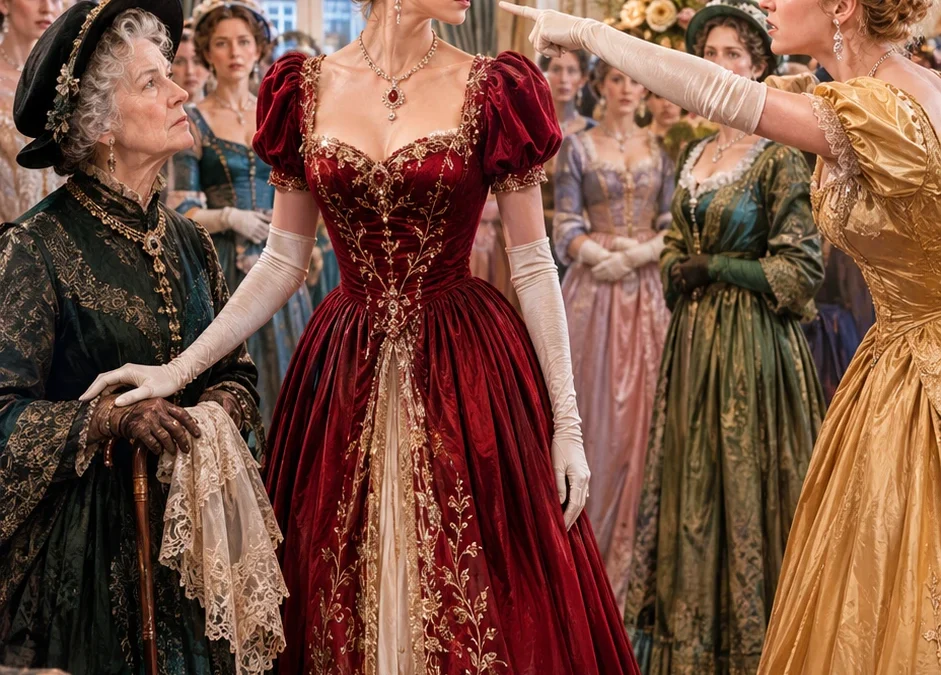
A Frail Old Woman Was Humiliated in Front of Everyone, Then One Stranger Stepped In, and by Friday Night the Most Dangerous Duke in England Was Asking for Her by Name 😱
Part 1
London society is a machine fueled by cruelty and silk.
The rules are simple. Punch down. Kiss up. And never, ever make a scene.
Beatrice Hastings knew the rules perfectly well. She simply didn’t care to follow them. 😏
The air inside Madame Valyrias’s shop tasted of heavily perfumed dust and desperate ambition. It was the height of the Season, when the city’s elite crammed into poorly ventilated rooms to judge one another’s worth by the width of a ribbon.
Beatrice stood near the back, nursing a quiet, pulsing headache. At twenty-six, the ton had firmly categorized her as a spinster. She wore the title like a comfortable, well-worn coat. It granted her a certain invisibility.
No one looked at a twenty-six-year-old woman with a modest dowry and sharp, observant eyes. They looked straight through her, to the nineteen-year-old heiresses fluttering near the French silks.
She was only here because her younger sister, Louisa, was hidden behind a changing screen, agonizing over the drape of a muslin bodice.
Beatrice preferred the quiet corners. From here, she could watch the ecosystem of the shop.
Near the front window, afternoon light caught the golden curls of Miss Harriet Finch. Nineteen. A dowry that could buy a small island. A voice like a silver spoon scraping the bottom of a china teacup. 🥄
Beside her stood her mother, Mrs. Finch, whose entire posture suggested she was perpetually smelling something rotten.
“I simply will not have it in blue, Madame,” Harriet announced, her voice cutting through the rustle of fabric. “Blue is for country girls and second daughters. I require the gold. The Duke of Ashborne returns to town this week, and I am told he favors gold.”
Beatrice stifled a sigh. The Duke of Ashborne. Leopold. Famously reclusive, notoriously wealthy, and entirely sick of the marriage mart. Every mother in Mayfair was treating his arrival like a military campaign.
She tuned out Harriet and turned to a small table of discarded remnants near the counter. Scraps of lace. Ends of ribbon. Slightly bruised silk flowers.
Beside it stood a small, stooped figure.
Beatrice paused.
The woman did not belong in Madame Valyrias’s. She wore a charcoal gray wool pelisse at least a decade out of fashion, its hem frayed and meticulously darned. Her bonnet was a plain black thing that shadowed her face.
She had removed one glove. With a bare, wrinkled hand, she was stroking a length of delicate, incredibly expensive Brussels lace.
Her fingers moved with slow, reverent gentleness.
It was a quiet, private moment.
Then Harriet Finch turned around.
She stopped short. A look of profound theatrical disgust washed over her face.
“What is that doing in here?” she demanded, her voice ringing out in the suddenly quiet shop. 😤
The shop assistant, a nervous girl with pins in her mouth, went pale. “Miss Finch, I…”
“Does Madame now cater to the workhouse?” Harriet pulled her expensive skirts tight against her legs as though proximity might transmit disease. “Or did someone leave the servants’ entrance ajar?”
The old woman did not flinch. She slowly turned her head, fixing Harriet with a look from beneath the brim of her bonnet.
“I am merely looking at the lace, young lady.” Her voice was raspy, dry as autumn leaves, but remarkably steady.
“You are touching it!” Harriet’s face flushed with the indignation of a girl who has never once been told no. “With bare, filthy hands! You couldn’t afford a single inch of that lace if you saved for a decade!”
Mrs. Finch hurried over, eyes narrowing. “Good heavens, Harriet, step away. The woman probably has fleas.” She snapped her fingers at the paralyzed assistant. “Remove this vagrant at once. We are spending a fortune in this establishment, and I will not have my daughter breathing the same air as a street beggar.”
The shop fell dead silent.
A dozen aristocratic women watched. Not one moved. It was the cardinal rule of their class. Never intervene in someone else’s tantrum. It was terribly poor form.
Beatrice felt a hot prickle of anger rise at the base of her neck.
She looked at the old woman. Thin shoulders squared. Still holding the edge of the lace. There was no fear in her posture. Only a deep, profound weariness. 💔
Beatrice dropped the bolt of green velvet.
She crossed the shop in four long strides. She did not hurry. Hurrying showed panic. She walked with the measured tread of someone completely comfortable in her own authority.
“Miss Finch.”
Her voice was not loud, but it carried a cold resonance that made Harriet jump.
Harriet whipped around. When she saw it was only Beatrice Hastings, the spinster with the mediocre dowry, her expression soured. “Miss Hastings, this does not concern you.”
“You are quite right.” Beatrice stopped beside the old woman. She was taller than Harriet by several inches, an advantage she rarely used and was very grateful for now. “It does not concern me. However, your volume is giving me a migraine, and I find your lack of basic manners deeply offensive.”
A collective gasp rippled through the room.
Mrs. Finch puffed up like an angry pigeon. “How dare you! My daughter is merely pointing out that a beggar has infiltrated a respectable establishment!”
“A beggar?” Beatrice turned to look at the old woman. The coat was frayed, yes. But impeccably clean. And the eyes beneath the bonnet were a startling, piercing blue. Bright. Intelligent. Highly amused.
She looked back at Harriet. “I see no beggar, Miss Finch. I see an elderly woman admiring a piece of lace. I also see a young woman behaving with all the grace and dignity of a cornered badger.”
Harriet’s mouth fell open. “You cannot speak to me like that! My father…”
“Earned his fortune in shipping, if I recall.” Beatrice said it smoothly. “A highly respectable trade, which makes it baffling that you act as though you were born with a crown on your head rather than a ledger in your hand. Wealth, Miss Finch, can buy you a gold silk gown. It apparently cannot buy you a shred of common decency.”
“Get out!” Mrs. Finch shrieked at the assistant. “Throw them both out! I shall take my custom to Madame Celeste!”
“You are perfectly welcome to.” Beatrice stepped slightly in front of the old woman, shielding her. “Though I hear Madame Celeste requires her clients to possess a modicum of class. You may find the entrance requirement somewhat steep.”
Harriet looked ready to burst into tears of pure rage. She opened her mouth, closed it, and finally settled on a vicious glare.
“You will regret this, Beatrice Hastings. You are a nobody. A dried-up spinster who will die alone. Do not think society will not hear how you defend gutter trash over your betters.”
“If you are my better, Miss Finch,” Beatrice said softly, her eyes entirely cold, “then I welcome the grave.”
Harriet spun on her heel, skirts snapping like a whip. “Come, Mother!”
They stormed out, scattering assistants like frightened birds. The bell above the door chimed violently, and the glass slammed behind them. 🔔
The silence that followed was thick and heavy. The other patrons suddenly found gloves and ribbons fascinating, pretending they had not just witnessed a social execution.
Beatrice let out a long, slow breath. Her hands were shaking. She hated making scenes. She hated the spotlight.
“Well,” a dry, raspy voice said beside her. “That was remarkably vicious.”
Beatrice turned. The old woman had not moved. She was looking up with those startling blue eyes, a faint, crooked smile on her thin lips.
“I apologize,” Beatrice said, her voice softening. “I fear I have a terrible temper when it comes to bullies. Are you all right, madam?”
“Quite well.” The woman looked down at the lace. “Though the young lady was correct in one regard. I cannot afford this.”
“It is meant to be admired. Madame leaves the offcuts for inspiration.”
“I used to make lace,” the old woman murmured, her thumb tracing the edge. “A long time ago.” She held up her bare hand. The joints were swollen, the fingers twisted with age. “My hands do not obey me anymore. I merely wished to feel the quality.”
Beatrice’s chest tightened. There was a quiet, unbroken dignity about this woman that made her heart ache. The cruelty of London was so casual. It ground people into dust without a second thought. 🥺
She walked to the counter and asked the price. The nervous assistant, still terrified of the woman who had just flayed Harriet Finch, mumbled that offcuts like this went for five shillings. It was practically a gift for Brussels lace.
Beatrice placed a shiny half sovereign on the glass and waved away the change. She had little pin money. Her father’s estate was heavily entailed, and her brother was notoriously tight-fisted.
But she had enough.
She wrapped the lace in tissue and carried it back.
“Here.”
The old woman’s white eyebrows drew together. “I cannot accept charity, child.”
“It is not charity. It is an apology on behalf of my entire miserable generation. Keep it in a drawer to look at, if nothing else. But do not let that wretched girl’s voice be the last thing you remember of this afternoon.”
The old woman studied her for a long moment. It was an unsettling gaze, as though she were peeling back Beatrice’s skin to examine the machinery underneath.
Slowly, the gnarled hand took the package.
“You are a very strange girl.”
Beatrice laughed. “So my family constantly reminds me.”
The old woman chuckled, a dusty, wheezing sound with genuine warmth in it. “Thank you, Miss Hastings. I suspect we shall meet again.”
She gave a slight, strangely elegant nod, entirely at odds with her frayed coat, and walked slowly toward the door. Beatrice noticed the limp then, and the plain wooden cane.
Miss Hastings.
Beatrice frowned. She had never given her name.
Twenty minutes later, Louisa’s muslin was ordered, and the sisters stepped out onto Bond Street into the dipping golden sun. Beatrice was pulling on her gloves when she noticed a commotion down the road.
Traffic had stopped. A massive lacquered black carriage, drawn by four perfectly matched midnight geldings, blocked the intersection. A vehicle designed to intimidate. No crest on the door. It did not need one.
And on the curb beside it, small and vulnerable against the gleaming wheels, stood the old woman in the gray coat. 😨
Beatrice’s protective instinct flared. “Wait here, Louisa.”
She hurried down the pavement. As she drew near, the carriage door swung open, and the man who stepped down did not belong on a London street. He belonged in a Gothic novel, or at the head of a cavalry charge.
Impossibly tall. Broad shoulders tailored flawlessly into dark superfine. Black hair swept back from a harsh, aristocratic face, a jaw that looked carved from granite. Terrifyingly handsome.
And his expression was one of cold, murderous fury.
“I told you to wait at the corner,” he snapped at the footman, in a deep baritone that sent a strange shiver down Beatrice’s spine.
“Apologies, Your Grace! The traffic, Your Grace!”
Your Grace.
Beatrice froze ten paces away. A duke. If he shouted at that old woman, duke or not, she was going to hit him with her parasol.
His dark gaze turned to the curb.
And the fury evaporated.
It was replaced instantly by a look of profound, exasperated affection. He stepped forward and took the old woman gently by the elbows.
“Mother,” sighed the Duke of Ashborne, his voice softening into something incredibly tender. “What did we discuss about wandering off without a footman? And why are you wearing that hideous coat? It smells like mothballs and despair.”
Beatrice’s heart stopped.
The old woman, the Dowager Duchess of Ashborne, smacked her son lightly on the arm with her cane. “Oh, hush, Leo. It keeps the sycophants away. If I dress in my silks, I cannot take two steps without some mother shoving a simpering daughter in my path.”
Beatrice stood frozen, mouth slightly open, realization crashing over her. She had just publicly humiliated the daughter of a shipping magnate to defend the mother of the most powerful, ruthless duke in England.
The Dowager’s sharp blue eyes scanned the crowd and locked onto Beatrice. Her smile widened. She raised her gnarled hand, the tissue-wrapped lace still in it, and offered a tiny, deliberate wave.
The Duke followed his mother’s gaze.
Beatrice found herself pinned beneath a stare so intense it felt physical. His eyes were a stormy, impossible gray. He did not look through her the way the ton always did. He looked at her, intently, taking in her flushed cheeks, her wide eyes, her white-knuckled grip on her parasol.
For one second, the entire street went silent.
Then panic took over. Beatrice spun on her heel, grabbed her skirts, and fled.
“Bea!” Louisa yelped as she was dragged down the pavement. “You are wrinkling my sleeve!”
“We are walking very fast, Louisa. We are never returning to Bond Street. I am joining a convent in France.” 🏃♀️
Back by the carriage, Leopold watched her go. He turned to his mother, one dark eyebrow raised.
“Her name,” Agatha said smoothly, allowing her son to hand her up into the velvet interior, “is Miss Beatrice Hastings. And Leo, darling, cancel our return to the country.”
He stepped in after her. “Yes, Mother.”
Agatha smoothed the Brussels lace over her lap and smiled.
“I believe we are staying for the remainder of the Season.”
The invitation arrived on Tuesday.
It lay on the silver salver in the Hastings’ cramped morning room like an unexploded bomb. Thick cream vellum. A heavy wax seal bearing a roaring lion.
And Richard Hastings, Beatrice’s brother, a man who calculated the monetary value of every interaction before speaking, stared at it with his toast frozen halfway to his mouth.
“The Duke of Ashborne is hosting a ball on Friday.”
Beatrice took a slow sip of lukewarm tea. She knew exactly why that invitation had come. It had nothing to do with Richard’s nonexistent influence or Louisa’s pretty face.
It had everything to do with a piece of Brussels lace.
I suspect we shall meet again.
It was not an invitation.
It was a summons. 😳
👇 Want Part 2? Find it in the comments, or leave any word and I’ll send it to you privately!
Part 2
By Thursday, the entire ton was vibrating with hysterical energy. Modistes worked their seamstresses to the bone. Florists were ransacked. The rumor mill churned out wild theories.
The most popular, broadcast loudly by Mrs. Finch at a Tuesday musical, was that the Duke had glimpsed Harriet through the window of Madame Valyrias’s shop, been instantly captivated by her golden profile, and thrown a ball solely to secure an introduction.
“She is insufferable,” Louisa whispered, watching Harriet preen by the pianoforte.
“She is terrified,” Beatrice corrected quietly. “Loud people usually are.”
On Friday evening, standing before her narrow bedroom mirror, Beatrice prepared for the slaughter. She had refused a new gown. She wore her darkest, least obtrusive dress, a deep plum silk that swallowed the light, with only her mother’s string of seed pearls. Her hair was pulled back severely.
She looked exactly as she intended: part of the furniture.
“You look like you are attending a very fashionable funeral,” Louisa observed.
“I am. The funeral of my quiet, uninterrupted life.”
Ashborne House did not merely occupy space on the square. It dominated it. Portland stone, dozens of windows blazing with thousands of candles, a line of carriages stretching around the corner.
Inside, the ballroom smelled of crushed orchids, hot wax, and sweat hidden beneath French perfume. Three hundred people roared over the orchestra, each trying to sound more important than the next.
Beatrice immediately initiated her survival protocol. She steered Louisa toward a cluster of potted palms near the terrace doors. Richard vanished within three minutes, drawn to a knot of elderly lords like a moth to flame.
In the center of the room, near the grand staircase, stood Harriet Finch in her gold silk. It was admittedly stunning, cut dangerously low and draped to perfection. Her eyes darted constantly toward the empty landing.
She was waiting for her duke. 👀
Beatrice stepped back into the shadow of a large fern. Three hours. Survive three hours.
A sudden hush fell over the room.
It rolled outward from the grand staircase like a wave, killing every conversation in its path. At the top of the stairs stood Leopold, Duke of Ashborne, in stark black evening dress. No medals. No ribbons. He did not need them. He gazed over the sea of expectant faces with an expression of soul-deep exhaustion.
He did not look like a man searching for a bride. He looked like a man evaluating a room full of cattle.
And beside him stood the Dowager.
Beatrice’s breath caught. Gone were the frayed gray wool and the ugly bonnet. Agatha wore midnight blue velvet. At her throat rested a sapphire the size of a quail’s egg, ringed with diamonds that threw prisms across the walls. She leaned on her cane, but her posture was ironed straight.
She looked like a queen surveying a slightly disappointing kingdom. 👑
They began their descent. The crowd pressed itself against the walls to clear a path. Harriet Finch stepped forward to the very edge of the human corridor, posing perfectly, a bright, practiced smile plastered across her face.
Leopold reached the floor. He began to walk.
He did not look at the women throwing themselves into his line of sight. He did not acknowledge the deep bows. His stormy eyes scanned the perimeter of the room, past the gilded mirrors, past the ice sculptures, past Harriet Finch.
Harriet’s smile faltered as the Duke walked straight by her without breaking stride.
He was walking toward the potted palms.
Beatrice felt the blood drain from her face. Her heel hit the plaster wall.
Don’t look at me. Walk past. Please, God, keep walking.
He did not.
The crowd parted, leaving a painfully empty stretch of floor between the Duke of Ashborne and Beatrice Hastings. He stopped a few feet away. Up close, the harsh angles of his face were even more pronounced. The faint shadow along his jaw suggested he hated his valet as much as he hated this party.
The silence was absolute.
Three hundred pairs of eyes pinned the spinster in the plum dress.
“Miss Hastings.”
She sank into a flawless, mechanical curtsy, eyes fixed on the silver buckles of his shoes. “Your Grace.”
“Look at me.”
It was not a request. It was a command, spoken softly, with absolute authority.
Beatrice straightened and met his gaze. His eyes were not cold, she realized. They were aggressively observant.
“My mother informed me I owe a debt to a woman in a modiste’s shop,” Leopold said, loud enough for the nearest bystanders to hear. “She told me this woman defended a stranger against a remarkably vicious attack by a girl with more money than sense.”
A sharp collective gasp. Harriet Finch let out a strangled squeak. 😱
Leopold did not break eye contact. “I assumed my mother was exaggerating. She enjoys drama. But I see she understated the matter.”
“I merely spoke out of turn, Your Grace,” Beatrice said, her voice tight but steady. “I have a habit of doing so.”
“Is that so?” The corner of his mouth twitched, a millimeter of a smile. “I find it remarkably efficient. You cut straight through the rotting wood to the core. A rare trait in this city.”
He held out a hand, large and encased in white silk.
“They are playing a waltz, Miss Hastings. And my mother has threatened to beat me with her cane if I do not dance with you.”
Beatrice stared at his hand. This was a public execution. If she took it, she would paint a target on her back for the rest of her life. Harriet Finch would likely hire an assassin.
She looked at his face. He knew exactly what he was doing. He was forcing her out of the shadows. But there was no malice in his eyes. Only a quiet, demanding challenge.
Are you brave enough?
She let out a slow breath and placed her hand in his.
“I would hate for Your Grace to suffer a bruising on my account.”
His fingers closed around hers, firm, warm, entirely grounding.
“Come,” he murmured. “Let us go ruin your reputation.” 🔥
He walked at a measured pace, forcing the crowd to fall back. The orchestra, which had faltered, scrambled to pick up the waltz. When they took their positions, Leopold pulled her slightly closer than was proper. It was not intimate. It was a barricade, insulating them from the hundreds of glaring eyes.
“You are stiff, Miss Hastings.”
“I am terrified, Your Grace,” she replied honestly, voice low. “There are women in this room calculating how to poison my tea. I can feel them staring at the back of my neck.”
He let out a short, rough laugh, rusty from disuse. “Let them stare. They are vultures. They only pick at things that are already dead or dying. You, Miss Hastings, are very much alive.”
“I was perfectly content being dead to society. Invisibility is a highly underrated survival tactic.”
“Invisibility is a coward’s tactic. And you are not a coward. A coward does not humiliate a shipping heiress in public to protect an old woman.”
She glanced over his shoulder. “I did not know she was a duchess.”
“Would you have walked away?”
“No.” Her jaw tightened. “But I would not have given her a half sovereign out of pity either. That was incredibly patronizing of me.”
“My mother has an estate that generates forty thousand pounds a year,” Leopold said, his tone turning warm and distinctly proud. “She owns rubies Catherine the Great once tried to buy. And that piece of lace you bought her sat on her vanity table beside her hairbrushes. She did not stop talking about it for three days.”
“Why was she wearing that dreadful coat?”
“Because she finds London ridiculous. She dresses down to see who will treat her with basic human dignity when the title and wealth are stripped away. It is a cynical game. She usually goes an entire Season without finding a single person who passes.” His dark eyes held hers. “Until Tuesday.”
They moved across the floor in silence. The physical reality of him was overwhelming. He smelled not of cheap cologne but of clean linen, saddle leather, and the crisp cold air of the north.
“You do not like the ton either,” she observed.
“I loathe it. It is a marketplace where human beings are weighed, priced, and traded for land and influence.”
“Yet here you are, hosting the biggest market of the year.”
“My mother required a stage. She wished to demonstrate to London what actual grace looks like. To humiliate the Finch family for their vulgarity.” He spun her, plum silk flaring against his black trousers. “And mostly, she wanted to see what you would do when dragged into the light.”
Beatrice’s eyes narrowed. “I am not a performing monkey, Your Grace. Nor a pawn in your mother’s games.”
“I know.” His grip on her waist tightened fractionally. “If I thought you were, I would not have asked you to dance. I would have sent flowers and a polite note and left you to your precious invisibility.”
The music swelled toward its final bars. He slowed them to a stop at the edge of the floor, but did not step back. He kept her close for one second longer than necessary.
“You are angry.”
“I am annoyed,” Beatrice corrected, dropping into a quick, sharp curtsy. “I do not like being manipulated, even by duchesses.”
“Good.” A dangerous, fascinating gleam lit his eyes. “Keep that anger, Miss Hastings. You are going to need it.”
Before she could ask what he meant, he bowed stiffly and disappeared into the crowd.
Beatrice stood alone at the edge of the floor, exposed, stripped of her armor. A shadow fell across her path.
The Dowager Duchess, sapphire glittering violently in the candlelight, leaning heavily on her cane.
“Well done, my dear. You did not step on his toes once.”
“Your Grace,” Beatrice said, guarded. “Your son informs me I am part of a demonstration.”
Agatha chuckled, dusty and dry. “My son lacks tact. He thinks everything is a cavalry charge. Walk with me, child. Let us find the supper room. I wish to speak with you without Mrs. Finch throwing her daughter under my feet.”
Beatrice had no choice. She offered her arm. The old woman’s gnarled hand closed around it, surprisingly strong. As they walked, the crowd parted like a sea of silk and broadcloth.
Beatrice kept her chin high. She had spent six years fading into the background. In the span of a ten-minute dance, Leopold and Agatha had dragged her onto center stage, handed her a script she had not read, and locked the doors behind her.
The game had changed entirely.
And she had no idea what the rules were anymore.
Agatha led her to a secluded alcove draped in heavy gold velvet and guarded by two footmen who looked more like hired muscle than servants. She lowered herself into a chair with a weary sigh.
“Eat the broth, Beatrice. It will settle your stomach. I detest ballroom food. It is designed for display, not digestion.”
“I am trying to determine whether I am a guest or a hostage, Your Grace.”
Agatha barked a laugh. “A guest, I assure you. But I understand why you feel cornered.” Her expression shifted, the cynical edges melting away to reveal something deeply, profoundly lonely. “My husband loved the noise. The sycophants. The endless chatter. When he died, Leo inherited the title, the debts, and the vultures. He was twenty-two. He spent ten years fixing the estate and learning to hate the people who praised him to his face while waiting for him to fail.”
Beatrice said nothing.
“He needs a wife,” Agatha continued, her voice dropping to a harsh whisper. “Not a girl who faints when he raises his voice. Not a woman who calculates her affection by the balance of his ledgers. Someone who is not afraid of the dark. Someone who will stand in a crowded shop and tell a bully to go to hell.”
Before Beatrice could process what that implied, the velvet curtain was yanked aside.
Mrs. Finch stood there, gripping Harriet by the arm. Harriet was pale, her lower lip trembling, the gold silk suddenly looking heavy and ridiculous.
“Your Grace,” Mrs. Finch gushed, curtsying so deeply she nearly toppled. “We simply had to pay our respects. Harriet wishes to apologize. For Tuesday. We did not realize who you were.”
“Ah.” Agatha rested her spoon in her bowl and leveled a gaze of pure ice. “You did not realize I was a duchess. That changes the mathematics of your cruelty, does it not? If I were truly a penniless old woman, your daughter’s behavior would have been perfectly acceptable.”
Harriet flinched as if struck.
“You are a vulgar, cruel little girl,” Agatha said, and the air in the alcove turned freezing. “You judge the world entirely by its wrapping because you have nothing of substance inside your own. I have no interest in your apologies. They are motivated by terror, not regret.”
Mrs. Finch looked ready to weep. “Your Grace, please. My husband’s standing…”
“Is not my concern.” Agatha gestured toward Beatrice. “If you wish to apologize, you will apologize to Miss Hastings.”
Both Finches stared at Beatrice. Apologizing to a spinster with a mediocre dowry was visibly agonizing, an upending of their entire worldview.
Beatrice looked at Harriet. She saw the panic. The humiliation. The sheer desperation to cling to a rung on the social ladder.
Six years ago, she might have felt vindictive joy. Now she felt only pity. It was a miserable way to live. 😔
“That will not be necessary.”
Agatha frowned. “Beatrice. Do not let them off the hook.”
“There is no hook, Your Grace.” Her eyes stayed on Harriet. “An apology extorted under threat of social ruin is worthless. I do not want it. Miss Finch and I understand each other perfectly well. Let us leave it at that. You may go.”
Harriet’s lips parted. Confusion warred with relief on her face. For the first time, the golden girl looked entirely lost.
Mrs. Finch dragged her daughter out. The curtains fell shut.
“You are too merciful,” Agatha sighed.
“Mercy requires power, Your Grace. I have none. I merely refused to participate in their degradation. It is exhausting.”
“It is,” a deep voice agreed from the shadows.
Leopold stepped through the curtain. He had watched the entire exchange. His stormy gray eyes were focused entirely on her.
“The carriage is ready, Mother.”
Agatha smiled, slow and immensely satisfied, and reached for her cane. “Excellent. It was a profound pleasure, Miss Hastings.”
She walked out through the curtains, leaving the two of them alone in the dim light.
“You did not gloat,” Leopold said, stepping closer.
“Gloating is for people surprised by their own victories. I did not win anything tonight, Your Grace. I merely survived it.”
He reached out. For a moment she thought he would touch her face. Instead, his hand lightly brushed the fabric of her plum sleeve.
“I will call on you on Monday, Miss Hastings.”
It was not a question. It was a statement of absolute intent.
“My brother will be thoroughly unbearable.”
“I do not care about your brother.” He stepped back, the candlelight catching the harsh angles of his face. “Good night, Beatrice.”
He turned and left, and Beatrice stood amid cold supper and the terrifying realization that her quiet life was over.
But the next morning, in a small, obscure park, the Duke of Ashborne was waiting for her under an oak tree with something in his hand, and what he said next would tear her carefully armored heart wide open. 💔
👇 LIKE or COMMENT “REVEAL” to see Part 3, which will be posted after enough comments!
Part 3
Saturday morning tasted of damp wool, cold tea, and raw panic.
Richard had returned from Ashborne House at three in the morning, smelling of expensive brandy and vibrating with a manic energy. By eight, he had summoned the tailor, the modiste, and his solicitor.
Beatrice sat at the breakfast table, staring at a piece of dry toast.
“He danced with you.” Richard paced the dining room, hands clasped behind his back. “He bypassed three earls’ daughters, the Finch heiress, and Lady Mary to dance with you. And then the Dowager took you to supper. The woman is a dragon, Beatrice, and she shared her soup with you!”
“It was broth, Richard.”
“It does not matter if it was poisoned water. It was a public endorsement!” He leaned over the table, eyes feverish. “Do you understand the leverage this gives us? When he calls, you must be perfectly agreeable. Agree with his opinions. Laugh at his jokes.”
“I will not.”
Richard blinked. “What do you mean, you will not?”
“I will not simper. I will not laugh at jokes that are not funny. I will not pretend to be a porcelain doll.” Beatrice pushed her plate away and stood. “If the Duke of Ashborne wanted a sycophant, he had a ballroom full of them. If he calls on me, he will get me. Nothing more, nothing less.”
“You are throwing away the greatest opportunity this family has had in a century!” Richard shouted, his face turning purple. “You will ruin this with your stubborn, spinsterish pride!”
“My pride, Richard, is the only thing I actually own.” Her voice was deadly calm. “You control the estate. You control my dowry. You control where I live. But you do not control my character.”
She walked out, ignoring Louisa’s wide-eyed stare from the doorway.
Ten minutes later, in a plain brown walking habit and sturdy bonnet, she slipped out the back door. She avoided the main thoroughfares and headed for a small, unfashionable park a few streets over, with ancient gnarled oaks and patches of wild grass. The morning air was biting, carrying the scent of rain.
She walked for twenty minutes, letting her mind go blank. She refused to think about Leopold’s dark eyes. She refused to think about the absolute certainty in his voice when he said her name.
“You walk exactly like you dance.”
Beatrice froze and turned.
Leopold stepped out from the shadow of a massive oak. He wore a heavy riding coat of dark blue wool, tall mud-splashed boots, and a loosely tied cravat. He looked rougher, more dangerous, entirely out of place in a small London park.
“Do you make a habit of stalking women in public parks, Your Grace?” Her voice was steady despite her racing heart.
“Only when they flee their own homes at nine in the morning. Your footman was easily bribed. He mentioned you favor this square when you wish to avoid your brother.”
“Remind me to dismiss him.”
“Don’t. He was merely looking out for his livelihood.” Leopold shoved his bare hands into his pockets. He looked exhausted, shadows prominent beneath his eyes. “I know I said Monday. But I realized I made a tactical error last night.”
Beatrice’s chest tightened. Here it comes. The retreat. The realization that a spinster is not worth the scandal.
“A tactical error,” he repeated. He pulled his right hand free. In it was a small, familiar tissue-paper package.
“My mother asked me to return this to you.”
Beatrice stared. The Brussels lace. A cold, hollow feeling spread through her stomach.
She took it, her gloved fingers brushing his. “I see,” she said quietly, looking away at a patch of muddy grass. “The demonstration is concluded. The point has been made. I am to take my charity back and resume my invisibility.”
“Look at me, Beatrice.”
She snapped her head up, eyes flashing. “Do not speak to me like one of your servants, Your Grace. You have had your amusement.”
“I am returning the lace,” Leopold said, his voice rising, drowning her anger in sheer desperate intensity, “because my mother told me that if I want you, I must earn you myself. I cannot use her gratitude as a bridge.”
Beatrice stopped breathing.
The small package crushed in her grip. Leopold took a step closer, and the air between them crackled.
“I spent ten years fixing a broken estate. Ten years surrounded by people who see me as a bank vault with a title attached. I am tired of the artifice. I am tired of the lies.” His stormy eyes stripped away every defense she had built. “I saw you in that shop. I saw a woman with more courage, more raw, unvarnished decency in her little finger than the entire peerage combined. You stood between a predator and her prey, and you did not flinch. I do not want a porcelain doll. I do not want a political alliance. I want a partner.” 💔
Beatrice swallowed hard. The cynical armor was cracking under the weight of his terrifying honesty.
“I am not a romantic, Your Grace. I am practical. I am sharp-tongued. I will likely irritate you on a daily basis.”
“I am counting on it.” A shadow of a smile touched his lips. “A quiet house would drive me mad. And your brother will try to exploit you. I will crush him financially if he tries. It will take roughly three minutes.”
Beatrice let out a breath that was half laugh, half sob. She looked down at the lace, then up at the towering, formidable man standing in the mud.
“You are offering a very strange bargain, Leopold.”
It was the first time she had used his Christian name. His eyes darkened at the sound.
“I am offering you the truth, Beatrice. No games. No societal mechanics. Just a life where you never have to hide in corners again. Unless you want to, in which case, we shall hide together.”
He did not ask for an answer. He took her hand, pressed a firm, warm kiss to the back of her glove, and stepped away.
“I will call on Monday. To ask your brother for permission. Be prepared to catch him when he faints.”
He turned and vanished into the morning mist.
Beatrice stood alone under the oak. She carefully folded the tissue paper, tucked the lace into her pocket, and began the walk home.
For the first time in six years, Beatrice Hastings did not look down at the pavement.
She looked straight ahead. 🌅
Monday afternoon arrived like an executioner.
Richard paced the Persian rug, carving a frantic trench into the wool, smelling of bay rum and raw anxiety. Louisa sat frozen on the sofa. Beatrice stood by the window in a plain green day dress, turning the pages of a book she was not reading.
When the brass knocker cracked against the door, Richard stopped breathing.
Leopold walked in, stripping off his leather gloves. He bypassed pleasantries entirely, his presence suffocating the room’s oxygen.
Richard launched into a frantic, groveling bow. “Your Grace, a profound honor! Shall we repair to my study to discuss settlements?”
“No.”
The word dropped like lead. Richard’s greedy smile faltered.
“I do not want your sister’s dowry,” Leopold said, devoid of warmth. “I want your signature. You will sign a document waiving any future financial claim upon my estate. I am marrying Beatrice. I am not funding your political ambitions or paying your tailor. If you attempt to leverage my name for gain, I will bankrupt you by Thursday. Do we understand each other?”
Richard’s mouth opened and closed. The grand fantasy of tapping the Ashborne fortune evaporated in seconds, leaving only terror.
“I… I understand.”
“Good.”
Leopold dismissed him without another glance and crossed to the window, stopping inches from Beatrice. The ruthless Duke vanished. In his place stood the tired, brutally honest man from the park.
He drew a worn velvet box from his coat and placed it in her hand.
“It belonged to my grandmother. She was entirely too loud, but she loved my grandfather fiercely, and never let a single person dictate her life. I thought it appropriate.”
Beatrice held the small, heavy box. She looked into his stormy eyes, tracing the deep lines of exhaustion she knew she could help him carry. He was not a fairy-tale prince. He was a man holding a fortress, offering her a place on the wall. 🏰
“I require my own library,” she said quietly, holding his gaze. “I will not be confined to a drawing room, and I will not tolerate being managed.”
“You get the East Wing. And the day I try to manage you, I expect you to stab me with a letter opener.”
A genuine, unpracticed smile broke across her face. She placed her free hand in his.
“Then I accept your bargain, Leopold.”
He exhaled a rough, heavy breath and leaned down until his forehead rested against hers, right there in front of her stunned siblings.
“Thank God. Now let us leave this wretched city. I want to show you the dogs.” 🐕
Three weeks later, London Society received its final shock.
There was no grand spectacle at St. George’s. The Duke of Ashborne married Beatrice Hastings in a tiny, drafty stone church in Derbyshire. The only witnesses were a weeping Louisa, a thoroughly defeated Richard, and the Dowager Duchess.
Agatha stood in the front pew, leaning on her wooden cane. She wore the frayed gray wool coat.
And as her son kissed his new, stubbornly cynical duchess, the old woman smiled. 💛
Because the lace had never been the test. It had only ever been the door.
Beatrice Hastings had spent six years hiding in corners, believing kindness was a weakness the world would punish. She had no idea that a single, careless act of decency, performed for a stranger in a frayed gray coat, would lead her to the one man in England who had been waiting his whole life for someone brave enough to say what no one else would.
If this story warmed your heart, share it with someone who believes small kindnesses can change everything.
This story is entirely fictional and created for entertainment purposes only. It does not represent any organization or individual, nor does it encourage inappropriate behavior. The content was generated with AI assistance.








