A Half-Frozen Woman Slipped Into a Lonely Soldier’s Bed at Midnight. He Reached for His Rifle. Then He Saw Her Feet, and Everything Changed.
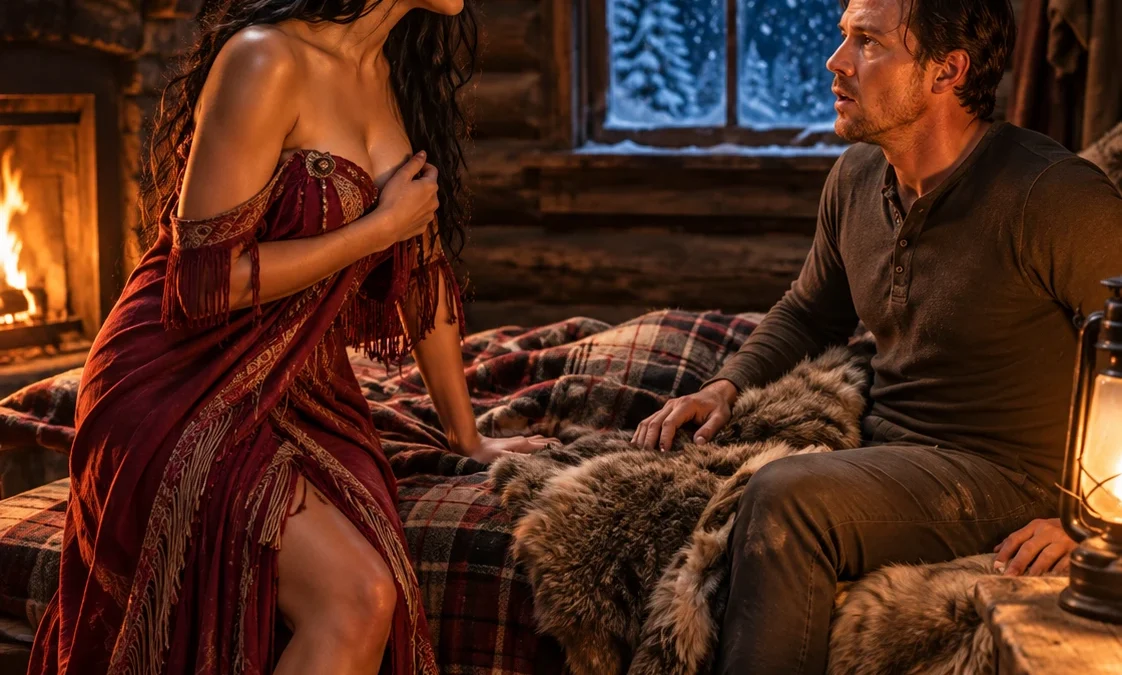
🔥 A Half-Frozen Woman Slipped Into a Lonely Soldier’s Bed at Midnight. He Reached for His Rifle. Then He Saw Her Feet, and Everything Changed. 😱
Part 1
The wind had been rising all evening, scraping across the wide Wyoming flats and pushing through the cracks in Calder Boone’s cabin walls.
The place was old, built before the war, with gaps no amount of mud chinking could ever seal. He was used to the sound by now. It had been three winters since he bought the land and took to living mostly alone.
Most nights he mended tack, smoked, or read by the lantern until his eyes burned. But tonight he had turned in early. The sky had been heavy with clouds at sundown, and he knew the temperature would drop hard after dark.
He lay on the cot against the far wall, one arm behind his head, the other hanging over the edge with his fingers near the rifle stock. His hat rested over his face. His eyes weren’t shut.
Sleep never came easy. The war had left him that way, too light a sleeper, too ready to wake at every sound. In Tennessee, it had saved his life more than once. These days, it only kept him company in a cabin that was too quiet when the wind died.
He was thirty-nine, worn lean from long days and leaner winters. The blue of his cavalry coat had faded near gray, frayed at the cuffs where he had patched it more than once. His revolver hung on the peg by the door, never out of arm’s reach.
He didn’t expect trouble. He didn’t expect company, not this far from town.
That was why the sound made him sit up fast.
A faint scuff of feet outside the door. It wasn’t the wind. He knew the difference between wind and weight.
The porch plank groaned. Calder swung his legs over the cot and closed his hand around the rifle. He rested the barrel across his knees and waited.
The latch didn’t rattle. The door didn’t slam open. There was only a pause, long enough for the wind to die down, and then the softest creak as the door gave way.
Someone was inside.
He was on his feet now, bare toes against the cold floor.
“Who’s there?”
No answer.
He reached the lantern on the table and struck a match with a sharp hiss. Light spilled across the room, throwing long shadows up the walls.
That was when he heard the cot creak behind him.
He turned, rifle half raised, and saw a shape under his blanket. Not a man. A woman. She had slipped into his bed in the space of a heartbeat and curled tight against the far wall like a cornered animal. 😳
“Get out of there,” he said, low and hard.
She flinched but didn’t move.
The light caught her face. Bronze-skinned. Young, no more than twenty-four by his guess. Apache, by the long black hair falling wild around her shoulders and the sharp cut of her cheekbones.
She was barefoot. Her feet were raw and blistered, one ankle swollen. Her dress was torn, hanging loose, the hem dark with dried blood. She smelled of smoke and sweat, like she had been running for days.
His first instinct was to haul her up and throw her back out into the cold. This was his cabin, his cot, the one space in the world that belonged to him alone.
But she didn’t speak. She didn’t beg. She looked at him with wide, dark eyes, not pleading, not defiant. Just waiting to see what he would do.
That was what stopped him.
If she had begged, he could have hardened himself. If she had lied, he could have turned cold. But she simply waited, shoulders bunched like she would bolt if he stepped too fast.
Calder cursed under his breath and lowered the rifle. He grabbed the extra wool blanket from the chair and tossed it toward her, sharper than he meant to.
“You stay there. Don’t touch me.”
She caught it slowly, her fingers trembling, and pulled it around herself.
He blew out the match, let the lantern burn low, and sat on the edge of the cot’s far end with the rifle across his knees. He stared at the cold stove, listening to the wind and to her breathing.
It wasn’t fear he felt now. It was something harder to name.
She was trouble. He knew that much. No one showed up like this without a story that could bring more men to his door. He could tell her to leave at dawn, wash his hands of her, and go back to the quiet that had kept him alive this long.
But the memory of her cracked, bleeding feet and the bruises on her arms wouldn’t leave him alone. Whatever she was running from had already stripped her down to bone and desperation.
And he couldn’t bring himself to be the one to finish the job. 💔
Morning came gray and bitter. Calder woke before the sun cleared the horizon, as he always did. His eyes went first to the far edge of the cot.
She was still there. A small shape beneath the blanket, her dark hair spilling across her face.
He stoked the stove and set the coffee on. When the smell filled the room, she sat up slowly, the blanket clutched around her shoulders. Her eyes found him at once, alert but not panicked.
“You’re still here,” he said, more to himself than to her.
He poured two cups and set one on the table within her reach. When she crawled toward it, her feet touched the floor and he saw her wince. Up close, her soles were split and bruised, some of the cuts deep enough to bleed again.
“Sit back down. You’ll tear them worse.”
She froze, then lowered herself back onto the blanket.
He found a tin of salve he used for saddle sores and crouched near her. “Hold still.”
She watched him with that sharp, unreadable stare. Then she shifted and pulled her feet out from beneath the blanket. He worked in silence, dabbing salve over the worst of the cuts and wrapping them with strips of cloth torn from an old shirt. Her skin was cold enough that he felt it through his calluses.
When he finished, she pushed the empty bowl of beans back toward him and said quietly, “Naya.”
He looked up.
“My name.” She touched her chest.
“Calder.”
She repeated it under her breath, like she was testing the sound. 🌙
For two days, she stayed. She swept the floor. She stacked kindling. She mended his shirt with crooked stitches. When he asked where she had come from, she said only, “South.”
“Anyone following you?”
Her needle stopped in midair. She gave one small nod.
Calder felt the tightness in his gut settle deeper.
“Then if they come, you do what I tell you.”
She nodded.
On the third night, she didn’t wait for him to offer. She sat on the cot and left a space beside her. He hesitated a long moment. Then he lay down on his side of it, careful not to touch her.
In the dark, her hand brushed his arm, light as breath.
“You safe,” she whispered.
“You too.”
It was the first night in years he slept without dreaming of war.
But in the morning, riding the north pasture, Calder found something that made his blood go cold.
Fresh tracks. Two horses, too deep to be his own, heading west.
Part 2
Fresh tracks. Two horses, too deep to be his own, heading west.
Calder crouched beside them for a long time, jaw tight. Someone was still looking.
When he returned to the cabin, Naya was tending the fire. She looked up and read his face before he said a word.
“Tracks,” he said.
Her fingers tightened on the poker, but she didn’t speak.
“We’ll be ready.”
She gave a single sharp nod. When he sat to pull off his gloves, she came and stood near him, her hand brushing his shoulder in a small, wordless gesture that said I trust you to keep that promise.
That promise had come the night before, by the fire. She had asked him, plainly, “You fight for me?”
He had looked at her, really looked, and seen that the question wasn’t only about rifles. It was about whether she could trust anyone at all.
“I will.”
“Town no safe,” she had said. “West no safe. Here safe.” And her gaze held his, as if to make clear this wasn’t just a safe place she had found. It was one she had chosen.
Then she had leaned forward and kissed him, soft and sure, tasting of smoke and stew. Calder had frozen for half a second. Then his hand came up to her cheek. 💛
Now, in the gray stillness of the next morning, the kind of quiet he never trusted, he stood on the porch with his coffee and saw two faint specks far down the trail.
They grew into riders.
“Naya,” he said through the door, voice calm and firm.
She appeared instantly. “Men?”
“Yes.”
He expected her to retreat to the back of the cabin. She didn’t.
“I stay.”
He held her gaze a long second, then nodded. “Bolt the door after me. Don’t open unless it’s my voice.”
He stepped onto the porch, rifle in hand, as the riders reached the gate. The older one had a trimmed beard and a worn coat. His hand rose in greeting that didn’t match the hard look in his eyes.
“Morning.”
“You’re a long way from town,” Calder said.
The younger one shifted in his saddle. “Looking for someone. Apache girl, maybe twenty-four. You seen her?”
“No one here but me.”
The older man’s mouth curved slightly. “Funny. We heard different.”
“You heard wrong.”
The wind was dead. Calder could feel Naya’s presence just beyond the door. He knew she was listening.
“She stole something,” the older man said, spitting in the dirt. “Doesn’t belong out here. You’re not doing yourself any favors keeping her.”
Calder stepped off the porch and leveled the rifle. Not aiming to fire. Making it clear that he could.
“Trail’s that way. You ride it.”
The younger man looked like he might argue, but the older one put a hand on his arm. After a long moment, they turned their horses.
“This ain’t done,” the bearded one called over his shoulder.
“Then make sure you’re ready next time.”
When Calder opened the cabin door, Naya stood in the middle of the room, hands clenched at her sides. She stepped forward, took the rifle from him, and set it against the wall. Then she wrapped her arms around his middle and pressed her face to his chest.
“They’ll come again,” he said quietly.
“I know.” She stepped back. Her eyes were dry but hard, no longer the eyes of someone ready to run. “I fight, too.”
He studied her, then nodded once. “All right.”
That afternoon, he showed her how to load the spare rifle. Her hands were sure on the lever. She sharpened the kitchen knife on the whetstone and tied her hair back like she meant to be ready.
The next day, the wind picked up, carrying a low hiss through the cottonwoods along the creek. Calder was stacking wood when he saw them again.
This time they came faster. And this time they weren’t alone.
Three riders. 😨
He went inside, voice clipped. “They’re back. Three now.”
Naya’s face didn’t change. She took the rifle and moved to the corner of the cabin where she could see the door but stay out of sight.
Calder stepped onto the porch and waited. He didn’t call to them this time. He let them ride close enough that the dust settled in the yard.
The bearded man swung down from his horse, boots hitting the dirt hard.
“Last chance, boy. Hand her over and we ride out clean.”
“She stays here.”
“Then we’ll take her.”
The younger rider moved to dismount, and Calder fired.
The shot hit the dirt close enough to the man’s boot to throw up dust.
“You try,” Calder said, voice flat, “and one of you won’t ride home.”
The bearded man’s hand hovered near his revolver. He looked from Calder to the cabin, where Naya now stood in the doorway, her rifle leveled steady at his chest.
And then the third rider, the one who hadn’t spoken a word, slowly raised his head.
Naya’s face went white.
Part 3
The third rider pushed back his hat.
He was older than the others, gray at the temples, with a face Naya knew better than she had ever wanted to. His eyes found hers across the yard, and something cold and patient settled in them.
“Naya,” he said, almost gently. “That’s enough now.”
Her rifle did not waver. But her voice, when it came, was barely a breath. “You.”
Calder’s eyes moved between them. “You know him.”
“He bought me.” She said it flat, in the careful, broken English she used when words cost her something. “From the men who killed my family. Three years. He keeps me. Locked in his house.”
The air in the yard went still.
The gray-haired man smiled thinly. “A misunderstanding, Mister Boone. The girl is mine by lawful bill of sale. I’ve the papers in my saddlebag. She ran off with property that doesn’t belong to her, and I’ve come to settle the account.”
“What property?” Calder asked.
“A ledger. My business is none of yours.”
Naya’s chin lifted. “No ledger. I take nothing.” Her eyes stayed on the man. “He lies. He wants me back because I saw. I saw what he did to my people. I saw him sign papers with the men who burned our camp. I know names. I know where the bodies are.” Her voice shook, but not with fear. “That is why they chase me. Not for stealing. For knowing.”
The bearded rider shifted uneasily. The younger one looked at his boots.
Calder understood then. A woman no one would believe, hunted by men who could not afford for her to be believed.
“Papers,” Calder said slowly, “don’t make a person a thing you can own.”
“The law says otherwise.”
“Not in this territory. Not anymore.” Calder kept the rifle level. “And no law I know of gives three men the right to ride onto my land and drag a woman off it at gunpoint.”
The gray-haired man studied him a long moment. “You’re a soldier. Or were. You know what happens to men who take sides in matters like this.”
“I know what happens to men who don’t.” Calder’s voice was low. “I spent four years watching it.”
Silence stretched across the yard like a drawn wire.
Then the younger rider, the one who hadn’t looked up, spoke in a cracked voice.
“Mister Hale,” he said. “Sir. You told us she stole money.”
The gray-haired man did not turn. “Be quiet, Tom.”
“You said she was a thief. You didn’t say nothing about…” He swallowed hard. “About the camp.”
“I said be quiet.”
“I ain’t riding for that.” The boy turned his horse a quarter step away. “I signed on to fetch a runaway. Not for this.”
The bearded man’s head snapped toward him. “Tom.”
“I’m done.”
It was only a few words. But in the stillness, they cracked something open. The bearded rider looked at Hale, then at Naya standing in the doorway, rifle steady and eyes burning, and Calder with the barrel aimed at the center of his chest.
“This ain’t worth hanging for,” the bearded man muttered.
Hale’s smile vanished. “You fool.”
His hand dropped toward his coat.
Everything happened at once.
Calder’s rifle cracked. Hale spun in the saddle, his shot tearing wide into the porch post. A second report split the air behind Calder, and Hale slid from his horse into the dirt, clutching his shoulder, a Winchester ball from the cabin door buried deep in the muscle.
Naya lowered the rifle slowly, smoke curling from the barrel.
The bearded man had thrown both hands in the air. Tom sat frozen in his saddle, pale as flour.
“Don’t,” Calder said to the bearded man. “Not one more move.”
“I ain’t,” the man rasped. “I ain’t!”
Calder crossed the yard and kicked Hale’s pistol out of reach. The old man lay gasping on his back, eyes glittering with hatred.
“You’ll hang for this,” Hale spat. “A white man shot for an Apache whore.”
“Say that word again,” Calder said quietly, “and I won’t need a rope.”
Hale fell silent.
Behind them, Naya stepped off the porch. She walked across the yard, barefoot on the cold ground, and stopped over the man who had owned her. She did not raise the rifle. She did not speak for a long time.
When she did, her voice was steady.
“I was fourteen,” she said. “You said I would have a good home.” She looked down at him. “I will never be in your house again.”
Then she turned away, and Calder saw her hands begin to shake.
He reached her in three strides. She did not fall. She did not cry. She only stood there, breathing hard, and let him hold her while the thing she had carried for three years finally cracked open and let in the air. 💔
The territorial marshal rode out from Cheyenne four days later, summoned by Tom, who had ridden all night to find him. Tom told it plainly, a boy who had stumbled into something far darker than the job he signed on for. Naya told it too, in her careful English, every name, every date, every place. She did not flinch. Calder sat beside her through every word.
The marshal listened without interrupting. When she finished, he was quiet for a long while.
“Miss,” he said at last, “I’ve been hearing rumors about a man named Hale for six years. Never had a witness.”
“You have one now.”
He looked at her, and then at Calder, and nodded slowly.
There was a trial in the spring. It took only three days, because Naya’s testimony named things no one could have invented. A burned camp in the hills south of the border. Land deeds forged in a dead man’s hand. Eleven families who had simply vanished. The bearded rider turned witness to save his own neck, and Tom, trembling, confirmed it all. Hale’s own ledger, found hidden beneath the floor of his house, did the rest.
He hanged in June.
Naya did not attend. She stayed at the cabin, and when Calder returned from town, she was sitting on the porch steps in the long gold light, hands folded in her lap, watching the horizon.
“It is done?” she asked.
“It’s done.”
She nodded. For a long time she said nothing. Then she let out a breath that seemed to come from somewhere very deep.
“My mother used to say a person is not free until they can sit with their back to the door.” She turned her head and looked at him, and for the first time her smile was full and unguarded. “I think I am free.”
He sat down beside her. “You were always free. They just took a long time admitting it.”
Her laugh was soft, startled, and real.
They married in September, in the yard in front of the cabin, with the marshal, Tom, and a handful of ranchers from three spreads away standing witness. She wore a dress she had sewn herself, the stitches finally neat. She said her vows first in her own language, low enough that only Calder caught the words, and then again in English for the others.
He had understood the first one before she translated it.
That winter, when the wind came scraping across the Wyoming flats and pushed through the cracks in the old walls, the cabin no longer felt too quiet. There was the crackle of the stove. There was the soft sound of her humming over the mending. There was a second cup beside the first on the table every morning.
One night, deep in January, Calder woke to a faint sound in the dark. He lay still, every muscle tensed, listening.
Then he smiled.
It was only Naya, slipping back into bed with cold feet, pressing them against his shins to warm them up.
“You are awake,” she whispered.
“Hard not to be.”
She laughed against his shoulder. “You said once I could not touch you.”
“I said a lot of foolish things.”
“You did.” She was quiet a moment. “I came into your bed that night because I was cold. And because it was the only light for miles. I did not think you would let me stay.”
“I didn’t think I would, either.”
“Why did you?”
He thought about it, listening to the wind. Thinking of a cabin with one cot and one cup. Of a man who had spent years believing the world had nothing left to give him.
“Because you didn’t beg,” he said. “You just waited to see what kind of man I was.”
“And what kind are you?”
He pulled her close and rested his chin on her hair.
“The kind that stays,” said Calder Boone.
She smiled into the dark. Outside, the wind eased and died, leaving the night still. Inside, the fire burned low and steady, and for the first time in either of their lives, there was no one left to run from.
Only home. 🌾
This story is entirely fictional and created for entertainment purposes only. It does not represent any organization or individual, nor does it encourage inappropriate behavior. The content was generated with AI assistance.








