A Hiker Stepped Off a Bus Into the Ozarks and Vanished. Two Years Later, a Trucker’s Headlights Caught a Barefoot Figure in the Fog, and When Doctors Tried to Look Inside Her Mouth, They Stopped Cold
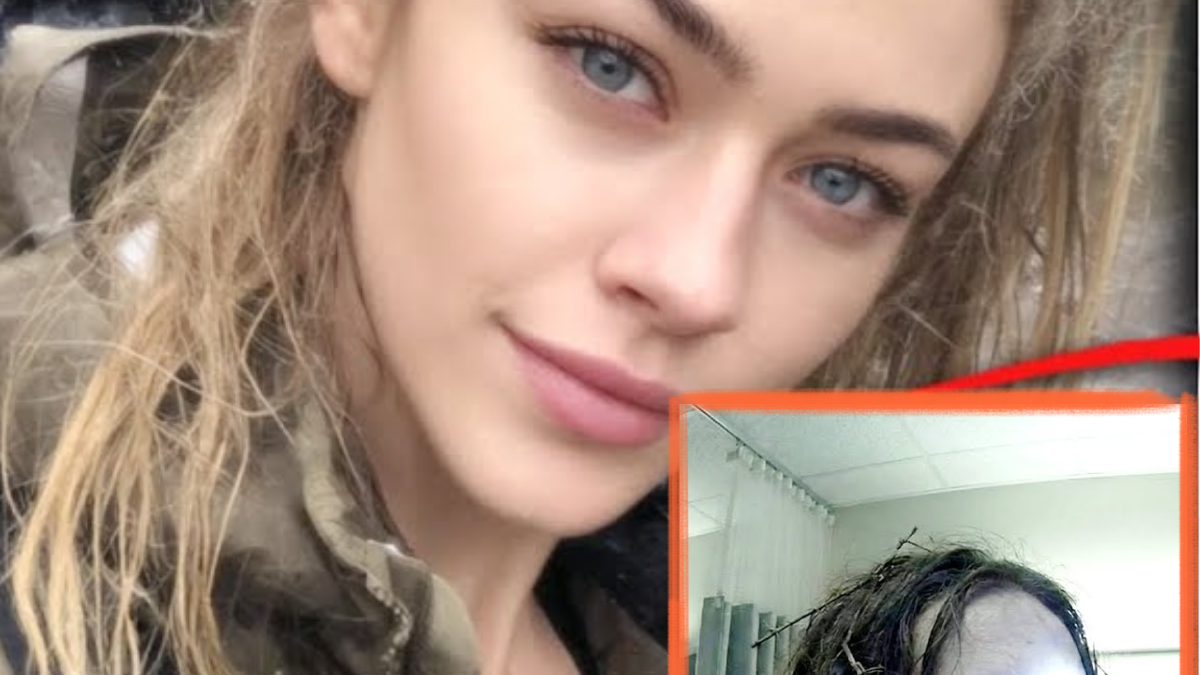
A Hiker Stepped Off a Bus Into the Ozarks and Vanished. Two Years Later, a Trucker’s Headlights Caught a Barefoot Figure in the Fog, and When Doctors Tried to Look Inside Her Mouth, They Stopped Cold 😨
Part 1
At 2:40 a.m. on October 12, 2018, a trucker named Ted Vance was hauling lumber through thick fog on a lonely stretch of Highway 21 in the Arkansas Ozarks.
Visibility was ten yards. The road had become a narrow white tunnel.
As he slowed for a blind curve, his headlights caught something pale and motionless on the shoulder.
A deer, he thought. He stood on the brakes, and the heavy truck shuddered to a halt on the wet asphalt.
It was not a deer.
It was a woman, standing barefoot on the icy road, arms hanging at her sides, as if waiting to be struck. 🕯️
She wore a crude wrap of burlap and tarp tied at the waist with rope. Her feet were black with dirt and covered in sores. Her skin was so pale it looked translucent, stretched over bone like parchment. A smell of damp earth, rot, and ammonia rolled off her.
Vance’s first instinct was to climb back into the cab and lock the door.
“Do you need help? Can you hear me?”
She did not answer. She did not nod or cry. Her eyes held no fear and no hope, only a dead emptiness.
She took one slow step toward him.
And the night was filled with a strange sound, a sharp whistling breath through her nose, like a broken accordion.
Two years earlier, in October 2016, twenty-four-year-old Mia Griffith had boarded a morning bus from Fayetteville.
She was a barista, tired of the city, in need of quiet. She had no car. Her plan was a hike to Whitaker Point, a famous cliff-edge overlook in the Ozarks. To get there, she asked the driver to let her off at a lonely turnoff on Highway 21, far from any official stop.
The driver remembered her clearly: olive jacket, black leggings, chunky boots, headphones on.
On the steps, she paused.
“Will you be passing back here this evening?”
He nodded. It was the last run of the day.
“I’ll be here,” she said, and stepped onto the wet gravel.
It was the last time anyone saw her.
When the bus returned that evening, the roadside was empty. The driver honked, waited a few minutes, and drove on, assuming she had found another ride.
The next morning, her coffee-shop manager called her parents. She had missed her shift.
Search teams, rangers, and volunteers combed the route. A dog picked up her scent at the highway and followed it up the gravel road for two miles. Then, at a sharp bend near a dry creek bed, the dog began circling and whining.
The scent did not go into the forest or the ravine. It simply ended in the middle of the road.
No blood. No struggle. No sign of anything.
Her phone’s last signal had pinged a tower at 9:15 that morning.
Then the file went to the archive, stamped unsolved. 🌙
Now, in the fog, Ted Vance draped his jacket over the woman’s shoulders. She let him, like a doll.
He sat her on the truck’s step and called 911. When the patrol car arrived, the officer found no ID on her. But a scar above her eyebrow, a mole on her neck, and a database match told the story.
It was Mia Griffith.
She was alive. And she had not said a word.
In the ambulance, a paramedic leaned close. “Mia, if you can hear me, try to say your name. Or just nod.”
She understood. Her eyes were clear and terrified. The veins in her neck bulged as she tried.
But her lips would not part. Her jaw tensed and strained, and her mouth stayed sealed, as if something were locking it from the inside.
Only that thin, whistling breath escaped her nose.
At the hospital, the anesthesiologist, Dr. Henry Foster, bent over her with a headlamp.
“Miss, I need to look at your throat. Please open your mouth as wide as you can.”
Mia’s whole body went rigid. The muscles in her neck stood out like ropes. The whistle sharpened.
Her jaw did not move a millimeter.
Fearing tetanus, Foster took a metal spatula and tried to ease her lips apart.
What the metal met made him stop dead and step back from the table.
Part 2
What the metal met made him stop dead and step back.
The preliminary report, later filed as evidence, described it in dry, clinical language. The soft tissues of her mouth had fused. The inner cheeks and gums had healed into a single mass of scar. The corners of her lips were drawn tight by thick keloid scars.
Mia could not open her mouth. She could not speak. She could not even scream.
Foster canceled the intubation and sent her straight to CT.
The images told the story better than any words. It was not disease. It was engineering.
Her mouth had been forced shut by some device for months, a homemade gag that squeezed the jaws together and pinned her tongue against her palate. Constant pressure and small wounds had set the body to healing, but with nothing allowed to move, the tissue knit itself into one solid wall.
Her tongue had partly grown to the roof of her mouth. Her cheeks had grown into her gums.
A small hole near a missing tooth on the left side showed how she had been kept alive. A thin tube had fed her liquid nutrition through the gap.
The room of doctors fell silent. Whoever did this had wanted a perfect mute doll. 🕯️
At 8:00 a.m., Detective Bill Gale of the county sheriff’s office walked into the hospital. He had led the search for Mia two years ago, and had been the one to tell her parents it was over.
The physician told him plainly: no interview was possible. She could hear. She could think. She could not utter a single sound.
Gale entered Room 407. Mia lay still, her arms thin and lifeless on the white sheet. He did not take out a recorder. He took out a tablet and set it to finger-painting mode.
“Mia,” he said softly. “We’ll take this slowly. I need you to try to show me where it happened.”
She raised a trembling finger and began to draw.
First, a sharp curved cliff. Whitaker Point, the place she had been heading. Then a road. Then a rectangle with two circles beneath it.
A car.
“They took you away in a car?”
She blinked slowly. Yes.
Gale spread a topographic map over the bed table. Mia studied it, and her finger traced a route across a bridge over the Buffalo River and stopped at a place where state forest met private farmland. A dead-end gravel road. Scattered buildings.
She tapped the spot.
Then, on the tablet, she drew a square and began shading it black, pressing so hard her knuckles whitened. Above it she drew a roof, the outline of a barn or garage.
She looked up at him. Then she touched her neck and her sealed mouth.
Gale felt a chill. She had been kept underground, beneath an outbuilding, where no one could hear.
He stepped into the corridor and dialed the sheriff.
“She’s pointing to a stretch off a road locals call Old Quarry Road. There’s a farm. I need a warrant for the whole property, and ground-penetrating radar. There’s a void under one of those structures.” 🌙
At 10:45 a.m., a convoy of patrol cars and an armored SWAT van rolled onto Old Quarry Road without sirens.
The farm belonged to Cain Thompson, forty-five, a laborer who lived like a hermit. He had a thin record, a few fines for disturbing the peace, and neighbors who said only that he was strange and disliked visitors.
The house looked abandoned. Tall dry grass. A rusted tractor sunk into the earth. Peeling paint. Inside, half-drunk coffee on the table, dirty dishes in the sink.
No Thompson.
But a service dog named Bruno ignored the house and dragged his handler to an old wooden shed in the backyard, locked from outside with a heavy chain.
Inside, the shed was crammed to the ceiling with junk. The dog scratched at the dirt floor under a massive workbench. When officers shifted bags of cement and old tires, they found the outline of a wooden hatch, disguised in dust.
It was heavier than it looked. Underneath, it was padded with industrial felt and rubber for soundproofing.
A smell rose from the hole, damp, human waste, mold, rot. Veteran forensic technicians reached for respirators.
It didn’t smell like a home, one later said. It smelled like a grave.
They climbed down a rickety ladder into a concrete hole so low an adult could only stoop. The walls were covered in old mattresses and thousands of cardboard egg trays, crude soundproofing against any scream.
In the corner lay a moldy sleeping bag and a plastic bucket.
And on the wall hung the thing that made the detectives go silent.
A row of homemade gags, neatly hung on nails. Hard rubber cut from tire tread and wrapped in black electrical tape. Leather straps with metal buckles. Wooden bars carved to the shape of a human jaw.
On a shelf nearby sat water bottles, a tub of cheap protein powder, silicone tubing, and large syringes.
Detective Gale understood the mechanics at last. No surgery. No sophistication. Just a sadist who strapped a gag onto a woman’s face and left it there for weeks, for months, feeding her through a tube.
Her body, trying to heal under constant pressure, had simply sealed her mouth shut.
But the man who had built this room was not here.
An old Ford pickup sat under a tarp behind the house. Its hood was cold.
He had left on foot.
Part 3
State police launched a perimeter operation code-named Ring. The county’s rocky slopes, ravines, and sinkholes made it a perfect place to vanish. A man with water and local knowledge could hide for weeks.
Bloodhounds were given a dirty shirt from Thompson’s house. At 2:15 p.m. the lead handler gave the signal. The dog took the trail from the backyard and pulled toward the Little Buffalo River along a narrow animal path.
The special forces team followed, expecting traps or an ambush.
But the forest was quiet. Too quiet.
At 4:40 p.m., a drone operator saw a faint heat signature in a deep canyon three miles from the farm, at the mouth of a limestone cave hidden behind blackberry brambles. The heat did not move, even with a helicopter thundering overhead.
That stillness worried the commander more than any gunfire.
“Cain Thompson, Arkansas State Police! You are surrounded. Come out with your hands up!”
Silence. Not a sound. Even the birds were quiet.
After a second warning, a stun grenade went in. Officers rushed the cave with tactical lights.
They found him at the very back, leaning against wet stone, filthy, his clothes torn by thorns. He had no firearm. He had nothing in his hands.
When the team burst in shouting, he did not raise them.
He clamped both hands over his ears so hard his knuckles went white. His face was frozen in an expression of almost physical pain. He squeezed his eyes shut and rocked back and forth, muttering.
He wasn’t hiding from the law. He was hiding from sound.
He was cuffed without a single shot fired. He only moaned when the metal clicked. Outside, in daylight, he squinted and pulled his head into his shoulders, as if the very existence of the outside world hurt. 🌙
The interrogation lasted over twelve hours. Detective Gale later wrote that it felt like talking to a concrete wall.
Thompson’s first request was to switch off the air conditioning. The low hum of the fan, he said, prevented him from thinking.
When Gale laid out photos of the bunker, the gags, the stained mattress, a calendar of forced feedings, Thompson did not even blink.
“Is this your property?”
“I don’t know what other people dug up there.”
“Someone built a soundproof bunker under your barn, ran power from your panel, and you didn’t notice for two years?”
“I don’t go in sheds. They’re full of junk. Maybe squatters.”
Shown Mia’s photographs, one smiling on a mountaintop, one from the intensive care unit, he grimaced and turned his head.
“I don’t know this woman. Take it away.”
But the evidence was louder than his silence. The state lab found his DNA on the inside of the duct tape wrapped around one of the gags. His fingerprints were on empty bottles from the bunker. And in his pickup’s glove box, mixed with old receipts, was a pharmacy slip from August 2017.
A bulk purchase of high-calorie enteral nutrition, the formula for people who cannot chew. The same brand as the empty bottles in the cellar. Sterile gauze. A large bottle of antiseptic.
When Gale read the list aloud, Thompson showed emotion for the first time in twelve hours.
“It’s for my dog. He had dental problems.”
“Veterinary records show your dog died and was cremated five years ago,” Gale said, laying a copy on the table. “But you had a woman in your basement. And you fed her through a tube.”
At the hospital, Mia was shown a tablet with six photos of men of similar age and build. She did not hesitate. She slammed her finger onto photo number three, Cain Thompson, with all the force her wasted muscles could muster, and made a raw, hateful sound in her throat. Her heart rate leapt to 140.
When told she had identified him, Thompson only looked at the table.
“She thought she saw me. People make mistakes when they’re scared.”
He never confessed. Not a word of remorse. Not a single explanation of why he chose her.
His trial opened in March 2019 in the county courthouse. At the family’s request, and given Mia’s fragile state, the judge closed the hearing to the public.
Throughout, Thompson sat with his head down and his palms pressed over his ears. Every time the prosecutor raised his voice, he flinched, as if the volume of human speech physically hurt him. He refused to testify.
The jury took less than four hours. Thompson’s DNA on the gag tape, the pharmacy receipt, surveillance footage from hardware stores where he had bought soundproofing, all of it added up.
Guilty on every count. Kidnapping. Torture. Grievous bodily harm.
The judge sentenced him to life without parole, plus one hundred years.
When the gavel fell, Thompson showed no anger and no fear. He only grimaced, as if from a sharp toothache.
For Mia, the harder fight had only started.
In May 2019, she went into surgery at a maxillofacial clinic in Little Rock. The chief surgeon called it reconstruction of ruins. For more than nine hours, a team dissected the thick scar tissue millimeter by millimeter, separating cheeks from gums and tongue from palate, with a scalpel passing dangerously close to facial nerves and major vessels.
Then came the months of rehabilitation. Relearning to open her mouth. To move her jaw. To chew soft food. And the hardest part, finding her voice. After two years of silence, her vocal cords had partly atrophied, and the muscles of her throat and diaphragm had forgotten how to work together.
In autumn 2019, six months after the surgery, she sat in a speech therapist’s office before a large mirror. Outside the window, an old park was blazing in crimson and gold, the same colors as the forest on the day she vanished three years before.
Thin, barely visible scars marked her cheeks. Her face had hardened. There was a steel in her eyes that had not been there before.
The therapist switched on a metronome.
“Take your time, Mia. Breathe from your diaphragm. Feel the vibration in your chest. Just one word. Your name.”
Mia closed her eyes and drew a deep breath. Her fingers gripped the armrests until her knuckles turned white.
She opened her mouth.
The lips that had been sealed by pain for so long moved freely. She exhaled, pushing air across ligaments that had not carried a sound in two years.
What came out was hoarse and cracked, like gravel on metal, like the creak of an old door.
But it was a human voice.
“Mi… a.”
The therapist smiled and nodded without stopping the metronome.
Mia opened her eyes and looked at herself in the mirror. A single tear slid down her cheek, along the line of a scar.
She drew another breath, straightened her back, and spoke again, more firmly, looking straight into her own eyes.
“I… am… Mia.”
The forest had taken two years of her life. Cain Thompson had tried to make her a silent thing.
But in that quiet room, with a metronome ticking, the silence that had seemed endless broke for good. 🌙💔
This story is entirely fictional and created for entertainment purposes only. It does not represent any organization or individual, nor does it encourage inappropriate behavior. The content was generated with AI assistance.








