A Housemaid Bid Her Last Coin Against the Richest Duke in England for a Horse Nobody Wanted. He Bought Her Entire Home Before Midnight, and What He Overheard in the Stable at 2 A.M. Changed Everything
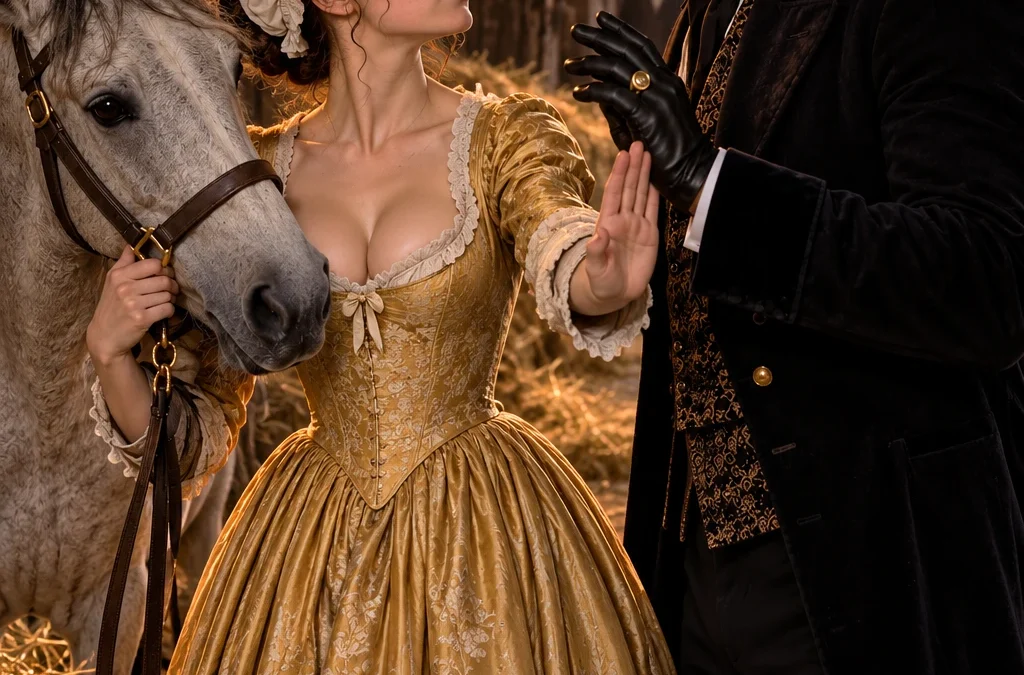
A Housemaid Bid Her Last Coin Against the Richest Duke in England for a Horse Nobody Wanted. He Bought Her Entire Home Before Midnight, and What He Overheard in the Stable at 2 A.M. Changed Everything 😱🐎
Part 1
She raised her hand a third time, and the whole of the Marchfield Paddock seemed to hold its breath. 🐎
Denzel, ninth Duke of Hartcliff, had come to the sale expecting to be bored.
He had come to nod once at the auctioneer, pay whatever a plain country crowd could not, and be back at Hartcliff Court before the light failed. He had not expected to be beaten by a girl in a gray wool dress who kept lifting her chin as though the sum she named were nothing at all.
“Nine guineas,” the auctioneer called, and his voice cracked on the last word.
Nine guineas was a shocking price for a leggy gray filly no one else in the county wanted.
“Nine guineas from the young woman by the rail. Do I hear ten?”
“Ten,” said Denzel. He heard himself say it before he had decided to.
Every head turned toward him, as heads always did. What he was not used to was the small, composed face at the rail turning last of all, unhurried, as though she had been expecting him and found him a moment late.
She was perhaps four and twenty, fair and clear-skinned, with a few dark curls escaping the plain cap tied under her chin. Her gown was worn at the cuffs. Her boots were honest and cracked. And she looked at the richest man in three counties as though he were a boy who had reached across the table for the last of the bread.
“Eleven,” she said.
A ripple went through the crowd of farmers and horse copers and idle gentry. Someone laughed, delighted, the way people laugh when a duke is being defied and they are safely out of range of his displeasure. Denzel’s steward, Mr. Crane, made the low sound of a careful man watching his master about to do something that would be talked of in the taverns for a fortnight. 😳
Denzel ignored him. He was looking at the filly.
To the untrained eye she was nothing. Gray where fashion wanted bay or chestnut, narrow through the chest where a buyer wanted breadth, one hind foot cocked as though the whole business bored her as much as it had bored Denzel an hour ago. Three men had passed her over already.
But Denzel had learned horses from a father who cared for nothing else, and he saw what the copers had missed. The slope of the shoulder that meant a long, low stride. The flat bone below the knee. The deep, clean angle of the hock. And the eye, large and dark and quietly furious, the eye of a creature that had decided the world was beneath her and had not yet been given a reason to change her mind.
She was bred to run. She was bred to run a great deal faster than anyone in this paddock suspected. And the only other person who appeared to know it was a housemaid at the rail with eleven guineas she could not possibly own.
“Twelve,” said Denzel.
“Thirteen,” said the girl.
“Fourteen.” “Fifteen.” The auctioneer’s head went back and forth like a spectator at a tennis match.
Mr. Crane leaned close. “Your Grace, the animal is not worth six.”
“I am aware of the horse’s worth, Crane. Sixteen,” said the girl, and now there was color high in her cheeks, and her hand, when she lifted it, was not quite steady.
Denzel noticed that. He noticed she had committed everything she possessed, and possibly a great deal she did not. That she was terrified. And that she had no intention whatever of stopping.
He should have crushed her. It was the simplest thing in the world. He had only to keep saying numbers until she ran out of them.
He opened his mouth to say “eighteen.”
The filly chose that moment to swing her gray head over the rail and lip, delicately, at the ribbon of the girl’s cap. It was not the behavior of a horse toward a stranger. It was the behavior of a horse toward the one hand in the world it trusted. The girl reached up without looking and steadied the animal’s nose against her cheek, and the filly sighed and stood quiet.
And Denzel understood, all at once, that whatever he had come to this sale to buy, this girl had been buying it since before it was foaled. 💔
“Seventeen guineas,” the auctioneer said into a silence gone taut as a fiddle string. “Your Grace, do I hear eighteen?”
Denzel looked at the filly’s dark, furious eye. He looked at the girl’s cracked boots and her steady chin and the terror she was managing so beautifully to hide.
He said nothing.
“Seventeen guineas, going once, going twice, sold to the young woman by the rail, and God bless her nerve, for I’ve not seen the like in thirty years of trade!”
The hammer came down. The crowd broke into a roar of laughter and applause, the gentry already composing the story they would tell at dinner: how a housemaid outbid the Duke of Hartcliff for a gray nag no one wanted, and how the great man had simply stood there and let her.
The girl did not laugh. She wrapped both arms around the filly’s neck and pressed her face to the gray coat for the space of one long breath. Denzel, too far away to hear, would have sworn on the family plate that she was thanking the animal rather than the crowd.
Then she straightened, wiped her palms on her skirt, turned, and looked directly at him.
He had expected triumph. What he got was a look of frank, wondering assessment, as though she had beaten him at a game he had not known they were playing, and could not for the life of her decide whether he had let her win.
He crossed the paddock. The crowd parted before him, Mr. Crane hurrying behind with the expression of a man watching a coach lose a wheel on a hill. The filly put back one ear at him and did not trouble to put back the other.
“Madam,” said Denzel.
“Your Grace.” She dropped a curtsy perfectly correct and somehow, in its very correctness, faintly impertinent, as if reminding them both that she knew exactly what was owed to a duke, and had decided to pay it, and not a farthing more.
“You have a good eye for a horse.”
“I have the best eye for a horse in this county, saving perhaps your own, which I will allow was a near thing.” She looked up without flinching. Her eyes were gray as the filly’s coat, and rather more furious. “You saw her, too. I watched you see her. That is why I could not stop.”
Something stirred in his chest that he had not felt in a very long time. It took him a moment to recognize it as amusement, and another to recognize, beneath it, something older and more dangerous.
“You have spent a great deal of money you can ill afford, in front of half the county, to defy a man who could make your life exceedingly difficult. May I ask why?”
“You may ask,” she agreed. “But you saw her, too, so I think you already know.”
And she turned her back on the Duke of Hartcliff in front of the whole staring crowd, which no one had done in living memory, took the filly’s head collar, and led the gray away toward the tumbledown stables with the unhurried gait of a woman going home. 😲
Denzel watched her go.
“Well,” said Mr. Crane, determined to salvage something. “Cheaply got out of, Your Grace. The girl will regret her seventeen guineas by Michaelmas.”
“Crane. Who is she?”
“A servant, by her dress. Of this household, most likely.” He gestured at the sagging roofline, the peeling shutters, the weedy carriage sweep of a place being sold up brick by brick because its master had died in debt. “Shall I bring the carriage round? You have a dinner at Fairhaven.”
Denzel did not answer. He was thinking of Lady Fairhaven’s three unmarried daughters arranged along a table like a service of matched china, and the long, familiar, deadening evening of being wanted for his title and endured for himself. The prospect had become, in the last quarter of an hour, entirely insupportable.
“Marchfield,” he said. “It is all for sale?”
“The whole estate, yes. Encumbered, mind. The roof wants a fortune.”
“And the horses.”
“Such as they are, Your Grace. Nothing worth…”
Mr. Crane stopped. He had been steward to the Duke for eleven years, and he knew the particular quality of his master’s silence, the way a sailor knows the air before a squall.
“Your Grace, you cannot be considering…”
“I am not considering anything, Crane. I have considered.” There was, in the set of that hard mouth, the ghost of the beginning of a smile. “Find the man handling the sale. I will buy Marchfield entire. The house, the land, the debts, the stables, and every horse and every hand that comes with them, down to the last plow animal and the last scullery maid. Tonight, if it can be done. Before I change my mind.”
“Forgive me. You wish to purchase an entire ruined estate at ruinous cost, in order to acquire a stable of horses you have declared worthless. Why?”
“Because a housemaid outbid me for a gray filly, turned her back on me, and would not tell me her name.”
“That is the whole of it?”
“Very nearly. You have a gift for summary, Crane.”
And behind the sagging stables, a girl who did not yet know she had just been bought along with the plow stock murmured something soft and private to a gray filly. And the filly, for the first time all day, put both ears forward. 🥹
The deal was struck before midnight in the study of a melancholy solicitor who had been trying to sell Marchfield for eleven months without a single serious offer. His hand shook with joy. When it was done, the Duke drew on his gloves and asked the one question he had come to ask.
“The staff. There is a housemaid. Gray eyes. She was at the sale today bidding for a horse.”
“That would be Devona Ashby, Your Grace. The daughter of the old horse master. There is a note here. The old squire left instructions that she be kept on in any sale.”
“John Ashby,” said Denzel. “A famous hand with a horse.”
“You knew of him? He died three winters back. A fever. The girl stayed on as a maid, there being nothing else for a horse master’s daughter to do once the stable was gone.”
Riding home through the dark, Denzel turned the name over like a coin. Devona Ashby. A girl raised in a great stable, who had watched it sold out from under her piece by piece. Who scrubbed the floors of the house where she had once ridden the yearlings. Who had spent the last of everything she owned to buy back the one creature her dead father had bred with his own hands, and had done it by beating a duke in front of the county.
He should have felt a great deal more foolish than he did. Instead, examining his own mind with the cool honesty he prized, he found he did not regret a farthing.
He had been bored for a very long time. Bored through the dinners at which he was the great prize. Bored through the endless silent rooms of Hartcliff Court, where his father’s clocks ticked and nothing happened that he had not arranged himself. He had believed that a man who could have anything must necessarily want nothing.
And then a girl in a gray dress had said eleven, and he had felt his own heartbeat.
That was worth Marchfield. That was worth a good deal more.
The next morning, he arrived at an hour indecent in a guest and merely thorough in a new proprietor. The staff stood assembled in the great flagged hall: a butler grown gray in the service of a house that could no longer pay him, a weeping housekeeper, a cook, two footmen, a boot boy, a scullery maid.
And at the end of the line, in the same gray wool dress, with her chin at the same unrepentant angle, stood Devona Ashby.
He watched her see him. He watched the exact moment the arithmetic completed itself behind her gray eyes: that the man who now held her livelihood, her lodging, and her bread in the palm of his gloved hand was the man she had beaten at the rail and told, in front of the county, that he already knew why.
To her very great credit, she did not blanch. A muscle moved once in her jaw. Then she dropped the same correct, faintly impertinent curtsy.
And Denzel understood that whatever this was going to be, it was not going to be dull. 🔥
Part 2
He greeted each of the staff in turn, longer than a great man usually keeps servants he means only to inspect. He told Mrs. Pember, who had begun to weep at the kindness of being spoken to, that no one would be turned off, that wages long unpaid would be made good by week’s end, and that Marchfield would be put back on its feet, roof and land and all.
He was aware throughout of one pair of gray eyes at the end of the line. He found he wished to be seen doing the thing well.
“Ashby. You are kept on. I understand you have been long at Marchfield.”
“Since I was nine years old, Your Grace. I know every draught in the house and every loose board in the stable. If you mean to put the place to rights, you will find no one who knows better what is wrong with it.”
It was not humility, and it was not defiance. It was the level self-respect of a person who has been given very little and has decided that her worth is not among the things she is willing to lose.
“And the filly?”
“She is very well. She is, I believe, the only creature in the county entirely unaffected by yesterday’s excitement.”
“Seventeen guineas. A great deal of money.”
“It was all the money I had.” She lifted her chin. “I do not regret a farthing of it.”
And Denzel, who had said very nearly those exact words to his steward the night before over a purchase a thousandfold larger, felt the strangest sensation of standing before a mirror. 😏
“I shall want to see the stables this morning. Ashby knows them best.”
The stables had been built for a great deal more than they now held. Three-quarters of the loose boxes stood empty, swept scrupulously clean, bedded down dry against no horse at all, out of habit or hope. On a bracket by the door hung a bridle, soaped and supple, the only piece of leather in the place that gleamed. And on the whitewashed wall behind the row of pegs, in a careful, faded hand, someone had painted the names of horses long since sold or dead: Peregrine. Andromeda. Selkie. Bright Morning.
A whole vanished stable, kept alive in white paint by a girl who would not let them be forgotten. 🕯️
In the last box, the gray filly put her head over the door and regarded them with her cool, disdainful eye. Devona stepped past him without being asked and let herself in, and the whole animal changed. The filly pressed her forehead flat against the girl’s chest, blew out a long breath, and stood as soft and still as a horse in a painting.
“Your father bred her,” said Denzel quietly.
Devona’s hand went still on the gray coat. “Who told you that?”
“The solicitor. This is the last horse your father made.”
For a long moment she said nothing. When she spoke, her voice was steady in the particular way of a voice that has decided to be.
“He bred her the winter he died. He was already ill. He knew it, I think, though he never said. He would go out to the mare in the small hours with a lantern when he could barely stand. And in the spring the filly came, gray as a ghost, on the coldest night of the year. He lived long enough to see her stand.” She smoothed the forelock between the wide-set eyes. “He said she would be the best horse he ever made. He said it the way he said everything about horses, quietly, as though it were simply a fact, like the weather.”
She turned, and her gray eyes were bright, but her chin was level.
“I have spent three years terrified that the day would come when they sold her, too. So when it came, Your Grace, I bid every coin I had saved in seven years of service. And I bid it against a duke, because the duke had seen what my father saw. And I would sooner have died at that rail than let her go to a man who wanted her for a curiosity.” She lifted her chin the last fraction. “That is why. You asked me yesterday. I told you that you already knew.”
A pigeon shifted in the rafters. Down the row, the old hunter sighed.
“You are mistaken on one particular,” said Denzel. “I did not want her for a curiosity.” And because he had discovered in a single day that he could not do otherwise with this particular woman, he told her the truth. “I have bought the best that money could buy and been given by all of it exactly the pleasure a man is given by a fine clock. Cool, and passing. And I stood at that rail and saw a filly three fools had passed over and I felt, for the first time in longer than I can tell you, that I wanted something. Not that I ought to have it. That I wanted it.” He met her eyes. “You were not the only one at that rail who could not stop, Ashby. You were merely the only one honest enough to say so.”
He had not meant to say so much. His silences were famous; his confidences unknown. He saw the surprise register in her face, saw her genuinely at a loss for the next move for the first time since the paddock, and he enjoyed it enormously. 💛
“Well,” said Devona, and the corner of her mouth was fighting itself. “That is a very handsome speech from a man who has just spent a fortune buying the whole stable out from under the horse he lost. The fishmonger says you bought Marchfield entire in a fit of pique because a maidservant beat you at the sale and would not tell you her name.”
“The fishmonger is very well informed.”
“The fishmonger is a great gossip and half wrong about everything, which leaves him half right, and I am trying to work out which half.” She folded her arms. “Am I to understand you mean to make me an offer for her?”
“Would you accept one?”
“No.”
“Then I shall not make one. I dislike being refused. It is the single luxury I have consistently been able to afford.”
She laughed.
It was not a laugh she had meant to give him. It escaped her, quick and surprised and entirely genuine, with her whole face in it, and it changed the plain, grave face into something he had to look away from and then, deliberately, made himself look back at. It was, he thought, quite the most dangerous thing he had seen in a very long life of being careful. And he had walked straight into it with his eyes open.
“I will make you a different offer. She is yours. She was fairly bought, and I will not offer you a farthing for her while I live. But she is the best horse your father ever made. Very well, prove it. Not to me. To the county that passed her over. Bring her on. Train her. I will find the money and the meeting and the men, and you will find the horse. And when she runs and wins, the whole county that laughed will eat every word of it, and your father’s last horse will carry his name back into every mouth that has forgotten it.”
“And what do you get out of it, Your Grace? For a man who does nothing without a reason?”
He thought of the silent rooms and the ticking clocks. He thought of the moment at the rail when a girl in a gray dress had said eleven and his own dead heart had beaten.
“I get,” he said, “to not be bored.”
He inclined his head to her exactly as though she were a great lady and not the housemaid he had bought with the plow stock, and walked out into the raw gold morning, and did not look back. He had felt the game turn. He had felt her decide to play. 🔥
He told himself he came to Marchfield to see to the roof. It was not, strictly speaking, a lie. But he found himself riding the six miles from Hartcliff Court far more often than any roof in England could account for, always in the mornings, always arriving just as the light came gray and gold over the paddock, the hour when Devona brought out the filly to work.
She did not use a whip. She conversed with the filly. She asked, and waited, and asked again, and when the animal gave her what she wanted, she stopped and let it understand it had done well.
“You do not use a whip,” he said one morning over the rail.
“I have a whip. My father’s. It hangs in the tack room. I have never once had cause to take it down.” She halted the filly with a word. “A whip tells a horse you have run out of things to say. She and I have a great deal still to say to one another. Good morning, Your Grace. You are earlier than the roofers again.”
“The roof is proceeding admirably without my supervision, which is more than can be said for most things I own.”
“Is that a complaint, or a confession?”
“An observation.”
And Denzel, leaning on the rail in the cold gold light, found that he was smiling, which his household had not seen since the old Duke died. 😊
Then came the night he had no business being there at all.
He had dined alone at his father’s long table, and found the silence suddenly unendurable. He called for his horse at an hour when no duke calls for a horse and rode six miles through the dark, telling himself he meant to look at the filly. A lantern burned in her box. He came to the half door soft-footed and did not announce himself.
Devona sat on an upturned pail in the straw, in a shawl over her nightgown, with the filly’s great gray head resting in her lap. She was talking low and unguarded, in a voice with all the armor taken off.
“He would have liked you above all of them, you know. Because you are difficult and clever and will not do a single thing you have not decided for yourself. He said an easy horse was a horse that had given up.” She smiled down at the filly. “He would laugh himself sick to see us now. His gray filly that no one wanted, bought off a duke for seventeen guineas. I wish he could see what you are going to be. He always knew it first.”
Her voice caught and steadied.
Denzel stood in the dark and did not breathe, and understood, with a clarity that had never once in all his careful life been turned on his own heart, that he had not ridden six miles through the dark to see a horse. 💔
He was in love with her.
Part 3
He drew back from the door before she could see him, led his horse out of the yard by hand so the hoofbeats would not carry, and rode home slowly under the cold autumn stars with something lodged behind his breastbone that he had spent a lifetime making sure he would never have to feel.
He examined it the next morning over his solitary breakfast, with the same cool honesty he brought to a horse’s conformation. It did not improve on examination. It did not go away.
He was the Duke of Hartcliff. She was a housemaid he had bought along with the plow stock. His aunt would have an apoplexy. The county, which had made him the talk of six taverns, would make him the talk of six hundred. And he sat at his table with his father’s clocks ticking and understood that he did not care for any of it a single farthing.
But he did not tell her. A great man’s fancy for a servant was the oldest and cruelest story in the county, and every version of it ended with the servant ruined and the great man consoled. Devona had been given too little in her life to be asked to gamble the last of it on the honor of a duke who had bought her with the stable.
So he would wait. He would let the filly grow and the trust grow, and let her arrive at it in her own time, which was the only way she ever arrived at anything. 💛
The county, meanwhile, decided it understood everything perfectly and was scandalized. There was a scheming servant who had trapped the Duke at a horse sale. She was installed at Marchfield in silks bought with Hartcliff money. The Duke had been heard to laugh, which no one who valued the natural order could regard as anything but the gravest symptom.
“They have her in silks,” Denzel said, when Mr. Crane had finished. “She was mucking out the sick box this morning in a dress with a mended elbow, and told me that a duke’s stable might keep its opinions to itself and buy oats instead. I bought the oats. I did not buy the dress. She would have thrown it on the muck heap and me after it.”
Lady Surett’s reply came within three days, written entirely in capital letters. She arrived on a Tuesday, in a coach drawn by four blacks, with two maids, a companion, and the settled conviction that she had come to save her nephew from ruin. She was a small, upright, formidable woman near seventy who had been trying to marry Denzel off for five years and had moved nothing whatever.
“You have bought a bog,” she said. “A bog with a house falling into it, four hundred acres of thistles, and you did it because a serving girl outbid you for a gray horse. I have come to see the girl.”
“You have come to disapprove of the girl.”
“I have come because it is not over a horse. A man does not buy a bog over a horse, Denzel. You Hartcliff men go through life cold as a cellar, then take one look at entirely the wrong woman and burn the house down. Your grandfather did it. Your father very nearly did.”
He had not warned Devona. Some cold, curious, unworthy part of him wanted to see what would happen when the immovable object of his aunt met the irresistible force of Devona Ashby.
He brought Lady Surett to the paddock at the working hour. Devona halted the filly, looped the rein, and dropped the marchioness a flawless curtsy.
“You will be the Duke’s aunt. He has your chin. I hope your journey was not too cruel. I have put a mash on for your coachman’s off-side leader, which is going short on the near fore and will be dead lame by the county line if it is not seen to, whatever your man tells you.”
Silence. Lady Surett lowered her glass. “The off-side leader went short coming up the last hill. My coachman said it was the cold.”
“Your coachman is a good whip and a poor judge of a leg, which is a very common combination. It is a bruised sole from the flint roads. It wants a poultice and three days’ rest. The Duke will forgive me the mash. He forgives me a great deal. It is the chief entertainment of his day.”
Denzel, who had braced for battle, watched his aunt’s face do something it had not done in thirty years. It was briefly, and against its will, impressed. 😮
“You are the horse master’s daughter. Before your time, John Ashby brought a mare to Ashton, the year I came out. Bright Morning. I had five guineas on her against my mother’s express command. She ran fourth, and I have never forgiven her, and never forgotten the horse. She was plainly the best animal in the race, beaten only by the riding.”
“And this is?”
“His last,” said Devona quietly. “I have entered her for the Ashton Plate in the spring, in the Duke’s colors. I mean to win the race my father lost. And I will thank you, my lady, not to laugh, because everyone else in the county has done it already.”
Lady Surett did not laugh. She stood a long time at the rail, an old woman in furs looking at a gray filly in the mist.
“I dislike you,” she announced at last, with enormous dignity. “I feared you would turn out charming and stupid, like the last three my nephew would not have. You are neither. You are impertinent and clever and have a great deal too much opinion for a servant, and you have diagnosed my horse and put me in my place before breakfast. I dislike you extremely.”
She turned to Denzel, and her small shrewd eyes were terrible with understanding. “You have burned the house down. I am too old to put it out. But I will say this once. The county forgives a man anything he does with his money. You will lose a little standing and gain a wife. She will lose her whole world. Every soul of her station will call her a schemer, every soul of yours a servant, and she will stand alone between the two and be brave about it. Do not do it lightly.”
She walked back toward her carriage. Devona let out a slow breath. “Your aunt thinks you mean to marry me. She is wrong, of course. You are a duke and I am a housemaid, and we both know how that story ends. I would take it kindly if you would tell her so, so I do not spend the winter watching the whole county wait for me to be ruined.” Her chin was high. Her hands on the rail were not quite steady.
“I will tell my aunt nothing whatever,” said Denzel slowly. “My aunt is never wrong, and it is bad for her character to be told otherwise.”
And he walked away through the mist before she could armor herself against it, leaving the sentence hanging in the cold air, unretracted and entirely impossible to mistake. 💓
The confrontation came at the Fairhaven Hunt Breakfast, in front of forty people.
The winter had done its work. The filly had grown and hardened, and on the frosted Marchfield straight she lengthened and lowered and poured herself along the ground in a stride that left the old hunter twenty lengths adrift and blowing. Denzel felt the hair rise on his arms. They had something at Marchfield that had not been seen in a generation.
But secrets do not keep in a county. The gentry, unable to imagine that a great man might simply have found something he cared about, settled on the explanation that flattered them: that the servant had her hooks in him. And Lady Fairhaven, who had three unmarried daughters and a five-year grievance against Denzel, contrived that Devona should be invited, so the gentlemen might question her about the horse. Denzel did not see the trap until it closed.
Devona came in her one good dress, plain and dark and honest. She answered the sporting men with plain expert brevity, and one by one they leaned in, arguing distances and blood with her as they would with any trainer they respected. Denzel began to hope the morning might be got through.
Then Lady Fairhaven, seeing her entertainment slipping away, struck.
“How charming to hear a maidservant hold forth on bloodstock as though she were bred to it. Tell me, child, when you are not playing a trainer for His Grace’s amusement, what are your actual duties at Marchfield? Do you black the grates, or is it the slops?” She smiled around the table. “One hears the most extraordinary stories. One does like to know precisely what one is looking at.” 😡
Forty people went still, all having decided at once to enjoy something and pretending they had not.
Devona set down her cup with a small, precise click and fixed Lady Fairhaven with the level gaze that had beaten a duke at a rail. She was going to answer, and answer well. She needed no man to fight for her, and he found he did not care in the least whether she needed it.
He was on his feet before he had decided to stand.
“You are looking, Lady Fairhaven,” said the Duke of Hartcliff, in a voice that reached the farthest corner without being raised, “at the best judge of a horse in this county, saving possibly myself, and I am no longer certain of the exception. You are looking at John Ashby’s daughter, who has forgotten more about bloodstock than this table will learn if it lives to be a hundred. You are looking at the woman who will bring the winner of the Ashton Plate to the post in April. And I invite every soul here to remember, on that afternoon, precisely how you spoke to her this morning.”
Someone dropped a fork.
“You say the lines have grown blurred. I will unblur them. On one side stands a woman who spent the last seventeen guineas she possessed to save her dead father’s last horse, and who has worked from dark to dark all winter in a dress with a mended elbow to make something worth the making. On the other sits a table of people who have never wanted anything they were not born holding, amusing themselves before noon by wounding a servant because she has the effrontery to be better at something than they are.” He set down his cup. “I know which side I would rather stand on. I have known it since a gray morning at a country sale.”
He turned and offered her his arm, in front of forty people. No duke in England had ever offered a housemaid his arm at a gentleman’s table.
“Ashby. We are expected at the gallops.”
Devona looked at the arm. She looked at his face. And he watched her understand the finality of what he had done: the bridge burned, the choice made public and irrevocable.
She rose. She did not take his arm. She dropped Lady Fairhaven the flawless, faintly impertinent curtsy.
“I thank you for the breakfast, my lady. It has been most instructive. I have learned that a fine table is no guarantee of fine manners, which my father told me when I was nine. And since you were so anxious to know what you were looking at: you were looking at a woman who would not change places with a single soul in this room.”
Only then, having answered for herself, did she lay her hand light as a leaf upon his arm and let him walk her out past the silence and the dropped fork into the cold bright morning. 👏
In the frozen lane, her voice shook. “You have ruined yourself for me in front of the whole county, and I did not ask you to. Why? You are the Duke of Hartcliff. You had everything.”
And Denzel found that all the patience of the winter had burned away along with his good name.
“Because I would rather stand at your side and be ruined than sit at that table and be safe. It was never about the horse, Devona. I bought the whole of Marchfield to find out your name. You knew it in the paddock before I did. I am only saying it aloud because I have run entirely out of the coldness I used to keep it behind.”
And Devona Ashby, who had a ready answer for everything, found she had nothing whatever to say. 😭
She gave him her answer three days later, in the stable, at the hour that had always been theirs. He had done the hardest thing he had ever done, which was nothing at all. Lady Surett had written him a single line: I told you not to do it lightly. You did not. I withdraw my objection and double my wager. Come to dinner.
He found her on the upturned pail with the gray head in her lap, and knew she had been waiting since two.
“I have been thinking for three days, and I am very tired, so I will say it plainly, and you will let me finish, because if you interrupt, I shall lose my nerve.” Her fingers moved in the gray mane. “It was that I have loved you since somewhere in the middle of the winter, and did not let myself know it, because a housemaid who loves a duke is not a fool. She is a tragedy. And I had made a study of being neither.”
He stood very still.
“I know how this story goes. It ends with the servant turned off in the spring with a purse and a broken character. And I swore at fifteen that whatever I lost, I would keep my own good opinion of myself, because it was the only thing I owned outright. Then you offered me your arm in front of forty people, and I understood you had done to yourself on purpose the very thing I had spent my life terrified would be done to me. You put your good name on the muck heap where mine had always been, so that we should stand for once on the same ground.” She looked up, eyes wet and steady both at once. “No man has ever done anything like that for me.”
“Devona…”
“I have not finished, and this is the part that matters. I will not marry you now.”
He began to school his face back into coldness, his oldest refuge. She undid him entirely.
“If I marry you now, with the county watching, and my father’s horse not yet run, I will have proved them right. I would spend my life a duchess who knows in her heart she took a great man’s fancy and made a marriage of it. I could not bear it. And neither, I think, could you. So we will win the race first. We will bring my father’s horse to Ashton and win the plate in front of the whole county that laughed, on our own merit and no man’s fancy. And then, if you ask me again, Denzel, I will say yes, and say it in front of all of them.” She stroked the gray head. “It is a slower answer than the one you wanted. But it is the only one I can give and keep the thing my father left me, which was not this horse. It was the woman he made me.”
“You are,” said Denzel, “the most maddening woman in England.”
“I know. Now, are you going to sulk all spring, Your Grace, or are you going to help me win this race, so I can marry you and put an end to the fishmonger, who I understand now has us eloping to Gretna in a hot air balloon?”
Denzel laughed aloud, the way he had not laughed since his father died, so that the filly startled up her head. He crossed the box, crouched in the straw, and took her two work-roughened hands in his, and pressed his mouth to the knuckles, slowly, gravely, the way a man kisses the hands of a queen. 💋
There was nothing left that needed saying until April.
The spring came on cold and bright, and the filly came to her flower. She was rangy and deep-chested and iron-hard, with a stride you could have driven a coach through and an eye that had lost none of its fury, only learned where to spend it. They walked her the last miles to Ashton by hand. The county watched them go, the mad duke and the housemaid and the gray ghost off to be humbled in front of England, and laid its bets against them until she stood at forty to one, the longest price on the card.
Lady Surett put two hundred guineas on her through three separate agents, so as not to shorten the price, and wrote: I remember Bright Morning. I do not intend to be wrong twice. Bring her home in front, and bring the girl home a duchess, and I will forgive you the bog. She signed it, for the first time in his memory, with love. 💌
On the eve of the race, Denzel could not sleep. He walked out to the racecourse stables in the dark and found, as he had known he would, Devona on an upturned pail with the gray head in her lap. This time she knew he was there, and did not stop.
“Tomorrow you run the race he lost. Whether you win it or break my heart at the distance the way Bright Morning broke his, you will run it in front of all of them. So run your race, my gray girl. Not theirs. Yours. The way he taught us both.”
The morning broke clear and cold, with a hard, fast ground. Devona would ride. The stewards had objected, but Lady Surett’s lawyers had discovered overnight that no rule forbade it.
“There is no rule against it,” Devona told the outraged committee, “because no one ever imagined a woman would want to badly enough. I have wanted to badly enough since I was nine years old. You will find, gentlemen, that wanting a thing badly enough is a great solvent of rules.”
She was pale. But her hands were steady, the way they were only ever steady when there was a horse to be ridden. When the call came to mount, she turned to him with no wit in her face and no armor.
“Whatever happens, I do not regret any of it. The seventeen guineas, or the winter, or the lane, or you. You gave me back my father’s horse and my father’s race, and something I had stopped believing I was allowed to want, which was to be chosen for what I am. Whatever the ground does to us, you have already given me the thing.”
He threw her up into the saddle himself, his two hands closing for one moment around her boot. “Run your race,” he said.
“Ours,” she said.
And the gray filly, feeling the whole winter’s purpose settle into this one cold moment, put both ears forward and walked out onto the course like a queen going to war. 👑
Denzel could not afterward have given an honest account of those four minutes. He remembered the break, the gray shade slow away, settling toward the rear as Devona had planned, for the filly’s whole genius was her finish. He remembered his heart stopping, because no plan in the world does not look like disaster from the rail. He remembered the long swing down the far side, the gray lying fifth, sixth, running easy within herself, Devona low along the streaming mane, waiting with the iron patience of a woman who has one card to play.
He remembered the turn for home, the roar rising for the favorite, and a voice at the rail saying, half in pity, “The country filly’s beat. Poor thing.”
And then he remembered what he would remember on his deathbed.
He saw Devona sit down to ride. He saw her ask the gray filly at last the question they had been saving all winter. And he saw the filly answer. The terrible stride he had first glimpsed on a frozen morning opened under the wide pale sky. The narrow head went down. The ground poured away beneath her, and she came from fifth as though the others were standing still. One length, then three, then six, sweeping up the outside with her ears flat and her nostrils red, and the cheer for the favorite faltered and broke into a great, rising, astonished roar. 🔥
She caught the chestnuts at the distance. She caught the favorite fifty yards from home and swept past him with the contempt her father had bred into her. She passed the post three lengths clear.
The roar that went up off the downs was like the sea. And the cold, silent Duke of Hartcliff stood on the rail shouting himself hoarse with the farmers and the copers and the whole staring county, with tears on his face, and did not care who saw. John Ashby’s lost horse had just won the race John Ashby lost. 😭
Devona pulled up in the middle of the roaring course and did not raise a whip or a fist. She leaned forward and put both arms around the gray neck and pressed her face into the streaming coat, exactly as she had done at the rail on the day it all began, thanking the horse and not the crowd.
And Denzel understood she was not only thanking the horse. She was telling her father, through the one living thing he had left her, that it was done.
They came to her then, the whole county that had laughed, the sporting men, the stewards with their objections forgotten, even Lady Fairhaven, pale and stiff and unable to stay away. When Denzel fought his way through to the gray filly’s head, he found Devona on her feet in the midst of it, flushed and shaking and radiant, being congratulated by the very men who had wanted her blacking their grates a season before.
She saw him come. The crowd made a space for the Duke. And in that small clear circle, with the gray filly blowing and proud, Denzel found that he had run out of patience and caution and every reason he had ever given himself for waiting.
“Devona Ashby,” said the Duke of Hartcliff, not lowering his voice, not caring that half of England was listening. “In the frozen lane, I asked you to marry me, and you set me terms. We should win this race first, so that no soul on earth, including yourself, could say you were raised up out of a great man’s fancy. You have won it. By three lengths. Riding the horse you saved with the last coin you owned. The terms are met. The debt is paid. Your father’s race is won.” His breath was not quite steady, and he let it not be. “So I am asking again, here, in front of all of them, exactly as you demanded. Will you marry me? Not the housemaid, not the trainer. You.”
Even the horses seemed to go silent. Somewhere near, Lady Surett wept, upright and terrible. Mr. Crane blew his nose with great violence into an enormous handkerchief.
Devona’s chin was up. Her eyes were wet and bright and entirely level.
“You understand that I shall be a very great deal of trouble. That I have opinions, and a temper I keep on a short rein, and a settled habit of answering back that no duchess in England has ever been permitted. That I shall keep this gray filly in the best box at Hartcliff until she dies of old age, and go on riding before dawn whatever the county says, because it is the thing my father made me for, and I will not give it up. Not for you. Not for a coronet. Not for anything.” Her voice caught on the last word and steadied the way it always steadied. “You understand all that and you are asking me anyway?”
“I am asking because of all of it, and not in spite of a syllable. If you imagine I want a duchess who rises at noon and holds no opinions, you have understood nothing about me in an entire winter.”
And Devona Ashby laughed, the real laugh, the one that took her whole face. She let the filly’s reins fall into the hands of the boy behind her, stepped across the last of the clear space, and took the Duke of Hartcliff’s two hands in her own, in front of the entire county.
“Yes.”
Just that. Not the housemaid’s yes, not the trainer’s. Her own, given freely, on her own terms, in her own time. 💍
The roar that went up off the downs was greater than the roar for the race.
They were married in the summer, in the little gray church that served both Hartcliff and Marchfield, and the whole county came. Lady Fairhaven discovered a sudden enthusiasm for the match the moment it became impossible to prevent. Lady Surett wept again and told everyone she had known from the first morning how it would end, and had in fact brought it about, which was not true, and which no one dared contradict. Mr. Crane wept without any pretense of dignity and told anyone who would listen that he had always said the girl was worth ten of the county, an assertion so opposite to everything he had said for a year that no one had the heart to correct him.
Devona came up the aisle in a gown of gray silk. She had insisted, against all of Modesty’s horror: gray like the filly, gray like the dress she wore to beat him at the rail. She would not come to her own wedding pretending to be something she had not been. 🩶
Denzel restored Marchfield and gave it to her outright, deeded in her own name, so that the horse master’s daughter who had scrubbed its floors should own the house she was raised in. The county thought it eccentric. Devona thought it no more than justice. Denzel thought it the soundest investment he ever made. They bred horses there in the long good years, and added new names to the white wall as their own horses came and made their names and passed into memory. The great gray filly won the Ashton Plate a second time the following spring, just to settle the matter, then retired to the best box in the county and lived to a magnificent and disdainful old age.
And one first spring after they were married, Denzel painted a new name on the whitewashed wall, beneath the row of the vanished dead, and would not tell her what he meant to write until it was done.
She came into the stable at gray dawn and found it there, the fresh white letters gleaming. She stood before it a long time and said nothing at all, which in Devona Ashby was the rarest and most eloquent thing.
John Ashby, who was right about the gray filly and about everything.
She took his hand, her work-roughened hand in his, and stood beside him looking at her father’s name among the horses he had made, in the stable her husband had given her, in the life neither of them had ever let themselves believe they would be allowed to want.
“You know,” she said at last, and he heard the wit rising in her voice and the warmth beneath it, “the fishmonger always said you bought the whole stable just to meet me.”
“The fishmonger was a great gossip, and half wrong about everything.”
“Which half was he wrong about?”
Denzel considered it, in the gray light, with her hand in his and the great gray filly’s head coming over the box door to lip at the ribbon that was no longer there, because Devona was a duchess now and wore no cap.
“None of it,” he admitted. “Not a word. I bought the whole stable to meet you. I have never regretted a farthing of it, and I never will.”
And Devona Ashby, Duchess of Hartcliff, John Ashby’s daughter, the housemaid who had outbid a duke for a gray filly and been chosen for exactly what she was, leaned her head against her husband’s shoulder in the gray dawn light and watched her father’s last horse put both ears forward, and was content. 🐎💛
This story is entirely fictional and created for entertainment purposes only. It does not represent any organization or individual, nor does it encourage inappropriate behavior. The content was generated with AI assistance.








