A Midwife Pulled a Poisoned Earl Out of a Saffron Court Alley at Half Past One in the Morning
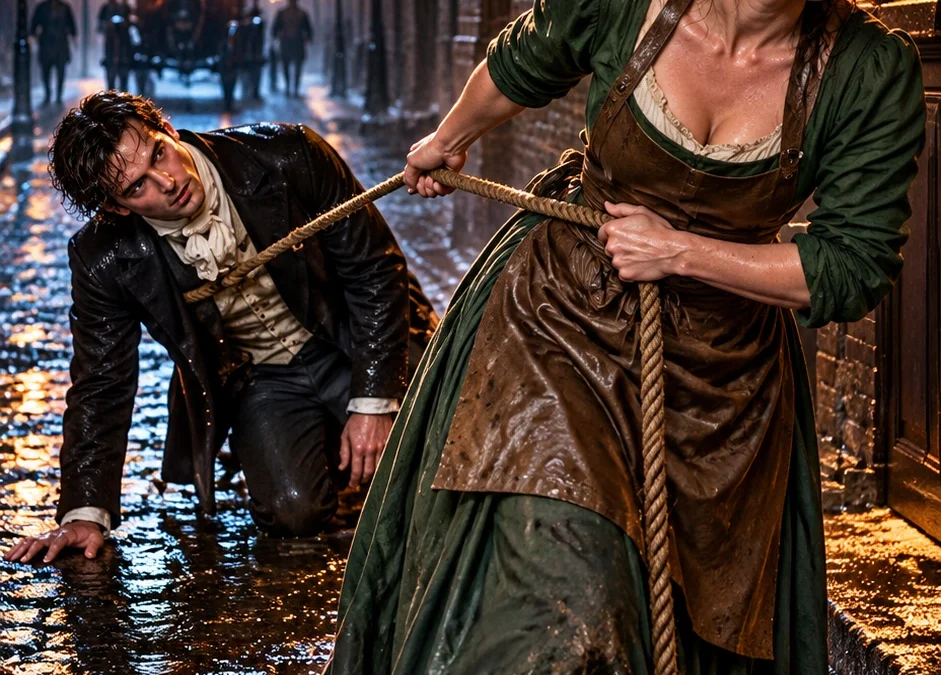
A Midwife Pulled a Poisoned Earl Out of a Saffron Court Alley at Half Past One in the Morning
Part 1: The Man in the Fog
The hackney carriage rumbled to a halt at the mouth of Saffron Court at one o’clock in the morning. From her upstairs window, Renpool — midwife, bone-setter, daughter of a healer — watched two men in dark coats haul something heavy from the carriage floor and drop it onto the wet flagstones. It landed with the dull, heavy thud of a sack of grain. They didn’t speak. They climbed back in, the door slammed shut, and the wheels vanished into the fog toward Cheapside.
Ren counted to thirty. Then she counted to thirty again. Then she picked up her tallow candle, slipped down the narrow stairs in her stockinged feet, and shouldered open the swollen courtyard door.
He lay face down. Tall, still, dressed in a coat of fine cut that no one from the court would ever have owned. When she turned him over, the scent hit her — laudanum, thick and sweet, and beneath it another smell: sharp, metallic, unforgettable. Drop of Silver. Her father had described it once, years before, after an apothecary’s apprentice nearly died of a botched mixture. Anyone who breathed it in had less than two hours before their breathing stopped.
She didn’t hesitate. She fetched her oiled binding rope, looped it under his arms, and dragged him backward into the passage, boots catching on the threshold, breath tearing in her throat, until she had pulled him inside and barred the door.
By candlelight she saw him clearly: young, perhaps thirty, jaw firm, the kind of face used to being obeyed. Thieves had taken his gloves and his watch, but missed the pocket sewn tight into the breast of his coat — hidden, unseen, waiting. His pulse fluttered, too slow, too faint.
She brought down her father’s tin medicine box — the one she had carried since consumption took him three years before — and held a handkerchief soaked with hartshorn and vinegar to his nose. He flinched. Breathed. Opened dark, unfocused eyes.
“Can you hear me?” she asked.
He made a sound that began as no and ended as yes.
“You were dropped outside. You’ve been given laudanum and Drop of Silver. You’ll feel like the underside of a barge for a day and a half. Your name?”
He was quiet so long she thought he hadn’t heard. Then he said, “Calder.”
“Is that all?”
“For the moment.”
She met his gaze and saw calculation — a man deciding how much truth to give. “I am Renpool. This is my surgery. The court is Saffron Court. I won’t write a name you aren’t ready to share in my books — but when we go to the magistrate, I will need the truth. Drink what I give you. Don’t sit up. Don’t involve my apprentice. Do we understand each other?”
He stared, surprised, as if no one had spoken to him like that in years. “Yes.”
Through the small hours she sat vigil, brewing her father’s secret remedy: willow bark, charcoal water, and one unlabeled ingredient written only in his abbreviated Latin. By dawn his breathing steadied. By seven he was sick, purging the poison, and by eight his colour had returned and he could sit up, wrapped in a blanket, holding a cup of hot water in steadying hands. Blythe, her apprentice — fifteen, practical, from the workhouse — said nothing, simply put the kettle on and kept watch from the next room.
He wrote a note in fine, careful script to his sister Dora at Number 14, Bloomsbury Square. Ren sealed it and sent Blythe with strict instructions: give it to no one but the lady or her own maid, and come straight back.
Before Ren left to attend her patients — a confinement in Clothfair, a broken arm in Gilt Street, a bad hip in St Bartholomew’s Close — she paused at the door.
“The sewn pocket in your coat. I haven’t touched it. But whatever is inside is why they left you here. When you’re ready to tell me — tell me, not the newspapers.”
He watched her. “I will.”
Part 2: The Earl and the Secret
Ren returned at eleven to find her surgery full of quiet warmth. Blythe mended by the table, and the man from the passage sat in her best chair by the fire — and beside him knelt a young woman with fair hair and the same firm jaw, holding his hand tight, eyes red but dry.
She looked up. “You are Miss Pool. I am Dora Rell — Dorothea. And my brother is not Calder. He is Neil Harwick, the Earl of Harwick. He will be angry I told you — but you saved his life, and you deserve the truth.”
Neil looked at her, half-exasperated, half-grateful.
Dora spoke steadily. “Someone has been trying to kill him for seven months. Last October a runaway cart — we called it an accident. It wasn’t. In February our elder brother Felix fell from a window at the Hartwell Club. The coroner said accident. Dr Oswell Price signed the death certificate — and received five hundred pounds from Felix’s fiancée, Levvenia Stur, a fortnight later.”
Ren sat slowly on her stool.
“Levvenia was engaged to Neil,” Dora went on. “When Felix died and the title passed to him, she demanded the engagement be renewed. Neil had ended it — he knew her. She found allies — men who know how to find poisons that do not exist in ledgers.”
Neil spoke, quiet and hard. “I found a letter in Price’s surgery last October. Proof — of Felix’s death, of the payment, of the lies. I took it and sewed it into my coat. I carried it every day, because once you lay such a thing before a magistrate, there is no turning back. Tuesday night I drank wine at the Hartwell Club — and woke on your stones.”
Ren considered it all plainly. “They will know you survived. They will strike again. We must act.”
She set the plan: write immediately to their family solicitor, Mr Crab of Lincoln’s Inn — do not go there, do not be followed. Crab will come here. This surgery treats half the parish; no one watching Bloomsbury Square will suspect refuge here.
Neil’s eyebrows rose. “You are not afraid?”
“I am afraid,” she said. “I have a practice, a reputation, a girl to protect. But there is no clean path forward that does not begin in this room. I will not look away.”
Dora’s assessment of Ren hardened into trust. “I will send my maid by the back alleys. She will deliver the letter unseen.”
Part 3: The Ledger and the Law
Crab arrived at eight the next morning — neat, reliable, ink-stained cuffs, a man who had served the family decades. He read the letter twice, sat quiet, then said: “This moves us forward. But we need more — the source of the poison.”
“Finch,” Ren said. “Near Smithfield. I know him. My father knew him. He sells what should not be sold — and keeps two ledgers: one for show, one for his protection.”
The plan was made: Ren would go alone, as a healer seeking medicine, to confirm the hidden ledger’s place. She returned by midday.
“It sits behind the blue bottles on the shelf — small, black. Crab must send to Sir Richard Bernie at Bow Street for a warrant. Finch will hand it over voluntarily — he knows resistance looks worse than cooperation.”
As they prepared, Neil paused, looked at her with something new and careful in his face. “I have two things to ask — one professional, one personal.”
“Speak.”
“Professionally — I need your formal statement. You saw the men, the time, the smell, the treatment. Your knowledge of the poison is evidence no one else can provide.”
“And the personal?”
He hesitated. “I have watched you these days — steady, sharp, kind to everyone except what threatens. When this is done — may I come back? For a reason that is not being left for dead on your floor?”
Her answer was soft and sure. “Yes.”
Over three days the chain of evidence was forged strong and true:
- Ren’s sworn account — the carriage, the alley, the distinctive scent, the saving dose
- The letter from Price’s desk — proving conspiracy
- A fourteen-year-old link boy’s testimony: he saw the carriage, noted the number, heard one man called Tuck
- Finch’s black ledger — produced without a fight, bearing entries for Miss L. Stur and a purchase of Drop of Silver
- William Tuck, night porter at the Hartwell Club — arrested and giving evidence
Price confessed everything: the bribe, the falsified certificate, the fear that had kept him silent. Levvenia Stur and her accomplice were taken at her lodgings.
Part 4: The Verdict and the Morning After
The hearing lasted five hours. Ren stood in the witness box in plain brown dress, her father’s tin box at her feet, and spoke clearly — of poisons, of margins between life and death, of what her father had taught her: that healers must know the dangers as well as the cures. When Levvenia’s counsel challenged her right to speak, Sir Richard Bernie ruled her evidence admissible before the objection finished.
Levvenia was committed for trial — conspiracy to murder, and accessory to Felix’s death. The truth was out.
On the steps outside, Neil joined her. “Felix would have liked you.”
“Tell me something of him,” Ren said.
“He saved every letter anyone ever sent him. Six boxes, organised by year — would quote them to settle arguments at dinner. The most methodical and least solemn man I knew.”
They stood a moment in the November air.
“I meant what I said,” Neil told her. “I want to ask properly — not on a courthouse step, but when we are whole again. Give me two weeks.”
“Two weeks,” she agreed.
Dora invited her and Blythe to Sunday dinner — “I want to hear all the questions Blythe has about court — she had four last night and I only answered two.”
Ren walked home through familiar streets, past courts and stalls, to her own door. The flagstones were washed clean by rain — nothing left but wet stone. She put the kettle on. Blythe looked up from her mending. “Well?”
“The chain held.”
“Good.”
Two weeks later, on a crisp November morning, Neil knocked at her door — whole, upright, in his own fine coat.
“I’ve come to ask properly,” he said. “First — I admire you. Second — I find myself unable to stop thinking about you. Third — may I court you?”
Ren opened the door wide. “Come in.”
He stepped across the threshold. She gave him the chair. She put the kettle on. And the day began — ordinary, warm, entirely theirs.
This story is a work of historical fiction created for entertainment purposes only. ✅
Disclaimer: This story is fictional and created for entertainment purposes only.
Any names, characters, places, or events are fictitious or used fictitiously.
No real person or organization is intended to be portrayed.








