A MOB HUNG A GIANT APACHE WOMAN IN THE TOWN SQUARE, BUT WHEN A STRANGER CUT HER DOWN, THE REAL KILLER WAS WATCHING FROM THE CROWD
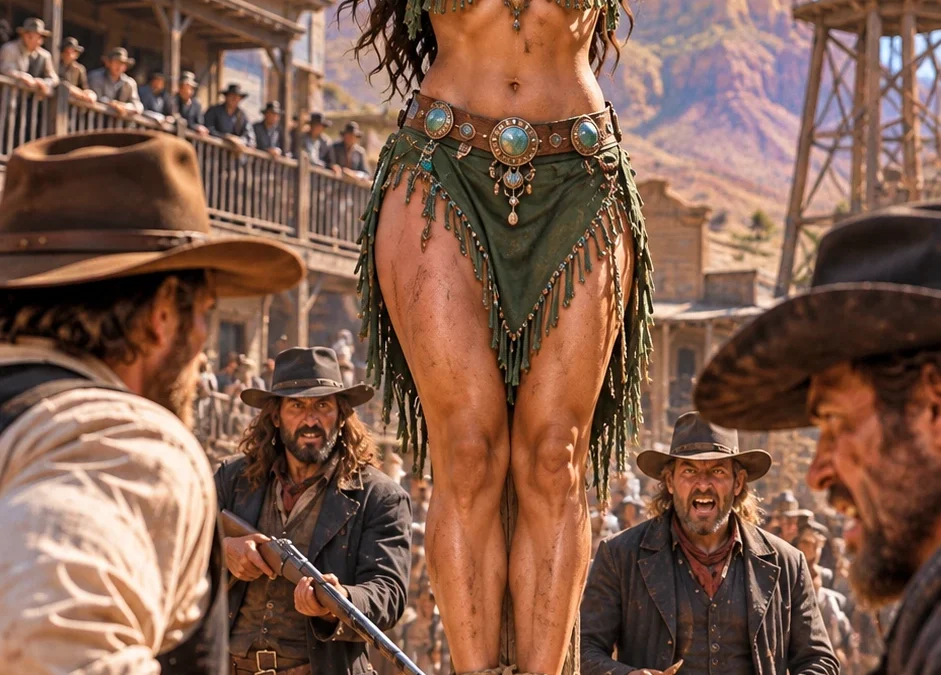
A MOB HUNG A GIANT APACHE WOMAN IN THE TOWN SQUARE, BUT WHEN A STRANGER CUT HER DOWN, THE REAL KILLER WAS WATCHING FROM THE CROWD 🪢🔥
Part 1
Noon did not arrive in Wolf Creek. It landed. ☀️
White-hot. Flat. Pressing down on the tin roofs and boardwalks until the whole town seemed to hold its breath.
The square that should have been empty was packed. Dust hung gold in the air. And above it all, a shape swung from the barnyard gallows nobody had used in three years.
A giant of a woman. Bare feet kicking weaker. Rope already dark at her throat.
Her eyes still burned. Not with fear.
Whit Calder felt it before he saw it. He felt it in the way his mule slowed without being told, ears twitching. Animals know trouble before men do.
He had only come in for salt, nails, and a sack of coffee, since his had run out three days back. Simple errands, the kind that shouldn’t turn into the rest of your life.
But the voices in the crowd were thick with the righteousness of people who had already decided.
“Sheriff Bragg says she killed one of her own kind. Imagine what she’d do to decent folks.”
“Never seen a woman built like that. Ain’t natural.”
“Best thing for this town, getting rid of her quick, before more of them come looking.”
More of them. Whit turned that phrase over. This wasn’t fear of one accused killer. It was fear of a whole people, dressed up conveniently in one woman’s rope.
He looked at the gallows. No judge. No paper with a signature. Just a rope and a crowd and a woman too big, too foreign, and too inconvenient for anyone to ask a single hard question.
The deputy holding the slack end was grinning. Grinning like there’d be pie after. 😠
That was what turned Whit’s stomach. A man carrying out justice doesn’t grin like a boy at a county fair. This wasn’t justice. It was a show somebody had written the script for.
And the rope was pale. Stiff. Brand new.
He thought of Adeline, his wife, two years gone. A man’s whole character shows up in the five seconds nobody’s watching him decide.
Everyone was watching now. It didn’t matter.
He climbed down from the wagon, walked forward with the same steady gait he used crossing a field he knew had rattlesnakes in it, and drew the hunting knife from his belt.
Someone near the edge of the crowd shouted his name. He didn’t stop.
One stroke. The rope split with a sound like something exhaling.
The giant woman dropped hard onto her knees, gasping a terrible rattling gasp, like a door dragged open after years shut. The square went dead silent.
Then it didn’t.
“Calder!” Deputy Voss, Sheriff Bragg’s man, had his Colt half out already. “What in the hell do you think you’re doing?”
Whit crouched beside her, one hand under her arm. Even collapsed, she held herself like a wall still standing after the roof burned off.
“This woman’s a murderer!”
“Says who?”
“Says the whole territory.”
“Funny.” Whit rose slowly and let his eyes drift to the rope end still dangling from the beam. “Rope looks brand new to me. You buy that special, Voss, or did somebody buy it for you?”
Something flickered across the deputy’s face. Quick, gone. But Whit had caught a hundred small lies in a hundred card games during the war.
Guilt doesn’t hide well in daylight.
“Get in the wagon,” he told her quietly. She didn’t move. She was deciding whether trusting a stranger with a knife was any better than the noose she had just left.
“Please,” he said. “I didn’t cut you down to watch you die slower.”
Something in her shoulders gave. A fraction. Enough.
She rose, the way a building rises, and walked to the wagon on her own two feet, blood trailing thin behind her heels in the dust.
Voss raised his Colt. Whit pulled the Winchester off his back and put one round straight into the sky. 💥
The crowd scattered like water on a hot skillet. In that half second, Whit swung onto the wagon seat, snapped the reins, and they were gone, dust kicking up behind the wheels.
“You just started a war, Calder!” Voss screamed after them. “You hear me? A WAR!”
Whit didn’t look back. Looking back had never fixed a single thing in his life.
That night, in his silent cabin, neither of them slept. She sat rigid by the hearth. He sat by the door with the rifle across his lap.
And somewhere in the black hour before dawn, Whit let his mind drift to the thing he avoided most.
Adeline hadn’t been sick. Hadn’t been reckless. She had gone into town for thread, and come home three days later in a pine box. A runaway wagon, the sheriff’s office said. An accident nobody witnessed.
But Silas Bragg’s survey crew had been walking Whit’s southern boundary that same month with paperwork he’d never signed.
He had never said the thought out loud. Not to the sheriff. Not to God.
And now, two years later, he had just put a bullet in the sky over a rope that looked bought. Days ahead. For a hanging nobody was supposed to have planned.
Coincidence had never much impressed him. 😨
👉 Want to know who the woman was, and who had really been planning this since before she ever reached town? Part 2 is waiting in the comments. Leave any word and I’ll send it to you privately!
Part 2
Coincidence had never much impressed him.
Dawn came up pale and hard. Whit was already outside, fighting his fence line. The wind held a personal grudge against it.
He had just sunk the shovel into the dirt when a shadow fell across the hole.
She stood there. Upright. Steadier than she’d looked eight hours ago.
Before he could say a word, she bent down, wrapped both arms around the fence log he’d been wrestling, a log that had taken him and a mule to drag out here, and lifted it. She set it into the hole like it weighed nothing.
Whit just stood there. The war had shown him what strength costs a body. He had never seen anything like this.
“You don’t have to,” he said.
She didn’t answer. She held the post steady while he packed dirt around it, then moved three feet down the line to the next broken section without being told.
They worked that way all morning. No words. Just rhythm. He’d pull the wire taut. She’d hold the post. He’d swing the hammer, and she’d have the next nail ready before he reached for it.
Around midday, he offered her the canteen. She drank and passed it back. Their fingers didn’t touch.
Something else did.
“Name,” he said finally. “A man can only work beside a stranger so long before silence stops feeling like peace and starts feeling like a debt. You got one?”
A long pause.
“Yanaba.”
He turned the word over carefully, like something he didn’t want to break by saying it wrong. “Mine’s Whit.”
She looked at him. Not appraising, exactly. Just deciding whether the name matched the man. 💛
That evening she stopped at the edge of the pasture, where a small square of ground sat fenced apart, marked by a single flat stone no bigger than a supper plate.
“Adeline,” Whit said. He didn’t need to be asked.
The stone carried a name, a year, and the word beloved, cut plain by his own hand.
“Never put a cause on it. Sheriff’s report called it an accident. Didn’t feel right carving a lie into rock I’d have to look at every morning.”
“You do not believe the story.”
“No. I don’t.”
She held his gaze. “Then we are already the same. Both carrying a lie somebody else wrote for us.”
Whit had no answer. He just let the silence settle into something a little warmer.
Over the following days, the ranch fell into a rhythm. Mornings were fence and water. Afternoons were harness and smokehouse. Evenings were soup and fire and small trades of words.
“Teach me something,” he said one night. “A word. In your tongue.”
“Shash.”
“What’s it mean?”
“Bear.”
“That an insult?”
“Only if you are slow to understand it.”
The corner of her mouth twitched, almost a smile, there and gone. Something warm moved through his chest that hadn’t moved there since before the pine box.
Out in the dark, a wolf howled. Her whole body went still, listening.
“Trouble?”
“No. Just old ones talking across the dark. I was raised to listen for more than words.”
She was a hunter, too. When the smokehouse ran low, she came along with a bow she’d made herself from a branch he’d never noticed missing. She read pronghorn sign he walked straight past.
“I fed a war party for three winters,” she said, wiping her hands in the grass. “A woman who cannot provide is not kept long as a warrior.”
“You’re better at this than half the men I served with.”
“Probably.”
“Ma’am, I believe that’s a joke.”
“I do not joke.”
“You keep saying that. Getting less convincing every time.”
They walked home with the pronghorn slung between them, and Whit realized he was laughing, easy and unplanned.
“There it is,” Yanaba said quietly. “The sound a man makes when he remembers he is still alive, not only surviving. I have been waiting to hear it since the rope.” ❤️
Then one night a storm rolled in, and by the fire she finally spoke the question she’d carried for days.
“Why did you save me?”
“Because nobody else was going to.”
She turned toward the flames, and something in her face opened like a door with one loose board.
“It was my own people who put the rope there.”
She had been promised to a chief’s son named Askala. She had refused him before the whole council fire. Two moons later, his young cousin was found dead near the river camp, and the elders looked for someone to blame.
“They found me standing closest to that grief.”
“You didn’t do it.”
“No.” She stared into the fire. “But someone wanted it to look like me. Somebody in Wolf Creek knew I was coming before I arrived. Knew. And was ready.”
“The rope,” Whit said slowly. “Pale. Bought special.”
Neither of them said Bragg’s name.
Then Whit heard something outside. A single rider, moving slow and careful, the pace of a man who wants to see without being seen. By the time Whit reached the door, the rider was gone.
At two in the morning, he woke to a choked sound from her corner. Her hands were pressed flat against her own throat, exactly where the rope had sat.
“You’re here,” he said quickly, staying where he was. “Cabin. Fire. No rope.”
It took her a long moment.
“It comes back,” she whispered. “Not the rope itself. The moment before, when I understood no one in that whole square was going to stop it.”
“I’m not going anywhere. And the rope’s not coming back. Not while I’ve got breath to stop it.”
“Stay awake with me. Until it passes.”
He did. And in the dark, he told her about the war, and the brother he lost at a river crossing, and Adeline’s letters that dragged him back to life.
“Then we will find out who cut that rope,” Yanaba said. “Hers and mine both. I do not think anymore that they are separate ropes.”
He looked at her and felt something settle that had been drifting for two years.
“No,” he said. “I don’t think they are either.”
A few days later, a single unfletched arrow appeared on his porch rail, tied with a strip of hide. Yanaba went very quiet.
“My brother’s mark. He is telling me he is near.”
And at the edge of the tree line, one evening, Whit saw a young man crouching just long enough to be seen on purpose.
Her brother. Taji.
Then, the very next afternoon, he heard thunder under a cloudless sky.
Hooves. A dozen riders, dust boiling gold behind them. Deputy Voss out front, holding something small and dark in his fist.
A torch. 🔥
👉 Like or comment “REVEAL” to unlock Part 3! It will be posted as soon as there are enough comments. ❤️
Part 3
A torch. Unlit. Yet.
The riders fanned into a half circle around the cabin. Yanaba stood on the porch, axe in hand, not raised, only held, waiting like a held breath.
“Calder!” Voss’s voice cracked across the yard. “Send the monster out, and maybe this town lets you keep breathing!”
Whit stepped up beside her. He didn’t reach for his rifle.
“Funny thing about that rope, Voss. Been thinking on how new it looked. How somebody had it ready before the crowd even gathered.”
The same flicker crossed the deputy’s face.
An older rider, a man who sold Whit nails most Tuesdays, shifted uneasily. “Silas never said nothing about buying rope ahead of time, Voss. Did he?”
“Shut your mouth, Pruitt!”
Silas. Whit filed the name away. He didn’t say it aloud.
“Sheriff Bragg send you personal? Or is this an errand a deputy just takes on himself out of civic spirit?”
The riders went quiet. Real doubt moved through men who had ridden out sure of themselves an hour ago.
Voss felt it too. He reached for the only tool a man has left once a lie starts to wobble. Fear dressed up loud as anger.
“She’s not human! Three days you’ve had a killer under your roof!”
“That a threat, deputy?”
“Or a confession.”
Voss’s face went white, then red. A wild shot cracked at the sky. Horses reared. Yanaba’s hand closed around Whit’s arm, steady, a fixed point in the chaos.
“Not today,” Voss spat, wheeling his mare. “But we’ll be back, Calder.”
They thundered away. The scorch mark from his torch smoked faintly on the porch rail all night. 😤
“Voss slipped,” Whit said afterward.
“A thread is not a rope, Whit Calder.”
“No. But it’s a start toward weaving.”
Taji came on the third night. Close this time, with the same steady bones as his sister beneath fewer hard years.
“You are the rancher who cut the rope. Then I owe you a debt I did not expect to owe a white man.”
“Owe me nothing. Owe your sister the truth. That’s worth more.”
Taji drew a small knife from a fold of hide, the handle carved with markings Yanaba recognized instantly.
“This is Askala’s.”
“I found it buried near the river camp, where our cousin died. Askala claims he lost it. But the blade still carries old blood in the seam near the hilt.”
“I cannot show the elders yet. Askala has grown careful and generous. Repeating rifles have appeared among his closest men, the kind no trading post sells without a name attached. And I have watched him meet a man at the eastern ridge, alone. A man who wears a badge.”
Whit’s blood went cold. “Bragg.”
It made a terrible, elegant kind of sense. A sheriff hungry for land and water. A rejected suitor hungry for a council seat. Two men who never needed to like each other to see how useful they could be.
And somewhere in that arrangement, a rope bought days ahead.
“I was never just convenient,” Yanaba said quietly. “I was necessary. I was watching too closely. Asking questions neither man wanted answered.”
“Then we’re not just fighting for your name anymore,” Whit said.
Three days later he rode alone into Wolf Creek, against every ounce of her protest. A giant Apache woman on Main Street would only get her roped again.
At the land office, the clerk Holloway went pale. The survey records from two years ago? Lost in a fire. A convenient fire. His hands shook.
“Anybody ask after those files before the fire?”
“Sheriff came by. Routine business.”
“Routine business needing my southern boundary survey. The same week my wife died on the road home from this exact office.”
Holloway said nothing. His silence said everything.
Whit stepped outside and froze. Sheriff Silas Bragg stood in the shade of the mercantile awning, arms crossed, quiet and patient. The kind of man who never needed to shout because he had arranged for others to do it.
“Heard you had quite a week, Calder. Wouldn’t want to see you throw away two years of goodwill over a stranger who isn’t even yours to protect.”
“She’s got a name.”
“So did your wife. Didn’t stop the road from taking her anyway.” The words landed like a fist. “Careful roads out that way. Shame nobody thought to fix them.”
He walked into the mercantile. And Whit stood in the street, his hands curled into fists, finally certain. 💔
That night he knelt at Adeline’s stone.
“It wasn’t an accident, Adeline. The man who did this is still walking around free, wearing a badge. I aim to fix that. Whatever it costs.”
When he returned to the cabin, Yanaba asked, unprompted, “Tell me about her. Not how she died. How she lived.”
“She laughed too loud for church. Kept bees. Said honey was the only thing sweet enough to match her disposition.”
“She sounds like a woman who knew her own worth.”
“You’d have liked her. Or driven each other half to madness. Both at once.”
“Both at once sounds correct for two women worth knowing.”
Her hand rested near his on the bench between their chairs. Not touching. Not yet.
Then Taji came pounding in on a lathered horse. He had found a widow named Nizoni who had seen Askala leaving the dead man’s fire circle that night, blade in hand.
Two nights later, in her brush shelter, Nizoni trembled as she told it. “I told myself I had misunderstood what I saw in the dark. Told myself that for many nights, until I no longer believed my own lie.”
“Will you speak it before the chief?”
“If the knife stands beside my word. Yes.”
They had barely finished their preparations when the attack came. Four nights later, Whit woke to the smell of smoke.
The yard swarmed with riders. Voss’s men, and mounted figures at the tree line moving with a discipline Wolf Creek’s mob never carried.
“Askala’s men,” Whit said. “They’ve joined forces.”
A torch shattered against the north wall. Flames caught fast.
“I will hold them from the yard,” Yanaba said. “You save what can be saved.”
“I’m not leaving you out there.”
“You are trusting me to do what I have done my whole life.” Beneath the fierceness, something he hadn’t seen before. She was afraid of losing him, and hated herself a little for it.
She burst through the door, axe raised, a shape half-lost in firelight and smoke. The fight blurred into pieces. Whit beat flames from the wall with a soaked blanket until his lungs burned. In the chaos he spotted old Pruitt at the yard’s edge, sick with every scream. “This what you signed on for? Burning a woman alive?”
Pruitt wheeled his horse and fled.
By dawn, the attackers were gone. Voss was the last, bleeding, shouting over his shoulder. “Bragg’s done being patient! And Kosoha’s already halfway to believing his own daughter turned snake!”
Whit found Yanaba in the smoking yard, blood on her arm that wasn’t hers.
“I am whole, Whit Calder. Look at me.”
He looked. And something in him stopped holding back.
“When that rider went for you, I thought…”
“I know what you thought. I thought the same, watching flame climb that wall with you inside it.”
He closed the last of the distance, slowly, giving her every chance to step back. She didn’t. The kiss was brief and careful, two people who had both lost enough to know how precious it was.
“This complicates matters,” she said, her forehead against his.
“Reckon it does.”
“I do not regret it.”
“Neither do I.” ❤️
Then new hoofbeats came across the plain. Dozens of horses, moving as one.
Kosoha.
Thirty riders formed a half circle. At their head sat the chief, grim, and beside him the young warrior who’d shouted traitor in the fight, whispering into his ear.
“Word reached me that you fight beside a white rancher against your own blood,” Kosoha said to Yanaba.
“Or word was delivered to you. One arrives on its own. The other is carried by someone with a reason.”
Askala rode forward, handsome in a careful, calculated way. “She accuses me now, Father? Is this not proof?”
“Convenient,” Whit said, “how a man so eager to talk about her fall never mentions what actually killed your cousin.”
Kosoha raised a hand. “Suspicion is not proof. A council does not judge on hope alone.”
Hooves thundered. Taji broke through the circle at a dead run, Nizoni behind him.
“I bring proof!”
He held up the knife, with the old blood in the seam. Then Nizoni slid from the horse on trembling legs, chin lifted, and told it all before the whole circle. The fever. The river water. Askala crossing the camp with his blade drawn. The raised voices, then silence. The walk back, wiping his hands clean against his leggings.
When she finished, the riders were deathly quiet. Kosoha had aged ten years in a single testimony.
“Askala. Tell me this woman lies.”
“She lies. A frightened widow…”
“The blade. Is it yours?”
A long silence. “It is mine. But that proves only that I lost it.”
“Then explain the blood.”
Askala said nothing. The silence became its own confession.
“Why? Your own cousin. Why?”
His composure shattered. “Because he discovered what I was doing! The rifles! The arrangement! He threatened to bring it before the council!” He jabbed a finger toward Yanaba. “She was simply convenient. Who would question her guilt once I made the story point only one direction?”
The confession hung in the air.
“You have condemned a woman,” Kosoha said hollowly, “to protect an alliance with the very man selling rifles to divide our own people. In my name. Wearing my blood as your shield.”
That was when the hoofbeats came from the road. Sheriff Silas Bragg rode in at the head of a dozen armed men, rifles already raised.
“Looks like I’ve arrived just in time for a family reunion.”
“You knew,” Whit said, his voice flat and dangerous. “About the murder. About the frame.”
“I knew Askala needed a problem solved, and I had rope enough to help.” Bragg’s mouth curved. “Wasn’t personal. Just business. Same business I had with your wife.”
Whit’s hands shook. “Say it plain. Say what you did to her.”
“Your wife found paperwork she wasn’t meant to find.” Bragg shrugged, casual, monstrous in its casualness. “Roads out that way really are dangerous, Calder.”
“You orchestrated all of this,” Kosoha said slowly.
“Divided people are easier to profit from, Chief.” Bragg raised one hand. “Can’t have a united front walking away from this yard.”
His men opened fire. 💥
Whit hauled Yanaba down behind the water trough as splinters tore from the porch rail. Taji fought beside the chief’s riders. Kosoha cut down two of Bragg’s men with grim precision. Yanaba moved through the smoke like something the old stories warned men about, driving back attackers with her axe.
Then Whit saw Askala, weaponless, disoriented, lunging for a fallen rifle and raising it toward Yanaba’s back.
“YANABA!”
The shot that rang out didn’t come from Askala’s weapon. It came from behind him. From Kosoha, still mounted, face carved from something far older than grief.
Askala dropped without a sound.
“I could not save you from what you chose to become,” Kosoha said, quiet enough that only the closest heard. “But I would not let you take her from this world, too.”
Then his focus snapped back to the fight, grief folded away until duty was paid.
Whit saw Bragg through a break in the smoke, mounted, directing his men with the same cold precision he’d used on everything. Two years of grief went very still inside him.
He rose from behind the trough and walked straight into the chaos, Winchester steady.
“Bragg.”
The sheriff turned, and for the first time, Whit saw a crack in that careful calm.
“Come to finish what you started three weeks back?”
“Come to finish what you started two years back.” Whit stopped ten paces off, rifle level.
“You could walk away, Calder. You’ve got a woman waiting who’d rather see you breathing.”
“She’s earned better than watching you ride off free.”
“Same pride that got your wife killed, if you want the honest truth. Woman couldn’t just let a boundary dispute lie. Had to go digging.”
Something in Whit went cold and very still. “Careful.”
“You really willing to die for a woman you’ve known three weeks? Over a wife two years in the ground?”
“She’d have wanted this. Wanted somebody to finally stop you before you buried anybody else’s whole life the way you buried hers.”
The shot, when it came, was Whit’s. Fast, clean, years of war teaching his hands what to do before his mind caught up. Bragg’s return shot went wide.
The sheriff dropped. And Wolf Creek’s careful architecture of lies and greed dropped with him. 🏛️
Bragg’s men lost their will the moment the man paying for their loyalty lay dead in the dirt. Silence settled over the yard in slow degrees. First the gunfire. Then the shouting. Then even the horses.
Yanaba found him there. She stood beside him, shoulder against his, and turned his face toward hers, checking him over the way she’d checked fence posts weeks back.
“You are not hurt.”
“Not where it shows.” His hands were still shaking. “Two years I carried that, not knowing for certain. Now I know, and I don’t know what to do with the knowing.”
“You do not have to know yet. Grief settling into place after so long takes its own time.”
They crossed the yard to Kosoha, who looked years older than he had at dawn.
“I failed you. Failed to see what stood plain in front of me because grief made me eager to believe whatever story required the least painful truth.”
“Grief makes fools of even careful men,” Yanaba said, gentler than Whit expected. “I do not hold that against you, provided you do not let it happen twice.”
“You have every right to hate me.”
“I have every right. I choose otherwise.”
Something in the chief finally broke. “Come home. Let me restore what was wrongly taken. Your standing. Your honor.”
The offer hung in the morning air. Everything she had lost, within reach again. Whit didn’t speak. He didn’t dare.
“I am grateful,” she said finally. “But I did not survive that rope to return to exactly where I stood before it. I choose to stay here. Not because I owe this rancher a debt. That was settled weeks ago in fence posts and honest labor. I choose to stay because here, for the first time in my life, I am seen as a whole person. Not a warrior first and a woman second. Not a daughter measured against a brother’s ease or a suitor’s pride. Simply myself, whole, without anyone deciding which parts were acceptable to show.”
Kosoha studied her a long moment. “Then I will not ask you to choose differently. Only that you do not consider yourself exiled from us. Wherever you build your fire, you are still my people’s daughter.”
“I would like that.” Her voice thickened. “More than you know.”
Taji pulled his sister into an embrace that needed no words. “You did this,” she whispered. “All of it.”
“I only refused to stop asking questions. You taught me that.”
Whit crossed to Nizoni and held out his hand. “You saved more than one life today.”
“I only told what I saw,” she said, her posture straightened, some old weight finally set down. “The courage belonged to those willing to listen.”
Voss, it turned out, fled the county for good the moment word of Bragg’s death spread. Pruitt arrived among the first townsfolk once the fighting ended, offering supplies and a clumsy apology, the kindness of a man trying to make amends for cruelty he’d been too afraid to refuse.
Wolf Creek would take longer to heal than a single morning. But the healing had begun.
Before the riders departed, Kosoha extended his hand to Whit. “My daughter stands alive because a stranger chose courage over comfort in a town square that offered him every reason to ride on past. Whatever debt exists between our peoples, know that I count you among those who helped balance it toward something better.”
“Wasn’t looking to be owed anything, Chief. Just couldn’t ride past what I saw that day.”
“That is precisely why the debt exists regardless.”
Spring arrived early that year, ice breaking clean off the creek weeks ahead of schedule, green pushing up stubborn and certain through soil that had looked dead all winter.
Whit stood at the mended fence line while Yanaba came up beside him with a post balanced easy across one shoulder.
“Same section. The wind found it again.”
“Wind’s persistent.”
“Guess we are too, given everything.”
She smiled, a real smile now, full and unguarded, nothing like the careful flickers of those first weeks. They worked the fence together in the rhythm they’d found that very first morning, no words needed.
Past the fence, the garden they had broken together in the storm-torn weeks showed green shoots along its rows. Corn and squash. Adeline’s old plot, given new life by hands that understood what it meant to coax something living back out of ground gone fallow with grief. 🌱
“Wolf Creek’s talking,” Whit said. “Holloway came forward with what records survived that fire. The land office is opening a proper investigation into Bragg’s dealings.”
“Justice arriving slow, same as most true things do.”
“Adeline would have liked knowing it finally caught up to him.”
“She sounds like a woman who understood patience carried its own kind of justice, given enough time to work.”
Whit looked at Yanaba, really looked, seeing not the giant warrior Wolf Creek had feared, not the fugitive he’d cut from a rope, but the woman who had freely chosen to build a life here beside him.
“Reckon she’d have liked you plenty.”
They walked back past Adeline’s old hives, empty for two years, now humming with a fresh swarm that had found its way home on its own, the way some things do given patient enough waiting.
“Shash,” said Yanaba, nodding toward the hives, warmth and teasing in her voice. “A bear would not hesitate here. It would simply take what it wanted.”
“That an insult?”
“Only if you are slow enough to still be standing here empty-handed by supper.”
“Ma’am,” Whit said, reaching for her hand instead of the honey, “I believe that’s a joke.”
“I do not joke.”
“You keep saying that.”
“And you,” she said, lacing her fingers through his, “keep proving me wrong about it, one season at a time.” 💛
They stood there in the gold afternoon, the hives humming behind them, the fence standing straight and whole for the first time in longer than either could remember. And somewhere past the ridge, the road to town wound quiet and unremarkable. No rope waiting anywhere along it.
The rope that nearly took her life, cut clean with one stroke of a stranger’s knife, had become something else entirely.
A beginning neither of them had been looking for.
A choice freely made that no rope, hers or his, would ever again have the power to take away. 🪢❤️
This story is entirely fictional and created for entertainment purposes only. It does not represent any organization or individual, nor does it encourage inappropriate behavior. The content was generated with AI assistance.








