A Night Clerk’s Jacket Still Hung on Her Chair and Her Cigarette Was Still Burning. Then a Man Called Police About a “Robbery.” 27 Years Later, a Detective Replayed That Call and Whispered: “It Sounds Staged.”
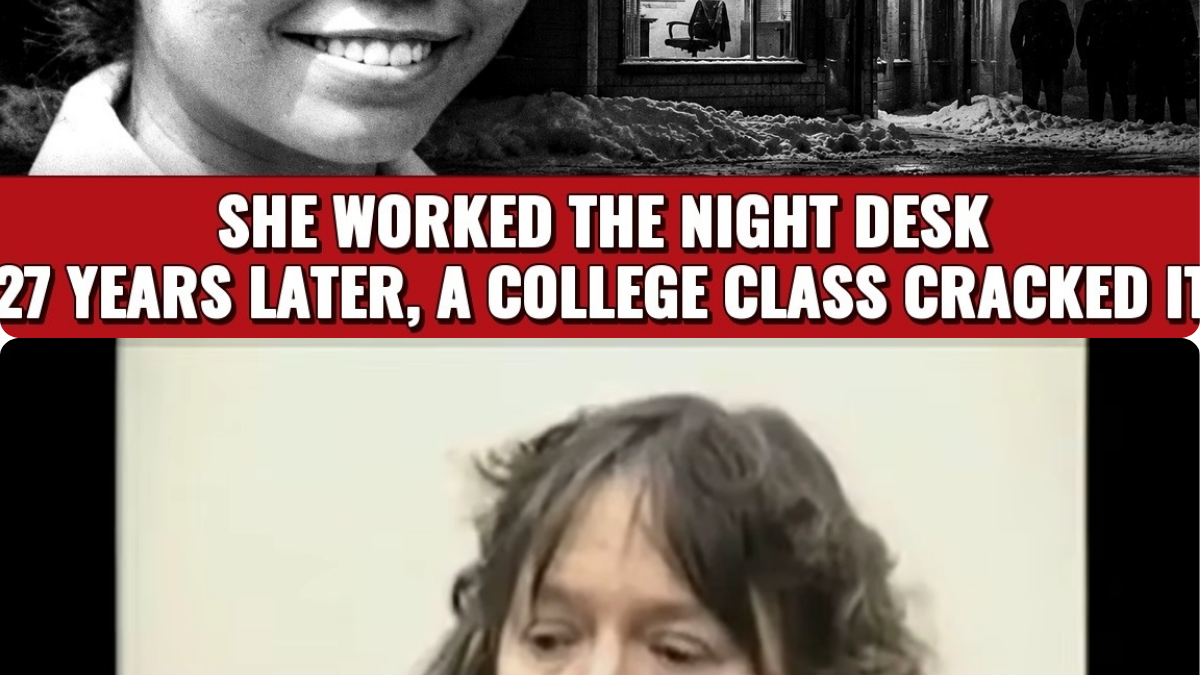
A Night Clerk’s Jacket Still Hung on Her Chair and Her Cigarette Was Still Burning. Then a Man Called Police About a “Robbery.” 27 Years Later, a Detective Replayed That Call and Whispered: “It Sounds Staged.” 😨
Part 1
Just after 2:00 a.m. on January 31, 1979, a man phoned the police in a small Michigan lakeshore town to report a robbery at the Lakeview Inn.
About five hundred dollars was missing from the motel office.
So was the night clerk.
Her name was Joanne Mercer. She was twenty-two, a music student at the local college, and she sang in her church choir. When officers walked into the office, her winter jacket still hung on the back of her chair.
Her cigarette was still burning in the ashtray. 🕯️
Nobody walks into a Michigan January night without a coat. Nobody leaves a lit cigarette unless they expect to be back in seconds.
Joanne never came back.
That winter, the town had been quietly transformed.
In October 1978, a bitter strike had shut down a chemical plant, and the company brought in a private security firm to guard its property. Some seventy out-of-town guards arrived with nowhere to live. Most of them ended up at the Lakeview Inn.
The motel stopped being a quiet roadside stop. It became a small, closed community. The guards and the staff passed each other in narrow halls every night. There were parties. The line between guests and employees blurred.
Joanne worked the night desk there to pay for college. She came from a close, devout family. Her parents, Tom and Ruth Mercer, and her younger brother, Danny, were proud of her.
She shared a house with the motel’s night manager, Lynn Hollis, who was also her supervisor. They lived together. They worked together.
On the night of January 30th, Joanne started her shift just before midnight, behind a desk in a building full of strangers.
By two in the morning, she was gone.
Detective Jim Foster arrived and started knocking on doors. Had anyone heard anything? Seen the clerk leave?
Nobody had anything to say.
At least, nothing anyone was willing to say.
Her family did not wait for morning. Tom, Ruth, and Danny searched through the freezing night.
Nearly a full day passed.
Then, around one in the morning on February 1st, a snowplow driver clearing an interstate far to the south saw something in a wooded turnaround beside the highway.
It was Joanne.
She was thirty-five miles from the motel desk where her coat still hung. The evidence showed she had died the very night she vanished.
Someone had driven her out of town in the dark for more than half an hour, left her by the road, and driven away.
The news shattered her family. It shocked the whole college town. The music department mourned one of its own, and her church choir was left with an empty seat.
Police believed they were looking for a stranger passing through in the night.
The truth was far worse.
The people responsible had not fled. Not yet. They were still in town that week, reading the same newspapers, working the same strike, sleeping in the same motel. 🌙
Detective Foster and his team worked relentlessly. They tracked down everyone who had stayed at the inn. Their notes grew past a thousand pages.
And in the bars, men were said to be bragging about what had happened to Joanne.
But every time police chased a rumor to its source, it evaporated.
No fingerprints. No forensic science that could name anyone. No confession. No arrest.
The people who knew what happened were outsiders who would soon pack their bags and scatter across the country.
And they did.
The robbery call, taken at face value, went into the file as a simple motel holdup.
The file went into a cabinet.
Years passed. 1979 became 1989. Then 1999.
And across all that time, dozens of people who knew something about that January night carried the secret with them, into new jobs, new states, and new families.
Not one of them said a word.
A retired homicide expert who later reviewed the case said he had never heard of so many people staying quiet for so long.
Then, in the fall of 2003, a college professor gave his documentary class a project.
Part 2
Professor Daniel Reed taught at the same college where Joanne had once studied music. His students chose an unsolved case from that campus: a student who had vanished in the winter of 1979.
None of them had even been born when the robbery call came in.
They had help from the one man who knew the file best. Retired detective Jim Foster, the first officer to walk into the Lakeview Inn, had never forgotten that empty chair. He pushed for the film. He pushed for a new look.
A student sat down with Joanne’s parents and asked about their daughter, about twenty-five years of waiting. Tom and Ruth spoke into the camera.
The students edited it into an eighty-minute documentary. In January 2004, exactly twenty-five years after the crime, it premiered at a theater in downtown. Then it aired on public television across the region.
It put Joanne’s face back in living rooms. It put her story back into conversation. And it put her face back in front of the police.
It looked like a small college assignment.
It wasn’t. 🕯️
On April 28, 2004, the local police and the state police announced a joint cold case team. There was no DNA, and no fingerprints to match. There were only people.
So the team went looking for them.
Over the next months, detectives conducted more than three hundred interviews in eighteen states. They knocked on doors and sat in living rooms. Most people still claimed to know nothing.
But in Minneapolis, a former guard let something slip. A rumor that had circulated among the men back then. The guard who had phoned the police that night, he said, was involved.
Detective Jeff Carlson went back to the archives, found the recording of the 1979 call, and listened.
Then he listened again.
He kept noticing what was missing from the caller’s voice.
“It sounds staged to me,” he later said. “There’s no emotion.”
The very first piece of evidence in the case, the call that had sent police to the motel, had been a performance.
Detectives found the caller’s former roommate, who handed over a stack of photographs taken at the inn that winter. Guards. Parties. And Joanne, frozen in the middle of the world that would swallow her.
Carlson had a reputation among his colleagues. They called him the closer.
For three months he sat across from the man who had made the call. He interviewed him about eighteen times.
And in June 2005, the silence finally broke.
The man was a security guard named Ray Dillon. He had been staying at the inn. He admitted that he had staged the robbery.
After twenty-six years, he told his version. It was a party that went wrong, he said.
“But it wasn’t intentional.”
Part 3
Ray Dillon’s confession cracked everything open.
He had staged the robbery, he admitted. Joanne had been lured away from the front desk with the promise of a surprise party and taken to the security company’s guest house nearby.
She never came back from that house.
But why her?
The answer came from the person who was supposed to be looking out for her. Her supervisor and housemate, the night manager, Lynn Hollis.
The motive was not a robbery. It was not a random stranger. It was jealousy.
Lynn had resented the attention Joanne received at the motel, especially from the highest-ranking guard on site, a man named Carl Pruett. The plan, she later testified, was to bring Joanne “down a few notches” and teach her a lesson.
Detective Dave Maddox flew to Pennsylvania to sit across a table from Lynn. And as the investigation deepened, the wall of silence began to crumble.
A woman who had watched from the motel balcony that night came forward. She said they had all been warned: keep your mouth shut, or it could happen to you. Another witness described the same threats.
Fear, not indifference, had kept the secret for decades.
On February 7, 2006, Ray Dillon was arrested. He was sixty-six. The man who picked up a telephone in 1979 and reported a fake robbery was finally in handcuffs.
He was not the last. By September 20, 2006, six people had been charged: Dillon, Lynn Hollis, Carl Pruett, and three other former guards.
Dillon pleaded guilty to second-degree charges and agreed to testify. He told the court he hoped his plea would bring the family some peace. But on the stand, his cooperation faltered. Decades of heavy drinking, he said, had left him unable to recall much.
“I’ve been a confirmed alcoholic for almost fifty-five years,” he told the court.
Lynn Hollis pleaded guilty as well and testified. Asked why she was finally telling the truth, she said it was the right thing to do, and that she did it for Joanne’s family. She had been afraid since she was twenty-one years old. For almost three decades she had told no one, not even her own family, terrified she would be charged and terrified of what the truth would do to her relationship with her daughter.
It was a bitter irony. The two people who had kept the secret the longest were the witnesses the case depended on, and neither could give the jury everything.
The rest would have to come from the people who had watched. 🌙
The main trial opened in the fall of 2007 at the county courthouse. There was no DNA. There were no fingerprints. Not a trace of physical evidence tied the four remaining defendants to the crime.
It was a case built entirely on memory: the people who had looked away, and the people who had been told to keep quiet.
The defendants maintained their innocence. They denied ever being at the guest house that night. Their lawyers argued that memories fade after almost three decades and that witnesses had been coached.
On November 1, 2007, the jury returned.
All four men were found guilty. Carl Pruett was convicted of the most serious charge, held responsible for her death. The other three were convicted on second-degree and felony charges.
In the courtroom, the state’s attorney general summed it up: this case is about never giving up.
Retired detective Jim Foster, who had testified, said it plainly. “I knew it could come. That’s why I tried to get the cold case going, making the college film. And it worked.”
On December 10, 2007, all four were sentenced to mandatory life without parole. Not one of them spoke.
Joanne’s father did.
Tom Mercer stood in court beside his wife, white flowers pinned to their lapels. “They thought they got away with it,” he said, “and for the most part, they did. They’ve lived the last twenty-eight years with their careers and their lives.” He thanked the cold case team and the jurors for seeing the true evidence.
Ruth said they had been waiting twenty-eight years for that day. She ended with four words: God is our judge.
The detectives had become family to them. They had even placed flowers on Joanne’s grave on the anniversary.
Tom refused to let hatred swallow the rest of his life. “I can’t hate them,” he said, “because that would make me like them.”
The legal fight continued. In 2009, the convictions were affirmed on appeal, and Tom drove to the hearing to sit through every word again, because how would he look as Joanne’s father if he stayed away?
The family also sued the security company that had brought the guards to town. A federal judge called the lead guard’s role in covering up the crime “appalling.” But the ruling went against them. The deadline to sue had expired in 1982, while the secret was still being kept. An appeals court upheld that decision in 2012.
The law had a deadline. The silence had outlasted it.
Carl Pruett died in custody in 2013. Another of the four died in prison in 2020. Lynn Hollis was released in 2016.
So what did twenty-seven years of silence cost?
A thousand pages of notes. More than three hundred interviews in eighteen states. A family that waited almost three decades for answers. A brother who grew up without his sister. A town that lost its comfortable belief that a secret that big could never stay buried.
And all that time, the people who knew went on living, working, raising children, celebrating every birthday Joanne never got.
The answer had never been locked in a laboratory. It had been walking around inside people’s heads.
All it ever took was someone to ask the right question, and keep asking it eighteen times.
The people who finally did were not who anyone expected. A retired detective who couldn’t let go. A professor who handed out a class project. A handful of students who sat with a grieving mother and father and pointed a camera at a case everyone else had stopped talking about.
“It was justice for Joanne,” the retired detective said afterward, “but it took too long.”
Her father put it more simply. There was closure, he said, but he didn’t think there would ever be justice.
And her mother held onto one last hope. “Someday, Joanne,” she said, “we’ll all be together.”
Ruth Mercer passed away in January 2024, at eighty-nine.
On the night of January 30, 1979, a twenty-two-year-old music student sat down at a motel front desk to work the overnight shift. She hung her jacket on the back of her chair. She lit a cigarette.
She never came back for either one.
It took twenty-seven years, a professor, his students, a detective who heard what no one else had heard in a phone call, and a family that never stopped saying her name.
She was never just a case number. 🌙💔
This story is based on a real criminal case. Names, places, and some details have been changed. It is written for awareness and does not represent any real individual or organization. It was generated with AI assistance.








