A Rich Woman Stopped for Roses at a Tiny Market. Then the Poor Florist Looked Up, and Both Women Saw Their Own Face. What Had Been Taken From Them 30 Years Ago Would Break the Whole Town’s Heart
A Rich Woman Stopped for Roses at a Tiny Market. Then the Poor Florist Looked Up, and Both Women Saw Their Own Face. What Had Been Taken From Them 30 Years Ago Would Break the Whole Town’s Heart 🌹
PART 1
The roses were the color of old wine, and Vivian Sterling had been looking at them for a full minute before she realized her hands were shaking.
It was a Saturday morning in March of 1888, in the little flower market at Garnet Crossing, Colorado. The air smelled of wet earth and violets. Somewhere behind her, a vendor was shouting the price of eggs. Vivian stood before a humble stall with a canvas awning, in blue silk and white kid gloves, feeling like a visitor in her own town.
“Two dozen of the red,” she said. “For an anniversary. A sad one.”
“Of course, ma’am. One moment.”
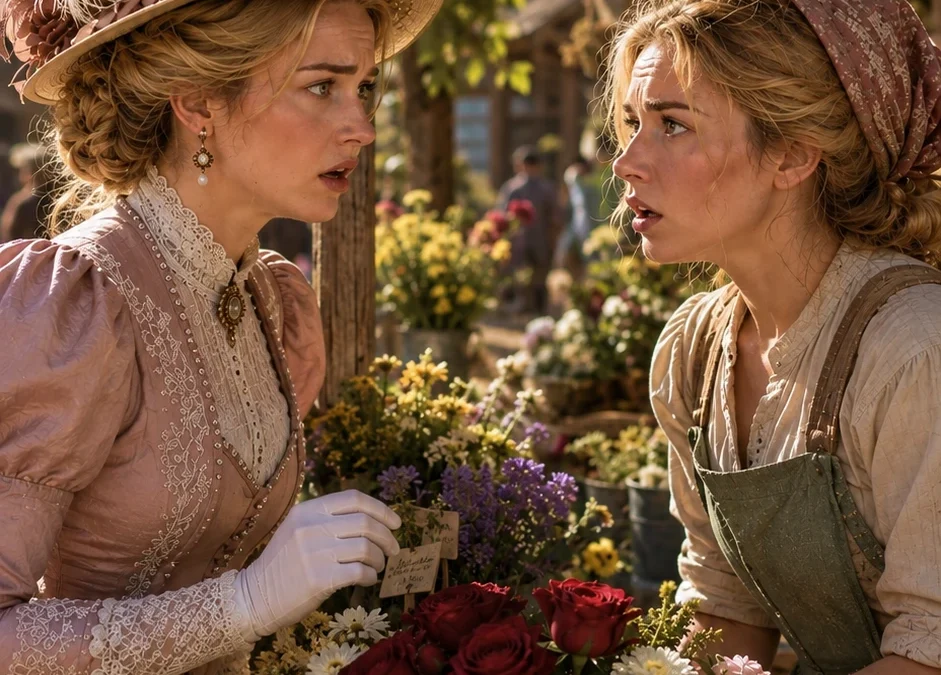
The florist had her back turned, bent over a bucket, trimming stems with a short knife. Brown apron, a scarf over her hair, mud on her sleeves. She straightened and turned with a bunch of roses in her arms, and she looked up.
Vivian forgot how to breathe.
Because the woman standing in front of her had her face. 😳
Vivian was thirty, and she lived in a house with nineteen rooms and almost no one in them. It stood on Larkspur Hill above town, a gray stone mansion with a wraparound porch and a conservatory full of ferns. Her father, Montgomery Sterling, had made his fortune in silver and railroad stock. He had died four years ago. Her mother, Cornelia, had died two years ago this very week. They had adopted Vivian as an infant and told her so over cocoa when she was seven. She remembered Cornelia’s hands trembling on the cup.
They had loved her, and she had never doubted it. But all her life she had felt a small ache, like a room in the house nobody had told her how to enter.
Now she ate breakfast at one end of a table built for twenty. Every morning, out of habit, she set out two cups. Every morning she drank from one and put the other back in the cupboard before the maid could see.
On Saturdays, she did one thing wholly her own. She bought small bunches of whatever was fresh and left them on the porches of people who lived alone. A widow on Mill Street. An old miner with no family. She never signed her name. She had done it for six years, and nobody had ever caught her. 💐
In two rooms above the feed store lived Daphne Calder, also thirty, thin and quick, with strong hands and a habit of talking to plants. Her mother, Maud, had raised her alone on a laundress’s wages and taught her everything about flowers. A garden is the only honest wealth, Maud used to say, because you cannot buy it, only earn it. Maud had died three years ago, of a lung sickness that took six months, and Daphne had nursed her through all of it.
Only since January had Daphne held a stall at the main market. She had built a glass frame against the south wall of the feed store, with a small iron stove inside, and coaxed roses to bloom in March. It was the most work she had ever done for the least money, and it was hers. She rose at four and worked until dark. When the last customer left, she wiped the plank counter, then wiped it again, because as long as there was something left to wipe, she did not have to climb the stairs to the empty rooms.
Every Sunday she tied her unsold flowers into small bunches and left them on the doorsteps of old people who lived alone. She never signed her name. It was Maud’s habit.
Now the market went still around them. A woman with a basket stopped mid-step. A boy holding a goose let it go. Two women stood face to face across a table of roses, one in blue silk and an elegant hat, the other in a brown apron and mud to her elbows.
The same green eyes. The same pointed chin. The same slightly crooked top lip.
“I beg your pardon,” Daphne whispered. “I do not know what is happening.”
“Nor do I,” said Vivian, her voice thin.
“It is a coincidence,” said a woman in the crowd, very firmly, as though she wished it to be one.
Vivian pressed coins into the nearest hand without counting, gathered the roses herself, and fled, forgetting her change. 🌹
She came back on Tuesday in a plain gray dress and no hat. “I believe I left without my change.”
“You left eleven cents. I kept it in a tin.”
“Then I seem to have found a very poor excuse to come back.”
Daphne’s mouth lifted at one corner, the same crooked half-smile Vivian saw in her own mirror every morning. Over coffee on Second Street they talked about nothing, then bit by bit like two people comparing maps of a country neither had seen.
“When is your birthday?” Daphne asked.
“March third.”
Daphne set down her cup. “Mine, too.”
Both were left-handed. Both hated pickled beets. Both bit their lower lip when counting money. Both had grown up in Garnet County, three miles apart. And both left flowers on strangers’ doorsteps without a name.
“You do that?” said Daphne.
“Every Saturday.”
“I do it Sundays. It was my mother’s.” Her voice caught. “I do not know why I am telling you this.”
“Because I understand it.”
Then, on Friday, a stooped old woman in a black bonnet stood in front of the stall for ten minutes before Daphne noticed her. Her name was Hester Pritchard. She was seventy, and in thirty years she had delivered nearly every baby in the county. Nobody had ever seen her cry.
“I want a word with you and Miss Sterling. Both of you. In private.”
On a bench behind the church, she sat with a black leather satchel on her knees and did not open it for a long time.
“I worked at Mrs. Teasdale’s lying-in house on Water Street. It burned in ’71. You were born there. March the third, 1858. A cold night with sleet.” She took out a cracked brown ledger. “Your mother’s name was Maud Calder. She was nineteen and a widow. She had twin daughters.”
The bench was very still.
“There were two of you. Born eleven minutes apart. I held you both.”
Daphne’s hand had found Vivian’s. Neither seemed to know it. 💔
PART 2
“The doctor was a man named Lyle Ferris,” said Hester. “He told your mother that one baby had died. It was a lie. I stood in that room and said nothing. I was afraid of losing my place. I told myself it was kinder. A widow with no money and two infants, and the Sterlings had been waiting years for a child.”
She gave Vivian a letter, the doctor’s retained copy, addressed to Montgomery Sterling, dated March 1858. Healthy female infant born this night. Mother deceased in childbed. No relations. No other issue. A line below, in a different ink, noted a fee.
“He told them the mother had died. He told them the child was alone in the world. They paid him for the lying-in, and they believed every word.”
“My parents did not know.”
“I do not believe so. I saw your father’s face when he took you. He thought he was saving you.”
Vivian closed her eyes. When she opened them, she looked at Hester, and the look was not kind.
“I am not asking you to forgive me,” said Hester.
“Good. Because I cannot promise that.”
Daphne kept her eyes on the ledger. “But you can begin by telling us everything.”
Hester did, in a dry, steady voice, and asked for nothing. Then, in Daphne’s rooms above the feed store, she told them about a bracelet.
“Your mother had one thing of value. A thin silver bracelet that had belonged to her own mother. On the night you were born, before the doctor spoke a word of his lie, she asked me to cut it in two. One half for each of my girls. I cut it with borrowed jeweler’s shears. A half was tied in the blanket of each baby. When the doctor carried one of you out of that room, your half went with you. Maud kept the other and wore it the rest of her life.”
“There was a half bracelet in my mother’s jewelry box,” Vivian whispered. “I thought it was a christening gift. I never knew why she looked at it so often.”
She was back within the hour, carriage horses in a lather, gray dress torn at the hem. She opened the velvet case. And Daphne, with trembling fingers, drew from a tin a half of a silver bracelet wrapped in a rag, which her mother had worn until the week she died.
They laid the pieces side by side on the rough table.
They fit. The break was clean. The silver rang faintly when they joined it. 🥹
“She said she had two daughters once,” Daphne whispered. “She said one went to heaven. She talked about her every March.” Tears ran over her chin. “She died thinking I was the only one.”
Vivian put her arms around her. She had never held anyone like that in her life.
“I had a sister,” Daphne sobbed. “I wished for one every birthday, and she was three miles away.”
It was a hard week. Vivian was furious, with a cold anger at the doctor and the lawyers, at a whole machinery of grown men who had decided something on a stormy night and let two children pay for it for thirty years. She thought of Cornelia’s trembling hands on the cocoa cup and, for the first time, understood them. Her mother had spent her life being grateful for a child someone else had paid for with grief.
Daphne wept too. Then she grew quiet. “It does not matter now who was wrong. It matters, but I do not want to spend what we have left being angry. I have lost so much already.”
“Promise me something,” said Vivian. “From now on, neither of us faces anything alone.”
“Not the winters,” said Daphne, laughing through tears. 🌨️
In the morning, Vivian arrived at the stall with a carriage, a lawyer, and the deed to a small cottage on Larkspur Hill. She meant it as a gift.
“No,” said Daphne, chin up. “You are my sister. You are not my bank. If you hand me a house, I will be a guest in it for the rest of my life. I do not want to be rescued. I want to be your equal.”
Vivian opened her mouth, and closed it. “I only know how to give things.”
“Then learn to ask me. I think you will find I say yes more often.”
At the end of Main Street lay an abandoned three-acre lot, with a collapsed greenhouse, a rusted pump, and thistles taller than a man. For sale nine years. “The best soil in the county,” said Daphne. “It only needs somebody to love it.”
“It needs a great deal more than that.”
“Then we will give it that, too.”
They wrote it on two sheets, each signing both. Equal partners, equal shares, equal say. They called it the Two Sisters Garden. On the first morning, they found Hester at the gate with a broom. “I do not need pay. I need something to do with my hands.”
“We are not taking a gift from you,” said Daphne coldly.
“I did not offer one.”
It took a month, but the broom was in the glass house every morning at five. In the end, Daphne wrote her a contract, with wages and a title, and laid it on the potting bench. And one morning, Daphne found a pot of coffee waiting with three cups. ☕
The first spring was a disaster. A cold snap killed half the seedlings. The pump failed twice. A runaway mule named Pickle ate an entire row of tulips and stood in the wreckage with a look of pure innocence. “It was an accident,” said Hester, straight-faced. “It was a mule,” said Daphne.
But by autumn there was a glasshouse, rows of roses, a shed where Daphne taught a dozen town children to plant bulbs, and three widows hired to tie bouquets. Old Mr. Fenn, with no family, was given a chair in the sun and a small wage.
And in the spring of 1889, Daphne told Vivian at the garden gate, in a very careful voice, as though reporting a minor accident: “The man who built the greenhouse frames, Rafael Ortega, asked me to supper at his mother’s house on Sunday. I said I would think about it. I have thought about nothing else for two days.”
PART 3
On Sunday afternoon, the sisters stood before the long mirror in Vivian’s dressing room, with half the wardrobe laid across the bed.
“Not the green. It makes you look like a bush.”
“I like the bush.”
“The bush is not going to supper.” She held up a mother-of-pearl comb. “It was Cornelia’s. I want you to have it.” She pinned it into Daphne’s hair, and in the mirror two identical faces looked back, one flushed and bright-eyed, the other with a trembling smile.
“Thank you for helping me look like someone worth coming to supper.”
“You always were,” said Vivian, tears in her eyes. “I only moved the comb.” 🌸
The supper was loud. Rafael’s mother, small and fierce, served a stew that made Daphne’s eyes water, while his four sisters examined her without mercy. When the youngest asked what she grew in her garden, Daphne began to answer, and heard herself still talking when the stew had gone cold. “I am sorry. I have talked far too long.”
Across the table, Rafael set down his spoon. “Please. Go on. You were about to tell me what you do about frost.”
At her gate, he turned his hat in his hands twice. “I have never listened to anyone so much.”
She climbed Larkspur Hill that night with her face burning and found Vivian waiting at the window. This time, neither teacup went back into the cupboard unused.
Vivian’s own romance began with a ditch. The garden needed water, and the county sent an engineer, Oliver Whittaker, thirty-four, tall and thin, with ink on his fingers and sandy hair that would not lie flat. He and Vivian argued for a week. He wanted a straight channel because straight was efficient. She wanted it curving along the roses because curved was beautiful. “Beauty is not a unit of measurement,” he said. She said that was the saddest thing she had ever heard, and handed him coffee.
“A bargain,” he said at last. “A straight main, as engineering requires, and a curving branch for beauty. If you will explain to me why it matters.”
She told him about the garden she had dreamed of as a girl, with benches and a pond. He listened to the whole of it. “Most people ask how much water I can bring. You were the first to tell me who will sit beside it.”
He stayed through the summer and built the pond himself. One evening, he took off his hat and asked if he might call on her formally. She had spent thirty years learning to say no politely. She said yes in a voice she hardly recognized. 💧
They were married on the same day, in the garden, in May of 1890. “Why would we do it twice?” said Vivian. “We have done everything else together.” Roses climbed the new trellises, and the whole town came. Old Mr. Fenn gave a toast so long that Daphne promised him a second slice of cake if he would sit down.
The sisters had asked Hester to walk with them. She said no twice. The third time, Daphne said, “We are not asking you to make up for anything. We are asking you to come.” Hester came in her black bonnet with a single rose pinned to it, chin high, eyes bright. Daphne wore white cotton sewn by Rafael’s four sisters and finished with Cornelia’s comb. Vivian wore her mother’s lace.
“I do not think I have ever been this happy,” Vivian whispered under the table.
“Be careful,” Daphne whispered back. “It might get contagious.” 💍
That autumn, Daphne said she was expecting. The very next week, Vivian, a little pale, announced that she was too. “It is impractical,” said Hester. “It is wonderful,” said Daphne. “It is both,” Hester conceded, and, having delivered the sisters themselves, set to work.
Raphael built a cradle from pine. Oliver built his from walnut, with a joint calculated on paper. They stood side by side on the porch for a month, and the women laughed every time they looked at them.
Daphne’s daughter came first, on the first of March, 1891, small and fierce with dark hair. “What will you call her?”
“Cornelia. Leah, for every day. For the woman who raised you. She believed what she was told and she loved you anyway. I want her name in our family.”
Vivian could not speak. She pressed her forehead against her sister’s.
Three weeks later, Vivian’s daughter was born, named Maud, for the mother she had never met. Daphne held her and wept without shame. “Hello, little cousin. Your mothers are very silly. You are going to be so loved.” 👶
The families grew. Five children in all, running through the garden in a pack with an extraordinary number of aunts and uncles, because by then the whole town counted itself family. Once the sisters argued for a week over whether the south bed should be lavender or iris. On the eighth morning, Rafael and Oliver carried two chairs into the middle of the bed and sat down side by side with their arms folded. “We will not plant a thing until you two agree.” Neither sister could keep a straight face. “Lavender,” said Daphne. “Iris along the edge,” said Vivian. “Done.”
In the spring of 1902, a freeze came three weeks late, on a still, clear night. Daphne smelled it at supper and put down her fork. “Frost. Tonight. Hard.” The garden was in full bloom. Within the hour, the families were out with lanterns, hauling straw, rigging oil lamps, while Hester, eighty-four, sat on an upturned bucket and directed everyone with a cane. By midnight, thirty neighbors had come: the three widows, old Mr. Fenn in his nightshirt and coat, the grocer with an armload of blankets, men who had never touched a rose in their lives, kneeling in the cold. They worked until dawn.
Under the covers, most of it had lived. A row of seedlings was lost, and Vivian knelt over it a moment. “We will replant,” said Daphne. Vivian looked up at the town, asleep on its feet in the grass, holding mugs of coffee.
“We built this.”
“No.” Daphne shook her head, tears in her eyes. “We started it. They built the rest.” 🌅
On the third of March, 1918, thirty years to the day since a wealthy woman had stopped to buy roses, the whole family gathered in the garden. A long table stood on the lawn, set for forty. Leah, a botanist at the state college, had brought her husband and small daughter. Mateo ran the growing. Maud taught at the garden school. Wesley, a railroad engineer, was home on leave. Rosa played the fiddle and was about to be married. Nine grandchildren tore across the grass after a young mule with a look of innocence that reminded everyone of Pickle.
Hester had been gone some years. Her small black bonnet hung on a nail by the glasshouse door, and her place at the ledger had passed to Leah. Every Sunday, the children still carried the unsold bunches to doorsteps, unsigned.
The two sisters, both sixty, gray-haired and bespectacled, with the same crooked half-smile, sat together on a bench in front of the glass house. Oliver and Rafael, white-haired now, argued softly about irrigation.
“Have you ever imagined,” said Daphne, “what our lives would have been if you had not stopped to buy those roses?”
Vivian looked at the garden, the children, the table, the stone bench engraved with a name she had never known and now knew by heart.
“I imagine it sometimes. A big house. A lot of ferns.”
“And?”
“And that is why I thank God every day that I stopped. A family is not only the people we are born to. Sometimes it is the people we find by grace, and by luck, and by stopping for a moment to look up.” 🤍
Is there someone in your life you are glad you stopped for? Tell me in the comments. 👇
Disclaimer: This story is entirely fictional and created for entertainment purposes only. It does not represent any organization or individual, nor does it encourage inappropriate behavior. The content was generated with AI assistance.








