A Ruined Merchant Offered His Daughter to the Drunkard Duke to Erase a £900 Debt. By Morning, the Key to the Wine Cellar Had Vanished.
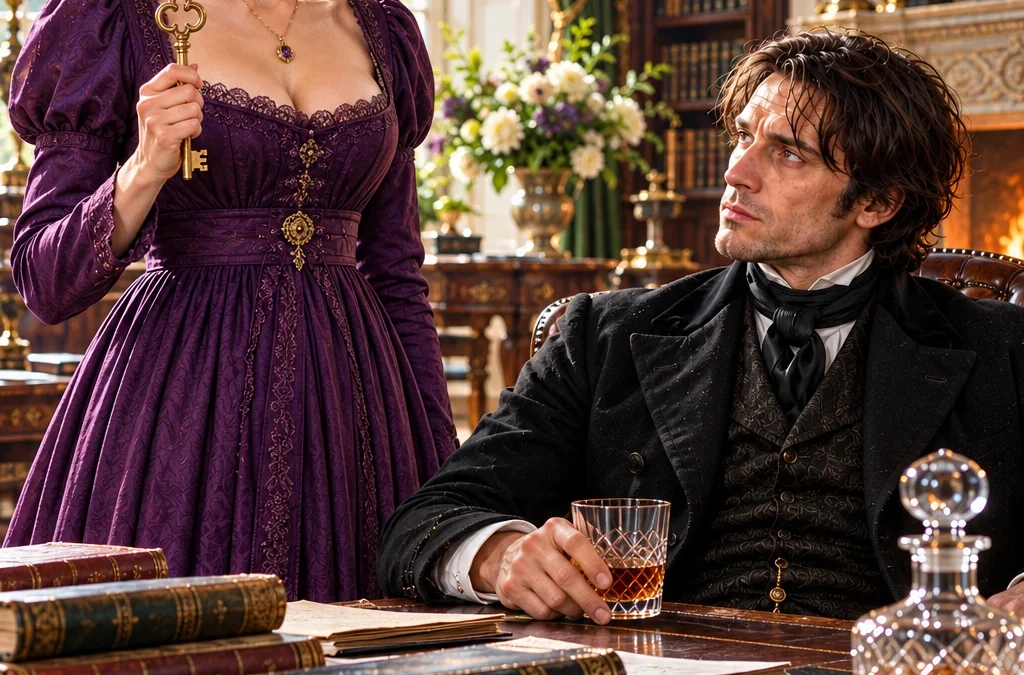
A Ruined Merchant Offered His Daughter to the Drunkard Duke to Erase a £900 Debt. By Morning, the Key to the Wine Cellar Had Vanished.
PART 1
On a night of heavy snow, a ruined wine merchant brought his daughter to the door of the most notorious drunkard in Derbyshire. ❄️
He offered her in marriage to erase a debt of £900.
The Duke was so drunk he could barely stand. His closest friend laughed out loud and called the match a bargain. But the young woman did not cry. She did not beg.
She looked the Duke straight in the eye and named a condition of her own. 😳
The first days of December brought a great snow to the hills. In the middle of that white wilderness stood Ravensmere Abbey, ringed by yew trees bowed under ice. It looked less like a home than a fortress the world had forgotten. Once the pride of the county, it was now a ruin in waiting. Candles guttered in their sockets. Cobwebs hung from the mounted stag antlers. The hearths were always short of coal, and most of the servants had gone. 🏚️
At the end of the long dining table sat one man with a decanter of brandy.
Nathaniel Vale, the ninth Duke of Ravensmere. Thirty-four years old, broad in the shoulders, gray eyes ringed with shadow, his once handsome face gaunt from sleepless nights and three long years of drink.
Three years earlier, he had been a proud and capable Duke, a superb horseman, a landlord his tenants spoke of with real respect. Now the county called him the drunken Duke.
Ever since his twin brother Frederick had drowned in the frozen lake behind the estate, Nathaniel had not been able to look in that direction. He drank to fall asleep. He drank to forget. And in the end, he drank simply to get out of bed the next morning. 🥃
Across the table, Sir Reginald Blackthorne lifted his own glass with easy grace. Forty-seven, polished and charming, he had been Nathaniel’s friend for years, and for the last three he had managed every penny of the Ravensmere finances. He never once tried to stop the Duke from pouring another glass.
“A grieving man needs something to carry him through the long days,” he liked to say.
Nathaniel never understood that his own dependence had become the most profitable venture of Blackthorne’s life.
Near midnight, carriage wheels crunched across the frozen courtyard. Henshaw, the sixty-eight-year-old butler, announced that Mr. Gideon Whitam, the wine merchant from Belwick, had come about his account.
He had brought his daughter.
Gideon entered in a faded coat dusted with snow, his face gray with cold and fear. Beside him stood a young woman of twenty-five in a gray wool dress mended many times, an old cloak, and a bonnet whose ribbons had faded to the color of weak tea.
Clara Whitam.
Not one man in the room stood to greet her.
Gideon explained that three years of wine had never been paid for. The sum had reached £900. His warehouse had closed, and his family stood to lose even their small house. Blackthorne feigned astonishment, though he himself had placed every order.
Then Gideon, trembling, made his final offer. If the Duke would cancel the debt, he could marry his daughter.
Blackthorne burst out laughing. “A drunken Duke and a bankrupt merchant’s daughter! The most perfectly matched couple Derbyshire has ever seen!”
Gideon lowered his face in shame.
Clara did not. 💔
Nathaniel lifted his heavy eyes to her. He was used to pity and disgust. She offered neither. She looked at him the way one might look at a man in very bad condition who was not necessarily beyond saving.
“Does your father have the right to decide for you, Miss Whitam?” he slurred.
“My father may speak about the debt, Your Grace. But my life is mine to decide.”
For one brief moment, Blackthorne stopped laughing.
Clara laid out her terms. She would accept if her family’s debt was resolved. But she would not become a joke, nor be directed by Sir Reginald. If she was to be the Duchess of Ravensmere, she would be a true wife, with authority to manage the household. She did not ask the Duke to love her. She asked only that he never insult her dignity.
Nathaniel, still drunk, studied her for a long moment and said yes.
And then Blackthorne drew from his coat a special marriage license, already prepared and signed. 😨
No one thought to ask how long he had been planning this, or why.
They were married by candlelight in the cold family chapel. Nathaniel stumbled through his vows. Clara did not falter on a single word. His late mother’s ring slid onto her finger, a little too loose.
The next morning, Nathaniel woke with a pounding head, went looking for a drink, and found that the key to the wine cellar was gone.
When Henshaw told him the new Duchess was holding it, he felt something new.
He was afraid of the woman he had married. 🗝️
She had gone to the cellar before dawn, sent for a locksmith, replaced both locks, and now wore the new key on a cord at her waist. She had paid for it from her own small purse. She had also asked the housekeeper to bring every account book on the estate to the study.
He found her at his late father’s desk, sleeves rolled, fingers stained with ink.
“The key, Clara.”
“No.”
“I am master of Ravensmere.”
“You are. And I am your wife. The keys of a household belong by custom to its mistress.” She glanced at his shaking hand. “You could not hold a teacup steady. I know the signs. I watched my grandfather sink into drink for years before it killed him. I do not intend to watch it again.”
“You know nothing about my grief!”
“I do not need to understand your whole past to see what is destroying you in the present.”
Something snapped in him. In desperation, he seized her wrist and tried to tear the key from her waist.
Henshaw and a young footman came running. Nathaniel saw the horror on the old butler’s face and understood he had become exactly the kind of man he despised.
He let go.
Clara did not cry out. She only stepped back. And that quiet step hurt him more than any accusation. 😶
By evening, he was burning with fever and shaking violently. In the worst hours of the night, he saw Frederick standing at the foot of the bed, clothes soaked through, and called his brother’s name again and again.
Clara stayed beside the bed. Her care did not mean she had forgotten what he had done. But she did not leave.
On the third night, the fever broke. He woke to find her sitting by the fire with a thick ledger on her lap.
“What are you reading?”
“The estate accounts. I have found a great many payments I cannot explain.”
He was silent for a long time. Then: “Read them to me.”
For the first time in three years, the Duke of Ravensmere wanted to know what was happening to his own house.
She turned to a page marked with red silk. A large sum had been spent repairing a tenant farm roof. According to the housekeeper, that roof had never been touched. And beside the payment, in neat, confident ink, stood the name of Sir Reginald Blackthorne. 😳
PART 2
Snow kept falling past the windows of Ravensmere. Every evening, Clara carried the account books to Nathaniel’s room and read them aloud. At first even simple sums made his head ache, so she simply read each entry again. 📒
£400 for a roof that still leaked. £320 for breeding cattle that never arrived. She had spoken to the farm manager and the older tenants. Every one confirmed it.
Nathaniel asked her to add every suspicious payment. She checked twice.
Over £4,000.
Enough to repair cottages, pay every overdue wage, and feed the estate through winter. While he had drowned himself in brandy, Blackthorne had been taking what belonged to the people who depended on Ravensmere to survive.
“He is not my friend,” Nathaniel said at last, staring into the fire. “He is only the man who made sure my glass was never empty.” 🔥
Weeks later, he came down the staircase and heard Blackthorne’s voice drifting from the study, scolding Clara for examining finances that were “no business for a woman.”
“The estate belongs to my husband,” she answered calmly, “and I have every right to learn why it is bleeding money. More than £4,000 in payments that no one has explained.”
Blackthorne laughed with open contempt. “You are the daughter of a failed tradesman. A woman handed over like a cask of wine nobody wanted to buy.”
“I was reading ledgers before I was old enough to enjoy a novel. Many wealthy gentlemen were never required to learn arithmetic. Now. Explain the payments with receipts rather than insults.”
Blackthorne’s smile went cold.
Hidden on the landing above, Nathaniel nearly rushed down. Then he realized she did not need rescuing. She had defended herself with facts. A new resolve took root in him. 💪
After a month of sobriety, Nathaniel rode out to the tenant farms he had abandoned for three years. The welcome was wary. He listened, took notes, and slowly relearned what it meant to be responsible for something.
One afternoon, he walked past the yews toward the lake. He had not set foot there in three years. Clara followed and simply waited beside him.
“This is where Frederick died.”
Then he told her everything. After an afternoon of hard drinking, the twins had wagered over who could swim across the lake and back before dark. Nathaniel gave up first. Frederick mocked him and swore to finish alone. The current near the old sluice gate was far stronger than it looked. By the time Nathaniel realized his brother had vanished, he was too drunk to find him.
“What I cannot forgive is not only that he died. It is that I was right there, and I was not sober enough to do anything that mattered.” 🌊
Clara did not deny his share of the blame. She asked one question. “Did you mean for Frederick to die?”
“No!”
“Then you made a dangerous choice, and the consequences were terrible. But that does not mean you owe the rest of your life to destroying yourself. You cannot bring him back. You can only decide how you live from this day forward.”
“I do not know where to begin.”
“Begin by being sober when life hands you the next choice.”
And Nathaniel laughed, a rough, clumsy sound, as though he had forgotten how. Tears ran down his face. For the first time in three years, he had spoken his brother’s name without reaching for a glass. 💧
On the walk back, their sleeves brushed. He wanted to take her hand. He did not. Not yet.
In the great hall, Blackthorne waited by the fire with a bright idea: a grand dinner on the anniversary of Frederick’s death, so all of Derbyshire could see how well its Duke had recovered.
Clara looked at his smile and felt a chill that had nothing to do with the weather.
January passed in light snowfalls and long, busy days. Clara found a cheaper slate supplier. The tenant who lost his cattle finally got new cows. Overdue wages were paid. Old servants asked to return, and closed rooms were aired. Every evening in the library she read to him, once even a long treatise on farm drainage whose passion for ditches left them both helpless with laughter. 😂
He noticed how she turned the loose wedding ring on her finger when she was thinking. Her work-roughened hands seemed lovelier than any jeweled ones in London.
Before one small dinner, she came down in a deep blue gown that had belonged to her mother.
“You look very beautiful, Clara.”
“I am only a wine merchant’s daughter, doing my best to dress like a duchess.”
“I did not marry a pretense.” 💙
But Blackthorne watched with growing alarm. So on the night before the anniversary dinner, he stood alone in the room where the drinks were kept. He drew a small dark glass bottle from his coat, looked at the silver punch bowl, and smiled.
The next evening, Ravensmere blazed against the falling snow. Among the guests was Lady Winifred Harbury, a widow of sixty-nine whose judgment could make or break a family’s standing. Most came not to celebrate, but to see whether the rumors were true.
Across the room, Nathaniel saw Blackthorne, back turned, tip a measure of liquid into the punch.
A few minutes later, Blackthorne pressed a cup into his hand. Nathaniel caught the faint bitter scent. Laudanum. 😨
He understood the whole design. If the Duke behaved like a drunkard in front of the county, everyone would conclude Clara had failed, and her accusations would sound like the bitterness of an angry wife.
He could not denounce Blackthorne without proof. So he let the man believe it had worked. He spilled the punch down his waistcoat and began to sway, to laugh too loudly, to lean on the table.
He had no idea his performance was about to wound someone far more deeply than Blackthorne ever could.
Clara hurried to his side. “Come away from the drinks.”
“I am perfectly well!” he said loudly, in exactly the voice of the man she had married on that first snowy night.
Clara froze. At dinner, Blackthorne leaned close and murmured that a man forced to marry a tradesman’s daughter over a debt had no reason to stay sober for her sake. Cruel words hovered at the edge of Nathaniel’s tongue, the words that would seal Blackthorne’s trap.
He could not say them. But he stayed silent far too long, and the whole table took that silence for what it was not.
Clara laid down her napkin and rose. “Forgive me. I do not have the strength to sit here and wait to hear what he intends to say next.”
She left the room with her head held high. 💔
PART 3
When the last carriage rolled away into the snow, Nathaniel climbed the stairs. What frightened him was not the loss of his reputation. It was the thought that the woman who had brought him back to life might never trust him again.
Her door was not locked. Clara sat by the window in the deep blue gown, its lace collar crumpled where she had pressed her hands to her face.
“I will listen in the morning,” she said without turning. “Tonight I am simply too tired.”
“Clara.”
There was no slur in it. Only a low, clear, entirely sober voice.
She turned. She watched him cross the room without the slightest unsteadiness. He knelt before her chair so she would not have to look up. 🕯️
“You are not drunk,” she whispered.
He told her everything: the laudanum, the pretense, the hope of making his enemy reveal himself before witnesses.
Relief came first. Then the pain.
“Why did you let me believe everything we built had fallen apart?”
“It was a cruel choice. Hurting you was never my aim. But I protected my plan and failed to protect the person who mattered most.” His voice shook. “I do not expect forgiveness tonight. I only want you to know my three months of sobriety were no pretense. The ledgers were real. The reading was real. The peace I found by the lake was real.”
She looked at the husband kneeling before her. On their wedding night she had been brought to this house like goods to settle an account. Now he was not giving orders or reminding her of his rank. He was asking if she would stand beside him.
“Yes,” said Clara. “But from now on, any plan touching our marriage will be decided by both of us.”
“Agreed.”
In the quiet of that room, they began to plan. When he rose, she caught his hand and held it a moment. There was no declaration of love. But for the first time, they stood on the same side without doubting each other’s motives. 🤝
Blackthorne assumed the Duchess had simply nowhere to go. He did not know that overnight, a secret letter had been sent to London.
Rumors of the disastrous dinner spread across the county. Nathaniel corrected none of it. Blackthorne took the silence as defeat, and little by little let down his guard.
Clara drew up a list of every sum paid to him and matched each against the farm records. Nathaniel rode to every farm that had supposedly received repairs. The contracts passed through the same land agent in Belwick, Silas Benton, who had certified repairs that never happened.
Then, in an old ledger, Clara found a withdrawal order bearing Nathaniel’s signature. She laid it beside documents he had signed before Frederick died. The forger had copied nearly every line perfectly. But he had missed one flourish at the end, a habit Nathaniel had kept since boyhood. 🔍
It was the first proof that Blackthorne had not merely mismanaged the estate. He had forged it.
An independent London solicitor, Mr. Arthur Fenwick, whom Nathaniel’s father had trusted, confirmed it. Three more forged orders were found. The total came to £4,160.
Two servants, Oliver Reed and Matthew Price, were too frightened to speak at first. Nathaniel gave his word that no one would be dismissed for telling the truth. Their statements were written down and signed.
Then Clara proposed a small dinner for the same families who had watched her humiliation. Blackthorne, assuming it was a desperate attempt to mend the Duke’s reputation, accepted without a moment’s suspicion.
“Three years ago, I let him speak for me,” Nathaniel told her on the eve. “Tomorrow, I will speak for myself.”
The dining room was lit once more. The same table, the same silver, an entirely different air. Nathaniel touched no wine. Clara sat at the far end in a simple dark green gown, a duchess in complete command of herself.
When the last course was cleared, Nathaniel rose. He did not lift a glass. He laid a thick folder on the table.
“I owe everyone here an explanation for what happened in this room. I did not relapse. I saw Sir Reginald pour laudanum into the punch. I played the drunkard to discover how far he would go.”
Blackthorne gave a strained laugh. “The poor Duke is imagining things. A lingering effect of his years of drinking.”
“I am not finished.”
He set out the four forged orders, the London solicitor’s analysis, and the papers for repairs that never existed. He named the figure. Then he looked Blackthorne straight in the eye.
“It was Clara who discovered the irregularities. You once told her she lacked the ability to read a gentleman’s accounts. Strange, then, that she could read everything you spent three years trying to hide.” 🔥
Guests turned to Clara with open astonishment.
Oliver and Matthew stepped into the room and testified. Blackthorne flew into a rage, calling them liars. But every account matched the documents.
“Sir Reginald is leaving my house,” said Nathaniel. “Please help him find the door.”
It was not a gentleman losing a debate. It was the fall of a manipulator before the very people he had despised. 🚪
In the silence, Nathaniel took from his pocket a brass key tied with a ribbon. The key to the wine cellar. That morning, Clara had returned it to him, wanting the next choice to be his alone.
Now, before every eye in the room, the Duke of Ravensmere knelt and placed it in her palm.
“My wife holds the key to the cellar, the key to the accounts, the key to my house, and every ounce of my trust. From this night forward, no one will call her a payment for a debt.”
Lady Harbury rose. She admitted she had judged the Duchess by her birth and by what she had seen at the last dinner. She apologized. Then she lifted her glass to the woman who had saved an estate from ruin through intelligence and courage. 🥂
One by one, the guests stood. The room that had witnessed Clara’s humiliation now rang with toasts in her honor.
As winter loosened its grip, the case became the talk of the county. Blackthorne was convicted of forgery and embezzlement, with total thefts above £4,300, and sentenced to transportation. Nathaniel took no joy in it. He felt only relief that the man who fed on his grief could never harm Ravensmere again.
One spring morning, he invited Gideon Whitam to the house. The merchant arrived pale, remembering the snowy night he had brought his daughter here.
“The £900 is forgiven in full,” said Nathaniel. Gideon wept. “But on one condition. You must never again use a member of your family as goods to solve a crisis. If you are ever in trouble, come and ask honestly. But never strip another person of their right to choose.”
Gideon bowed his head. After a long silence, he turned to his daughter. “I treated you as my last remaining asset instead of a human being. I am sorry.”
Clara heard him out. She accepted his apology, though it did not mean the past had never happened. Watching her, Nathaniel understood something. His wife never denied the wrongs others had done. Yet she could still see that they might become better.
That was exactly how she had treated him. 💛
When spring settled over the hills, she transformed the cellar. Every bottle was sold, the old racks torn out, and new shelves built along the stone walls. She turned it into a still room for herbal waters, remedies, and preserves. From her mother’s recipes came elderflower cordial and lavender water for the families of the estate.
“Does it not seem strange that the cellar that nearly destroyed me now helps the whole valley?”
“The stone walls are not to blame for what was once stored inside them. People decide what a place will be used for next.”
And in July, on a morning when the water shone gold and the current had been checked and found safe, Nathaniel finally went into the lake. 🌅
Stroke by stroke he moved away from the shore. He passed the old sluice gate that had haunted him for so long, keeping well clear of its pull. He remembered his brother’s laughter, the years before drink and guilt had torn everything apart. This time, the memories did not drag him under.
He reached the far side and swam back by his own strength. Clara handed him a towel. He dropped onto the grass, breathing hard, laughing.
“Frederick would have mocked me mercilessly for taking so many years.”
“I think Frederick would be glad you finally did it.”
He made no attempt to hide his tears. He took her hand.
In the years that followed, Ravensmere healed. The farms prospered. The cottages were repaired. Every shilling was accounted for openly. The great hall got a new carpet, the antlers were cleaned, and the candles never again guttered as they had on the night Clara arrived.
Each wedding anniversary, they held a small dinner for close friends. Lady Harbury never missed it, and each year she raised her glass to the Duchess who had rescued Ravensmere from ruin. 🕯️
On another winter night, snow fell once more. Nathaniel stood at the window, watching it cover the carriage drive. Clara came to stand beside him. He looked toward the chapel where their strange wedding had taken place.
“Have you ever regretted walking into this house?”
She studied him a moment. “I only regret that it took us so long to see it could become a home.”
He smiled and kissed her hand.
Behind them, the candles burned bright and steady. No cobwebs. No forgotten bottles. No man too drunk to stand. There was only a Duke, and the wife the whole world had once believed he did not deserve.
He had once believed her father used her to pay a debt of £900.
In the end, he understood that no sum of money on earth could ever have bought what she gave him. ❤️
Disclaimer: This story is entirely fictional and created for entertainment purposes only. It does not represent any organization or individual, nor does it encourage inappropriate behavior. The content was generated with AI assistance.
💬 Which moment hit you hardest: the missing key, the lake, or Nathaniel kneeling at the final dinner? Did Blackthorne get what he deserved? Tell me in the comments, and share this with someone who believes people can change. 👇








