A Scream Tore Through the Frozen Dawn. He Dragged a Dying Stranger Home. By Morning, Five Barefoot Women Rode In and Said, “You Pulled Our Father Out of the Earth.”
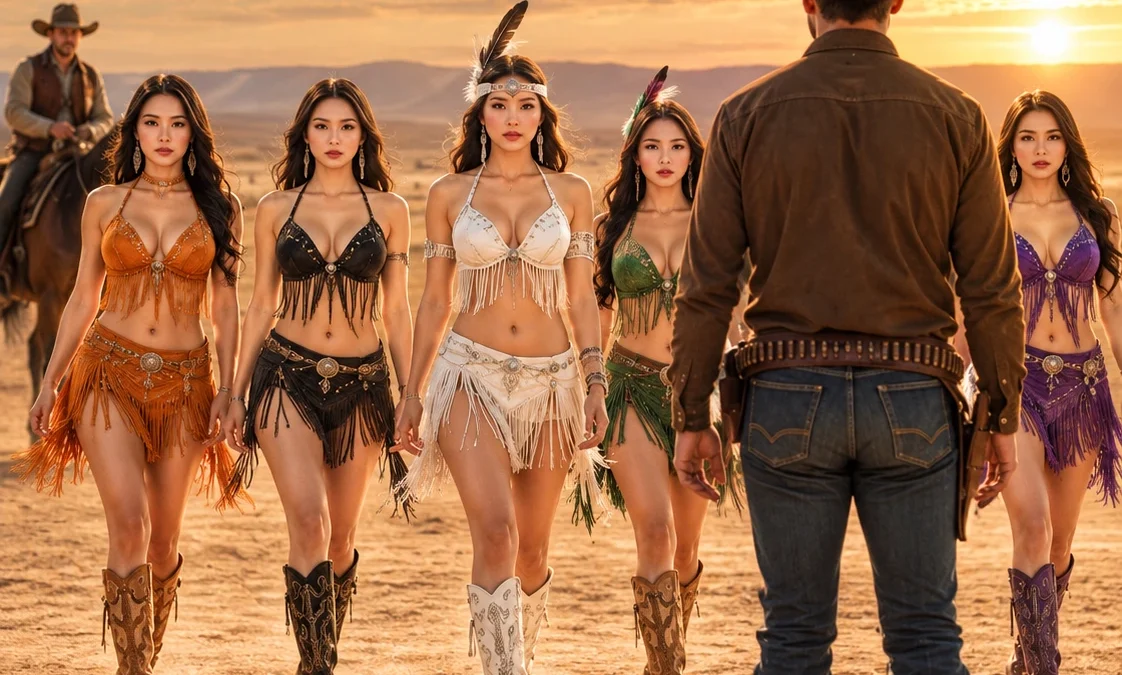
🔥 A Scream Tore Through the Frozen Dawn. He Dragged a Dying Stranger Home. By Morning, Five Barefoot Women Rode In and Said, “You Pulled Our Father Out of the Earth.” 😱
Part 1
A scream tore through the morning mist.
Sharp. Guttural. Too human to be mistaken for anything else.
It echoed across the Montana hills, chasing the silence off the ridgelines. Caleb Walker froze mid-swing, his ax hanging above a half-split log.
He listened. No second cry followed. Only the wind stirring the dry grass.
But years on the frontier and in bloodsoaked battlefields had taught Caleb something few men learned and even fewer survived to remember. When a sound like that cuts through stillness, it leaves a scar.
He slung his coat over his shoulder, holstered his revolver, and stepped into the pale light. His boots crunched across frozen ground. His breath hung in small clouds. The sun had not yet risen, but the fog was lifting, revealing long thin trails etched into the frost like veins across a dead man’s hand.
He found the body by a rocky outcrop.
Not dead. Not yet.
A man, native by the look of him, lay curled at an angle that spoke of pain and exhaustion. A broken arrow jutted from his side, buried deep beneath the ribs. Blood had crusted around the wound, but the smell of iron still clung to the air.
Caleb scanned the ground. No struggle. No scattered gear. No pursuers.
The man hadn’t been caught. He had come here, collapsing in silence, swallowed by the land.
His eyes flickered open just enough to register Caleb. Then they closed again.
Caleb hesitated. Ten years alone on this land had taught him not to get involved.
But something deeper, a buried instinct, worn but not lost, moved in him. He grunted, knelt, and heaved the stranger across his shoulders.
The man didn’t cry out. He didn’t have the strength.
The ride back was wordless. The wounded man, barely conscious, gripped the saddle horn with surprising steadiness, as if to say: I’m not done yet.
In the barn, Caleb worked in silence. Boiling water. Whiskey for the pain, though the man wouldn’t drink it. Strips of old linen soaked in heat. The arrow came out clean, but the blood ran fast and hot.
Caleb pressed hard against the wound.
“Don’t you go dying in my house,” he muttered.
It was less a plea than a command.
Near dawn, the man still hadn’t woken, but his breathing was steady and deep. Caleb slumped in a chair by the fire, eyes closed, not from sleep but from habit. That scream still rang in his ears.
When the first sunlight bled across the frost, he stepped onto the porch.
There in the snow were footprints.
Small. Bare. Delicate.
Not his. Not the stranger’s.
Someone else had come in the night, and left without a sound. 😳
Caleb didn’t sleep that night. Not truly. He sat by the fire, ears attuned to every creak of wood, every shift in the wind. Outside, the wind picked up, carrying a tension he hadn’t felt in years.
By sunrise, the tracks had faded into slush. No knock. No fire. Not even a stolen biscuit from the cupboard. Just the prints, like a whisper across the threshold.
He stepped outside with a mug of black coffee and scanned the pasture.
They were already there.
Five figures on horseback, moving slowly across the open field, silhouettes in the lifting mist. They rode with the confidence of people who knew exactly where they were going and exactly who they would find.
Caleb didn’t move. He sipped his coffee. Watched. Waited.
Women. All of them. Different ages, different frames, but sharing the same quiet strength in their posture. Their clothes were worn but well kept. Saddlebags tied with purpose.
Not drifters. Not beggars.
They dismounted in silence. One of them, a tall woman with thick gray streaks in her hair, stepped forward. She looked Caleb in the eye and nodded, neither deferential nor defiant.
“You pulled our father out of the earth,” she said. “We’ve come to hold up what’s left of him.”
Caleb blinked. “He’s still alive. For now.”
She didn’t ask permission to stay. None of them did.
They moved past him like they already belonged. One led her horse toward the barn. Another toward the shed. The youngest, barely more than a girl, slipped inside the house, her boots silent on the wood floor.
Caleb didn’t protest. Not with words. Not even with posture.
He simply stood there, coffee going cold, watching his world, so long silent, fill with the purposeful rustle of strangers who didn’t act like strangers.
At dusk, the barn smelled of straw and warmth again. Someone had lit the kitchen stove. The scent of root vegetables and smoked fat drifted through the walls.
Caleb sat on the porch. The youngest girl appeared beside him, barefoot on the old floorboards. She held out something small.
A carved pendant made of bone.
“He made this when he thought he was dying,” she said. “Told us to bring it to the one who pulled the arrow.”
Caleb took it without a word. He didn’t look at her. Didn’t ask her name. But he slipped the pendant into his pocket, fingers closing tight around it.
From the barn, someone was humming.
And for the first time in a decade, Caleb realized he was no longer the only heartbeat in the house.
By the third day, the place no longer smelled of dust and firewood. Broth and lye soap filled the corners. The women hauled water, patched the barn roof, mended the broken gate. They had not asked his permission to use the hammer.
It was as if the ranch itself had called them, and they had answered.
Caleb watched. The eldest, whom he had come to think of simply as Ma, walked the fence lines, knuckles brushing the wire like she was measuring old injuries. The tall one took inventory of his feed barrels like she had once run a cavalry supply line. And the youngest, Asha, brushed his horses with such tender certainty that the animals nickered as if she were part of the herd.
Near sundown, Asha approached with a bowl of something hot.
“You haven’t eaten.”
“I eat when I’m hungry.”
He took the bowl anyway.
She didn’t leave. She stood there, arms folded. “You’re not asking questions. You’re not the asking kind. That’s why we came.”
He looked at her then. Really looked. Her face was young but not soft. It bore the marks of places where names didn’t matter and faces didn’t last.
Before she stepped off the porch, she paused, not turning back.
“This land was empty because no one could hold it. We came to see if that’s still true.”
Caleb stared after her for a long time.
That night, when he walked the boundary, he looked back at the house and saw something he hadn’t expected. Not just his home.
A line, being drawn. Not between him and them. Between them and the world.
And he wasn’t sure yet which side he stood on.
Then, in the dead of night, the quietest of the women, Sonnie, spoke without turning her head.
“There will be men coming. Soon.”
Caleb frowned. “How many?”
“Enough. The kind who don’t let women like us settle without paying a price.”
And at dawn, when Caleb opened the front door, he found a fresh bootprint on the porch steps.
It faced the door. Whoever had made it had come all the way to the threshold and then turned back.
Not because they were afraid of what was inside.
Because they weren’t ready yet. 😨
Part 2
Not ready yet.
Caleb stood on the porch long after the print had stopped being fresh, studying the mud. The boot was too narrow for his, too large for any of the women, and pressed deep.
Whoever it was had stood there a long time.
He said nothing of it until breakfast. The women sat around the small table eating in silence. Ma sipped broth. Tula worked dough between her palms. Asha leaned against the doorway.
“Someone was here last night,” Caleb said. “Didn’t come to steal.”
They did not look surprised.
“They’re measuring,” said Mika.
“Testing boundaries,” Ma added.
Sonnie rose and went to the window. “Won’t be long before they stop watching and start deciding.”
Later that day, Caleb rode the perimeter. Three wires had been snipped clean, low to the ground. Not damage. Precision. One of the bone knives was missing from the tool wall. Winona’s herb beds had been overturned. Not destroyed. Tampered with.
Asha found the last of the arrowheads in a box near the forge and began fashioning new points by the fire. She didn’t say why. No one asked.
The next day, Caleb rode into town for salt and flour. The general store was nearly empty, the stove cold, but the eyes of the few men inside burned hotter than any flame.
Grady, the storekeeper, nodded without meeting his eyes. “Heard you got company up on that ranch.”
Caleb set his list on the counter.
“Five of them, isn’t it? A whole damn camp. Wild ones. Makes folks uneasy.”
Roy Dinsmore leaned against a shelf, arms crossed, grinning like he’d stepped in something he meant to drag across your floor. “Funny thing. That land used to be Boone property before he drank himself into the grave. Ain’t nobody claimed it legal since.”
“I’m on it,” Caleb said.
“Living on it ain’t the same.”
Caleb lifted the flour sack and turned.
“You might want to settle this before folks decide to settle it for you.”
Outside, the air felt tighter. Even the sky seemed lower.
He took the long path home through the ridge pines. When he reached the ranch, smoke curled from the chimney, Asha sat by the fence sharpening a knife, and Ma hung herbs in the window. They looked like they had always been there.
Caleb opened the drawer where he kept his deeds. It was empty. He had never needed one. He had claimed this land the way old mountain men did, with work, sweat, and years of silence.
But men like Roy weren’t looking for fairness. They were looking for excuses.
On the porch that night, Asha asked, “You afraid?”
“I should be.” He looked at her. “You?”
“Not anymore.”
In the distance, a coyote called once, then fell silent.
They came the next afternoon, when the light was strongest and the shadows shortest. As if to say: We aren’t hiding.
Three riders from the west, dust trailing behind like smoke from a slow fire. The first sat stiff in the saddle, a man raised more by orders than by sun. The second chewed a toothpick like it was his last meal. The third was Roy Dinsmore, smiling with everything but his eyes.
Caleb met them halfway between the barn and the porch. He did not carry his rifle. His hands were enough.
“We came to ask about your arrangement here,” the first man said.
“No arrangement. They live. I live.”
Roy chuckled. “Five women, no kin, no papers, settling on what some folks still consider open land.”
“It ain’t open,” Caleb said flatly. “It’s occupied.”
Asha appeared behind him, arms crossed. Ma stepped onto the porch. Mika leaned on the rail, a short ax dangling from her belt. No one spoke, but the message was clear.
“What gives you the right to claim it?” the first man demanded.
Caleb looked him dead in the eyes. “Blood. Work. Time.”
Roy’s hand drifted toward his saddlebag. Just a little. Just enough to be noticed.
Tula stepped out of the barn with a shovel slung across her shoulder. That was enough.
“We’ll be seeing you again,” the first man said, “with more than questions.”
They turned their horses without hurry, but without joy. Men who had come expecting fear and found something else. Something steady.
“You think they’re bluffing?” Asha asked.
“No. I think they’ll wait for the wind to change. Then they’ll burn whatever’s left.”
He glanced at the five faces behind him.
“And we don’t burn easy.”
But the next dawn brought something worse than riders.
Three symbols, drawn in ash outside the barn door. Circles within circles. A broken line cut through them, sharp and final. Feathers had been tied to the fence, hawk, raven, crow, all facing inward.
Asha knelt by the marks, and her face went still.
“This is a boundary spell,” she murmured. “But one meant to erase. Not to protect.”
Ma stared at it with calm eyes. “They didn’t come to kill. They came to claim.”
Caleb stared at the ash, and a cold understanding crept up his spine. Whoever had drawn it had known exactly what it meant.
And they had known exactly who in that house would recognize it.
Part 3
Mika spat on the ground beside the ash. “Let’s give them a boundary of our own.”
That afternoon, Caleb stoked the fire pit until the coals glowed white. He dragged out the old cattle branding iron, long rusted, and the women reshaped its tip together. Mika carved a new face from iron. Sonnie cooled it in snow. Asha polished it until it caught the firelight.
The design was five branches, interwoven, bound at the root.
At dusk, they burned it into the center beam above the gate. Smoke curled skyward like a signal. No one said a word. 🔥
That night, Caleb watched from the porch. Across the valley, flames flickered in the distance. Other camps. Other watchers. Someone knew what they had done, and they did not like it.
In the morning, he found the brand smeared thick with pig fat, meant to rot and draw flies.
He cleaned it in silence, reheated the iron, and branded the beam again. Two marks now, side by side.
“They want us to stop marking this place,” Asha said.
“They want us to forget we belong here,” said Ma.
Caleb looked at the glowing iron.
“Then we mark it again.”
And they did, three nights in a row.
The snow was gone, but the cold lingered, pressing into the bones of the house like an old regret. For three nights they waited, not out of fear, but because waiting is its own kind of war.
Caleb walked the line at dusk, rifle across his back. He wasn’t looking for signs anymore. He knew the signs. He was chasing a feeling now, the moment when the stillness turned too clean, too careful.
Inside, the others had found their rhythms. Ma brewed herbs with the patience of a woman who had buried husbands. Mika sharpened tools. Winona wrote in a book no one was ever allowed to see. Asha walked the fence each morning, fingers brushing the wood as though she could hear it speak.
It was Sonnie who saw them first. Two riders in the hills beyond the east ridge. They didn’t come close. They didn’t wave. They sat like crows on a split rail.
“Marking time,” she said. “Seeing how long we hold our breath.”
That night, Caleb found Asha at the edge of the porch, bare feet against the cold wood, a knife lying across her lap, not drawn, just there.
“They’re not coming tonight,” he said.
“You sure?”
She didn’t answer right away. Her eyes were fixed on something far past the field.
“I used to live near this kind of waiting,” she said quietly. “Where men decided your life was worth less than their pride. They didn’t come in rage. They came calm. Prepared. Like business.”
Caleb sat beside her. “Did they take something from you?”
A long pause. “No. Because I left before they could.”
Another silence. This one felt different. Not empty. Full.
“What about you?” she asked.
Caleb stared into the dark. “They took everything. But they did it one piece at a time, so I didn’t notice until I was empty.”
Asha turned to look at him. “You’re not empty now.”
He didn’t reply. But he didn’t disagree.
The next morning, someone had left a single horseshoe by the creek, polished, standing upright on a flat stone. A challenge. Caleb turned it over in his hand. The iron was still warm.
“Means they were close,” Mika said, appearing behind him. “Close enough to know we’d find it.”
“They want us to come out or give up.”
“They’re going to be disappointed.”
That night, no one slept. Sleep felt like surrender. They played cards by lantern light. Ma told stories that drifted into parables. Winona sang a single soft lullaby in a language Caleb didn’t know, and it made the walls feel thicker. 🌙
Near midnight, the horses in the barn stirred. Caleb went out with Asha, rifles in hand. They saw nothing at first.
Then, by the tree line, a flicker.
Not a man. A match. Someone lighting a cigarette in the dark, just long enough to show they were there. Just long enough to prove they weren’t afraid to wait either.
Then nothing.
Back inside, Caleb stared into the fire.
“You think they’re trying to wear us down?” Asha asked.
“No. They’re trying to make us blink.” He looked at her. “And if we don’t, they have to show who they really are.”
They came at first light.
Six men on horseback, riding single file along the ridge the way soldiers move, the way hunters track. No banners. No war cries. Just the creak of saddle leather and the distant thunder of hooves over dry soil.
By the time they reached the lower field, the ranch was already in formation. Ma stood by the door, arms crossed, her apron dusted with flour. Mika waited near the forge, hands black with soot but steady. Winona knelt by the herb beds, eyes down but ears turned toward the danger. Sonnie sat on the porch rail, legs swinging, a knife spinning slowly between her fingers.
Asha was already beside Caleb when the riders dismounted.
Roy Dinsmore was not among them this time. The new leader wore a faded blue jacket with dulled brass buttons. He had a face made for sermons and eyes built for verdicts.
“You’ve had our patience,” he said.
Caleb did not respond.
“You are occupying land with no legal deed, harboring women of uncertain status, and obstructing the natural order of this territory.”
Ma chuckled once. “Didn’t realize God started issuing building permits.”
The man’s jaw tensed.
Asha stepped forward. “This land was nothing before we made it something.”
“And that’s the problem. You made it something that doesn’t fit.”
Caleb’s voice cut through. “We didn’t ask permission. That doesn’t mean we’re giving it back.”
The tension hummed. A hand twitched near a revolver. A boot scuffed the dirt.
Then Sonnie stood.
“Fire one shot,” she said, almost gently, “and I’ll cut down the first man who moves next.”
She wasn’t yelling. That made it worse.
The man in blue stepped forward slowly. Not toward Caleb, but toward the gate. He stared at the five-branch brand, still blackened from the last burning.
“What does it mean?”
Caleb answered. “It means we belong here together.”
The man touched the wood once. Then turned back to his men.
“We’ll be back. With paper. With law.”
Caleb gave a short nod. “Bring whatever you need.”
And just like that, they rode away. Not in defeat. In retreat. For now.
The dust settled slowly. The silence returned, but it no longer felt like solitude. It felt earned. Asha laid a hand on Caleb’s shoulder. No words. Just that. 💛
The men never returned the way they had promised, with paper and badges and dusty ledgers. For days the ranch waited, coiled like a spring. But when no one came, the tension did not snap. It simply unwound into motion.
The women did not celebrate. No shouts, no songs. That was not their way. They rose earlier the next morning. The forge was hot by sunrise. The herb beds were replanted with sturdier roots. The chicken coop got new hinges. The gate was branded a third time.
If the world outside the fence wanted them gone, it would have to try harder.
And Caleb, for the first time in years, stopped checking the windows at night.
Then, one morning, the man they had pulled from the woods opened his eyes.
He didn’t speak much, his voice a rasp. But when he did, he asked for Ma first. She sat by his side for hours, feeding him broth, telling him stories from when he was small. His daughters never left the ranch again. 🥹
It was Asha who said it first, quietly, as she tied bundles of dried lavender for the rafters.
“I don’t think we’re leaving.”
Caleb was mending a saddle girth with Sonnie, threading thick cord through steel. He did not respond right away.
“You all right with that?” she asked.
He paused, knife in hand. “I think I’ve been waiting for you longer than I’ve been alone.”
That night, Asha sat on the porch with her feet tucked beneath a blanket, watching the stars break open the sky. Caleb joined her and set two cups of coffee between them. She didn’t speak, but the slight lean of her shoulder toward his was answer enough.
No one called the ranch by name. The brand above the gate was name enough. Travelers began to come, quiet and respectful, bringing goods to trade, news to share, sometimes only stories to leave behind. None asked who owned the place. None were foolish enough to try claiming it.
Word spread. They called it the place where the women stayed. The place where the man didn’t ask them to leave.
In spring, the soil softened under their hands. Crops grew. Trees budded. The creek swelled with cold, fast meltwater. New life arrived: chicks, foals, a litter of barn cats that Winona insisted on naming after old stars. ⭐
Caleb began to write again. Small notes, lists, but sometimes he let his pencil wander. In the back of an old journal, beneath the page where his wife’s name had once been the last entry, he wrote five words.
They stayed, and so did I.
He never crossed out the old name. But he stopped writing only about ghosts.
One evening, Ma found a box of seeds left near the gate. No note. Wrapped tight in oilcloth, neat rows of wheat, barley, and onions. A peace offering, or perhaps an acknowledgment. Not everyone who had watched from the ridge was an enemy. Some were just men caught between a past and a future they didn’t yet understand.
The days grew longer. The women stopped locking their doors at night, not because they had forgotten what danger felt like, but because they had changed what safety meant. Each of them had built walls in the world before: walls of silence, of running, of knowing better than to stay too long. But here, among the timber and the fences and the slow breath of horses, they had built something different.
Not a house. A home.
Caleb never led them. But they let him stand with them.
That summer, a storm ripped half the roof from the barn. They rebuilt it in two days, not out of fear of the next storm, but because they were finally living for what would come after it. They planted corn. Caleb started singing again, short bits of old cowboy hymns while he worked. Asha laughed when she caught him off-key, and for once, he didn’t stop. 🎶
Sometimes at night he still sat alone at the porch rail. The land stretched out before him, unchanged yet never the same. Behind him, the quiet murmur of women tending small things. The flick of a page. The soft clatter of mugs. The rustle of wind through linen curtains.
He no longer needed to look back. Nothing he had left behind could rival what stood in front of him now.
Some places are not built for spectacle. They do not boast. They do not call attention. They endure.
The ranch in Montana was such a place. Lonely, raw, quiet as a wound that never fully closes. It did not promise salvation. It did not offer escape. But for those who arrived broken, exhausted, or simply needing somewhere to stand still, it offered the most precious thing of all.
A chance to begin again.
Caleb had never gone looking for them. The women had never sought a leader. No one drew a map to this place. And yet, by some quiet grace, they found each other. They came not to be saved, but to survive, and then, slowly, to live.
The lesson is not about grand battles or bold declarations. It is about what happens in the quiet, defiant choice to stay. In a world that rewards running, from pain, from responsibility, from the risk of belonging, these people chose otherwise. They built something not with words, but with sweat, with care, with unspoken trust. They defended it not with violence, but with presence.
Strength, here, wore no armor. It carried no flag. Strength was a woman planting herbs after her fence was cut. A man mending a gate for people he hadn’t known he needed. A girl brushing a horse like she had always belonged.
This is what community looks like at its rawest, its most real: a handful of people choosing each other again and again, not because they must, but because they can.
In the end, it was not about who came.
It was about who stayed.
And what they grew, no one could ever take. 🌾
This story is entirely fictional and created for entertainment purposes only. It does not represent any organization or individual, nor does it encourage inappropriate behavior. The content was generated with AI assistance.








