A Teen Vanished on a Sunny Yosemite Trail. Three Years Later, Hikers Spotted Something Sitting 20 Feet Up an Old Pine, Smiling at Them With an Impossible Secret
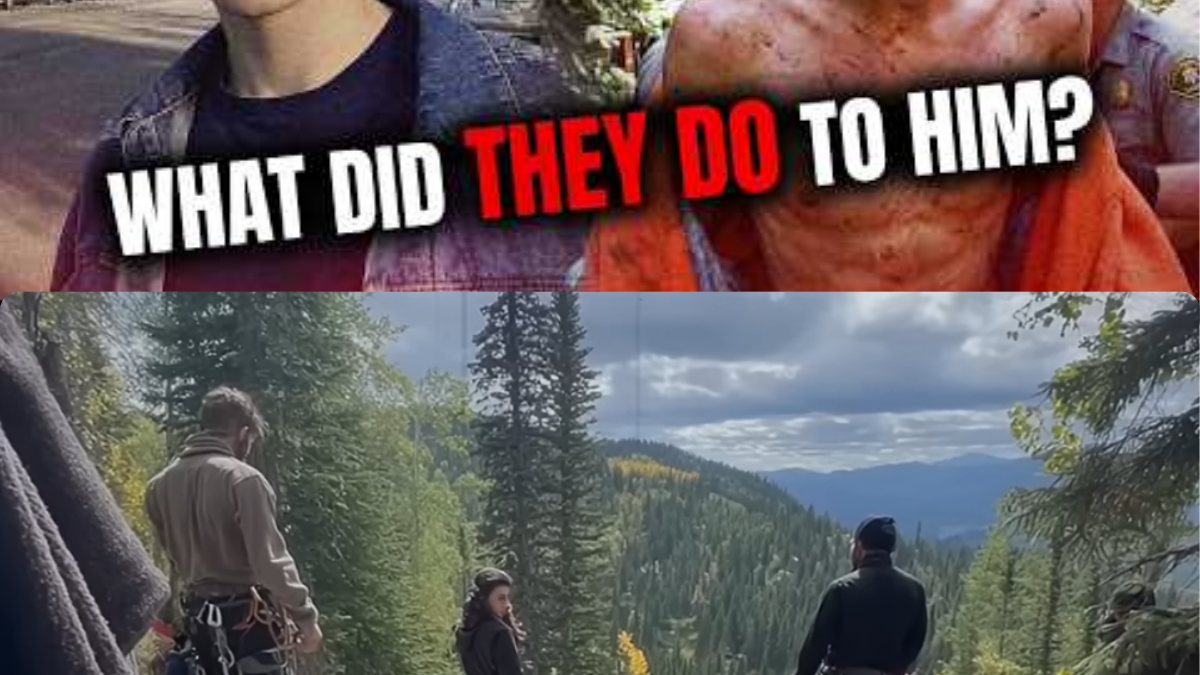
A Teen Vanished on a Sunny Yosemite Trail. Three Years Later, Hikers Spotted Something Sitting 20 Feet Up an Old Pine, Smiling at Them With an Impossible Secret 😨
Part 1
On the morning of July 12, 2013, five hikers stopped for a break beneath North Dome in Yosemite and noticed something strange in the branches of an old pine.
At first, they thought it was a scrap of fabric torn loose in a storm.
Then it moved.
Jonathan Reeves, the group’s leader, raised his binoculars and felt a chill crawl down his spine. It was a person. They sat twenty feet above the ground on a thick branch, wrapped in rags of no color at all, long fingers hooked into the bark as if trying to become part of the tree.
They did not shout or wave. They did not ask for help.
When the hikers reached the base of the trunk, the figure slowly lowered its head and looked straight at them.
“It was a look empty of every human emotion,” Reeves would later write in his report, “except one. A frozen, impossible joy.”
Three years earlier, on June 15, 2010, eighteen-year-old Ethan Harlow had walked out of his front door into a morning so clear that the granite walls of Yosemite Valley seemed carved from glass.
He was the captain of his school team, a straight-A student, and the kind of boy neighbors pointed to when they talked about the future. In a few months he would leave for university. This hike was meant to be the start of his last perfect summer.
His parents, Sarah and Mark Harlow, would later say the morning felt too perfect. Their son had been unusually happy.
Ethan set out for the Mirror Lake Loop with three close friends: Liam, Marcus, and Chloe. By 9:45 a.m. they were at the trailhead, and a security camera caught their car pulling in calmly, with no hint of what was coming.
Around 11:30, the friends entered a narrow stretch of trail in Tenaya Canyon. Rangers privately call this part of the park “the zone of silence,” because the dense pines and towering rock swallow sound whole.
Liam, Marcus, and Chloe walked ahead. Ethan lingered behind, adjusting the focus on his camera.
Chloe looked back and saw him, only a hundred and fifty yards away, in full sun, on a straight and open stretch of the path. Only a few boulders and pines stood between them.
No scream. No falling rock. No struggle.
Just a strange, heavy silence, as if the canyon itself were holding its breath.
Five minutes later, when the friends stopped to wait, the trail behind them was empty.
They called his name for thirty minutes. They searched the brush for a quarter mile.
The forest did not answer.
By evening, Sarah Harlow had called her son’s phone nine times. The carrier later confirmed its last signal had pinged a tower near the park entrance at 9:20 a.m. After that, nothing.
By 8:15 p.m., Mark was standing at the ranger stand in the parking lot, waiting for a patrol car.
The next morning, dogs from Mariposa County and a helicopter joined the hunt. The dogs picked up Ethan’s scent for the first mile of the trail, where dozens of hikers had passed. Then it died on the rocky terraces as if he had stepped off the earth.
On the third day, searchers found the only physical clue they would ever recover.
Ethan’s sunglasses lay on a flat rock in the middle of the trail, half a mile from where he was last seen. They had been set down carefully, arms folded, without a single scratch on the lenses.
They had not fallen. They had not been dropped.
They had been placed.
Detectives stared at them in silence. It looked like a message. A calling card. Proof that someone had been there.
Yet there was no sign of a struggle, no blood, and no disturbed soil. Rangers suggested a cougar, but experienced trackers shook their heads. Predators always leave something behind. This place was clean. 🕯️
For weeks the search went on through abandoned mines and dry creek beds. Then it slowed, and then it stopped.
Every day, Sarah Harlow drove to the park entrance and sat behind the wheel for hours, staring at the road. Each time a patrol car passed, her hands trembled with hope. Each evening that hope turned to stone.
Ethan Harlow had simply dissolved into the granite.
Until the morning of July 12, 2013, exactly 1,123 days later.
David Miller, the first rescue climber to reach the pine, moved up the rope slowly. He did not yet know that the man in the tree was the same boy whose disappearance had triggered the largest search in the park’s history.
The figure was skeletal. Ribs showed through the rags, and his skin was gray and scratched.
But when Miller came within a few feet, he recoiled.
The young man, who should have been twenty-one, was smiling.
It was a broad, stretched, grotesque smile that pulled his gaunt face from ear to ear like a mask.
Ethan did not speak. He did not flinch. His eyes were fixed on something far beyond the rescuers.
They lowered him to the ground on ropes, and for the first time they saw why the smile looked so wrong. As his lips pulled back, a silence fell over the group.
His mouth was empty.
Ethan Harlow had no teeth at all. His gums were mangled, scarred, and ridged with uneven growths of tissue.
At the hospital, the forensic dentist who examined him the next morning pulled off his gloves very slowly.
His teeth had not rotted. They had not been knocked out in a fall.
They had been taken, one by one, over three years.
Part 2
His teeth had not rotted. They had not been knocked out in a fall. They had been taken, one by one, over three years.
The dentist’s report was cold and exact. The extractions had been done with a strange, amateur precision, as if someone were imitating a medical procedure with the wrong tools. Industrial pliers. Construction clamps. The jawbone was cracked in dozens of places and had healed badly, leaving painful ridges.
Even more chilling was the timeline.
Some of the empty sockets had sealed over completely, which meant those teeth were pulled within the first months of his disappearance. Others were fresh, taken only weeks before the hikers saw him.
Whoever did this had never stopped.
Ethan was moved to an isolated hospital unit the staff called Ward 4. He weighed ninety-eight pounds. He flinched from sunlight and crawled under the blankets whenever someone raised the blinds.
And he shook at any metallic sound. A rolling cart. A set of keys. A dropped instrument. His body would convulse as if the sound itself were a blade.
White coats froze him into a catatonic stupor. He stopped blinking. His gaze turned to glass.
He could not speak. He answered no written questions. The only sound he made was a faint, guttural whisper in his throat.
So the police did what many in the department called an act of desperation. They went back to the beginning.
They went back to the three friends. 🌙
Three years had turned teenagers into adults, but not into calm witnesses.
Marcus was a wreck. During five hours of questioning, he avoided every pair of eyes and picked at the skin on his fingers until blood seeped from under his nails. His memories of that day were absurdly detailed in places, and completely blank in others.
Chloe was the opposite. Her calm was unnatural. When detectives laid photographs of Ethan’s emaciated body in front of her, she did not flinch. She answered in short, flat sentences.
The officer in the room wrote in his report that her composure felt “rehearsed.”
To many investigators, the case was suddenly simple. A prank gone wrong. A cover-up. A kidnapping staged to hide an accident.
But in the analysts’ office, a different team had been pulling old archives from the park’s far northwest, near an area called Crane Flat. In 2010, searchers had skipped it. It was on the opposite side of the park, and no one believed a kidnapper could have carried a victim that far without being seen.
There, an abandoned sawmill sat rotting in the trees. Foresters’ old diaries mentioned strange lights in its windows at night, and the hum of a generator deep in the woods.
In 2010, those reports had been dismissed as homeless campers.
Then the digital forensics team finished enhancing the security footage from the park’s main exit on June 15, 2010.
An old, dark car, belonging to no one in Ethan’s circle and registered at no hotel, had turned onto a service road. The road led straight to the sawmill.
The timestamp read forty-five minutes after Ethan vanished from the trail.
Investigators stared at the screen. For three years, hundreds of volunteers had combed the forest around Tenaya Canyon.
And Ethan had been sitting underground, on the opposite side of the park, the entire time.
Marcus’s trembling hands had never been guilt. They had been terror, the instinctive fear of something he could not name. Chloe’s cold face had been a wall built against trauma.
The friends were innocent.
Now the detectives needed the one thing the video could not give them. They needed the name of the car’s owner.
The technician typed the plate into the database.
The screen flickered.
And Detective Lambert, who had spent twenty years reading files on the worst men in California, felt a cold hand close around his throat.
Part 3
The name on the screen was Victor Graves.
He was twenty-eight years old. He lived in a quiet suburb of Mariposa. And as Lambert’s team dug into his past, the picture that emerged was not that of a random monster.
It was something far more disturbing.
Victor Graves had once been one of the brightest dental students at the University of California, a young man predicted to have a brilliant future in maxillofacial surgery.
In 2008, it ended abruptly. The dean’s office expelled him permanently, citing a “morbid fixation on the physiology of pain” and repeated aggression toward instructors during practical classes. A supplementary report said he had run unauthorized experiments on laboratory animals, trying to find the exact limit at which pain becomes unbearable but does not cause death.
The dream of becoming a doctor collapsed. And Victor never accepted it.
Investigators went through his finances and found the next piece. In April 2010, two months before Ethan disappeared, he had used fake accounts and illegal online marketplaces to order a large batch of lidocaine, surgical elevators, dental forceps, and sterile solutions.
He did not order them for a clinic. He ordered them for a room only he knew existed.
His job gave him the rest. Since 2009, Victor had worked as a night watchman at Woodside Supply, a company that delivered construction materials for park maintenance. His workplace sat three miles from the abandoned Pine Creek Mill. He had keys to the barriers on closed service roads and knew every ranger patrol schedule down to the minute.
Even the rangers’ own logs betrayed him. For three years, a white Ford pickup had been spotted repeatedly on closed fire roads. Each time, it had been written off as the excessive diligence of a conscientious guard.
It had been his supply line.
Then, on July 21, 2013, Ethan began to speak.
It came as a whisper, with barely any movement of his lips, as if opening his mouth wide brought pain or panic. He told Detective Lambert the truth in fragments, and it took ten days to assemble them into a single picture.
He described a white room, fifteen by twenty feet, deep underground. It smelled of medical alcohol and cold, raw earth. Black mold and tree roots showed through the paint on the walls.
Ethan called the man who kept him there only one thing.
The doctor.
The doctor never raised his voice. He never shouted. He spoke to Ethan like a clinician to a specimen, and he called him Patient Number One.
Every few months, he came with a metal tray. The soft clink of steel on steel was the sound that made Ethan convulse in Ward 4. During each procedure, the doctor demanded perfect stillness. Any flinch was “patient disobedience,” punished by weeks of total darkness or days without water.
And he whispered the same thing every time: each loss was a step toward purification.
Ethan had one more thing to tell.
In early May 2010, a month before the hike, he had begun to feel watched. He had seen a stranger in a white pickup behind the fence of his school’s sports field. Once, late at night, he had seen the same figure near his house while taking out the trash.
The hunt had been planned for months.
One night, in the middle of a sentence, Ethan froze, staring in terror at the ward door. When a nurse tried to calm him, he whispered that the doctor would come for him because he had broken patient confidentiality.
Police tightened security at the hospital. Every visitor was checked twice. Every service exit was sealed.
But they already had a name.
At 5:00 a.m. on July 31, 2013, a Mariposa County task force and a tactical unit moved in on the abandoned Pine Creek Mill.
A cold fog hung over the stream. The old sawmill loomed above them like the skeleton of some enormous beast, wrapped in moss and vines.
The basement entrance was hidden beneath rusted metal sheets and sawdust in a corner of the old woodworking shop. Behind it, officers found a heavy airtight door with a modern electronic lock.
When they forced it open, a concrete corridor stretched downward. The floor was covered in medical-grade linoleum, a clean white strip cutting through the rot above.
At the end was a room the case files would later call the pain room.
A makeshift dental chair stood in the center, built from old office furniture and industrial parts, with worn leather straps on the armrests and footrest. A shadowless lamp hung above it, powered by a standalone generator. The air smelled of iodine, chlorine, and damp earth, exactly as Ethan had described.
Along the wall, on glass shelves, officers found thirty-two small plastic containers.
Each held a single human tooth. Each had a label with a date written in careful, elegant handwriting.
The first date was June 15, 2010, the day Ethan vanished. The last was three days before the hikers spotted him in the tree.
Beside the instruments lay old university textbooks, their margins filled with Graves’s notes. He had recorded Ethan’s resistance and his reaction to pain. He had written that he was “cutting out the rotten roots of society” and saving Ethan “from the lies that his teeth told.”
And on the shelf, at the very end of the row, one container stood empty.
Victor had been saving it for the last stage.
Graves was arrested at 8:45 that morning on Highway 49, in his white pickup, loaded with fuel cans and a change of clothes.
He did not resist. He showed no fear and no remorse. According to the arrest report, he looked at the officers with contempt, like men who had interrupted an important experiment.
“I gave him help that no one else in this worthless world dared to give,” he told Lambert. “I spent three years cleansing him. Every tooth was a victory over the false social mask.”
To Victor Graves, Ethan had never been a person.
He had been a patient, a punishment, and a revenge on the profession that had thrown him out.
The central mystery of the sunglasses finally made sense. They had been Victor’s signature, the first thing he left behind. A gentleman’s courtesy to a victim. A sign to the world that he had been there, and that no one had noticed.
And the tree.
Ethan had not been abandoned in the tree. Doctors and detectives believed that in his final weeks, after the last extraction, he had found some way to escape the bunker, or Graves had released him in the forest, and he climbed. Twenty feet above the ground, among the branches, he had finally found the only place where the doctor could not reach him.
Detective Lambert would say later that Ethan had survived because Victor Graves did not yet consider his treatment finished.
The trial opened on September 15, 2014, in Mariposa County Superior Court. The courtroom was packed. Reporters, activists, and neighbors who had followed the case for years stared at the glass booth where Graves sat upright, motionless.
When the prosecutor showed the jury the thirty-two small boxes, he never blinked.
His lawyers argued insanity, claiming schizotypal disorder and messianic delusions. An independent psychiatric panel rejected it. Graves had high intelligence and acted according to a clear plan. He had known precisely what he was doing.
On October 23, 2014, at 2:30 p.m., he was found guilty on all counts: kidnapping, unlawful imprisonment, and grievous bodily harm with particular cruelty. The judge sentenced him to life in a maximum-security prison without the possibility of parole.
When the gavel fell, Victor Graves only nodded slightly, as if he had received approval for years of scientific work.
For Ethan, the verdict was a legal ending. It was not the end of the story.
When he returned to his parents’ house in Mariposa, it was only his body that came home. Sarah and Mark Harlow told psychologists that their son was a shadow of the laughing boy who had once dreamed of university.
The house that had been full of music fell silent.
Ethan could not use metal cutlery. The clink of a fork against a plate triggered instant panic: shaking, hands over his face, crawling under the table. The family switched to soft plastic dishes. He ate only purees, yogurt, and broth. Anything solid reminded him of the underground room.
The best specialists in the state fitted him with modern dentures that restored his appearance completely.
Yet he almost never smiled.
Sarah said he could sit by the window for hours, watching the forest with a lifeless gaze. When he caught his own reflection, he turned away immediately, as if afraid to see not the new teeth, but the emptiness that Victor Graves had made over 1,123 days.
In his final report, Detective Lambert wrote the words that would become the epilogue to the case:
“We found Ethan twenty feet in the air, where he was trying to hide from the world. He survived by escaping into the wilderness, but he will forever remain the boy in the tree.”
For the Harlows and the community, Yosemite would never mean the same thing again. The granite cliffs and ancient pines no longer felt like symbols of eternity. Behind every tree, every crevice, and every abandoned building, they now saw someone’s unfinished, sick dream.
Monsters, the case reminded everyone, do not live only in fairy tales.
Sometimes they wear white coats and know every service road by heart.
And the silence in Tenaya Canyon still holds the doctor’s whispers, and the frozen scream of the one who returned from the forest but never fully came back to life. 🌙💔
This story is entirely fictional and created for entertainment purposes only. It does not represent any organization or individual, nor does it encourage inappropriate behavior. The content was generated with AI assistance.








