A THOUSAND SILVER MARKS FOR ANYONE WHO COULD OUTSHOOT HIM. THE WOLFLESS WAITRESS HIT THE BULLSEYE ON HER FIRST SHOT. THEN THE HOODED STRANGER IN THE CORNER WHISPERED HER DEAD FATHER’S NAME
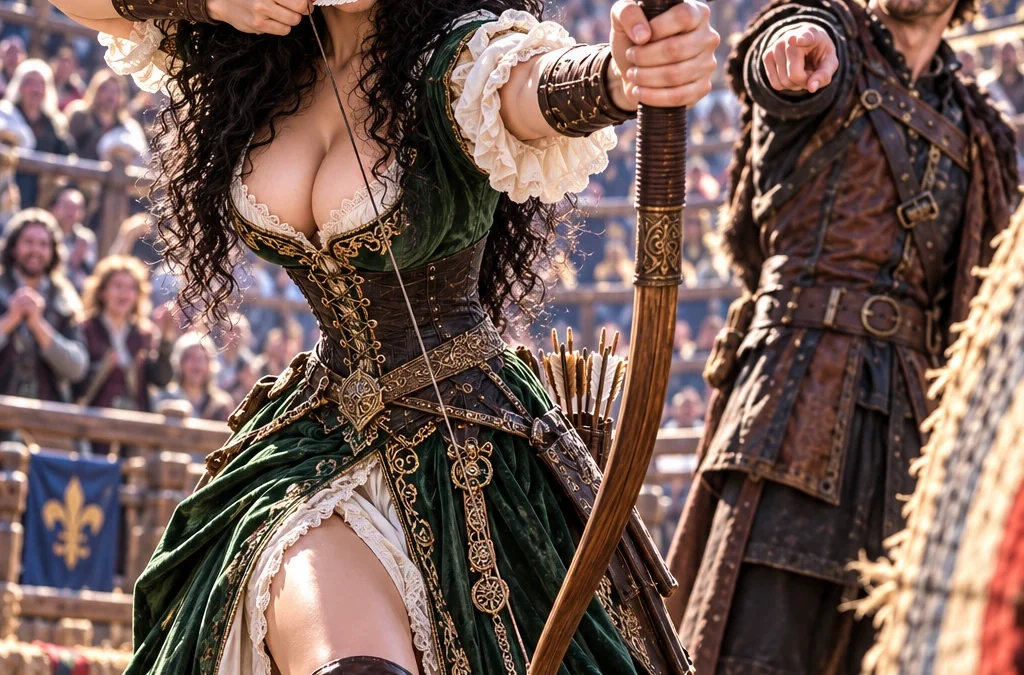
A THOUSAND SILVER MARKS FOR ANYONE WHO COULD OUTSHOOT HIM. THE WOLFLESS WAITRESS HIT THE BULLSEYE ON HER FIRST SHOT. THEN THE HOODED STRANGER IN THE CORNER WHISPERED HER DEAD FATHER’S NAME 😱🏹
Part 1
“A thousand silver marks to anyone in this yard who can outshoot me.”
Beta Lucan’s voice crossed the back court of the Hollow Lantern like a dropped anvil, and every other sound died beneath it. The fiddler stopped mid-bar. The dice stopped rolling. Even the chestnut seller, who had not ceased crying his prices since dawn, closed his mouth and studied his boots.
Molly was halfway across the yard with a tray of six tankards. She did what she had done for three winters whenever a lord raised his voice. She stopped breathing and made herself small.
Small was a skill. It was the only one anyone in Eldermir believed she had. She was an omega with no wolf, a tavern girl in a borrowed apron, with a dead father’s debts hanging over her head. She had learned early that the safest place in any room is the place nobody looks.
It was the afternoon before the midwinter fair. The town smelled of pine smoke, honey cakes, wet wool, and the sour breath of ale barrels rolled into the weak sun. The sky was the color of pewter and had threatened snow since morning.
At the far end of the long court, eighty paces off, a straw butt leaned against the old town wall. Three rings of faded red lime were painted on its face, and a single brass tack was hammered into the heart.
Lucan stood at the near end with a war bow in his hand, enjoying himself. He was thirty-five, with the cool, pale face of a man who had never been cold in his own house, and eyes the gray of a knife blade held to the light. A silver clasp gleamed on his shoulder. Behind him, six riders of his household lounged along the stable wall, grinning. They had been drinking Burda’s best dark ale since noon.
“Nobody?” Lucan turned in a slow circle, arms spread. “The North March is famous for its archers, I am told. Land your arrow closer to the heart than mine, and the purse is yours. I am weary of traveling through a province that cannot produce one decent bowman.”
His riders laughed. A few townsfolk laughed with them, thinly, the way people laugh when they are not sure they are allowed not to. A thousand marks was more silver than most of them would see in ten lifetimes. Still, no one moved. They understood the true price of beating a beta in front of his men.
Molly kept her eyes on the tankards and her feet pointed toward the kitchen door. If she walked slowly, the moment would pass over her like weather.
It did not.
“You.” Lucan’s voice found her the way a hand finds a latch. “The omega with the tray. Come here.”
Every head turned. 😨
Her knees did not give way, and she would never fully understand why. Her father had been Hail, the bowyer of Cooper’s Lane. He made real bows of yew and horn and sinew, each one tillered by eye and hand until it drew like a held breath. By seven, she could sort arrow shafts by weight with her eyes closed. By twelve, he had made her a small pale bow of her own.
He never taught her to win. He taught her to be still. Let the string tell you when, he used to say.
Then came the winter of the gray fever. It took him in nine days. Within a week, a steward from Lucan’s own house arrived with a writ and a clerk. Her father had borrowed against the workshop, and the debt had grown teeth. The shop was seized, the tools carted off, the drying loft sold for firewood.
She kept one thing. While the steward’s men were busy with the lathe, she wrapped her small bow in oilcloth and hid it under her cloak.
It lived now beneath the straw of her cot in the Hollow Lantern’s loft. Once a month, on the darkest nights, she took it out, drew it until her arm shook, and put it away again. That was her whole secret. That, and the fact that her wolf had never come.
“Your name?” said Lucan.
“Molly, my lord.”
“Do you shoot, Molly?”
“I carry trays, my lord.”
“A pity. I had hoped for sport.” He held out the war bow on the flat of his palm. “Take it. I would like these good people to see what a tavern omega looks like with a weapon.”
“Lucan.” Burda, fifty-two and built like a barrel of her own ale, shouldered out of the kitchen doorway. “The girl has work.”
“The girl has a thousand marks to win,” Lucan said pleasantly, “if she is not afraid.”
Molly took the bow. It was not courage. It was arithmetic.
That morning, a steward in Lucan’s colors had informed Burda that the Lantern’s tithe would be doubled by the eve of the fair. Burda had gone down into the cellar and sat on a cask with her hands over her face. It was the same house, the same seal, the same kind of writ that had taken Molly’s father’s shop.
A thousand marks would pay that tithe a hundred times over. It would keep a roof over Burda, over Pip the stable boy who slept above the horses, and over Ansa the toothless cook.
And Molly was so very tired of being small.
“Then I will shoot it,” she said. She had not planned to say it.
Silence. Then Lucan laughed, and his riders with him. “One arrow,” Molly said over it. “Closer to the heart than yours. And the thousand marks counted out as you promised.”
He leaned close, voice smooth as oil. “And when you miss, girl, you will apologize on your knees before this whole stinking town, and carry my boots for the rest of the fair.”
“We have an agreement.”
Lucan drew first. His shot struck a thumb’s width from the brass tack, and the crowd gasped. It was a splendid shot at eighty paces in a rising wind.
Molly walked to the line. The bow fought her. The string bit her fingers, and every muscle in her back burned. Somewhere a rider snickered.
She let her breath out. All of it, until her chest was empty and quiet, as she did in the dark loft.
The yard fell away. There was only the brass tack, small as a seed at the end of a long gray tunnel.
Let the string tell you when.
It told her. She loosed.
A small flat tock, clean as a nail into oak, came from the far end of the yard. Fifty heads turned. In the very center of the red rings, buried to the fletching, her arrow stood, the brass tack flattened around its shaft like a bright coin. 🎯
Lucan’s arrow stood beside it, suddenly looking like a child’s attempt.
The yard exploded. Pip hurled himself at her waist. Burda’s broad red face crumpled, then straightened.
Then Molly looked at Lucan. His face had gone white. His riders were no longer lounging, and their hands had drifted toward their belts.
“Luck,” he said. “The wager is void. A bonded maid owns nothing.”
Then a calm, rough voice cut across the yard from the shadows under the stable eaves, and it stopped the beta dead.
“Enough.”
A hooded stranger had risen from his barrel. He walked into the open ground between them, and Lucan’s riders found they had changed their minds about their swords.
“A wager made before witnesses is a wager,” said the stranger. For one instant, his pale gray eyes lifted and met Molly’s. They were tired, and unexpectedly kind.
The next morning, the tavern doors burst open on a king’s horn. Banners snapped in the street. A hundred horsemen dropped to one knee, rank after rank, like wheat bowing in a long wind.
And the hooded traveler walked across the threshold and pushed back his hood.
“Forgive me, Molly,” said Tristan, Alpha King of the North March. “I had hoped to tell you in a gentler way.” 👑
Part 2
“Forgive me, Molly,” said Tristan, Alpha King of the North March. “I had hoped to tell you in a gentler way.”
Molly stood against the bar with a bread knife in her hand and could not make her body move.
The king looked at the blade. He looked at her face. Then, very gently, he put out one scarred hand and folded her fingers away from it.
In the doorway, Lucan stopped dead at the sight of the kneeling host, his gloves crushed in one fist. The color left his face the way water leaves a cracked cup.
“Beta Lucan,” the king said without turning, his voice carrying like iron on stone. “I believe you owe this woman a thousand silver marks. And I believe she owes me an answer.”
He looked down at her. “Who taught you to shoot?”
“My father,” she said, smaller than she meant to. “Hail. The bowyer of Cooper’s Lane.”
The king’s hand was still around hers. At the name, something moved behind his gray eyes, quick as a fish turning under ice, and was gone.
“Hail of Cooper’s Lane,” he repeated, as though setting the words carefully on a shelf. “Then it seems the North March owes your family more than one debt.”
The steward who had read the forfeiture writ lay flat on the floorboards, trying to vanish into them. Tristan held out his hand. “Molly. Read it to me.”
She read the sentence aloud. The Lantern forfeit. Burda cast beyond the wall by noon. The maid taken into custody for slander.
“Slander,” said the king, “for hitting a target she was invited to hit.” He glanced at the hearth. “Molly, I believe you are standing nearest the fire.”
She laid the writ on the coals and watched the edges curl and blacken. Somewhere near the stair, Pip let out a breath like a sob.
By noon, twenty leather bags of Lucan’s own silver sat on Burda’s scarred table. Burda sat beside them with her mouth open and nothing coming out. Then she found her voice and signed Molly’s bond free with her own thick hand, the king standing witness. Three years of Molly’s life were undone with a drop of red wax. 🥹
Later, when the town had gone to its feasting, Tristan stood by the kitchen door with his cloak over one arm.
“I would see your father’s bow,” he said quietly. “The small one.”
She climbed to the loft, unwrapped the oilcloth, and laid it across the table. He bent over it for a long time without touching it. His eyes went to the grip, to the little three-leaf sprig burned there above the leather.
The muscle along his jaw went still.
“He marked all his work this way,” said Molly. “Every stave. He said a maker should sign what he made.”
“I see.” He straightened. His face was perfectly composed and perfectly closed, and the closing frightened her, as if a door had been shut quietly in a house she had not known was there.
“I will tell you why I ask. I swear it. But not here, and not yet. Come north with me to Greywatch. Not as a servant. As my guest. And if you are willing, as keeper of my archery yard.” A flicker crossed his face. “I think my bowmen could learn from a woman who empties her breath before she shoots.”
Burda propped her chin on her fist. “Go,” she said. “Go and be someone, girl. I will keep your cot warm.”
At Greywatch, the whispers ran through the court like fire through straw. Some tavern omega. No wolf, they say. Molly lifted her chin anyway. In the archery yard, forty young guards who could not hit a barrel at thirty paces learned to breathe out, and loose on the empty. By the fourth week, a hundred stood in the lane.
And the king watched from a narrow high window, withdrawing whenever she looked up, staying whenever she did not. One frosty morning, she found a steaming cup of spiced wine waiting at the end of the lane. There was no note. She knew exactly whose hand had left it. ☕
On the eve of the anniversary of his father’s death, she carried a pot of barley stew up to the north rampart, where he kept his vigil alone. She said nothing. She set out two spoons. And when her fingers found his on the freezing parapet, he turned his hand over beneath hers and left it open, waiting to see if it would be refused.
She did not refuse it.
Three days later, he led her up a narrow stair to a bare stone chamber. A single candle burned beside a table. On the table, on a gray wool cloth, lay one old arrow shaft, its fletching ragged with age.
Burned into the wood beneath the nock, small and neat and unmistakable, was a three-leaf sprig.
Molly stopped breathing.
“I found it in the grass beside my father’s horse,” Tristan said behind her, his voice gentle and heavy as a stone. “The day he was murdered at the Ashen Ford. It is the only arrow I ever recovered. For six years I have hunted whoever made it.” A long pause. “That is why I came to Eldermir as a traveler. I was looking for the bowyer of Cooper’s Lane.”
Her father’s mark. On the arrow that killed a king. 😱
Part 3
“My father was a bowyer,” Molly whispered. “He was not an assassin.”
“I do not say he was.” Tristan came to stand beside her, careful of the space between them. “I say I think someone used his name, or his stock, after he died. I came to find the answer. Instead I found a woman who makes a soup I would drink at the end of the world.” His voice was ragged. “I showed you this because there is no one else in the kingdom I trust.”
She turned. Their faces were closer than they had ever been. Then a thought struck her like cold water.
“Lucan’s house took the stock. My father’s whole shop. The seal on that writ was a silver clasp. They carted away every stave in the loft, and I never saw one again.”
Tristan went entirely still. “Say that again.”
The door crashed open. Callum stood there, white to the lips, sword half-drawn, with Varya and half a dozen guards crowding the stair behind him.
“Majesty. The council is in the great hall. They have a paper. And they are asking for her.”
The hall was already full. Elder Oswin sat on his bench with his worn satchel on his knee. In the center of the floor stood Lucan, smiling with flat pale eyes, a scroll in his hand.
“It seems the bowyer Hail of Cooper’s Lane sold two hundred bows and ten thousand shafts to the southern lords of Veil in the year before the Ashen Road,” Lucan said smoothly. “The bill bears his mark, and it is witnessed by the girl who now sits at the king’s right hand.” He lifted his eyes to hers. “I ask the council to hold her until her part in the murder of the old king is known.”
The whisper ran bench to bench. Traitor’s daughter. Veil’s spy. Varya stepped in close behind Molly’s shoulder. Callum’s hand tightened on his sword.
Tristan stepped in front of her. “Read it again, Lucan. Slowly.”
The beta read it again. At the foot of it, in a fine clerkly hand, was Hail, his mark, a small sprig inked beneath. Below that: witnessed, Molly, daughter of Hail. It was her own name, in a hand that was not hers.
The old urge to make herself small rose in her like a tide. She let it pass. She let her breath out, all of it.
“May I see it?”
She read it once. Then she looked up, and was surprised how steady she sounded.
“My father could not write.”
A stir ran along the bench.
“Not a single letter. He was ashamed of it all his life, and he hid it by burning his sprig into everything he made and calling it his signature. I learned my letters from the priest’s wife at nine, and I used to read his bills to him by lamp. He would never have let a clerk write Hail beside his mark. He would have pressed the sprig into the wax. That is all.”
“A girl’s memory of a dead man,” said Lucan.
“Paper is not memory,” said a dry voice. 📜
Elder Oswin had risen. He drew a stub of candle and a flint from his satchel, lit it, and crossed the floor with the careful step of a man carrying something precious. He held the scroll up between his eye and the flame. The parchment glowed gold, and faint as breath on glass, a shape swam up. A little wheel, a curl of wheat.
“I kept the royal scriptorium for thirty years,” said Oswin mildly. “A paper is like a face, if one knows how to read it. This is the watermark of the mill at Brightwater. That mill was built four winters ago, Majesty. Not seven.” He lowered the candle. “And the mill belongs to the house of the beta.”
The hush that fell was the kind that comes before thunder.
“This bill claims to be written the year before the Ashen Road. It was written within the past year, on paper that did not exist when the old king died. A forger should be more careful with his stationery.”
“The old man’s eyes are failing—”
“Steward Harwin,” said Tristan softly.
At the back of the hall, the man who had read the false writ in the Lantern went the color of dishwater. Varya was beside him before he could finish a lie. She did not touch him. She only looked at him, and his knees gave out.
“It was the beta,” he sobbed. “The beta had it drawn. I copied the hand from a shop bill, in case the girl ever began asking questions.”
Lucan did not break at once. He denied everything once, in a voice like cracked ice. Then Harwin kept talking, and the beta’s face slowly drained of all expression.
It had begun with his father. The old lord of Lucan’s house had drowned in debt, and when the old king began to curb his tithes, he struck a treacherous bargain with the southern lords of Veil. Silver now, and the North March’s weakness later. The bowyers of Eldermir made the finest shafts in the north. Hail’s stock, seized for a manufactured debt, was sold to Veil by the cartload. When the old king rode to the Ashen Ford, hooded archers lay waiting on the hillside with Hail’s own arrows in their quivers.
And if the old king’s son ever traced those shafts, there was a dead bowyer to blame, and a wolfless daughter with no friends to speak for her.
“I was twenty-nine,” Lucan said at last, and it did not sound like a defense. “I might have gone to the king. I told myself it was done, and the boy who inherited the crown would be a better king for not knowing.” He looked at Tristan, and for one moment his face was only tired and young. “Six years I watched you hunt for it. And I wore the silver clasp and said nothing.”
“You did worse than say nothing,” said Tristan quietly. “You made a girl the price of your silence.”
“Majesty.” Molly stepped forward. Every eye turned. “Whatever law you set upon him, I ask that it not be a cruel one. I do not forgive him. I will not pretend to. He took my father’s shop and my father’s name, and he would have taken my life to save his clasp. But I have been invisible. I would rather he were made to answer than made to suffer.”
Lucan stared at her. No one had ever spoken to him that way.
Tristan nodded slowly. “A beta who betrays the throne forfeits his rank, his house, and his clasp.”
Lucan unpinned the silver clasp from his shoulder and laid it on the flagstones, where it rang once and lay still. He was sent south of the pale before the new moon, on foot, with a cloak and a loaf, his house’s wealth given to every family it had robbed. Before he left, he bowed to the king, and then, unexpectedly, to Molly. She never saw him again. Years later she heard he mended roofs in a village beyond the southern hills, and was thought a quiet, careful man. ⚖️
That night, she could not sleep. She went to the archery yard in the small hours with her father’s bow and drew it until the shaking left her arms. She did not hear him come.
“You were extraordinary today.”
“I was frightened out of my wits.”
“Yes. That is what made it extraordinary.”
She laughed, and the laugh wobbled into something else. “He used my father. All those years I thought he died owing money. They made him a traitor.”
“They failed to make him one.” Tristan stopped in front of her. “I came to Eldermir to find a villain. I found a daughter who had carried her father’s honor in a bundle under a cot for three years and drew it only when no one was looking. I have never been so glad to be wrong.”
She understood suddenly that she was not afraid of him. She had not been since the kitchen, since the bread and the fire. She had only been afraid of how much she wanted to be near him.
“I would like to go home,” she said. “Only for a little. To see the shop.”
“Then we will go.” No hesitation. “May I come? I should very much like to see Cooper’s Lane.”
Eldermir in the thaw ran with meltwater, and the townsfolk stopped in the streets and stared, then began, one by one, to cheer. The shop stood at the bottom of the lane exactly as it had been, a low, crooked building with a broken shutter. But the king’s men had ridden ahead and recovered what they could. The lathe. The tillering frame. The ironbound chest of tools. Her father’s stained leather apron on its peg.
She stood in the doorway and smelled linseed and beeswax and shavings, faint and sweet, as though he had stepped out a moment before. She laid her hand flat on the workbench, worn smooth by thirty years of his palms.
“It is yours,” said Tristan behind her. “You may sell it, or open it again.”
“I would like to make bows,” she said, and her voice broke.
“I thought you might.”
Burda met them at the Lantern with her arms flung wide and did not bow to the king at all. Pip nearly toppled them both. Callum, introduced as a warrior of great reputation, was promptly handed a ladle and told to stir. 😂
But peace had one more test. The envoys of Veil came to the Ashen Ford at the first full moon of spring, and Molly rode at the king’s side. On the far bank stood four hundred archers of Veil. On the near bank stood three hundred of the host. Between them, on the dry shingle, sat a table, two chairs, and a jug of water.
Old Lord Irvin of Veil sat and looked at his hands. “I did not know,” he said. “My nephew bought those shafts from the beta’s steward and told me they came from a shop in the south. I am ashamed. If it is war you want, I will not blame you.”
Tristan’s hands were flat on the table, the cords in his wrist standing out like rope. And on the hillside, somewhere, a young archer’s nerve broke.
A bow creaked. Then another. Then the whole bank came alive with the hiss of leather and wood, seven hundred bows lifting to point across the river.
“Hold!” Varya roared. Nobody held.
Tristan rose. The alpha surged in his face, a dark and dreadful stillness, and every man at the ford flinched.
Molly did not think. She walked out from beside the table into the open ground between the two armies, in her green wool dress, with her father’s small pale bow in one hand and nothing in the other.
“Molly!” “No,” she said, and did not turn.
Seven hundred arrows pointed at the sky around her. She let her breath out, all of it, until her chest was hollow and still. She thought of her father’s workbench. Of Burda’s laugh. Of a hand turning over beneath hers on a cold wall, open, waiting to see if it would be refused.
Let the string tell you when.
Something stirred beneath her ribs. It was not a roar. It was wide and quiet as snow falling on a still field, and it was hers. It had been hers all along, patient as a stone in a river, waiting for a moment in which it was needed more than it was afraid.
Her wolf woke, and her wolf was calm. 🐺
It spread across the shingle like a hush. Not the strength that breaks a fight, but the stillness that ends one. On the far bank, an archer’s arm began to shake. On the near bank, Callum lowered his bow with a bewildered, shining face. One bow after another dipped, like wheat when the wind passes, until the only sound along both banks was the river.
At her back, she heard Tristan’s boots. He did not touch her. He only stood beside her, and she felt the dark alpha in him settle like a hawk folding its wings, and go quiet in the presence of hers.
“The next arrow shot at this ford,” Molly said into the silence, “will be the last. Is that what we want?”
No one answered. Then across the water, old Lord Irvin rose from the table, drew his sword with trembling hands, and laid it on the shingle.
They wrote the treaty at that table, with her father’s bow lying across the parchment to hold it flat in the wind. Veil surrendered the nephew and the men who had drawn on the old king, paid silver to the families of the fallen, and returned every shaft bought from the beta’s cellars. History would call it the Treaty of the Calm Wolf. Molly never liked the name, but she did not argue with it.
It was early summer when he asked her, on the north rampart of Greywatch, in the long gold light, with a cup of Oswin’s spiced wine between them.
“I would rather say this badly than not at all.”
“You say most things badly.”
“It is a terrible failing.” His mouth quirked, then grew serious. “When I met you, I was a man who had stopped being touched. Then a woman I did not know shot an arrow into a tavern butt at eighty paces, and refused, absolutely refused, to be afraid of me. I love you, Molly. Stay. Not as my archer, nor my guest. As my wife. And if you would rather go home and make bows for the rest of your days, I will ride beside you to Eldermir and carry your tools, and count it the greatest honor of my life.”
He stood with his hands open at his sides and waited to be refused.
She thought of the girl in the Lantern with her tray and her borrowed apron, who had practiced being nothing for so long.
“I will make bows,” she said slowly. “At Cooper’s Lane in the spring and the autumn. I will not be a queen who sits in a gown and is looked at. But I will come home to Greywatch at night, every night I can, because it is home now, and because you are in it.”
He did not move. “Is that a yes?”
“It is a yes. With terms.”
He laughed, a startled, helpless, shining sound, and took her face between his scarred hands as though it might break. 💍
They were married at midsummer in the old stone chapel at Eldermir, because she would not be married anywhere else. Burda cried through the whole of it and swore she had not. Pip, thirteen now, held the rings and the king’s banner and dropped neither. Callum, captain of the archers, took three attempts to stop blushing. Varya bent her head, and a single tear ran along her scar. Oswin read the old vow and added that a king and queen ought to be like two strings on the same bow, each useless without the other. Then he sat down and pretended he had not been moved.
Cooper’s Lane has a new sign now, over the door of the crooked little shop at the bottom. It shows a three-leaf sprig, and beneath it two words: Hail & Daughter.
Travelers come from the southern hills to buy the bows. They say the pull is true and the balance perfect, and that the shop smells of linseed, beeswax, and shavings. In the evenings, when the light is gold along the lane, the king of the North March sits on an old upturned bucket where a little girl once sat, and watches his wife work. He says nothing. He has no need to.
Her father taught her one thing. It was never how to win. It was how to be still, and listen, and wait for the moment when the string says now.
It said now once, in a tavern yard in the snow. And the whole of her life came to meet her. 🏹💛
THE END
This story is entirely fictional and created for entertainment purposes only. It does not represent any organization or individual, nor does it encourage inappropriate behavior. The content was generated with AI assistance.








