A Widow Was Beaten for a Dead Man’s Debt… Then a Mountain Man Paid It and Said “Ride With Me”
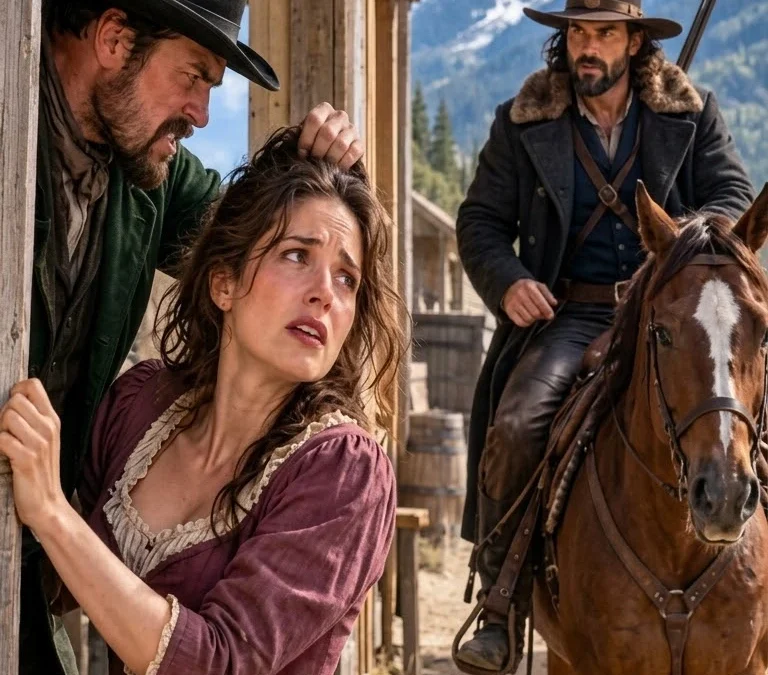
😱 A Widow Was Beaten for a Dead Man’s Debt… Then a Mountain Man Paid It and Said “Ride With Me” 🏔️🔥
PART 1
Giles Reic had his fist twisted in a widow’s hair before the back door had fully closed.
“One hundred and eighty dollars,” he said, quiet and patient, the way a man talks when he’s already decided the outcome. “Your husband owed it. Your husband is in the ground. So now it falls to you.”
Leona Fairchild forced her head down until her knees nearly gave. She didn’t scream. She grabbed a broken jar off the shelf beside her and pressed the jagged edge flat against his throat until a thin line of red appeared. 🩸
Giles looked at the blood on his collar.
Then he laughed.
Not the debt, not the fist in her hair. That laugh was the worst thing about him.
👉 If you were standing where Leona stood that October morning, with a dead husband’s debt around your neck and nobody in town willing to help, what would you have done? Leave your answer in the comments, and tell me where in the world you’re reading from. 🌍
Ror Fenwick had come down from the Lost River High Country for three things: salt, flour, and enough black powder to last until spring.
He was not a man who lingered in Juniper Crossing. The town looked at him the way towns look at men who don’t need them: part suspicion, part relief that he wasn’t staying. He’d ridden down before first light and meant to be back on the trail before the afternoon died.
The merchant, a thin man named Aldis Price, already had his order boxed. That was their arrangement. Ror sent a list down with a freighter in September. Price had it ready in October. Neither pretended the transaction needed conversation.
Ror was lifting the first crate when he heard it through the back wall.
Not a cry. Not a shout. Something worse: the sound of a person trying very hard to make no sound at all. A single suppressed breath, sharp with pain.
He set the crate down. Aldis Price immediately found something to arrange behind the counter.
“That backroom,” Ror said.
“Storage,” Price said, not looking up. “Nobody in there.”
A dull thud shook the wall. Then silence.
“Mr. Fenwick,” Price said carefully. “It would be very much in your interest not to.”
Ror crossed the store in four steps and opened the door.
Giles Reic stood in the center of the room with one hand fisted in a woman’s dark hair and the other clamped on her wrist. She had broken a glass jar, and the jagged base was pressed against his neck with every ounce of strength she had left. There was blood on her palm and blood on his collar. Neither had heard the door open.
Ror had seen violence before. He’d worked freight routes, trapped wilderness that could kill you six different ways, and spent one bad winter he still didn’t discuss. What stopped him in that doorway wasn’t the blood.
It was Giles’s face. He was smiling.
“Mountain man,” Giles said pleasantly. “This is a private matter. I’m in the middle of a debt conversation.”
Ror looked at the woman. Her jaw was locked, her eyes fixed on something past Giles’s shoulder. She was holding herself together the way people do when they’ve decided falling apart is something they’ll do later, privately, if they live long enough.
“Let her go.”
“Son, I’ve got three men outside.”
The hammer of Ror’s Winchester clicked back. It wasn’t loud. It didn’t need to be. 🔫
Giles released her hair slowly, like a man making a point. He smoothed his lapel. He straightened his hat. Then he looked at Leona the way you look at something you’ve set down in a public place, with complete confidence it will be there when you come back.
“Her husband owed me one hundred and eighty dollars,” he told Ror conversationally. “Mr. Fairchild had the good sense to die before repayment. The debt transfers to the surviving spouse. I’ll go find Sheriff Quill. He’s a reasonable man when he’s compensated to be.” He let that sit. “Paper tends to outweigh a rifle.”
He walked out without hurrying.
In the silence, Leona tore a strip from her underskirt and bound her cut palm, pulling the knot tight with her teeth. Ror watched and didn’t offer to help, partly instinct, partly because she hadn’t asked.
“The debt is real,” she said, her voice flat the way a sentence goes flat when you’ve said it too many times. “Matthew borrowed when the hay crop failed. He didn’t tell me until February. He died in April. Giles will come back with Quill, and whatever Quill carries will have a judge’s stamp on it, because Quill knows which judges are affordable.”
She met Ror’s eyes directly.
“So if you’re waiting for me to say something grateful and watch you ride away, I appreciate the interruption. Truly. It won’t change what happens in about an hour.”
Ror turned his hat once in his hands. “I came here for supplies.”
“I know.”
“I’ve got a hard trail back before the light goes.”
“I know that, too.” She watched him steadily, not pleading, not performing helplessness. “Take me with you.”
He looked at her.
“Not to marry. Not whatever else you’re imagining. I need to be somewhere Giles Reic cannot follow with purchased paper. You live above the snow line, in mountains most people in this county have never seen the inside of.”
“The last trail up closes in four or five weeks,” Ror said, listing facts, not arguing. “After that, nothing gets in or out until March. One cabin. One room. One bed. Thirty below in January.”
“I can sleep on a floor.”
“The floor gets cold enough to kill.”
“Then teach me the stove.” She lifted her bandaged hand slightly. “I can cook over open fire, mend leather, dress small game, and treat hoof rot in livestock. I’ve already handled the worst cut of the morning without help.”
“Why didn’t you leave on your own?”
“I tried. Three months ago I had enough for the stage to Twin Falls. Giles paid the driver to return my money.” Something shifted in her voice, the weight of having asked for help and had it refused. “He owns pieces of everyone here. The blacksmith. The judge. Two of the three ranch foremen. A widow on foot with twenty dollars gets about six miles.”
She lifted her chin. “I’m not asking for charity. I’m offering work.”
Ror stood with one hand on the doorframe, weighing it the way he weighed everything: food, trail, daylight. Then he said something she hadn’t expected.
“The debt is documented. If I pay it, he has no legal claim.”
Leona stared. “He’ll invent another one.”
“If I have a numbered receipt with the original note attached, his second claim falls apart the moment a lawyer checks the dates.”
He walked to the front of the store.
“The Fairchild note, Mr. Price. The original, and a receipt marked paid in full.”
Price’s eyes flicked to the door. “Mr. Reic won’t…”
“Mr. Reic isn’t the one asking.” 💵
Ror counted one hundred eighty dollars onto the counter, squared the bills, and waited while Price’s hands shook through four minutes of paperwork. He read every word of the receipt. Then he placed it in the flat tin that rode in the inner pocket of his coat, the last place anyone searched a man.
“Get your things,” he told Leona. “Thirty seconds.”
Eleven minutes later, Giles returned with Sheriff Hyram Quill and two deputies.
Price told them, with genuine apology, that Mrs. Fairchild had left with a mountain man named Fenwick. The debt had been settled. Giles looked at the ledger entry. He looked at the blank space where the note used to be.
Something passed over his face that Price had never seen there before. Not anger, which was familiar. A still, cold calculation, the look of a man who realizes the game moved a step without him and is already planning two steps back.
“How much lead does he have?” Quill asked.
Giles set his hat back on his head. “Enough,” he said quietly, to no one in particular. “For now.”
Up on the trail, Ror rode ahead and Leona followed on a short-legged bay, her own horse, one of the few things Giles had never been able to touch. For hours they didn’t speak. He watched her ride the way a man watches for the thing that will eventually cost him. He found a woman who rode like she’d done it all her life.
That night, under a granite overhang, he handed her his buffalo robe and went back to checking the animals.
She pulled it around her shoulders and stared at the dark line of the peaks above.
One room. One bed. No way back until March.
She had made the choice with her eyes open.
What she didn’t know, and what Ror had been carefully not thinking about since the storage room, was that the receipt in his coat pocket wasn’t just paper. It was a trap, set months before Giles knew he was walking into it. And somewhere below them, in a warm office in Juniper Crossing, Giles Reic had already begun to write a second debt. 😳
👉 What was in that second claim, and what would it cost two strangers snowed in on a mountain? Find PART 2 in the comments, or leave any word and I’ll send it to you privately! 💬
PART 2
Somewhere below them, in a warm office in Juniper Crossing, Giles Reic had already begun to write a second debt.
The cabin sat at the end of a timber-framed clearing, built for function rather than comfort by a man who had never needed to consider whether anyone else might live there. One room. Packed-dirt floor. An iron stove. A sleeping platform raised eighteen inches off the ground.
Leona stood in the doorway and let her eyes adjust. Then she crossed to the stove, crouched, and fixed the warped draft plate with two fingers.
“Your draw’s been bad since September,” she said. “It’ll work now.”
Ror walked in with the first crate and stopped. He had expected an hour of awkward settling-in. Instead she asked, “Where do you want me to start?”
By evening, supplies were stowed, the animals bedded, and a pot of beans simmered with a steadiness that suggested she’d done this math before.
The sleeping argument took thirty seconds. She refused the platform. He refused the floor. They compromised on a thick robe by the stove, which was warmer than she’d hoped, and she made it into a bed in ninety seconds with no romantic ideas about it at all.
“I don’t want your bed,” she told him plainly. “I want to be useful. Those aren’t the same thing.”
The first weeks were quiet, which was a credit to them both and a sign they were each working very hard inside their own heads. Ror rose before light, built the fire, checked the animals. Leona learned his routine the way she read weather, not trying to change it, simply staying out of its way.
Then she began fixing things.
She replaced a girth strap that had been wired together since August. She found early thrush in the mule’s hoof and packed it with pine salve before Ror had noticed the limp. She reseamed his coat in linen thread, because cotton fails in the wet, and never mentioned it.
One morning she reached for coffee and came down with the small tin instead. The smell was extraordinary, dark and expensive, as if the altitude had briefly stopped mattering. She brewed it without realizing. Ror drank half a cup before he noticed.
He went very still. He finished his cup and said nothing.
Four mornings later she asked about it. “The good beans,” he said. “One tin a year. For rare occasions. I’d had it since August.”
“And you didn’t say anything? I used almost half.”
“You looked like you needed good coffee.”
She stared at him. It was so simply said, so free of performance, that she laughed. A real laugh, startled out of a place that had forgotten it existed. It was her first since before Matthew got sick. For a heartbeat it felt like betrayal. Then it felt like something Matthew would have been glad to hear. ☕
Ror looked at the table. Something around his eyes shifted, there and gone.
He taught her the snares in the third week. She asked questions that made clear she meant to do the thing, not just nod along. When she set her own trap and got the trigger balance right on the second try, he said only, “That’ll hold.” From Ror, she was learning, that was nearly a speech.
But the winter was coming, and winter on that mountain did not negotiate.
The first blizzard arrived on a Thursday in November. The jays had gone quiet two days before. The mule was restless. Ror read every sign correctly. What he hadn’t done was fix the back corner of the lean-to roof, the same gap Leona had flagged.
When the wind hit, he pulled on his coat. “I’ll be twenty minutes. Keep the stove built.”
She watched from the window. She watched the roof lift and come down. She watched Ror step back, find nothing behind him on the ice, and vanish.
For thirty seconds, she couldn’t see him at all.
She was at the door before she’d decided anything. She tied one end of the rope to the hitching post and the other around her waist with the flat knot he’d shown her the first week. Then she walked into the white. 🌨️
The wind hit like a wall with bad intentions. She followed the rope to its full length and found him eight feet past its end, on his knees beside the water barrel, one arm held wrong.
“I’m fine,” he said.
“You’re not.”
She got under his good arm. Together they staggered back toward the cabin.
By evening, his fever spiked. A fallen board had caught his shoulder, and the cold had found what the impact started. For three days the storm sealed them in, the window turning white and staying white. Leona fed the stove every few hours, rationed willow bark, and kept him alive.
On the second night he talked in his fever. A name she didn’t know. Twice, the second time sharp, like a man reliving something and not yet knowing the outcome.
“Cal.”
She said nothing. She pressed a damp cloth to his forehead. 🕯️
On the morning the fever broke, she asked him quietly, “Who’s Cal?”
He stared at the cup in his hands for a long time. She waited. She had learned that Ror’s silences weren’t walls. They were routes that took longer than other people’s.
“My partner,” he said finally. “On the freight routes, seven years ago. Calvin Marsh. Twenty-six. A route I knew. The signs were bad, and I wanted to finish. Another day and we’d have been done. I decided to push.” A pause. “He died by morning. His gear wasn’t good enough, and I didn’t see it failing until it was too late.”
The stove popped once.
“I was fine,” Ror said, and the words held a bitterness that was not self-pity but something colder. “I had the better gear. And he followed me into a decision that killed him because I’d been doing it longer.”
“And you came up here.”
“Alone means the only person who can die from my bad decisions is me.”
Leona sat with that for a moment. Outside, the wind had dropped a register, tired the way a storm sounds when its main work is done.
“You weren’t the only one making decisions that day,” she said. “He was twenty-six and capable of his own thinking. That doesn’t mean you weren’t wrong to push. But that’s two people making choices, not one person causing everything.” She paused. “You’ve been carrying the whole of it. Someone should. That’s not the same as carrying it correctly. Living alone isn’t the same as never hurting anyone. Sometimes it just means nobody gets close enough to tell you you’re wrong.”
Ror looked at her directly, with nothing managed in his face, the way he rarely did.
He didn’t argue. He didn’t exactly agree. But something in his shoulders shifted, the way a weight shifts when it has been redistributed rather than removed. 💔
Winter deepened. Two people who had run out of reasons to be formal still hadn’t decided what to replace formal with. She cut his hair one afternoon, and his skin remembered what careful hands felt like. He caught her hands once between his own after she came in from the cold, rubbing warmth back into them, then stopped, startled at himself.
That night she set two cups side by side on the shelf. For seven years, he had put out one. 🥺
Then, in March, the light changed. The snow line pulled back. And with it came something neither of them could stop.
“The lower trail will be passable in six weeks,” Ror said. “Giles will have been watching the weather. He’s had all winter to find another legal angle.”
He went to a shelf, moved two cans, and opened a long wooden box. Inside lay a Remington revolver.
“You’re going to learn to use this.”
“You think he’ll come up here armed?”
“I think he’ll come with legal paper, two hired men, and a purchased sheriff. I’m not training you to start a fight. I’m training you so that if one starts without your permission, you can finish it.”
She picked it up. It was heavier than she expected. “Show me.”
Her first shots went wide. She hated it. She kept going. By week three she was hitting the middle post. He taught her one more thing: not to aim at the center of a man, but at the arm holding the gun.
“You’re not trying to kill someone. You’re trying to make them stop.”
Then, one morning at first light, they stood together at the edge of the clearing, watching the snow retreat to show bare earth beneath. Spring wasn’t a comfort. It was the thing that had been protecting them by accident, and it was about to end.
“I have something to tell you,” Ror said, his jaw braced. “When we rode out of Juniper Crossing, I didn’t come back for you because of the rifle. I’ve ridden past a lot of things I heard. I didn’t ride past that one.”
Her breath caught.
“I’m not telling you so you owe me anything…”
“Ror,” she said. “I know.”
He held her gaze.
“I’ve known a while. I haven’t said anything because I’m not sure yet whether what I feel is you, or what I feel about having somewhere safe to be. And I won’t say something to you until I’m certain those are different.”
“That’s fair,” he said roughly. “It’s more than fair.”
Twelve days later, the mountain jays went silent in the middle of the morning.
Ror raised his head. The silence was the wrong kind. Then he heard them: horses on the lower trail, moving at the deliberate pace of men who expect to arrive and meet no resistance.
“They’re here.”
Leona was already at the shelf. She took down the revolver, checked it by feel, six rounds, eyes on the door. Ror took his Winchester from its rack and worked the lever.
It stopped.
He tried again. The cartridge wouldn’t cycle. A swollen case. Moisture over the winter. He needed sixty seconds he probably didn’t have.
“Go inside,” he said.
“No.”
“Leona.”
She stepped to the right of the doorframe and held the revolver down at her side. “If you tell me to go inside, I’ll be angry about it later, when there’s time.”
Down in the clearing, Giles Reic rode in on a well-fed gray gelding, with two hired guns behind him and a pale young clerk clutching a leather satchel that said courthouse louder than any badge. Giles swung down, wearing the same smile he’d had in the storage room.
“Mr. Fenwick. I’d say you’re looking well, but I can’t tell from here.”
He turned to the clerk. “Mr. Styles has a legal instrument I’d like read into the record.”
“Read it from there,” Ror said.
Styles unfolded a paper with unsteady hands. “This is a valid writ pertaining to a secondary obligation incurred by Matthew Fairchild.”
From the shadow of the doorway, Leona’s voice rang out clear and cold.
“What date was the note entered?”
Every head turned. 😳
Then Leona stepped into the clearing, revolver down at her side, and looked straight at the clerk. And the paper in his shaking hands, she realized, was about to answer a question Giles Reic had never expected anyone to ask.
👉 What did that date reveal, and what happened in the next sixty seconds with a jammed rifle and three armed men? Comment “LEONA” or tap LIKE ❤️ to unlock PART 3!
PART 3
Styles looked at Giles. Giles nodded.
“The secondary note,” Styles read, “was entered November fourteenth, 1880.”
“Matthew Fairchild died April ninth, 1885,” Leona said evenly. “Any note bearing his signature after that date is a forgery. What date is on that document, Mr. Styles?”
The clerk’s eyes dropped to the paper. They stayed there.
“The date isn’t Mr. Styles’s concern,” Giles said smoothly.
“You’re a court officer of Custer County,” Ror said, cutting him off cleanly. “What date is on that document?”
Styles went the color of bad milk. “June,” he whispered. “June seventh.”
“June seventh, 1885,” Leona said. “Two months after Matthew was in the ground.” She looked at Giles. “So this is fraud.”
The word sat in the clearing like a dropped plate.
Giles moved, not toward her, since he was smart enough for that, but with a small sideways lean that told his men to go. The hired man on the right kicked his horse forward and reached for the rifle in his scabbard.
The shooting began in pieces, the way these things do.
The first shot went high, chipping wood off the cabin wall. Ror dove behind the wood pile, wrenching at the jammed lever. The second hired man’s horse spooked and nearly unseated him. Styles flattened himself behind his mare.
Giles didn’t flatten himself anywhere. He walked forward, drawing his pistol, straight toward Ror’s position. The equation had simplified. The mountain man’s rifle was jammed. The thing Giles had spent five months building was done.
He didn’t look at Leona. He hadn’t looked at her since she stepped out of the doorway.
That was his mistake. The same mistake he’d made in October, with the broken glass at his throat and the blood on his collar.
She was twelve feet from him.
She raised the revolver. She aimed for the arm. She fired. 💥
The sound was enormous. Giles’s pistol dropped from his hand. He spun, went down on one knee, and came back up clutching his right forearm, his face blank with disbelief, not pain. Not yet.
The hired man near the wood pile stopped. He looked at Leona. At the revolver. At his colleague, still fighting a panicked horse twenty feet away. Slowly he slid his rifle back into its scabbard.
“I’m done,” he said to no one in particular, with the flat practicality of a man who recognizes when the math has changed.
Ror stepped out from behind the wood pile and picked up Giles’s pistol. The wound was bleeding but clean, a graze along the outer muscle of the forearm. Leona had calculated that closely enough that it was no accident.
Her hand wasn’t shaking. She noticed that from a distance, faintly surprised. She’d expected more fear. What she found instead was a bright, specific clarity, the kind that comes when everything you’ve prepared for arrives exactly as expected.
“Mr. Styles,” she said. The clerk rose slowly, mud on his suit. “Who ordered you to carry that writ?”
Styles looked at Giles. Giles said through his teeth, “Don’t.”
Styles looked at the blood coming through Giles’s fingers. He looked at the revolver.
“Sheriff Quill,” he said. “He told me the writ was valid. He told me the note was properly registered. I looked up the date this morning when we camped, and I knew it wasn’t right. I told Mr. Reic, and he said it didn’t matter.”
Ror looked at Giles. “The original debt was paid at your own counter, in front of your own merchant, with your own receipt.”
He reached into his coat and drew out the small flat tin. He opened it and held up the folded paper: numbered, dated, paid in full.
“This lists the original note by date and number. Your secondary document claims the same note. The dates don’t match, and the note’s been discharged.”
Giles stared at the receipt. He hadn’t known where Ror kept it. He had spent five months building a legal weapon on the assumption that any receipt, if it existed, lay somewhere in the cabin where it could be burned or claimed lost.
Ror had carried it against his chest since October. 📜
In the cabin, they sat Giles in a chair with a cloth knotted around his arm. Ror had Styles write out everything: the writ, the date discrepancy, Quill’s instructions, the conversations between Quill and Giles over the previous month. Doyle, the first hired man, signed as witness.
“This goes to the circuit court at Chalice,” Ror said. “Not Quill. Not Juniper Crossing.”
Styles nodded, looking at his own handwriting. “I should have said something before we came up.”
“Yes,” Ror said. “You should have.”
Leona watched Giles through all of it. He looked like a man conducting a private audit, still searching for an angle. She set the revolver on the table between them.
“The Price family,” she said. His eyes lifted. “The Caldwell ranch. The Mercer place. The widow Anstruther, who moved away in eighty-three.” She had built the list in her head over five months, from conversations overheard before Matthew died, names attached to losses that never quite added up. “I don’t know how many of them have receipts. I suspect very few. The circuit court will know your name now. Whatever they find next is between you and the record you’ve made.”
She picked up the revolver and went to the doorway, and stood looking at the clearing, the spring light, the retreating snow line. She breathed carefully.
Behind her, Ror told Giles he could ride down under his own power or be carried. Either way, he was off the mountain by dark.
They left at four in the afternoon. Giles on the gray gelding with his arm in a sling made from Styles’s necktie. Ror stood at the tree line until the sound of hooves was gone.
When he came back to the clearing, Leona was splitting wood, the methodical rhythm of someone giving herself something physical to do. He saw the bruise across the heel of her palm, recoil from the revolver. He went inside, came back with pine salve, and held out his hand.
She gave him hers.
“I wasn’t afraid,” she said while he worked it in. “I thought I would be. But there wasn’t room for it.”
“There usually isn’t. In the moment.” His touch was careful, the way of someone who’d been careful so long he was still learning that careful needn’t mean distant. “It’ll hit tomorrow, or the day after. Your hands might shake when you do something ordinary. You might have a bad dream and not know why. It’s not weakness. It’s the body catching up to what the mind already processed.”
She nodded. He released her hand. They stood a while in the afternoon light, not speaking.
Three days later, a young deputy named Garrett rode up from Chalice, having heard through frontier gossip that something had happened at Fenwick’s cabin. He took statements for four hours. Leona spoke first, and at length, with the precision of someone who had ordered the facts in her head before presenting them. Ror followed, briefer. He had the receipt. He had Styles’s signed account. He had Doyle’s signature.
“Sheriff Quill is my superior officer,” Garrett said, quietly, looking at the pages.
“I know.”
He looked up. He had the face of a young man at a door he’d been told never to open, finding it already ajar. “He falsified court records.”
“Yes,” Leona said.
Garrett folded the documents and placed them in his own satchel. “I’ll take these straight to the judge’s calendar in Chalice. Not through the county office.”
“That would be appropriate,” Ror said.
As his horse disappeared down the trail, Leona thought about the paper in that satchel, the numbered receipt she’d watched Ror demand from a shaking merchant while she stood in a storage room with a bandaged hand.
“You protected me before I knew I needed protecting.”
Ror looked up from cleaning the Winchester. The swollen cartridge had finally cleared. “I protected the legal position. You protected yourself. That’s a distinction.”
“It’s the right one.” She watched him a moment. “Ror. I’m going down. To Juniper Crossing.”
He went very still.
“Not leaving. I need to finish Matthew’s estate. I need my belongings from Mrs. Harner’s. I need to open a bank account in my own name. I need to go back and finish what I left unfinished, and do it as myself, not as a woman who ran.” She paused. “I’ll come back. I’m telling you because it’s true, not because you asked. I need you to hear the difference.”
He looked at her for a long moment. He nodded.
“When?”
“Tomorrow morning.”
That night she packed her canvas bag by the door. Ror didn’t look at it. He went to bed. She lay by the stove and listened to the mountain in its spring configuration, all dripping and shifting water, and felt, for the first time since Matthew died, the specific feeling of having gotten somewhere by her own effort. Not rescued. Not carried.
Arrived. 🌅
Juniper Crossing looked smaller than she remembered. Aldis Price’s expression went through several stages when she walked into the store.
“Mrs. Fairchild.”
“Mr. Price. Matthew’s estate. What remains?”
It was less than she’d expected and simpler than she’d feared. The farm had reverted to the land office. But forty dollars sat in the town depository, overpaid on Matthew’s equipment tab before his death. Legally hers. She took it and opened an account in her own name.
At Mrs. Harner’s boarding house she found her belongings in a locked back room. Mrs. Harner, never comfortable with Giles Reic’s methods, had decided in October to hold on to the quilt, the iron, and the three books rather than let them be claimed.
Leona stood with the quilt in her hands. She had pieced it in the second winter of her marriage, from Matthew’s worn shirts and her own old dress fabric, when the future was still something they were both looking forward to. She hadn’t expected to see it again.
She folded it and put it in her bag.
At the hardware store she bought lamp oil, a good needle set, and two tins of coffee. She slept that night at Mrs. Harner’s, and the next morning she rode back up the mountain.
Ror was at the wood pile when she came through the upper tree line. He turned, axe in hand, and didn’t move toward her. His face held the expression he always had when he was containing something, tight around the edges in the way of a man who has been waiting without admitting it.
She tied the bay. She carried her bag inside. She unpacked the quilt onto the platform, the needles onto the shelf, the lamp oil against the wall. Then two tins of coffee, set side by side on the upper shelf between their cups.
Ror stood in the center of the room and looked at the tins for a long moment.
“Thought you might not come back.”
“I know.” She turned. “You paid me wages before I left. You calculated my share of the winter work and paid it without being asked. You were making sure I wasn’t leaving because I had no choice.”
“Yes.”
“That’s the most honest thing anyone has done for me in years.” Her voice was steady. “I have forty-three dollars in a bank in Juniper Crossing, a horse, a bag, and a quilt I made myself. I have enough trail competence to leave this mountain in most conditions and enough town competence to handle what waits at the bottom. I came back because I wanted to, not because I needed to.”
The spring wind moved through the trees, lighter than winter’s, still figuring out its own character.
“Why?” he said, low.
She pushed one cup toward him across the shelf.
“The first time I came up this mountain, I needed somewhere to survive.” She took the other cup. “This time I came because you’re here.” 💛
Ror looked at the cup in her hand. Then at her. He reached out and poured the good coffee into both, and the smell of it opened in the cabin like something the winter had been keeping back.
No debt between them. No rescue left to count. The trail was open in both directions, and she had ridden it alone both ways, and she was here because she’d chosen to be. He knew it. She knew he knew it. And the knowing made all the difference.
The spring that followed was nothing like what either of them had imagined. Surviving the cold, the fever, the blizzard, and Giles’s arrival had been one kind of work. Living afterward turned out to be another.
In her first week back, Leona woke twice at 2 a.m. with her hands shaking, a full-body tremor out of nowhere. The second time she sat on the edge of the platform, pressed her palms flat to the packed earth, and focused on its cold until it passed.
From across the cabin, quietly: “You want the lamp?”
She thought about it. “No. I’m all right.”
“I know.”
She lay back down. In October she’d thought what she was missing was safety. She hadn’t realized that being known, the specific shape of you at two in the morning, was something she’d been starving for.
She slept.
In April, Deputy Garrett climbed the trail again, pleased with what he carried. Giles Reic had been formally charged on three counts: fraud upon the court, falsification of legal instruments, and coercion. The bail had made his lawyer visibly pale. A circuit judge with no patience for purchased legality was hearing the case personally. Sheriff Quill had resigned the previous Tuesday. He had not been given a choice.
“Three other families have come forward,” Garrett said. “The Caldwells among them. A rancher named Pruitt, whose story is so close to Matthew’s that I should warn you.”
Leona sat very still. “There’ll be more.”
“Most likely. When people see it can be challenged, they find they’ve been waiting for permission.”
“What happens to the loans he holds?”
“A fraudulent instrument invalidates the debt. Any debt Reic holds that can be shown to have been manipulated. There are going to be a lot of people who get to stop paying.”
She thought about Matthew. About the second drought, and the borrowed money, and the look on a man’s face when he decides the future isn’t worth fighting toward. About how different the arithmetic might have been if he’d known the debt itself was the fraud, not his own failure.
She couldn’t go back and tell him. She could only sit with the knowledge that it was true.
Ror, who’d been at the wood pile, came in and set a cup of coffee in front of her without a word. She drank it. 🥹
By summer, Giles Reic’s lawyer had looked at the actual documents and knew what they said. He advised his client to negotiate rather than contest. The forged note had been drafted not by Giles but by a land agent forty miles south, who was now having a very uncomfortable conversation with the judge’s office.
Leona had written her own statement at the cabin table, on two sheets, in the careful hand of someone who had thought through every sentence before committing it to ink. She wrote the storage room. She wrote October. She wrote the six months before October, and the way an entire town had arranged itself around a man with enough money to make looking away the practical choice. She didn’t soften a word.
In June, a letter arrived from Boise, six months late. The woman who’d offered Leona a spare room if things got bad was still offering. She’d even found work leads: seamstress, schoolteacher, whatever Leona needed to start over.
Leona read it twice. It was an offer of rescue, warm and real, to a woman who no longer needed rescuing.
She folded it and set it on the shelf. She would write back and thank her properly, because the kindness deserved it. But she’d say she wasn’t coming.
Ror came in from the afternoon check and saw the letter. “You going to answer it?”
“Yes.”
“What will you say?”
She looked at him across the cabin: the organized shelves, the stove with its correctly seated draft plate, the blanket folded with an adjusted precision that was neither hers nor his original, but theirs. The two cups on the upper shelf.
“That I found somewhere.”
He held her gaze, with the stillness that looked like distance from outside and was actually the opposite. Then he pulled out the other chair and sat down.
“All right.”
She wrote the letter while the afternoon light moved across the table. Across from her, Ror turned the pages of an almanac he’d owned for three winters, without the appearance of reading it closely.
There are questions a story like this can’t answer cleanly. What separates rescue from possession? What separates need from love? Not certainty, which comes later, if it comes at all. Sometimes what you have instead is a long, honest accumulation of days in which you kept choosing the same thing.
Two people can stand in a clearing and not know whether what they feel is real or the residue of shared survival. The only way to find out is to remove the survival from the equation and see what remains.
Leona went down the mountain alone and came back. What remained wasn’t a question anymore. It was just a fact. Small, unglamorous, entirely sufficient.
The final morning was a morning in late June, the first true summer morning, with warmth that made the altitude feel like a gift instead of a sentence. Leona stood near the lean-to running a brush down the bay’s flank. Ror came out of the cabin carrying two cups. He crossed the clearing and set one on the top rail of the fence without interrupting her.
“Northeast line,” he said. “If we leave by seven, we can reach the second ridge before the afternoon heat.”
“I know. I’ve been ready since six.”
He looked at her. Something that had been trying to be a smile in his face all winter finally finished itself. Not large. Not performed. There briefly, like weather.
She reached over and took her cup from the rail.
They stood in the morning light with their coffee and looked at the mountain ahead: the northeast face, the unexplored lines, the territory that had been waiting for two people instead of one. Neither said anything, because there was nothing left to say that hadn’t already been settled. The hard way, the honest way, the only way that lasts.
The trail was open. They would take it when they were ready.
Two cups. One shelf. The good coffee between them, and the whole summer mountain ahead. ☕🏔️
💬 If this story moved you, share it with someone who needed to hear that rescue is only the beginning, and choosing is what makes it real. And tell me in the comments: what would YOUR answer have been in that storage room? ❤️
Disclaimer: This story is entirely fictional and created for entertainment purposes only. It does not represent any organization or individual, nor does it encourage inappropriate behavior. The content was generated with AI assistance.








