A Widowed Mother Went Searching for Firewood to Save Her Two Children From Freezing. Beneath an Abandoned Nebraska Hill, the Ground Answered Back…
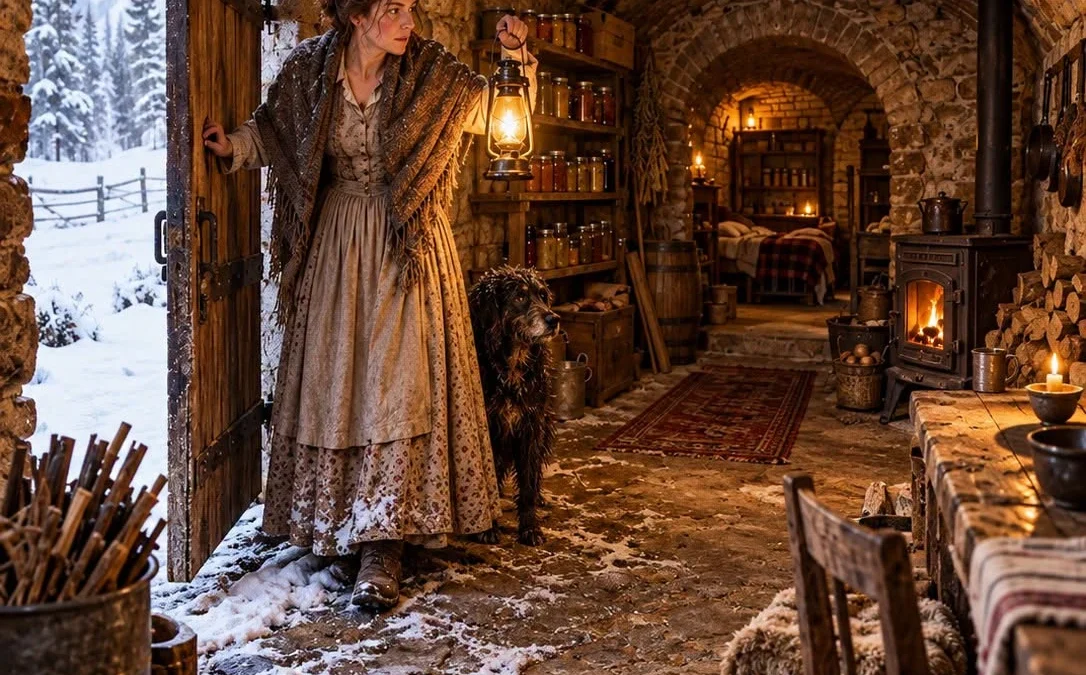
A Widowed Mother Went Searching for Firewood to Save Her Two Children From Freezing. Beneath an Abandoned Nebraska Hill, the Ground Answered Back…
Part 1
The first warning came from beneath Clara Hayes’s boots. 🪵
It was not the wind, though the November wind had been howling across the western Nebraska prairie since sunrise. It was not the snow, though the first pale flakes were drifting through the gray afternoon. It was a hollow knocking sound.
Clara stood on a lonely ridge with an armful of dead cedar branches against her worn wool coat. Under her right boot, the frozen ground had answered her weight in a way no solid earth should.
Knock.
A moment later, the ground gave way. She stumbled back, dropping the wood, as a section of dirt collapsed into a black opening. Cold air rose from beneath the hill, carrying the faint smell of old smoke. Someone had built something underground, and it had been waiting there for decades.
Six weeks earlier, she had buried her husband beneath a cottonwood behind their homestead. Thomas Hayes was thirty-nine, broad-shouldered, with rough hands and a quiet way of showing love. He fixed broken chairs, warmed the children’s blankets before bed, and left the largest portion of supper for Clara when he thought she was not looking. Then a splintered fence post cut his hand. By the fifth day, red streaks ran up his forearm. The doctor from North Platte arrived too late.
After the funeral, Clara learned that grief was not the heaviest burden a widow carried. There were bills, animals, a roof to patch, a stove that swallowed wood faster than she could gather it, and two children who looked at her whenever a hard question needed answering. Caleb was eight. Ruth was five and still asked whether Papa could see the house from heaven. Clara always said yes. It was the only answer she could give without crying. 💔
The cabin stood two miles from the nearest neighbor, built of rough timber and repaired so often that no two walls matched. With Thomas alive it had seemed sturdy. Without him, Clara noticed every gap between the boards. One evening she opened the woodbox and counted fourteen pieces of split wood. She counted twice. Maybe two days.
There were thirty-seven dollars in a tin under her bed. It had to cover flour, salt, lamp oil, spring seed, and whatever emergency came before then.
Their neighbor Samuel Price, sixty, stopped his wagon by her fence. “My boys could bring you a load.”
“I will pay you after spring.”
“I did not say anything about payment.”
“That is why I did.”
“Clara, nobody thinks less of you for needing help. Do not let pride make your children cold.”
That night she remembered what Thomas once told her after a hard harvest. Hard times do not get to decide what kind of people we become, Clara. We still get that choice.
Before dawn she wrapped his old scarf around her neck, took his small ax, and left Caleb in charge of Ruth. Then she walked west toward the sandstone ridges, cutting dead branches wherever she found them. By afternoon her palms burned. Her sled held perhaps three evenings of heat. She should have gone home. But she thought of Ruth sleeping with her little boots beside the bed, and of Caleb trying to split wood with an ax nearly too heavy for him.
“Just one more ridge.”
She found a fallen cedar with thick, dead branches and began to chop. The blade slipped and struck the frozen soil. Knock. Three feet left, the sound was solid. Two feet right, hollow. She brushed away dead grass and found a weathered plank. Then another. Then an iron hinge, and a heavy iron ring.
Someone had buried a door in the hillside.
She planted both boots and pulled. The old wood groaned. The soil along one edge collapsed, and cold, dry air rose from below. At the bottom of a narrow stone staircase lay what looked like the entrance to an entire buried home.
Night was coming. Snow had begun to fall. Every sensible instinct told her to close the door and go back to her children. Instead, Clara picked up her husband’s ax and took one careful step into the darkness.
What she found at the bottom would save her family. But the first storm would nearly kill them in it, and a neighbor would soon tell her why no one had used this place in fifty years. 😨
Part 2
The stairs went down twelve steps. At the bottom was a rectangular chamber of stone walls and heavy timbers. Three wooden bunks stood against one wall. At the far end, a low iron firebox fed a long stone structure running beneath the bunks, ending in a brick chimney.
Thomas had once described such stoves from colder parts of Europe. Hot gases traveled through passages in heavy masonry, which absorbed the heat and released it slowly. “Imagine a stove that stays warm after the fire is gone.” Clara had been too busy washing dishes to listen. Now she wished she had.
She cleared a bird’s nest and dirt from a chimney opening hidden under cedar roots on the ridge above. Then she lit a tiny fire of twigs, ready to abandon the experiment at the first sign of trouble. The smoke moved into the stone passage. After several minutes, a faint warmth reached her fingertips. The system worked. She put out the fire, checked every ember, and climbed out. She was not ready to trust it. But she could no longer dismiss it.
That evening she told the children. “A house under the ground?” Caleb breathed. She drew it on the back of an old invoice and wrote a list of everything she needed to know. Was the roof sound? Were the passages clear? Could the door be opened after heavy snow?
The next morning she took them to the ridge, forbidding them to touch the firebox. Under a bunk she found a wooden box holding scraps of cloth, a rusted cup, and a leather pouch that crumbled, spilling three coins and a folded paper. Faded ink read Elias Mercer, October 1873. It listed firewood, water, dried corn, lamp oil, blankets, and, underlined twice: Never let the stone go fully cold after the first hard freeze.
Behind the bunks, a wooden panel hid a narrow passage. At its end, a small second chamber held neatly stacked, split, seasoned hardwood reaching almost to the ceiling. Clara stood motionless. For weeks she had measured survival in single pieces of wood. Here was a winter’s worth. Her eyes filled. “Oh, Thomas. If only you could see this.” 🪵
“Are we going to be all right now?” Caleb asked.
“We have found something that might help us. That is what we know.”
Then a cracking sound rolled through the hill. Dust drifted from the ceiling. When Clara pushed the door open, the snow was racing sideways across the prairie, and the cabin had vanished behind a wall of white. They had stayed too long.
She roped herself to Caleb, who held Ruth’s hand. Within twenty minutes she could no longer tell whether they were walking toward home. Ruth was crying. Caleb’s eyebrows were crusted with ice. The shelter was closer. “We are going back.” She took his hand and began counting her steps.
When a dark cedar finally appeared through the white, she nearly wept. She pulled open the buried door and pushed the children down the stairs. The wind vanished. The silence seemed impossible. “I want Papa,” Ruth sobbed.
“So do I.”
Clara made a hard choice. They were shivering, the storm was killing weather, and she did not yet trust the old firebox. She would burn the smallest practical fire and watch for anything unusual. The stone stayed cold a long time. Then, slowly, warmth began to seep into the room. By midnight the fire was out, and the stone was still warm. At the cabin, the room was cold soon after the stove died. Here, the heat lived inside the masonry.
They stayed two days. On the second morning she divided the last bread. Caleb, thinking she was not looking, slipped half his piece onto Ruth’s cloth. Clara pretended not to see. Later, alone by the door, she whispered, “Thomas, I do not know if I am doing any of this right.” Only the wind answered. 💔
When the storm weakened, she climbed the ridge and saw a thin line of smoke rising from their cabin. Samuel Price stood beside a wagon, his sons unloading firewood. “Good Lord, Clara! We searched half the country!”
After they had eaten, she told him everything and showed him the paper. At the name, the old rancher grew still. “Mercer’s winter room. My father knew it.” He folded it carefully. “A man nearly died in that place. The fire was not the trouble. It was what the fire could not get out of the chimney.”
“Clara, you may have found the thing that can save your children. But unless we inspect it properly, that same place could kill all three of you in your sleep.” 😱
Part 3
Samuel returned the next morning with a lantern, hammer, wire, and tools wrapped in canvas. Clara had barely slept, picturing her children on those bunks while something invisible crept into the room.
“Do not punish yourself for what you did not know,” he said.
“I brought them into that place.”
“And brought them out alive. That does not make it safe. That is why we are going to look.”
Inside, he tapped the masonry with his hammer. At the second bend the sound turned hollow. Behind the stone, old clay mortar had collapsed inward. A small fire could pass the damaged channel. A larger one could have overwhelmed it. Samuel explained that heavy snow had once blocked Mercer’s chimney in January, and smoke had nearly killed him before he got the door open. “You were fortunate.”
Clara remembered feeding wood to the fire while Ruth shivered. If she had built a bigger one, the outcome could have been different.
“You still mean to live here?”
“Samuel, I have thirty-seven dollars, two children, one mule, and a cabin that cannot hold heat on a windy night. I do not have many choices. But I can make this one as carefully as possible.”
“Then we will do it right.”
For five days, the shelter became a work site. Samuel brought old firebrick from a collapsed smokehouse. Clara hauled clay and sand with the mule and sled. Caleb scrubbed each brick. Little Ruth, the self-appointed “chief builder,” carried cups of sand. They rebuilt the channel, cleaned every passage, and added an iron inspection plate at the bend so the family could check an area that had been sealed. They planned ventilation and agreed never to treat the absence of visible smoke as proof the air was safe.
Clara accepted every helping hand, but this time she worked beside everyone. She was not receiving charity. She was rebuilding a home. 💛
“Sometimes I think losing him took half my mind with him,” she told Samuel one afternoon. “Everywhere I turn, there is something he knew how to do.”
“Thomas learned most of those things because somebody showed him. You can learn them too.”
In the storage chamber she found scratches on the wall, groups of five, dozens of them, and beneath them the words January 12th. Not marks by a stranger, she thought. Evidence of another person’s determination to survive.
On December 18, the temperature plunged. Frost spread across the kitchen window, and the woodbox held three small pieces. “Get dressed,” she told Caleb. “We are going to the hill.” This time she had food, blankets, water, lantern oil, and a plan. She understood the shelter’s limits and had inspected it with Samuel. She left Daisy the mule in her lean-to with hay and water, and led her children west.
Looking back at the cabin, small and dark against the huge prairie, she remembered arriving there with Thomas years earlier, with almost nothing. She was leaving the house that held their life because it could no longer protect their children. It hurt. She kept walking.
Underground, she lit a controlled fire. The warm gases traveled through the repaired channels, and no smoke entered the room. By morning, the thermometer Samuel had hung on the cedar read six below zero. Beside the stone, the room read fifty-eight. The fire had been out for hours.
Clara held both hands near the stone. Warmth, steady and gentle. Ruth sat on the lower bunk without her coat. “Papa would have wanted to see this,” Caleb said.
“Yes. He certainly would.” 🌟
The cold lasted four days. When Samuel climbed down to check on them, he laid his hand on the masonry, then looked at the stack of firewood. “That is all you have burned?”
“That is all.”
“Thomas would be proud of you.”
The words struck her harder than she expected. She had spent weeks trying to be Thomas. She understood now that survival had never depended on that. She had survived by being Clara. By learning, working, accepting help without surrendering her dignity, and refusing to quit.
The shelter became their winter home. Neighbors came, curious or struggling with the same problem, and Clara showed them the masonry, the repairs, and the ventilation. She never pretended it was magic. Its value came from sound construction, stored heat, shelter from the wind, and careful maintenance. Edith Walker, whose farmhouse stood on exposed ground, put a hand to the stone. “Maybe we ought to learn a thing or two from this.” Families shared ideas about insulation and drafts. Samuel helped another family repair a dangerous chimney.
“Mama, people used to come here bringing things because they thought we could not manage,” Caleb said. “Now they come asking you how to do things.”
In February, Clara put Mercer’s faded note in a cedar frame Caleb made and wrote beneath it: Built by Elias Mercer, 1873. Restored by neighbors who believed a family should never face winter alone. Samuel took off his hat. “That is a fine way to remember him.”
In March, the first thaw came. On the ridge, Ruth took off her mittens. From there they could see the old cabin and a thread of smoke from its chimney. “Are we going back?”
Clara thought of Thomas in that doorway, of Caleb as a baby, of Ruth’s first steps, and of the terrible morning Thomas closed his eyes. There had been so much sorrow in those walls. But there had been more love than grief could erase. “We will spend plenty of time there,” she said. She would repair it, improve the windows, and keep the shelter as a refuge in severe weather.
She stopped at the iron ring and looked back at the fallen cedar where the ground had first answered her. She had come searching for a few more nights of firewood, tired and almost out of hope. She had not expected a stranger’s winter room to restore the dignity she feared she had lost.
“Thank you, Thomas,” she whispered. After a moment she added, “And thank you, Mr. Mercer.”
From below, her children called. “Mama! Come see what Ruth did!” She laughed and went down the stone steps, pulling the heavy door closed against the evening wind. 🌅
Winter had taken her husband, her security, and nearly her hope. It had not taken her children, her home, or the quiet strength that had been inside her all along. And beneath a forgotten Nebraska hillside, surrounded by warm stone and the sound of her children’s laughter, Clara Hayes found her way back to life. 💛
This story is entirely fictional and created for entertainment purposes only. It does not represent any organization or individual, nor does it encourage inappropriate behavior. The content was generated with AI assistance.








