After 8 Days Without Eating, a Waitress Served Me a Stew. One Taste Made Me Whisper My Mother’s Name. And While I Could Barely Hold the Spoon, Someone Was Moving My Businesses Behind My Back.
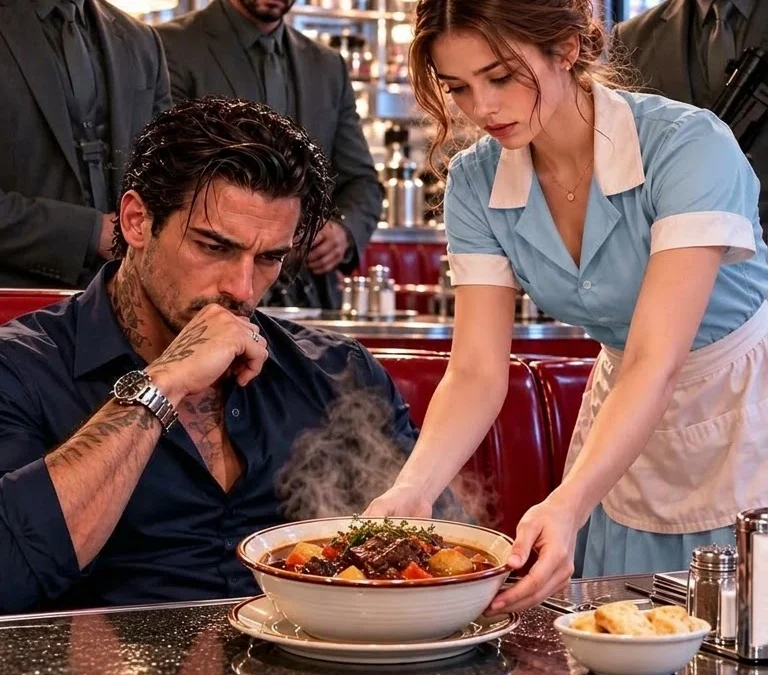
After 8 Days Without Eating, a Waitress Served Me a Stew. One Taste Made Me Whisper My Mother’s Name. And While I Could Barely Hold the Spoon, Someone Was Moving My Businesses Behind My Back.
Part 1
The first time I thought someone was trying to poison me, I stopped eating. The second time, I had my own kitchen shut down and slept with a loaded pistol under my pillow.
In Madrid, my surname was enough to lower voices. At thirty-eight, I controlled a network of nightclubs, security companies, and businesses nobody dared ask how they’d grown so fast. I had survived ambushes, investigations, and betrayals.
But I had gone eight days almost without food.
The reason had a name: Pablo.
Pablo Mena had been my right hand since we were teenagers. Two weeks earlier, he collapsed during a private dinner after tasting a lobster rice. The chef tasted the same dish and ended up in the hospital too. Since then, I saw poison in every bottle of water and a sentence in every plate.
“You have to eat,” said León Ortega, the bodyguard who had stood beside me for fifteen years.
I pushed away an untouched steak. “Pablo had to eat too.”
My voice was dry, but my hands were shaking.
Rumors were already spreading through Madrid: Gabriel Rivas is weak. Locked in his penthouse in Salamanca, doubting even the men who had bled for him. In my world, the smell of fear is all vultures need.
That stormy night, I stood up with difficulty.
“Bring the cars around.”
“Where to?”
“Anywhere nobody expects me.”
Three black vehicles crossed the city in the rain. We left the elegant avenues behind, dropped down toward Vallecas, and stopped in front of an old roadside bar by the former A-3 exit. The sign read CASA JULIÁN, though the J flickered like it was about to give up.
My men went in first. Within two minutes, the last customers had paid in a hurry and the owner, Julián, had turned white.
I sat in a cracked red vinyl booth.
“I want something made in front of me. Sealed packages. Nothing prepared.”
Julián swallowed. “We have meatballs, tortilla, stewed beef…”
“Open everything. Now.”
I didn’t know yet that someone was watching me from the kitchen doorway.
Her name was Nora Benítez. Twenty-four years old, a nursing student by day, serving dinners at night to pay for a shared room in Puente de Vallecas. She told me later she’d expected a monster. Instead she saw a pale, exhausted, starving man surrounded by four bodyguards who looked at him as if he might break.
Julián couldn’t even open a pack of beef without his fingers rattling.
“Let me,” Nora said.
“Don’t you dare,” he hissed.
“If you keep that up, you’ll cut yourself.”
She found sealed beef, potatoes, carrots, onion, a freshly opened carton of broth, and a cheap bottle of tempranillo. And she remembered a much smaller kitchen in an apartment in Usera, with a radiator that never worked.
Rosa.
The woman who raised her while her mother worked double shifts had taught her a simple stew. She always said good food didn’t need luxury. It needed memory.
Thyme for the earth. Cinnamon for the soul.
Nora seared the beef, added garlic, wine, vegetables, broth, thyme, a tiny pinch of cinnamon, and pepper. The smell spread through the bar until everyone fell quiet.
Thirty-five minutes later, she carried the bowl out herself.
I took almost a full minute to pick up the spoon.
I tasted a single mouthful.
Something in my face changed. I stopped looking at the plate like a threat and lifted my eyes to her, as though I’d recognized a ghost.
The spoon clinked softly against the porcelain.
“Rosa,” I whispered.
What happened next still gives me chills. Part 2 is in the comments—or leave any word below and I’ll send it to you privately.
Part 2
What happened next still gives me chills. Part 2 is in the comments—or leave any word below and I’ll send it to you privately.
I saw Nora’s back go rigid.
“What did you say?”
I wasn’t looking at her like a waitress anymore.
“Who taught you this stew?”
“Rosa De Luca. She looked after me when I was little.”
León stopped breathing for a moment.
I stood up. “Where is she?”
“She died twelve years ago.”
Something in my chest cracked wide open.
“No.”
Nora’s voice softened. “She kept a photo in a recipe box. A skinny, dark-haired boy with a split lip, hugging her. She said he was her nephew.”
I closed my eyes.
“He wasn’t her nephew. He was her son. That was me.”
The silence weighed more than the guns in the room.
“My father took me from her when I was ten,” I said. “He changed my surname. He convinced me she had abandoned me.”
Nora swallowed. “Rosa never stopped waiting for you.”
Just then, Julián came out of the kitchen holding Nora’s bag. “Your phone’s been ringing for a while.”
Seventeen calls from a hidden number. Two messages.
DON’T TELL HIM ANYTHING ABOUT ROSA.
Then another.
GET OUT OF THE BAR NOW OR YOU’LL END UP LIKE HIM.
León drew his weapon.
Nora fumbled in the bag for air, and her keychain slid across the table. A small brass key spun under the light.
The blood left my face.
“Who gave you that key?”
“Rosa. She made me promise never to throw it away.”
I picked it up with shaking fingers. “That opens my mother’s safe.”
And then white headlights flooded the blinds of the bar.
If you want to know what was inside that safe, and who was waiting outside, LIKE this post and comment “LLAVE.” When enough people comment, I’ll post Part 3.
Part 3
My four bodyguards moved at once.
León killed the lights in the dining room. Another man bolted the back door. Julián ducked behind the bar. Nora stayed on her feet, frozen, watching stripes of light slice through the blinds.
But I had gained something I hadn’t walked in with: direction.
“Nora, come with me.”
“Where?”
“To find out why someone knows you said my mother’s name.”
A hard knock hit the front door.
“Gabriel,” León said, “two cars. I don’t recognize the plates.”
I slid the key into my inside pocket and looked at her. “Did Rosa tell you what it opens?”
“No. She only said if anyone ever asked about ‘the boy with the gray eyes,’ I should give it to him.”
My eyes are gray.
The second knock was harder.
There was no time for sentiment. León led us through the supplier door, across a narrow courtyard stacked with soda crates, and into one of the cars. The others opened a diversion on the parallel street. For several minutes, rain turned Madrid into a blur of red and white reflections.
Nora clenched her hands on her knees. “I want out.”
“I can’t leave you alone.”
“An hour ago I didn’t even know who you were.”
“And an hour ago nobody knew you had that key.”
She glared. “That doesn’t give you the right to decide for me.”
I didn’t answer right away. The sentence hit me somewhere unexpected. For years I’d built my life by deciding for others before others could decide for me.
“You’re right,” I said at last. “You can get out when we stop. But if those messages are real, first I need to put you somewhere safe.”
She agreed only because the threat hadn’t looked like a joke.
We reached a private garage in Arganzuela. I sent everyone outside except León, asked for a clean phone, and dialed a number I hadn’t used in years.
“I need to know if storage unit 214 on Calle Marcelo Usera still exists.”
Nora turned. “Rosa lived there.”
“So did I.”
Thirty minutes later we stood before an old brick building with narrow balconies. Nora hadn’t been back since Rosa’s funeral.
We went down to the basement. Unit 214 was still rented under a company that no longer existed. The lock gave way to the manager’s master key. Inside: blankets, a sewing machine under dust, three cardboard boxes, and an old metal cabinet.
At the bottom of the cabinet was a tiny brass lock.
Nora took out the key.
It fit.
Inside was a wall safe far smaller than I remembered. Envelopes, photographs, a notebook, and four cassette tapes.
In the first photo, Rosa stood beside an eight-year-old boy in front of El Retiro. In another, the boy had a bandaged arm. In a third, they sat in a kitchen eating the same stew Nora had made me.
I sat down on the floor.
For years I’d told myself I had no family. I had turned that idea into armor. Now I held a photograph of my mother looking at me with a tenderness that contradicted everything my father had told me.
Nora opened one of the envelopes. “It’s addressed to you.”
It was Rosa’s handwriting.
I couldn’t read it at first. Nora broke the silence. “If she waited all these years, maybe she deserves for you to listen.”
I opened it.
The letter wasn’t long. It was enough.
Rosa explained that my father, Esteban Rivas, had taken me after a brutal fight over money. She had reported my disappearance, hired detectives, written letters for years. Esteban intercepted every one. By the time she found where I was, he had turned me into an angry teenager who believed my mother had chosen a new life without me.
The last line made me shut my eyes.
“If you ever come back, I don’t want you to avenge me. I want you to know I never left you.”
Nora looked away to give me privacy.
But something worse was waiting.
The notebook held names, dates, and payments. One name repeated for years: Álvaro Rivas.
My father’s younger brother. My uncle. The same man who had reappeared six months earlier offering “help” to reorganize several family businesses.
León cursed under his breath. “Álvaro knew about Rosa.”
I kept reading. Payments to a detective to locate her. Bribes to intercept mail. And recently, transfers to a catering company that worked with Pablo.
The blood drained from León’s face. “The rice.”
I looked up. “Pablo found something.”
León nodded slowly. “Three days before he got sick, he told me he was going through invoices. He wouldn’t say more.”
Nora’s stomach tightened. “Then they weren’t trying to scare you. They were trying to isolate you.”
The logic hit me all at once. If I stopped eating, I stopped going out. If I stopped going out, I looked weak. If I looked weak, my partners would begin to doubt me. And with Pablo gone, someone could step forward as the only man capable of “saving” my empire.
Álvaro.
I called a trusted doctor and requested Pablo’s hospital records. The story that had circulated said he’d died during transfer. But when León went through the documents, he found an anomaly: the death certificate had never reached the registry.
“This doesn’t add up.”
“Find him.”
It took less than an hour.
Pablo had not died. He’d been moved under a false identity to a private clinic in Guadalajara after the attending doctor received threats. Pablo himself had agreed to disappear, convinced someone close to me was controlling the group’s communications.
When we finally spoke on a secure video call, I stayed silent for several seconds. He was thinner, his voice weak, but alive.
“I knew if I warned you, you wouldn’t know who to trust,” he said. “And I was right.”
“Álvaro?”
Pablo nodded. “Him, and someone inside your circle.”
León tensed. I didn’t move a muscle.
“Who?”
Pablo took two seconds. “Ramón.”
Ramón Salcedo had managed my accounts for eleven years. He wasn’t a bodyguard, carried no gun, appeared in no photographs. That was exactly why nobody suspected him. He had facilitated payments, routes, schedules. And he’d had Nora’s number because minutes after I walked into Casa Julián, he asked for the staff’s details under the excuse of checking backgrounds.
I breathed slowly. For the first time, my fear had a concrete shape. And a concrete shape can be faced without turning everyone into an enemy.
At 6:20 that morning, I summoned Álvaro and Ramón to a warehouse in Villaverde, on the pretext of temporarily handing over control of several businesses. They came convinced hunger had broken the man they knew.
They didn’t find a broken man.
They found me at a table with three objects: Rosa’s notebook, a copy of the transfers, and a phone playing Pablo’s statement.
Álvaro stopped smiling. “You don’t know what you’re doing.”
“For the first time in years, I do.”
Ramón tried to deny everything. Álvaro chose another path.
“Your mother made you weak even after she disappeared.”
I stood. León stepped forward, ready for the worst.
But I didn’t hit my uncle. I didn’t draw a weapon. I simply pointed to the cameras mounted in the warehouse.
“Everything you say from now on, the police will hear too.”
Álvaro went pale.
Before the meeting, I had sent copies of everything to a criminal defense attorney. I had also handed over information on several companies I knew would be investigated. It was a dangerous decision, because it didn’t only drag down Álvaro and Ramón. It opened the door to examining part of my own empire.
León understood before anyone. “You’re going to lose a lot.”
I looked at Rosa’s notebook. “I already lost too much protecting the wrong things.”
The following weeks were an earthquake. Álvaro and Ramón were investigated for threats, fraud, and the attack on Pablo. Several of my companies were seized. Some partners ran. Others tried to negotiate. I closed two nightclubs, sold stakes, and let my lawyers regularize businesses that had lived in gray areas for years.
I didn’t become a saint overnight. I didn’t pretend the past could be erased. But I stopped building every decision around fear.
Nora went back to her classes. For days she avoided Casa Julián because reporters and curious strangers showed up looking for “the waitress with the stew.” She hated that name. She didn’t want to be a symbol or part of the legend of Gabriel Rivas.
So when I appeared three weeks later at 7:40 p.m., with no convoy and a single car, she nearly asked me to leave.
I took the same booth. “I didn’t come looking for trouble.”
“That’s what everyone says who brings it.”
For the first time, I smiled and meant it.
I set a wooden box on the table. Inside were Rosa’s recipes, restored and sealed in clear sleeves.
“These are yours.”
Nora frowned. “They were your mother’s.”
“She left them to you. That means something too.”
She ran her fingers over a page stained with wine. She recognized Rosa’s slanted handwriting and felt her chest tighten.
“There’s one more thing.” I slid over an envelope: a copy of another letter we’d found in the safe. In it, Rosa wrote about Nora, the little girl from apartment 4B who had given her back the will to cook when she’d already lost hope of ever hugging her son again.
Nora read in silence.
“For years I thought she’d chosen to live without me,” I said. “It turns out that when she couldn’t take care of me, she took care of you.”
Nora looked up. “And you believed a lie because you were a child.”
My jaw tightened. “Then I kept believing it because it was convenient.”
It was the first time I’d ever said anything close to a confession without an excuse.
Julián came out of the kitchen. “Are you going to eat, or did you just come to depress the staff?”
Nora laughed, startled.
I glanced toward the kitchen. “Is there any stew left?”
“No,” she said.
I looked down, disappointed.
She let two seconds pass. “But I can make it.”
She went in and opened the beef in front of me, though it wasn’t necessary anymore. She cut the vegetables. Added wine. Thyme. Pepper. And at the end, a pinch of cinnamon.
I watched from the booth with no guards aiming at the door, no one tasting each bottle, no one asking who had touched the spoon.
When Nora set the bowl in front of me, I didn’t hesitate.
One spoonful. Then another. Then another.
Julián pretended to polish the coffee machine so he wouldn’t look.
Nora leaned against the bar.
Outside, Madrid kept rushing along with its sirens and secrets. Inside that old bar, a man who had spent half his life mistaking control for safety finished his plate until it was empty.
Before leaving, I rested the spoon in the bowl and touched the photograph of Rosa I now carried in my wallet.
I didn’t ask for revenge. I didn’t promise to recover what was lost. I only said, quietly:
“I took too long, Mom.”
Nora didn’t answer. She didn’t need to.
The scent of thyme and cinnamon hung in the air, like a door that had finally stopped being closed.
Disclaimer: This story is entirely fictional and created for entertainment purposes only. It does not represent any organization or individual, nor does it encourage inappropriate behavior. The content was generated with AI assistance.








