“Am I to Sleep in Your Room?” She Asked on Her Wedding Night. The Cold Duke Never Looked Up. His Answer Would Haunt Her for Months, and Then Change Everything
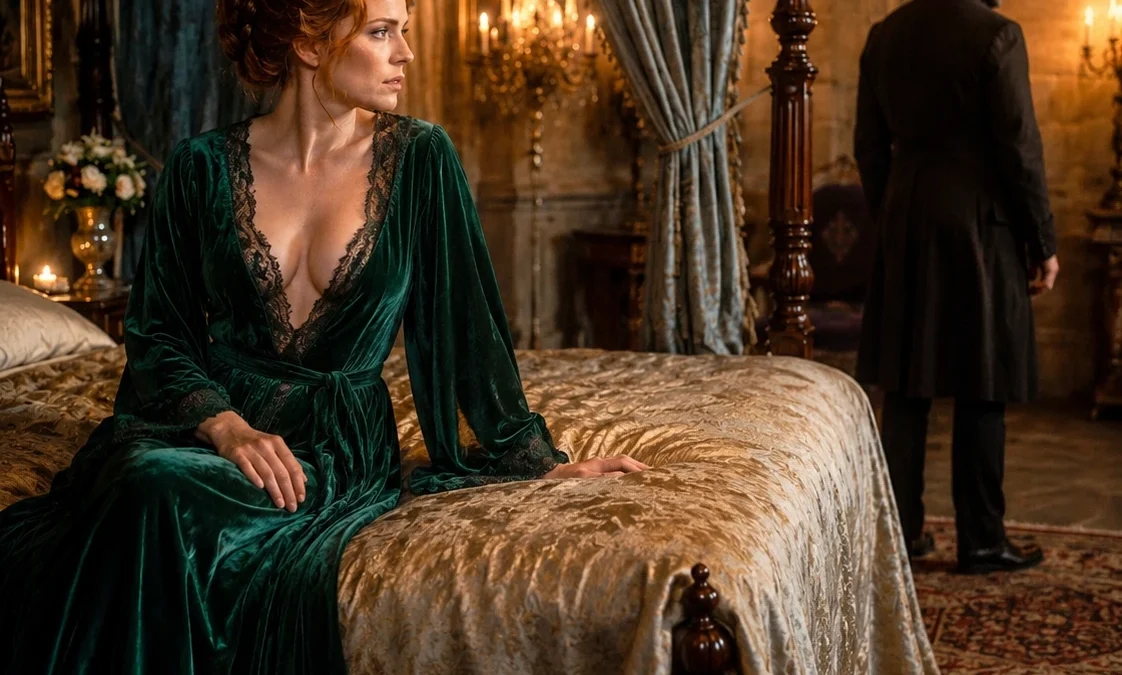
“Am I to Sleep in Your Room?” She Asked on Her Wedding Night. The Cold Duke Never Looked Up. His Answer Would Haunt Her for Months, and Then Change Everything
PART 1
Rosamond Etherington, six and twenty, widowed fourteen months, married seven hours, sat upon the edge of a bed she had not chosen and asked the only question that mattered. 🕯️
“Am I to sleep in your room, Your Grace? Or am I to be shown to one of my own?”
The Duke of Harrogate did not look up from the ledger he had opened upon the writing desk, as though a wedding night were an evening like any other, requiring only that the accounts be settled before the candles guttered.
“You are to sleep wherever you feel safest.”
And that was all.
No endearment. No cruelty either, which was somehow worse. For cruelty could at least be answered. 💔
She had expected many things of this marriage, contracted in the space of a fortnight to settle her late husband’s debts and preserve what remained of her mother’s name. But she had not expected indifference dressed so precisely as courtesy.
The room was cold in the particular way of great houses built for defense rather than comfort, its stone walls sweating faintly with the damp that rolled in off the Northumberland coast. Somewhere below, the gulls cried against a wind that smelled of salt and old rain.
Rosamond had been raised to expect a husband who wanted something from her. If not affection, then at least attention, the ordinary vanity of ownership. What she had instead was Julian Ashworth, seventh Duke of Harrogate, three and thirty, a man whose ledgers were kept more tenderly than any wife had ever been kept, and whose voice carried the flat courtesy of a man speaking to a steward.
She rose from the bed she had been offered and refused, found a smaller chamber down the corridor, its grate unlit, its linens cold, and told herself this was no worse than she had feared.
It was, in fact, considerably worse.
But she did not weep. She did not send for the housekeeper to complain of the draft. She did not write to her sister of her disappointment. She lay in the dark and listened to the sea, and resolved that whatever else this house withheld from her, it would not have the satisfaction of her tears. 🌊
What no one in that house yet understood was that Rosamond Etherington, now Duchess of Harrogate, had spent the whole of her first marriage learning to run an estate from a husband too fond of drink and cards to trouble himself with it. And that the same patience which had kept Etherington land solvent through three bad harvests would not be so easily broken by a cold husband and a colder house.
Her father had died leaving debts disguised as investment. Her first husband had died leaving debts disguised as nothing at all. Simply spent. Simply gone. She had buried him with the composure the county mistook for coldness, which was, in truth, the only inheritance he had left her: the knowledge that grief indulged changed nothing, and that a woman who wished to survive her circumstances must first refuse to be undone by them.
When the Duke’s solicitor called upon her with the proposal, a marriage of convenience, her remaining debts settled, her mother’s name protected, in exchange for an heir and nothing resembling affection, she accepted within the hour.
She had not expected to feel the refusal of affection quite so precisely once she was living inside it.
She had arrived at Harrogate three days before the wedding, carried north in a hired coach through country that grew wilder with every mile. The soft green of the southern counties gave way to gray moor and grayer stone, until she understood, long before she glimpsed the house itself, that she was leaving behind the only life she had known for one built on entirely different terms.
Her mother had wept at the parting, though whether from grief or relief, Rosamond was not entirely certain. Her mother’s debts, too, had been quietly absorbed into the marriage settlement, a fact neither spoke of, but which both understood governed every word of goodbye.
Harrogate Hall had not been built to be loved. It sat upon a headland where the land gave way to gray water, its towers older than the dukedom itself, its corridors so old that the housekeeper, a broad, watchful woman named Mrs. Pendergast, kept fires burning in rooms no one used simply to keep the damp from the plasterwork.
Rosamond learned the house the way she had learned every house that had ever failed to want her: by walking it alone, cataloging its neglects. She discovered where the roof let in water and where the tenant farms had gone unvisited for a decade. Within a fortnight she knew the Duke’s steward was incompetent and afraid to say so. That the home farm’s drainage had failed two winters running without remedy. And that the Duke himself, for all his wealth, walked his own grounds like a man serving a sentence rather than a man in possession of them.
She said nothing of this to him. She simply began, with the quiet, methodical competence that had kept her first husband’s estate from ruin, to fix what was broken. 🔧
It was three weeks before he noticed.
He found her in the estate office on a wet Tuesday afternoon, seated at the steward’s desk with the drainage accounts spread before her. The Duke stood in the doorway a long moment before she acknowledged him, and when she did, she did not rise, nor apologize for the ink upon her fingers.
“Your steward has been telling you the home farm’s yields are steady. They are not. They have fallen for two years running because the lower field floods every spring, and no one has troubled to dig a new channel. I have ordered it done. I hope Your Grace does not object.”
He said nothing for the length of a full minute. When he spoke, his voice had lost some of its flatness, though not enough that she could name what had replaced it.
“You did not think to ask me first.”
“I did not think you would answer,” said Rosamond, and returned to her figures.
He stood a moment longer before he left. And she permitted herself, once his footsteps had faded, a single long breath of something that was not quite triumph, and not quite relief. 😮💨
The steward, a nervous, balding man named Mr. Colby, took considerably longer to accept correction from a woman than the Duke had. So Rosamond waged a quiet campaign of patience. She did not argue. She began keeping her own ledger, parallel to his, recording every yield, every repair delayed, every tenant complaint dismissed, until the weight of accumulated fact made his objections impossible to sustain.
When at last she laid the two ledgers side by side before the Duke and asked him which steward’s arithmetic he trusted, he did not hesitate. Colby was pensioned within the fortnight.
It was a small victory, unremarked upon by anyone but the tenants whose roofs were mended before the autumn rains. But it taught her something she had not expected to learn at Harrogate: that competence, patiently proven, could not be argued away forever.
She began, too, to understand the particular loneliness of the man she had married. Not through any confidence he offered her, for he offered none, but through the small, accumulating evidence of a household built around the absence of feeling. The nursery wing had stood empty and shuttered for three years. The music room held a pianoforte no one played, its keys yellowed with disuse. Mrs. Pendergast let slip that the first Duchess had played beautifully, and that His Grace had not permitted the instrument tuned since her death.
As though silence were a kind of mourning he could control, when so little else had been controllable. 🎹
Rosamond did not ask that the room be reopened. She only noted it, filed it away with the same careful attention she gave the drainage accounts.
She rode out most mornings to the home farm and the outlying cottages. The tenant families were guarded at first, wary of a new Duchess in the manner of people who had watched great houses make promises and break them without consequence. But her insistence on walking their fields herself, on asking after their children by name, on returning a second and third time rather than making a single ceremonial visit, wore down their reserve by degrees.
An old widow named Mrs. Harker, whose cottage roof had leaked for three winters while petition after petition went unanswered, wept openly when the new thatching was finally laid, and told Rosamond, gripping her hand with a strength that belied her age, that she had not expected a Duchess to remember a name like hers, let alone a leaking roof.
Rosamond told her, gently, that she of all women understood what it was to be forgotten by those who owed her better. 🥹
It was this work, more than any single confrontation, that began to alter how the wider county spoke of the new Duchess. The whispers that had first greeted her arrival, a penniless widow married for her usefulness, gave way slowly to a grudging respect that Lady Augusta would find considerably more threatening than the original scandal.
It would be many weeks before Rosamond learned the shape of what made her husband so cold, though she gathered its edges early, the way one gathers the shape of a room in darkness by the furniture one bruises against. Mrs. Pendergast, thawing toward a mistress who troubled herself with drainage and tenant roofs rather than gowns and card parties, let fall one evening that the Duke had been married before, briefly, to a woman of great beauty and greater fragility, who had died at Harrogate three winters past in a manner the household did not discuss.
And that His Grace had not slept in the ducal bedchamber since.
Rosamond asked no further questions. She had learned from her own grief that the questions others asked of the bereaved were rarely kindnesses. And she extended to her husband the same mercy she had wished extended to herself: the mercy of not being made to speak of it.
She began, cautiously, to restore the walled garden behind the east wing, a place gone to bramble that Mrs. Pendergast said had once been the pride of the house, tended by the Duke’s own mother. She noticed more than once the Duke watching from the terrace above as she knelt among the roses with her sleeves pushed back and her hands in the soil. But whenever she looked up, he had already turned away, as if caught at something he had not meant to be seen doing. 🌹
Then his sister arrived.
Lady Augusta Marchmont came to Harrogate in the first week of Rosamond’s second month, ostensibly for a visit, in truth to assess the widow her brother had married with the transactional coldness of a woman purchasing a hunting dog. She was handsome, sharp, and entirely convinced that no woman married for debt and duty could possibly be worth her brother’s consideration. She examined the household accounts over the housekeeper’s shoulder, questioned the servants about the new Duchess’s habits, and remarked within easy earshot upon how quickly some women learned to make themselves comfortable in situations they had done nothing to deserve.
Rosamond bore it with the composure she had perfected over a decade of being underestimated by people who mistook her silence for submission.
“I do hope you understand,” said Augusta over tea on the fourth afternoon, drawing her chair a fraction closer, as though intimacy might disguise the blow she intended. “My brother married you for an heir and nothing more. You would do well not to mistake his civility for anything warmer. It would embarrass you both.”
Rosamond set down her cup with perfect steadiness.
“I understand a great deal more than you credit me for, Lady Augusta. I understand debt and duty. And the particular cruelty of being valued only for what one can produce. I have understood it since I was one and twenty, when my own father made it plain that my worth to this family lay chiefly in what marriage I could be made to secure. I do not require your instruction in it.”
Augusta, who had expected either tears or apology, received neither. She retreated to her chamber with the unsettled expression of a woman who has, for the first time, encountered an opponent rather than a victim. 😏
The Duke, it transpired, had overheard the greater part of this from the adjoining library, the door left carelessly ajar. He said nothing that evening. But Rosamond noticed, over the following days, a change in the quality of his silence at dinner. No longer the silence of a man enduring her company, but something closer to the silence of a man observing her. Turning some private calculation.
She told herself firmly that she did not care to know what it was. She had married for survival, not for scrutiny. And she would not permit herself the indignity of hoping.
Had anyone been watching closely, they might have seen the precise evening the crack began.
She had gone down to the lower gallery past midnight, unable to sleep for the wind battering the headland, and found the Duke there before her, standing before a portrait she had noticed but never remarked upon. A young woman, fair and laughing, in the fashion of some fifteen years past.
He did not hear her approach at first, and for a moment she saw him entirely unguarded. His shoulders bowed in a manner his ducal bearing never permitted by daylight. His dark eyes fixed on the painted face with an expression she recognized instantly, because she had worn it herself, alone, in the year after her husband’s death.
The expression of a person keeping vigil over a grief no one else was permitted to witness.
She ought to have withdrawn. She did not.
“Forgive me. I did not mean to intrude upon her.”
He turned, and for once did not retreat into the flat courtesy that had governed every exchange between them.
“That is my first wife. Cecilia. She died believing I had failed her. And I have never been entirely certain she was wrong.”
Rosamond did not offer the easy comforts others surely had. It was not your fault. You must not blame yourself. The soft nothings that ask the grieving to perform recovery for the comfort of the speaker.
Instead she said only: “Grief does not require you to have failed someone to be earned. Sometimes it is only the shape love leaves behind when it can no longer be given.” 🕯️
He looked at her for a long moment in the guttering candlelight and said nothing further. But something in his bearing had altered, some long-held tension eased by a degree so small she might have imagined it, had she not spent a lifetime learning to read the smallest degrees of things.
What followed began in nothing more dramatic than an increased frequency of his presence in rooms she occupied. The estate office. The walled garden. The small library where she read in the evenings. He began to ask her opinion of tenant matters before consulting his steward. He began, on the coldest evenings, to have the fire in her chamber built higher than the housekeeper’s usual economy allowed, though he never spoke of it, and she never thanked him for it.
Both of them observing the strange, unspoken treaty of two people unaccustomed to tenderness, testing whether it might be offered without demand attached.
One evening, ten days after the gallery, he found her in the walled garden at dusk, and instead of retreating to the terrace, as was his habit, he came down among the rosebeds and stood beside her.
“My mother kept this garden,” he said finally. “I let it go to ruin after Cecilia died. I could not bear a thing so alive when everything else in the house had gone so still.”
Rosamond did not pause in her pruning, though she softened her voice.
“Living things do not ask permission to keep growing, Your Grace. Not even in houses that have decided to stop.”
He was quiet. And then, unexpectedly, he knelt beside her and took up a trowel himself, working the soil with the same careful attention he gave his ledgers, his fine coat forgotten, his hands soon as soiled as her own. A state of dishevelment that would have scandalized his valet, and delighted, she suspected, his long-dead mother.
They worked together in the fading light without further words. And it was, she thought later, the first hour of their marriage that felt like companionship rather than arrangement. 🌹
But the armored grief he had carried since Cecilia’s death very nearly undid what had begun to grow. He withdrew for the better part of a week, canceling their walks, taking his meals alone in his study. Rosamond understood, without being told, that intimacy, however small, had frightened him more than any of his sister’s cruelties ever could. For cruelty he had long since learned to withstand. Tenderness offered him nothing to defend against.
She did not pursue him. She had learned in her own grief that a person retreating from feeling could not be chased back into it, only left a door unlatched and the patience to wait for them to choose it.
On the seventh evening, he appeared again at her side among the roses, offering no explanation and requiring none.
But Lady Augusta, unable to accept that her brother’s cold arrangement was warming into something she had neither engineered nor sanctioned, had written to their aunt. And the formidable Dowager Marchioness of Wexford, who possessed both means and malice in equal measure, was already on the road to Harrogate
PART 2
The Dowager Marchioness of Wexford was a woman whose reputation preceded her by some considerable distance. She had buried two husbands and outmaneuvered three decades of society matrons who had each, in turn, underestimated the precision of her cruelty.
She arrived at Harrogate with an entourage disproportionate to a family visit and installed herself in the best guest chamber with the quiet assumption of a woman accustomed to command wherever she set foot. She was civil to Rosamond’s face for the first two days, though her civility carried the particular chill of a verdict already reached and merely awaiting its formal delivery.
Rosamond, who had weathered worse from creditors and worse still from her first husband’s family, recognized the pattern and refused to be hurried by it. She continued her work in the estate office and the garden as though the Dowager’s presence changed nothing. This unsettled the old woman considerably more than open hostility would have, for she had expected either deference or defiance, and received instead a composure that gave her nothing to press against. 😌
On the third night she came to dinner armed.
“Tell me, Duchess,” she said, before the assembled household, with the precision of a woman who had rehearsed her cruelty in advance, “is it true your first husband died owing nearly every tradesman in three counties, and that you married my nephew within the year to escape the consequence of it?”
The table went silent.
Rosamond set down her glass with the same steadiness she had once used against Augusta.
“It is true my husband left debts. It is true I married the Duke within the year. It is also true that I have spent every week since correcting the neglect of an estate your family allowed to fall into ruin for a decade before I arrived. And I would ask, my lady, which of those facts you find more scandalous?”
It was the Duke who answered before his aunt could recover.
“My wife has increased the yield of the home farm by a fifth, restored the drainage that has failed since before I inherited, and corrected accounts my own steward was too frightened to admit were wrong. I invite you to name a single improvement to this estate in the last decade that was not accomplished at her hand.”
The Dowager, unaccustomed to contradiction, departed within two days, and Augusta with her. The household exhaled as one. 💪
Rosamond noted, with a private and unguarded pleasure she did not permit herself to examine too closely, that her husband had defended her not with the flat courtesy of duty, but with something that had, unmistakably, sounded like pride.
He came to find her that same evening in the small library, where she had taken refuge with a book she was not reading. He stood in the doorway a long moment, and she saw in his bearing the hesitation of a man unaccustomed to admitting what he wanted.
“I did not marry you expecting to be defended by you.”
“Nor did I marry you expecting to be capable of defending you. It seems we have both been mistaken about a great many things.”
He crossed the room and sat, not beside her, but close enough that the distance between them had become, without either announcing it, a matter of choice rather than arrangement.
“My aunt is not entirely wrong to be suspicious. I married you for exactly the reasons she named. An heir. A settlement of debts. A convenient arrangement that required nothing of me but civility. I did not imagine there would be anything more to it. And I confess, I did not want there to be.”
Rosamond watched him steadily. “And now?”
“Now I find I object to my own arrangement.” The admission seemed to cost him something, a small unlocking she watched pass across his face. “I have not slept in the ducal chamber since Cecilia died. I told you to sleep wherever you felt safest because I did not know how to offer you anything more, and did not believe I deserved to offer it.” 💔
Rosamond closed her book.
“I have not required you to deserve anything, Your Grace. I have only required you to be honest. And you have finally managed it.”
He almost smiled, an expression so unfamiliar upon his face that it transformed it entirely, softening a bearing she had thought permanently set in ice.
“Julian. My name is Julian. You are my wife. I should like you to use it.”
“Then you must use mine.”
And for the first time since her wedding night, she saw him look at her the way a man looks at someone he intends to keep. 🥹
There was no grand declaration, no theatrical turning of the tide. Only the slow accumulation of small honesties between two people who had each spent a great portion of their lives believing themselves unworthy of being chosen rather than merely acquired.
He began to walk the grounds with her rather than alone. She began to find some mornings that the fire in her chamber had been built by his own hand before the servants rose, a fact Mrs. Pendergast reported with the particular satisfaction of a housekeeper who had watched a cold house begin at last to warm. Neither spoke of love, not yet, both too wary of a word that had cost them each so dearly in its absence.
But the distance between the two bedchambers narrowed by inches, and then by nothing at all, until the question she had asked upon her wedding night, where she was to sleep, was waiting for its answer.
And as the first frost silvered the walled garden, Julian stood at the door of the small cold chamber down the corridor, a candle in his hand, and asked a question of his own.
PART 3
“Rosamond,” said Julian, in the doorway, the candle trembling very slightly in his hand. “I have a question. And I want you to know in advance that either answer will be the right one.”
She looked up from the book she was not reading. It was late. The wind battered the headland, and the sea beyond the window was black and loud.
“Ask it.”
“Would you sleep in my room? Not as a duty. Not as a term of any contract. Because you wish to.” He swallowed. “I have not slept there since Cecilia. I have slept in my study, in chairs, in the library. I have been, I think, a man who forgot how to go to bed. But I find I would like to learn again, if you would be willing to teach me.”
Rosamond set the book aside, rose, and crossed the cold floor to stand before him. She took the candle from his hand and set it on the sill, so that his hands were free.
“You asked me, once, where I felt safest,” she said softly. “I did not know the answer then.”
“And now?”
She laid her palm against his chest, over the heart that, she could feel, was beating far too fast.
“Now I know.”
He closed his eyes. And the Duke of Harrogate, who had never once raised his voice at a servant or wept before a living soul, let out a long, shuddering breath, and pressed his forehead against hers. 🥹
They did not speak again for some time.
The ducal bedchamber was cold. It had been shut for three winters, its shutters barred, its linens folded and shrouded. Julian stood on the threshold with an expression Rosamond had seen only once before, in the lower gallery, before a portrait.
“I cannot,” he whispered. “Forgive me. I thought I could.”
She did not tell him it was all right. She took his hand.
“Then we will not do it all at once.” She turned, and crossed to the nearest window, and drew back the heavy drapes. The shutters had swollen with damp, and she had to put her shoulder to them. Julian, without a word, joined her. Together, they threw them back.
The night air rushed in, salt and cold and clean, and the sea light poured across the floor in a long silver path.
“There,” said Rosamond. “Now it is simply a room.”
Julian stood very still, breathing the wind. And slowly, the stiffness went out of his shoulders. “It smells of the sea,” he said, wonderingly. “I had forgotten it smelled of anything.”
They lit a fire, the first in that grate for three years. They stripped the shrouds from the bed and shook out the dust. Julian laughed once, a short, startled sound, when a cloud of it caught him full in the face. And for the first time, the ducal chamber of Harrogate Hall rang with something other than silence. 🔥
“I should tell you something,” said Julian much later, with the fire burned low and the wind quieting at last. They lay in the dark, side by side, not touching, the way two people lie who are still learning the language of each other. “About Cecilia.”
“You do not have to.”
“I want to.” His voice was low, steady. “She was very young. Seventeen when we married, and so frightened of everything, of the house, of me, of what was expected of her. I was twenty and I did not know how to be gentle. I knew how to be correct. I thought that was the same thing.” He paused. “She grew ill in the second winter. A weakness of the lungs. I called every physician in England, and I thought that was love. I never once sat with her. I never once simply held her hand. I sent doctors, and money, and letters, and I thought I was doing everything. And on the last night, she asked me why I never came to her. And I had no answer.”
Rosamond turned her head on the pillow.
“That is what she meant when she said you had failed her.”
“Yes.”
“Julian.” She found his hand in the dark and laced her fingers through his. “You were twenty years old. You had never been taught that love is not something you fund. You were taught it was a duty, a form, a correctness. No one ever showed you the other thing.”
“No one did.”
“I am showing you now.” Her voice shook very slightly. “I am not Cecilia. I will not leave you at the end of a winter. And I would rather be held, badly, by a man who is trying, than served perfectly by one who is not.”
He turned to her then, and the dam that had held for three years broke at last. He wept as he had not been allowed to weep as a boy or a husband or a Duke, quietly, helplessly, his face pressed against her shoulder, while Rosamond held him and said nothing at all. She did not tell him it would be all right. She simply stayed. 💔
When it was over, he lay spent and quiet, his hand still in hers.
“Thank you,” he said hoarsely.
“For what?”
“For not leaving. For not telling me to stop.”
“I have spent fourteen months not weeping,” said Rosamond, with the ghost of a smile. “I recognize the look of a person who needs it done properly.”
He laughed, a damp, broken sound, and pulled her closer. And in the quiet dark of a room that had been a tomb, they slept at last, tangled together like two people who had stopped being afraid. 🕯️
Morning came gray and gold over the headland. Rosamond woke to find the other side of the bed empty, and the faintest sound of music drifting up the corridor.
It was the pianoforte.
She pulled on a shawl, her heart pounding, and followed the sound down the stairs, through the long gallery, past the portrait of the fair, laughing woman, to the door of the music room. It stood ajar.
Julian sat at the instrument in his shirt sleeves, his hair rumpled, his fingers moving clumsily across the keys. The pianoforte was badly out of tune. The tune he was picking out was almost unrecognizable. A child’s melody, one hand only, hesitant and sweet.
He looked up, saw her in the doorway, and flushed to the roots of his hair.
“Mrs. Pendergast said Cecilia used to play this,” he said. “I thought… I thought I might try. I am abominable at it. I should like to learn properly. I thought perhaps…” He faltered. “Perhaps you might sit with me.”
She crossed the room, sat beside him on the bench, and placed her hands over his. And together, wrongly, laughing, they played the child’s melody again. 🎹
By afternoon, Mrs. Pendergast had sent for a tuner from Newcastle. By evening, half the household was gathered in the corridor outside the music room, pretending to be dusting, listening to the sound of clumsy scales drifting down the stone halls. A footman wept quietly into a cloth. The housekeeper said nothing. But that night she lit fires in three more of the long-closed rooms, and told the cook, with the air of a woman announcing the end of a war, that the house was waking up.
The winter passed. The sea storms battered the headland, and the old stone walls sweated and groaned, and for the first time in a decade they sheltered laughter.
In spring the walled garden burst into bloom. Rosamond and Julian spent every free hour there, quarreling cheerfully over the placement of roses, planting, pruning, rebuilding. Mrs. Harker, the old widow, sent baskets of eggs and a fierce note that read Tell the Duke I said he is a good lad now. Julian had it framed.
The tenant farms recovered. The drainage held. The home farm’s yields rose by a fifth, then a third, and the whispers in the county curdled into something much more like admiration. Lady Augusta, who had come back once, in a sulk, left after three days with a rather tight and surprised expression, having found the Duchess too composed to quarrel with and the Duke too happy to be lectured. Her visits grew infrequent, and considerably more civil.
And the Dowager Marchioness of Wexford, upon being shown the new wing of the tenant school the Duchess had built, said nothing at all for a long moment, and then remarked that she supposed some women were worth more than their debts.
Rosamond, who had waited a decade to hear such a sentence from anyone, found she did not need it. She simply smiled, and said, “I know.”
By midsummer, the nursery wing had been aired, scrubbed, and painted. Its shutters were thrown back to the sea light for the first time in three years. Rosamond made no announcement. But one evening, as the sun went down gold over the water, Julian found her standing in the doorway of the small, bright room, one hand resting lightly against her waist.
He stopped. He did not need to ask.
“Julian.”
“Rosamond.” His voice was very quiet. “Is it…”
“Seven weeks,” she said. “I wished to be certain before I told you. I wished to see your face when I did. And I wished to say…” She hesitated, a flicker of the old fear crossing her face. “I did not marry you for this. I married you for survival. But I find I want this child very much. And I want it because it is ours.”
Julian crossed the room in three strides and dropped to his knees before her, his hands shaking as he laid them against her. His eyes were wet.
“I will sit with you,” he said, in a rough, breaking voice. “Every day. Every night. I will hold your hand. I will not send physicians. I will stay.”
“I know you will.”
“I swear it.”
“I know,” said Rosamond softly, and bent to kiss his hair. “You told me where I would feel safest. You never told me it would be here.” 🥹
Their first child was born in the depths of the following winter, in the ducal chamber, with the fire roaring and the sea storming against the glass. Julian did not leave her side. He held her hand through every hour, whispering nonsense, apologizing for things that were not his fault, until Rosamond told him through gritted teeth that if he said I am so sorry once more she would have him removed from the room.
When the baby came, a daughter with a shock of dark hair and a furious, rolling cry, Julian looked at her for a very long time. And then, without a word, he bowed his head against Rosamond’s shoulder and wept.
They named her Margaret, for his mother. And the walled garden bloomed with roses that summer as it had not bloomed in thirty years.
Years later, when their eldest daughter asked why the portrait of a fair-haired woman still hung in the lower gallery beside a newer likeness of her own mother, Rosamond told her, gently, that grief and love were not enemies. That a house could hold the memory of one loss and the substance of a second happiness without either diminishing the other. And that her father had taught her, in his own quiet way, that a wound honestly named was a wound already halfway to healing.
She told her daughter, too, of the wedding night she had spent alone in a cold chamber down the corridor. Of the question she had asked a stranger she did not yet know she would come to love. And of his answer, awkward and unfeeling as it had seemed at the time, which had turned out, in the fullness of years, to have been the truest kindness he knew how to offer a woman he had not yet learned to trust with anything warmer.
You are to sleep wherever you feel safest.
“It was not the answer of a cruel man,” she told her daughter. “It was the answer of a frightened one. And the two are seldom so different as the world likes to pretend.”
The gulls still cried over Harrogate’s cold stone every morning, and the sea still smelled of salt and old rain. But within those walls, at last, a duchess who had once been offered nothing more than the freedom to sleep wherever she felt safest had built instead a home in which she no longer wished to sleep anywhere else. 🕯️💛
💭 Isn’t it something, how the coldest answer can hide the deepest fear?
If this story moved you, a LIKE genuinely helps. 👍 Share it with anyone who believes love is built slowly, one honest moment at a time. And tell me in the comments: would you have waited for the door to open? 👇
Disclaimer: This story is entirely fictional and created for entertainment purposes only. It does not represent any organization or individual, nor does it encourage inappropriate behavior. The content was generated with AI assistance.








