An 8-Year-Old Boy Whispered in a Madrid Café That I Was About to Be Cheated Out of €890,000. My Own Interpreter Was Smiling the Whole Time.
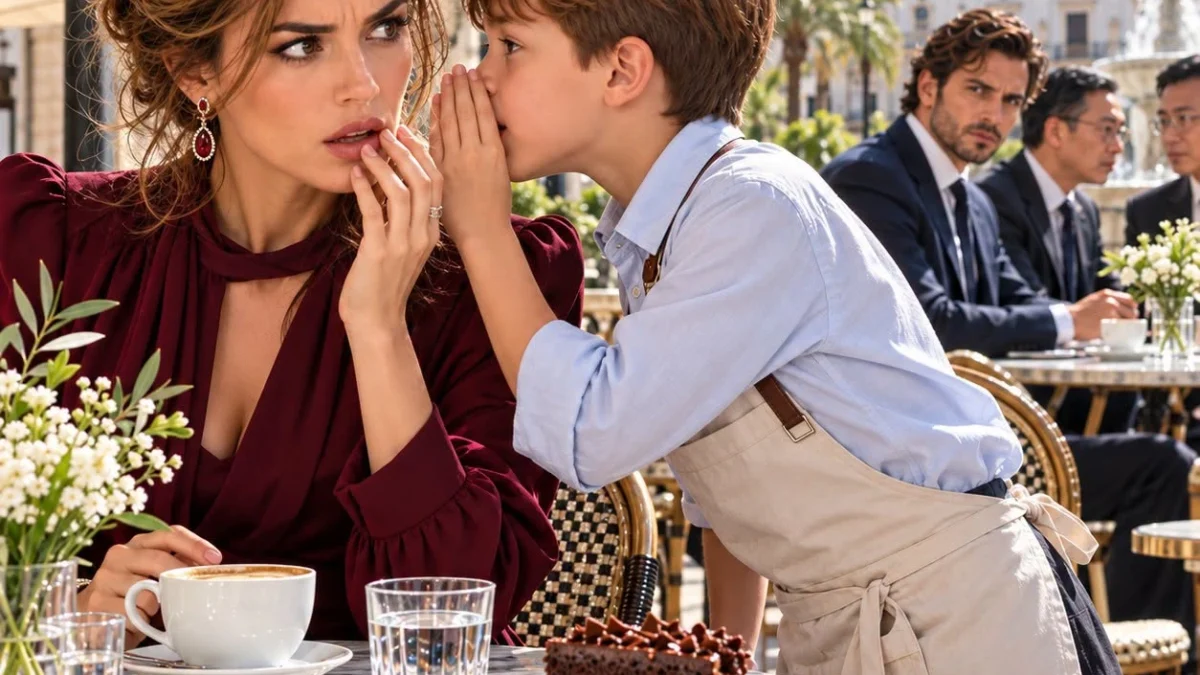
An 8-Year-Old Boy Whispered in a Madrid Café That I Was About to Be Cheated Out of €890,000. My Own Interpreter Was Smiling the Whole Time.
Part 1
“If you buy me a slice of chocolate cake, I’ll tell you why those men are trying to take almost 900,000 euros from you.”
I stopped reading the contract and looked up.
In front of me stood a boy of about eight, hair sticking up in every direction, eyes far too serious for his age, wearing a white apron that nearly reached his shoes.
“And if I don’t buy you the cake?” I asked.
“I’ll tell you anyway. But my father says bad news goes down better with something sweet.”
I smiled. I had no idea this child was about to save me from the worst betrayal of my career.
My name is Clara Montes. I own Frescamar, a chain of twenty-four supermarkets across Madrid, Toledo, and Guadalajara. I spent fourteen years building it from one small shop my parents left me. That morning, I was negotiating an eighteen-million-euro contract with a Japanese company that makes industrial refrigeration systems.
We were meeting at La Esquina, a café near the AZCA financial district in Madrid. The two Japanese representatives, Mr. Takeda and his colleague Mori, had just stepped outside. Javier Salcedo, the interpreter I had hired seven months earlier, was walking them to their car.
“What’s your name?” I asked the boy.
“Nicolás Ruiz.”
His father, Daniel, worked as a cook in the café. His mother had died three years earlier, and Daniel was raising him alone. He couldn’t afford an after-school sitter, so Nicolás did his homework at a tiny table beside the kitchen.
And he had one unexpected passion: Japanese.
He’d started with words from his favorite cartoons, then moved on to educational videos, secondhand books, and free apps. Daniel didn’t understand a word of it, but every night he made time to listen to whatever new words his son had learned.
The cake arrived. I watched him lower his voice.
“When I went to the bathroom, the two men were talking in Japanese. They thought I couldn’t understand.”
He told me what he’d caught: a conversation about a commission, customs expenses, and an amount close to 900,000 euros.
“And they said something that bothered me.” He frowned. “They said you weren’t understanding anything.”
I set my cup down.
“Are you sure?”
“I don’t know every word. But I know numbers. And they said the interpreter was in agreement.”
Something cold moved through me.
Minutes earlier, Javier had explained that I had to accept a mandatory surcharge of 890,000 euros for customs procedures, transport, and certifications. The contract was practically closed. It only needed my signature.
Then Daniel appeared, wiping his hands on a cloth.
“Nicolás! What are you doing bothering the lady?”
“Papá, they’re trying to trick her.”
Daniel went pale. “Forgive him, señora. Sometimes he talks too much.”
I raised a hand. “Your son just told me something very important.”
Daniel looked at the boy with real fear. I would learn later that he’d spent months dreading the loss of his job. He couldn’t afford trouble with an important customer.
The door opened.
Javier came back, beaming.
“Everything’s perfect, Clara. The Japanese are delighted. We’ll have the contract signed Friday.”
Then he noticed Nicolás.
“Hey, champ! Still studying Japanese?”
The boy nodded without smiling. Javier ruffled his hair.
“Keep at it. Maybe one day you can work like me.”
I watched that gesture. And for the first time, his smile looked false.
“Before we sign,” I said, “I want to review some details.”
“Which details?”
“All of them.”
Javier was silent for a few seconds. Then he answered with a calm that felt carefully rehearsed.
“Of course. Although delaying the contract could cost us a lot of money.”
I closed my folder. I didn’t have enough proof to accuse him.
But that same night, I would discover that the so-called translation error hid something far worse. And that the man I trusted with my business had also had access to secrets that were never meant to leave my office.
What happened next still gives me chills. Part 2 is in the comments—or leave any word below and I’ll send it to you privately.
Part 2
What happened next still gives me chills. Part 2 is in the comments—or leave any word below and I’ll send it to you privately.
That night I called Elena Vidal, an old university friend who had spent sixteen years working as a Japanese interpreter in commercial deals.
“I need you to review something, and I need you not to ask questions in front of anyone.”
She arrived at eight the next morning. I showed her Nicolás’s notes, the numbers he’d scribbled on a napkin, and the original emails exchanged with the suppliers. For almost two hours, we compared documents line by line.
Finally Elena put her finger on a sentence.
“This says the price includes transport, customs handling, and delivery to your warehouses.”
I opened Javier’s translation.
It said exactly the opposite.
“Could it be a mistake?”
“No,” Elena said. “He changed the meaning on purpose.”
We kept going. Warranty periods, altered. Maintenance terms, altered. Penalties for delays, altered.
I felt a deep, burning shame. When my finance director had raised doubts about this contract, I had defended Javier. I had even given him a bonus.
“I want them to repeat the lie in front of me,” I said.
On Thursday, we set up another meeting at La Esquina. Elena came as my supposed financial adviser. Javier arrived confident. Takeda and Mori took their seats.
“The final price is eighteen million euros,” Javier translated, “plus 890,000 for additional costs.”
I folded my hands. “Why should we pay customs fees that were already included?”
Javier relayed the question. Mori answered in Japanese.
“He says those costs have always been separate,” Javier told me.
Elena wrote a note and slid it toward me:
He didn’t say that. He asked whether you still don’t understand Japanese.
I breathed in slowly.
“Javier, show me the original email from September twelfth.”
“I don’t think that’s necessary.”
“I do.”
Elena pulled a copy from her folder. Then she began to speak in Japanese.
The change in the room was immediate. Mori stopped smiling. Takeda sat up straight. Javier went completely still.
Elena laid out the differences between the two versions and asked directly about the 890,000-euro surcharge. Takeda asked to check the document his commercial department had signed. Mori tried to interrupt him. Elena stepped in again.
I watched Javier’s confidence drain away.
“Who would receive that money?” I asked.
After a long silence, Mori answered. Elena translated.
“An intermediary company, created to collect those expenses. Javier would receive a commission.”
“That’s false!” Javier protested.
Takeda asked for the intermediary’s documents. Mori opened his laptop.
And then a name appeared that made me rise from my chair so fast it scraped the floor.
The company assigned to collect the 890,000 euros was tied to a business administered by my own brother, Andrés Montes.
The man who had run Frescamar’s finances for eleven years. The man I had trusted with my parents’ life’s work.
If you want to know how my brother answered, LIKE this post and comment “HERMANO.” When enough people comment, I’ll post Part 3.
Part 3
I stared at my brother’s name on that screen as if I were reading a sentence handed down by a judge.
For eleven years, Andrés had been my right hand. When our father died, he was the one who went with me to the notary. When our mother passed, he stayed by my side through the weeks when I could barely get out of bed. We had fought many times, mostly over business decisions, but I had never imagined he could betray me.
“I want a copy of those documents,” I said at last.
Takeda agreed to provide them through the proper legal channels.
Javier tried to stand. “Clara, listen to me. This isn’t what it looks like.”
“Then explain why my brother’s name is there.”
He looked at Mori. Then he lowered his head.
“Andrés said everything was authorized.”
That answer hurt more than any confession.
I felt something break inside me. I didn’t shout. I didn’t cry. I gathered the documents and left.
Before I did, I asked Elena to stay with the Japanese representatives for the rest of the talks. I called my lawyer and ordered every signature on the deal suspended.
That afternoon, I summoned Andrés to my office. He walked in with the same easy smile as always.
“What’s up, little sister? Javier says there are problems with the Japanese.”
I pointed at the chair. “Sit.”
He sensed it at once. Something had changed.
On the desk lay three documents: the original email, the altered translation, and the corporate records of the intermediary company.
“Do you know this company?”
He glanced at the papers. “It rings a bell.”
“You administer it.”
“I hold shares in several companies. I can’t remember every one.”
I slid another sheet across. “This one was authorized to bill Frescamar 890,000 euros. Javier was going to keep a commission. How much were you getting?”
Andrés stopped smiling.
“You don’t know how an international deal of this size works.”
“Explain it to me.”
“There are intermediaries, expenses, commercial commitments. It’s not as simple as you think.”
I stared at him in disbelief. “I’m the managing director of a company I’ve spent fourteen years building. Don’t talk to me like I’m a child.”
He leaned toward me.
“Precisely because you’ve worked fourteen years, you should understand that I deserve something too.”
Those words changed everything.
“Something?”
“You get the recognition, the interviews, the big decisions. I’ve spent years solving problems you don’t even see.”
A pang of sadness went through me. “You have a salary, shares in the company, and a position many professionals would envy.”
“Because I’m your brother.”
“Because I trusted you.”
He looked away. For the first time, I think he understood what he’d just lost.
I told him he was provisionally removed from his duties and cut off from the financial systems until an independent investigation was complete.
“You’re going to report your own brother?”
“I’m going to protect the company our parents built, which you put in danger.”
He stood up. “Mamá would never have allowed this.”
The words landed. For years, that sentence had been Andrés’s favorite way of winning family arguments.
This time, it didn’t work.
“Mamá wouldn’t have allowed you to use our trust to take money from the company either.”
He left without saying goodbye. When the door closed, I put my elbows on the desk and broke down crying.
Not for the 890,000 euros. For every memory I would now have to look at with different eyes.
Over the next twelve days, an outside audit examined the suspicious transactions. They found unjustified payments, suppliers indirectly linked to Andrés, and several invoices that needed explanations. The investigation couldn’t yet establish every responsibility, but it confirmed there had been serious irregularities. My lawyers recommended handing the documentation to the authorities.
I authorized it.
That night my brother called me seventeen times. I answered none.
The next day my aunt Mercedes appeared at the office.
“Is it true you’ve thrown Andrés out?”
“I’ve set him aside while what happened is investigated.”
“He’s your only brother.”
I looked at her with tired eyes. “And I’m his only sister. That didn’t stop him from using my trust.”
She was quiet.
“Family has to forgive each other,” she murmured.
“Forgiving doesn’t mean letting someone keep hurting you.”
It was the hardest conversation I’d ever had with that side of my family.
And yet that same afternoon, something happened that gave me a little hope. My phone rang. Daniel, the cook from La Esquina.
“Señora Clara, forgive me for bothering you. Nicolás has been asking for days whether you’re all right.”
I closed my eyes. I’d been so busy investigating my brother that I’d almost forgotten the small person who had uncovered everything.
“Tell him I’m fine. I’ll come see him tomorrow.”
“You don’t have to.”
“I promised him a cake. And I keep my promises.”
The following Friday, I walked into La Esquina alone, in jeans, white sneakers, and my hair pulled back. Nicolás was at his usual table, copying Japanese characters. When he saw me, he shut the notebook.
“Did they trick you?”
I sat down across from him. “Yes.”
“And did you lose the money?”
“No. Thanks to you, I didn’t sign.”
He grinned. “Then you owe me another cake.”
“It seems I do.”
Daniel came out of the kitchen with a tray. When he saw me, he looked uncomfortable.
“I didn’t know you’d come so soon.”
“I owed a big debt.”
I nodded at the chocolate slice. Daniel smiled for the first time since we’d met.
“If you keep paying like that, my son will think he can negotiate anything with a cake.”
“Papá, I would have helped her for free.”
“I know, champ.”
I watched Daniel stroke his son’s head. That simple gesture stirred something unexpected in me. I’d spent too many years surrounded by people who wanted something from me. Money. Contacts. Influence. Power. And here was a cook who seemed concerned only with teaching his son to be a good person.
“I want to thank you both,” I said, and took out an envelope.
Daniel looked at it without touching it. “What is it?”
“A reward.”
“We can’t accept that.”
“Your son saved me from an enormous loss.”
“And I’m very glad. But I don’t want Nicolás to learn that helping someone depends on how much money that person has.”
I had no answer. I hadn’t expected that.
“My son did the right thing,” he added gently. “That should be enough.”
Nicolás looked at us both. “Well, a cake wouldn’t hurt.”
The three of us burst out laughing.
In the end, I got them to accept something different: a Japanese course designed for his age, with materials and conversation groups. Daniel insisted on paying any other costs related to the classes himself.
I agreed. And I started visiting La Esquina every week.
At first I went to ask how Nicolás was progressing. Then I began taking an interest in the dishes Daniel prepared. And eventually I stopped looking for excuses.
I liked that man.
Daniel was thirty-nine and had worked at La Esquina for six years. Before that, he’d cooked in several Madrid restaurants, but he gave up the chance to become head chef when his wife fell ill. For two years he took her to appointments, treatments, hospital stays. After losing her, he decided no promotion was worth missing Nicolás’s childhood.
He’d learned to cook helping his mother in a small neighborhood bar. His biggest dream was to open a place of his own. Nothing luxurious. A cozy café with ten tables, an open kitchen, and a little shelf of books for customers.
I discovered that dream one afternoon when Nicolás began sketching his father’s ideal café.
“Here’s the kitchen. Here’s the coffee machine. And here’s my table to study.”
Daniel blushed. “Don’t mind him. Just our ideas.”
“I like them,” I said.
Weeks later, over dinner, I offered to finance the project. He turned me down immediately.
“I don’t need you to hand me a business.”
“It wouldn’t be a gift. It would be a loan.”
“Clara, I’d like to invite you to dinner without feeling like you’ve bought my future too.”
I set down my fork. “Invite me to dinner?”
He realized what he’d said. “Well… yes. I mean…”
From the other end of the table, Nicolás looked up. “Papá, you’ve been trying to tell her you like her for ten minutes.”
I burst out laughing. Daniel covered his face.
That night turned into our first date. Then came another. And another.
With Daniel, I could talk about anything without the conversation circling back to money. He discovered a woman who was funny, passionate, and far more vulnerable than she appeared in boardrooms.
But our worlds were different. I traveled constantly, attended business dinners, ran endless meetings. Daniel organized each day around Nicolás’s school schedule.
The differences began to weigh on us when I invited him to a corporate reception. A guest, thinking she was being witty, remarked:
“How curious. The great Madrid businesswoman and a café cook.”
Daniel smiled politely. On the drive home, he said nothing. Finally he confessed:
“I don’t know if I fit in your life.”
It hurt more than I expected. “Who said you have to fit? I want you to be part of it.”
“I don’t want you to have to choose someday between your world and mine.”
“And I don’t want to spend my life proving I deserve to be loved no matter how much money I have.”
We argued. We went four days without seeing each other. I buried myself in work again, until my phone rang.
“Clara, can you come to my school festival?”
I knew that voice instantly. “Of course.”
“I’m going to speak in Japanese in front of everyone.”
“Then I can’t miss it.”
“Do you promise?”
“I promise.”
The festival was on a Saturday at 5:00 p.m. That same day, I had a reception with potential partners to open eight new supermarkets in Castilla y León. It started at six. My team insisted I attend in person.
“They’re important investors,” my commercial director reminded me.
I looked at both appointments in my calendar. I thought about the last fourteen years. The family birthdays I’d missed. The vacations I’d canceled. The dinners I’d abandoned before dessert. My brother, who had told me so many times that the company needed all my attention.
And I remembered Nicolás asking whether I would keep my promise.
On Saturday, Daniel arrived at the school with his son. Nicolás wore a perfectly ironed white shirt. When he stepped onto the stage, he searched the audience and found his father in the third row.
But the seat beside him was empty.
Daniel saw his disappointment. The boy took a deep breath and began. He explained, in Japanese, why he dreamed of seeing Tokyo, how its trains worked, why ancient temples fascinated him.
Then, looking toward the back of the hall, he stopped.
I had just walked in. No elegant dress, no jewelry. Jeans and a blue sweater. I had sent my commercial director to the reception.
Nicolás smiled so broadly that several teachers exchanged surprised looks. He finished his speech without a single mistake. Then he added a sentence that wasn’t in his prepared text. His teacher translated it:
“He says today he learned that a promise can matter more than any word written in a contract.”
My eyes filled. Daniel turned toward me. He didn’t need to ask anything.
When the festival ended, Nicolás ran to hug me. “You came!”
“I promised.”
Daniel waited until the boy had gone off with his classmates.
“You missed an important meeting.”
“I sent someone perfectly prepared.”
“But they wanted to see you.”
I smiled. “So did Nicolás.”
Daniel took my hand. It was the gesture we’d both needed to start again.
Over the following months, the investigation into Andrés continued through the proper channels. I didn’t withdraw the complaints or hide information. My brother eventually admitted to his lawyers that he had taken part in some of the irregular operations, though other responsibilities remained to be clarified.
One afternoon, he sent me a letter. He didn’t ask for money. He didn’t demand forgiveness. He admitted that for years he’d been comparing himself to me, and that he had turned that envy into a justification for things he knew were wrong.
I read it several times. Then I put it away.
I wasn’t ready to rebuild the relationship. But for the first time, I understood that I could move forward without letting resentment steer my life.
The company changed too. We introduced independent translation checks, mandatory legal reviews, and procedures that prevented any extraordinary payment from being approved without outside verification. I stopped believing that trusting someone meant giving up the right to check their work.
Meanwhile, Daniel kept saving. He found a small space in Chamberí. The rent was reasonable, though it needed renovations. He took out a bank loan and partnered with Marcos, an old classmate from culinary school. I didn’t put in any money. But I helped them review the lease and the business plan.
“Advice is free,” I joked.
Daniel always answered, “Then I’ll have to pay you in croquettes.”
Nicolás joined every step of the preparations. He picked the plants for the windows. He helped line the shelves with books. And he proposed a name that surprised everyone.
Itadakimasu.
“It’s what you say before eating in Japan,” he explained. “It’s to thank everyone who made the food possible.”
Daniel loved it.
The new café had exactly ten tables and an open kitchen. On opening day, every one of them was full. Old coworkers, neighbors, relatives, a few regulars from La Esquina. Elena came too, carrying a gift for Nicolás: an illustrated Japanese dictionary with a handwritten dedication.
I arrived with flowers. Daniel met me at the door.
“What do you think?”
I took in the light wood, the plants, the smell of fresh coffee, Nicolás’s drawings framed beside the kitchen.
“It’s exactly how you imagined it.”
He shook his head. “It’s better.”
At seven o’clock, Nicolás tapped a glass with a teaspoon.
“Attention! I have something to say!”
Daniel looked up. “What have you done now?”
“I’ve decided you two should get married.”
Laughter filled the room. I pointed at Daniel. “I have no problem with that. Your father is the one who takes too long to make decisions.”
Daniel slipped a hand into his chef’s jacket and took out a small box.
Nicolás’s eyes went so wide he nearly dropped the glass. “Papá! You already had a ring?”
“Some things I can arrange without hiring my little adviser.”
Daniel came toward me. He didn’t give a prepared speech. He just took my hand.
“When you walked into our lives, I thought you were another important customer. My son saw something I hadn’t. He uncovered a lie, and he introduced us to a woman who needed to learn to trust again.”
I started to cry.
“I can’t promise you a perfect life,” he went on. “There will be hard days, burned dishes, arguments about who cleans the kitchen. But I can promise you that you’ll never have to buy my affection, or wonder whether I’m telling you the truth.”
He opened the box.
“Clara, will you marry me?”
I answered before he finished kneeling.
“Yes.”
Nicolás jumped for joy. The customers applauded. And Daniel held the two people he loved most in the world.
We married five months later. No lavish ceremony. A small wedding in the café itself, with white flowers, food cooked by Daniel, and family photographs on a table. A picture of my parents. One of Daniel’s. And a photograph of Nicolás’s mother, to whom he had wanted to give a special place.
Before the celebration began, I went to him.
“Do you mind if I marry your father?”
He looked at me, surprised. “You’re asking me now?”
I smiled. “I want to be sure you’re happy too.”
He thought about it.
“My mamá will always be my mamá.”
A small knot formed in my throat. “Of course.”
“But that doesn’t mean I can’t love you a lot too.”
I hugged him. Then, very seriously, he added:
“And you should know my dad snores.”
I laughed through my tears.
That night, after the guests left, Daniel turned off the kitchen lights. I was still sitting beside Nicolás, sharing the last slice of chocolate cake. The same recipe he had chosen the day we met.
Daniel stood watching us for a few seconds, thinking about everything that had changed. The boy who once studied Japanese beside someone else’s kitchen now had his own table in the family business. And Daniel, who had believed he’d never fall in love again, was married to a woman who had learned to love his son too.
Three years later, when Nicolás was eleven, the three of us traveled to Japan. He had planned the itinerary for months. In Tokyo he bought the metro tickets, ordered food in Japanese, and explained to us how to reach Sensō-ji temple. Daniel was so proud he couldn’t stop smiling. I watched in wonder. That small boy who had learned a language from used books and free videos was now walking through Tokyo with extraordinary confidence.
One afternoon, resting beside a traditional sweets shop, Daniel asked him, “Is it what you imagined?”
Nicolás looked at the streets, the lights, the people.
“No.”
Daniel seemed startled. “Are you disappointed?”
“It’s much better. The books never explained how this city smells when it rains.”
I stroked his hair. “And what do you want to be when you grow up?”
He thought. “An interpreter. But one who translates exactly what people say.”
Daniel burst out laughing. “That would be a good start.”
“And then I’ll open a restaurant in Japan so Papá can come cook.”
“And me?” I asked.
He gave me a mischievous grin. “You’ll review the contracts.”
The three of us laughed.
That night we went back to the hotel with a photograph we’d just taken in front of the great red lantern at the temple. When we returned to Madrid, Daniel hung it beside a much older picture: Nicolás at eight, in an enormous apron, sitting across from me at La Esquina. Between us, a slice of chocolate cake.
The two photographs hang together on the wall of Itadakimasu. One remembers the day we met. The other shows what we built.
Sometimes, when a customer asks about them, Nicolás tells how it all began because he overheard a conversation in Japanese while washing his hands. Daniel always adds that his son did the right thing by warning a stranger. But I gently correct them both.
“The most important thing wasn’t that Nicolás knew Japanese. It was that he had the courage to tell the truth when nobody expected a child to understand what was going on.”
Then I look at Daniel. “And that his father taught him to do the right thing without expecting a reward.”
Nicolás, who by now has an answer for almost everything, always chimes in: “Well, let’s not forget the chocolate cake.”
And the three of us laugh again.
Because I began this story convinced the greatest danger was losing 890,000 euros. I learned that money can be recovered, that broken trust needs time, and that sharing a surname doesn’t guarantee loyalty. Meanwhile, a boy nobody had paid attention to and a cook barely making it to the end of the month gave me something no contract could ever buy.
A family.
Every anniversary of that first meeting, I still sit by the window of the old café where it all began and share a slice of cake with Nicolás. The first time, he asked for chocolate in exchange for a truth. Now he doesn’t have to ask for anything.
I always remember his words: “Bad news goes down better with something sweet.”
But I’ve learned something even more important. Good people don’t always arrive when you’re looking for them. Sometimes they show up in an apron that’s too big, carrying a truth nobody wants to hear and enough courage to change your destiny.
And love, when it’s real, doesn’t ask how much money you have. It simply sits beside you, shares the last slice of cake, and keeps its promises.
Disclaimer: This story is entirely fictional and created for entertainment purposes only. It does not represent any organization or individual, nor does it encourage inappropriate behavior. The content was generated with AI assistance.








