AN 8-YEAR-OLD GIRL KNELT IN A DARK CHAPEL AT MIDNIGHT AND BEGGED FOR A JOB SO THEY WOULDN’T TAKE HER LITTLE BROTHER. THE DUKE SITTING BEHIND HER HAD JUST SIGNED THE ORDER THAT WOULD SEPARATE THEM…
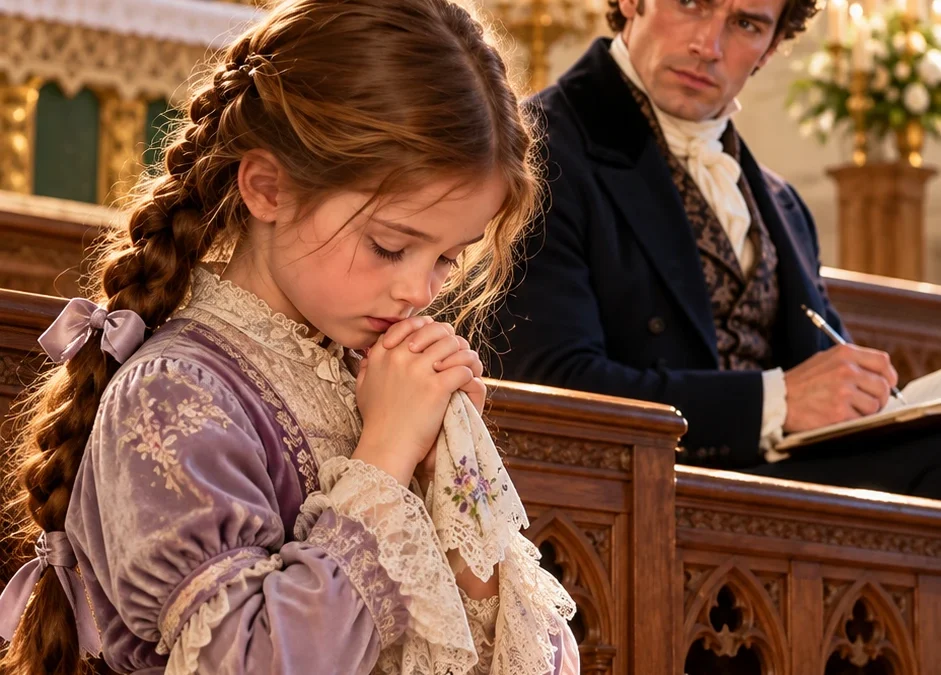
AN 8-YEAR-OLD GIRL KNELT IN A DARK CHAPEL AT MIDNIGHT AND BEGGED FOR A JOB SO THEY WOULDN’T TAKE HER LITTLE BROTHER. THE DUKE SITTING BEHIND HER HAD JUST SIGNED THE ORDER THAT WOULD SEPARATE THEM… 😢🕯️
Part 1
Edric Vale, Duke of Marlow, had just placed his signature beneath the order closing Saint Anne’s school when a child’s prayer stopped his pen.
He sat alone in the rear pew of the estate chapel, the school closure papers on one side and the proposed hunting lease on the other. His father had prayed in that chapel every Sunday. Edric had chosen it because he did not want to sign these papers in the library, where the walls were lined with portraits of men who would have argued with him.
The chapel was dark except for the lamps near the altar.
In the pew ahead of him knelt a child. Small. Thin. Wearing a coat far too large for her shoulders. One hand held a single old glove. The other was pressed against her mouth as she whispered into the empty chapel.
“Please give me a job. Then Tom can stay with me.”
Edric turned. The girl’s eyes were shut tightly. She did not know anyone was listening. It was close to midnight. No child should have been there alone.
“Are you hurt?” he asked.
She opened her eyes and stared at him. She shook her head.
“Not yet,” she whispered. “But tomorrow they’re taking Tom away. If I have a job, perhaps they will let him stay with me.”
Edric’s fingers stayed on the pen. He knew the name. Thomas Bell was six, the younger child of the late bellkeeper. His sister, Elsie, was eight. Their mother had died years ago, and their father had died three weeks earlier of a winter fever.
And Edric knew exactly what was scheduled for tomorrow. Elsie was to be sent to a boarding school in the county town. Tom was to be placed as a farm apprentice several miles away.
The arrangements were written in the same tidy hand as the papers in front of him. Until this moment, he had thought of them as necessary entries in a difficult file.
Now an eight-year-old girl was kneeling in his father’s chapel, holding a single glove as if it were the last thing keeping her brother in the world. 🕯️
“Who told you they were taking him?”
“Mr. Pritchard said Tom will go to a farm. He said it is close enough. I said I could work.”
“A job would not make you his legal guardian.”
She shook her head. “Do you have a guardian?” “The chapel people.”
“And where is your brother?”
“In the bellkeeper’s cottage. Asleep. I left when he stopped crying, because I thought the chapel people might help us. I meant to return before he woke.”
The answer was so quiet that Edric almost missed it. He set down the pen.
“You should not have left him alone.”
Her face crumbled. “I know.”
Edric stood at once. “I did not mean… You will come with me. We will fetch him.”
She stared. “Are you the Duke?”
“Yes.”
“Do dukes fetch children?”
“This one does tonight.”
He folded the closure order and slid it inside his coat. The land lease remained on the pew. He did not look at it again.
At the door, Elsie stopped. “Are you going to save the school?”
“I do not know yet.”
“Then what are you going to do?”
“Find your brother first.”
It was not enough to make her feel safe. But it was enough to make her move.
The bellkeeper’s cottage stood beside the schoolyard. Its windows were dark. Snow had gathered against the door.
Elsie pushed past him. Tom was curled beneath a thin blanket near the cold stove. He woke and sat up, clutching a wooden wheel.
“Elsie! I came back.” “You said you were going to the chapel.” “I brought someone.”
Tom looked at the Duke. Edric removed his own coat and wrapped it around the boy.
“Is he going to be angry?” Tom asked, looking at Edric’s boots.
“Not tonight,” said Edric.
He lifted the boy. Tom weighed almost nothing.
At the gatehouse, Edric ordered the spare room lit and sent for Mrs. Avery, the housekeeper. She arrived in a wool cloak, took one look at Tom swaddled in the Duke’s coat, and said only, “I will wake the kitchen.”
By the hearth, Elsie broke a piece of bread in half and gave the larger piece to Tom. Edric noticed. “You should eat too.”
“There is enough.”
“That was not my question.”
She waited until Tom swallowed before taking the smaller half. Edric pushed a second slice toward her. “I’m not very hungry,” she said. “Then you may leave it.”
She picked it up. He did not ask her to thank him.
Then came the parish officer, Mr. Pritchard, with a lantern and a face full of annoyance.
“The arrangements are not casual, your grace. Their father’s housing ended with his employment.”
“Tomorrow’s separation is suspended.”
“There is no approved household willing to take both children. You can provide a room. That does not make you their legal guardian.”
Edric disliked the word legal. It turned children into files.
“What is required?”
“A formal temporary guardianship application through your solicitor. The parish must be satisfied the children will have food, education, supervision, and a lawful place to live. The separation will not happen while the application is being made.” Pritchard studied him. “If you are prepared to accept responsibility for the delay…”
Through the office window, Edric saw Elsie sitting on the bed beside Tom, still in her coat, one hand still on the old glove.
“I am prepared to accept responsibility for the children.”
When he returned to the spare room, Elsie was awake.
“You said the school might close.”
“I said I do not know what will happen to it.”
“That is the same as saying it will close.”
Edric had no answer. She watched his face.
“My father rang the bell three times every day. The first bell meant come to lessons. The second meant school would close soon. The third meant everyone could go home.” She looked at the glove. “And if I hold Tom’s hand, he can come home with me. I know he can.”
It was a child’s certainty, not a legal one. It made him want to promise more than he could deliver.
“I will tell you what happens before it happens.”
“That is not the same as keeping him.”
“No.”
“Then you should work quickly.”
Edric almost smiled. “Yes. I should.”
But in the morning, he was about to discover how much worse the school was than any report had told him.
👇 Want Part 2? Comment any word and I’ll send it to you privately, or look for it in the comments!
Part 2
Edric had ordered the school prepared as a temporary shelter. The next morning, Mrs. Avery met him in the schoolyard with a ring of keys and an expression suggesting the keys would not solve the problem.
“The roof above the side room leaks worse than the classroom. The chimney draws smoke into the building. And one of the beds is missing a leg.”
Through the windows, Elsie and Tom stood with blankets around their shoulders, coughing in the smoke from the stove. Edric disliked how correct she was when she said:
“You did not even look first. You looked at the paper.”
“Yes.”
Tom poked the smoke-stained wall. “The paper did not say it was cold.”
“No,” said Edric. “It did not.”
The stove gave a loud cough and sent a gray cloud across the room. Tom sneezed. “Everyone out.”
Inside the school, he met the schoolmistress, Martha Gray, beside a dead stove. “Why is the fire out?”
“We have no dry wood.”
“How long has the roof leaked?”
“Since October.”
“Why was it not repaired?”
“The estate office said there was no money.”
The answer landed more heavily than he expected. The estate office was his office. The order to reduce repairs had carried his signature. He had not read the school report. He had accepted the summary that the building was too costly and underused.
Around him, three children shared one reader. An older boy cut kindling with a blunt hatchet. Two girls patched a curtain. A little one sat beside the dead stove with her hands tucked beneath her arms. Twenty-three attended in winter, more after harvest. The village repaired its own difficulties here, with potatoes, wood, and buckets of water, and Mrs. Gray accepted each as ordinary.
It was not ordinary. Edric had looked at the accounts and seen expense. He had not looked at the children and seen the cost of removing the school.
“If the school is to continue,” said Mrs. Gray, “I need more than a repaired roof. Books, coal, a reliable salary, someone who can decide what happens when the estate office says there is no money. I have asked for these things for two years.”
“My father intended it to continue.”
“Intentions do not pay for coal.” She looked at him, not unkindly. “You have just learned the roof leaks.”
He accepted the rebuke. “Then I have much more to learn.”
He wrote it down. A month earlier, it would have offended him.
Elsie led him up the chapel tower. The bell rope hung in two broken pieces. Snow showed through a gap in the roof.
“This is where my father worked. The first bell told children to come. The second told people school would close soon. The third told everyone they could go home.” She touched the broken rope. “Someone had to tell people when to come back. Because if someone heard it, they knew where to return.”
Edric looked down at the school, the chapel, the cottage. He had believed the old Duke’s support of this place was careless generosity, money sent whenever the roof leaked, books bought whenever the teacher asked, without a proper foundation. He had called it a failure of judgment.
Now he saw another possibility. His father had not been trying to look kind. He had been trying to keep one place in the village where children could come back to.
That did not erase the estate’s debts. But it changed what the school meant.
“Can it ring again?” Elsie asked.
“Yes. I am going to find out what it costs.”
“That is not a very good promise.”
“It is an honest one.”
“Honest promises are slow sometimes. I do not like slow.”
“Neither do I.”
But the lease was real, and so was the deadline.
Lord Henry Ainsley would rent the woodland, the meadow beyond the chapel, and the school grounds for a private hunting preserve. The rent would cover the estate’s cash shortage. The offer expired in three days. If Edric accepted, the school and chapel would close, and twenty-three children would lose the only school within walking distance.
The parish officer sent another message: the placements would proceed in the morning unless Edric submitted proof of a guardianship application.
Two problems. Not solvable by the same signature.
For the first time since inheriting the title, he did not send the problem to someone else. He called a meeting in the schoolroom. Mrs. Gray brought her repair list. The carpenter brought an estimate. Two tenants brought figures showing how much produce the school bought from local farms. Lord Henry’s land agent, Mr. Collins, arrived expecting to discuss only boundaries.
“Before I signed this,” Edric said, laying the lease on the table, “I want each of you to explain what the school and chapel require.”
“Your grace, this is not a discussion about charitable institutions. It is a discussion about land.”
“The land is used by more people than the lease describes. What does Lord Henry truly require?”
“The northern meadow, the woodland, and the western track. The school grounds are merely convenient.”
“Convenient is not necessary. Then calculate the value without it.”
The questions came from every side. Edric did not silence them. He wrote down the figures. By evening they had a plan. The woodland and distant meadow would be leased. The schoolyard, chapel, bell tower, and cottage would remain outside the lease. Part of the rent would go into a repair fund. The parish would carry more of the teacher’s salary. A school committee would form. And villagers began offering what they could: Saturday labor, timber from the common copse, leftover stone, lamp oil. The chapel keeper said the bell rope would cost very little.
“You mean you will not simply order it?” asked the carpenter.
“I have ordered enough things without asking whether they could be done.”
Mrs. Gray gave him a brief approving glance.
It was not a perfect answer. It would not make the estate rich. But it would leave the school standing.
Then Mr. Collins returned with a final message: the full parcel or no agreement.
“You are giving up the best part of his offer,” the agent said.
“I am keeping the part that should never have been offered.”
Edric signed the revised arrangement, not the old lease. And as the village gathered outside the chapel to watch, he turned so they could all hear him.
“I was prepared to close this school because I looked at what it cost and did not look at what it held.”
No one moved.
👇 Want to know what the magistrate decided about Elsie and Tom? LIKE or COMMENT “REVEAL” and Part 3 will be posted once we reach enough comments!
Part 3
“I saw a building needing repairs,” Edric continued. “I did not see the children who came here, the villagers who kept it standing, or the families who relied on it as the one place that did not send them away. The school and chapel will not be included in the hunting lease. This will not solve every difficulty. But it will create a structure that does not depend on one man remembering to be generous.”
His gaze moved to the chapel doors. “My father gave money here without building a permanent arrangement. I once thought the answer was to close what he had supported. I was wrong about the answer, even if the financial problem was real.”
The village carpenter let out a breath.
Edric looked at Elsie, standing near the school door, Tom beside her. Tom’s fingers were no longer locked around her hand.
“The guardianship application has been filed. The cottage will remain available to them. Elsie will return to school. Tom will enter the school with her until the magistrate confirms the arrangement. They will not be separated while the review proceeds.”
Elsie’s shoulders dropped. Tom squeezed her hand. “You can let go,” she whispered.
“I know.”
He did not let go immediately.
But Elsie still looked over her shoulder. When Edric walked her to the classroom the next morning, she turned back three times. On the fourth, she made herself face forward.
“If I go into class, will they take him?”
“No one will take him without your knowledge.”
“How do you know?”
“Because I am telling the parish he is under my temporary care until the hearing. If they do not listen, they will have to speak to me.”
Mrs. Avery would sit with Tom. Tom nodded before Elsie could speak. “She comes back.”
Elsie looked surprised.
She stepped inside, sat beside the window, and opened the reader with a shaking hand. Edric stayed outside until she looked down at the first line.
The hearing took place the following week in the parish office. The solicitor submitted an inspection report: the cottage roof patched, the stove replaced, the windows made to close.
The magistrate asked Edric whether he understood the responsibility.
“I understand that a house and a title do not, by themselves, make a safe home. That is why the children will have a named teacher, a housekeeper, parish oversight, and a school committee.”
Then the magistrate asked Elsie whether she wished to remain with her brother. She looked at Edric. He did not answer for her. She stood straight.
“Yes.”
“Do you understand that your brother will not need you to watch him every moment?”
She hesitated. “I do not know how to do that.”
The magistrate’s face softened. “She will learn,” Edric said. “I will help. But she will not be his only protector.”
The temporary guardianship was granted. 🙏
The next day, Lord Henry accepted the reduced lease. Mrs. Avery organized regular meals. Mrs. Gray added Tom’s name to the school register. The school committee held its first meeting.
For a week, Elsie walked Tom to class. On the eighth morning, he ran ahead.
“He’s going too fast.”
“He is going to school.”
“He may fall.”
“Then the schoolmistress will help him up.”
Elsie watched Tom reach the door. Mrs. Gray took his hand. Elsie’s fingers loosened around the old glove.
“You can keep it,” said Edric.
“It is not his.”
“No. It belonged to my father. Perhaps it is time to put it somewhere safe.”
She tucked it into her pocket. “I prayed with it. Do you think it worked?”
Edric looked at the school, the chapel, the repaired cottage.
“I think it made someone listen.”
“Who?”
“Me.”
Elsie considered this. Then she ran into the classroom.
The bell rope was repaired before winter ended. The first time Elsie rang it, the sound rolled across the village and startled three pigeons from the chapel roof. Children ran toward the school. A farmer waved from the road. Mrs. Gray stood at the door with her lesson book.
Elsie rang a second time, then a third.
Tom tugged her sleeve. “Does the third mean we can go home?”
“Not yet. It means school is beginning.”
“That is not what it used to mean.”
“The bell can learn new things.”
Edric stood below the tower, listening. 🔔
He had once thought responsibility meant keeping the estate from collapse by cutting away anything that could not be measured as profitable. He had thought his father’s charity proved that kindness without structure was foolish. He was still right about the need for structure. He had simply forgotten that structure was meant to hold people, not make them disappear from the accounts.
One afternoon, Mrs. Gray brought a list of three new children who would begin lessons the next day. Elsie read it over her shoulder.
“There will be three new children tomorrow.”
Edric sat beside her on the long bench. “Then we will prepare three places. Desks, books, and enough wood for the stove.”
“Tom needs a place, too.”
“Tom has a place.”
The boy climbed onto the bench and leaned against Elsie’s shoulder. “Small Thunder needs one,” he said, holding up the wooden horse.
“The wooden horse cannot attend lessons.”
“He can count. He counts the spoons.”
Elsie began to laugh.
Edric looked toward the chapel doors. He could still remember the night she had knelt in the front pew and whispered for someone to save her. He had turned because her words reached him before the papers did.
Now he sat beside her and listened to the entire list of things she believed the new children would need. She did not pray alone anymore.
When the lesson ended, Tom ran into the yard and called for his sister. Elsie answered from the schoolroom door instead of running after him. She finished placing the books on the shelf, then joined him at an ordinary walking pace, without gripping the glove so tightly.
Edric noticed the difference. No one had told her to stop guarding Tom. She had simply discovered that she did not need to earn a wage to keep him safe. The house, the school, and the adults around them could hold some of the weight.
And Edric no longer mistook a signature for the whole of his responsibility. 💛
This story is entirely fictional and created for entertainment purposes only. It does not represent any organization or individual, nor does it encourage inappropriate behavior. The content was generated with AI assistance.








