AN APACHE WOMAN KNOCKED ON THE WIDOWED RANCHER’S DOOR IN A BLIZZARD — WHAT HAPPENED NEXT CHANGED EVERYTHING
AN APACHE WOMAN KNOCKED ON THE WIDOWED RANCHER’S DOOR IN A BLIZZARD — WHAT HAPPENED NEXT CHANGED EVERYTHING
PART 1 — THE WOMAN AT THE DOOR
The blizzard had been talking all night.
Not the soft hush of ordinary snowfall, but a savage wind sweeping down from the San Juan peaks as though the mountains themselves had come looking for someone.
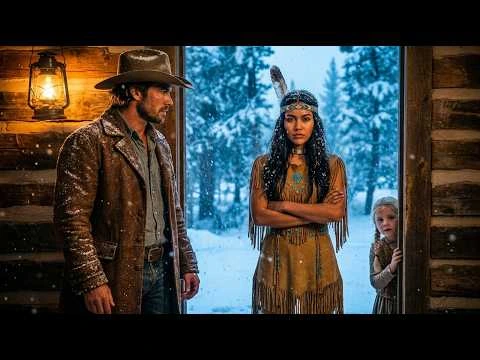
Eli Calhoun stood beside his front door with a rifle in one hand and a lantern in the other.
Then came three knocks.
Slow.
Deliberate.
He almost ignored them.
Almost.
When he opened the door, a young Apache woman was standing on his porch.
She was covered in snow, her dark hair frozen against her shoulders, her lips pale from the cold. One hand gripped the doorframe while the other rested against her side.
She looked directly at him.
“I will work,” she said in broken English. “Shelter.”
Then her knees gave way.
Eli caught her before she struck the porch.
She weighed almost nothing.
Behind him, his eight-year-old daughter Sarah stood halfway down the stairs, clutching the railing.
“Papa,” she whispered. “Is she dying?”
Eli looked down at the stranger in his arms.
He had no idea who she was.
He only knew one thing.
If he had waited another few minutes, she would have died on his doorstep.
Her name was Sona.
She had walked nearly forty miles through the winter storm after fleeing a man named Greer, a trader who claimed he had a legal right to take her as his wife.
The paper he carried was a lie.
Sona had never agreed to it.
She had fled before dawn, knowing Greer would follow.
Now she had reached the only light she could find in the mountains.
Eli carried her inside, wrapped her in blankets, and placed her near the fire.
He expected fear.
He expected suspicion.
Instead, when Sona woke before sunrise, she sat upright, took a cup of warm water in both hands, and looked at him with calm, exhausted eyes.
“My name is Sona,” she said.
Then she made him an offer.
“I cook. I mend. I know medicine. I work every day until spring.”
Eli looked at her damaged feet, then toward Sarah sleeping upstairs.
He knew what his neighbors would say if they learned he had taken in an Apache woman.
He knew trouble might follow her.
But he also knew what it meant to leave a human being outside in a blizzard.
“You stay,” he finally said. “We’ll work out the rest.”
Neither of them understood what those three words would cost Eli.
Because somewhere beyond the mountains, Greer was already following her trail.
And when he finally reached the ranch, he would not come asking politely.
Would Eli be willing to risk his home, his daughter, and everything he owned to protect a woman who had been a stranger only one night before?
#ApacheStory #CowboyStory #WesternStories #FrontierTales #OldWest #EmotionalStories
PART 2 — THE MAN WHO CAME LOOKING FOR HER
The first two days were cautious.
Eli gave Sona a small room beside the kitchen and made it clear she could stay through the winter as long as she caused no trouble.
Sona simply nodded.
Then she began working.
She swept the floors, repaired Sarah’s torn coat, gathered firewood, and learned exactly how Eli liked his coffee without ever asking.
Sarah followed her everywhere.
At first, Eli worried his daughter was becoming too attached.
Then one morning he heard Sarah laughing.
He stopped outside the kitchen.
Sona was teaching the girl the names of winter plants in her language, while Sarah tried to repeat the unfamiliar sounds and failed so badly that both of them burst out laughing.
It was the first time Eli had heard that sound in his house since Clara died.
Something changed after that.
The cabin felt warmer.
Not because of the stove.
Because there were voices again.
Sona also knew plants Eli had never learned to recognize. When Sarah developed a stubborn winter cough, Sona gathered pine tips and yarrow and made a bitter tea sweetened with honey.
Sarah recovered within days.
Eli began trusting her.
Then, slowly, he began looking forward to seeing her.
One evening, while Sarah slept upstairs, Sona told him the truth about Greer.
“He showed my uncle a paper,” she said. “He said I belonged to him.”
Eli’s jaw tightened.
“You never agreed?”
“No.”
“Then you don’t belong to him.”
Sona looked at him for a long moment.
“No.”
The answer was simple.
But the danger was not.
Two weeks later, Roscoe began barking in the middle of the night.
Eli grabbed his rifle.
Sona was already standing at the window.
“Three riders,” she whispered.
“South side.”
Eli looked outside.
Three men were moving through the trees.
The one in front called out.
“Calhoun!”
Eli stepped onto the porch.
The rider introduced himself as Greer.
“I believe you’ve got something of mine inside that house.”
Eli kept his rifle lowered.
“She’s not yours.”
Greer laughed.
“I’ve got papers.”
“Then take them to the sheriff.”
Greer’s expression hardened.
“I didn’t come here for a debate.”
Eli saw one of the riders begin moving toward the side of the house.
His hand tightened around the rifle.
Then Sona stepped onto the porch.
She looked at Greer.
He looked at her.
For several seconds, nobody moved.
Then Greer smiled.
“There you are.”
Sona’s voice remained calm.
“You should leave.”
Greer laughed again.
“You don’t give orders.”
He turned to his men.
“Take her.”
Eli raised his rifle.
“Nobody takes anybody from this house.”
Greer’s men reached for their weapons.
Then Sona touched Eli’s arm.
“Give me fifteen minutes.”
He turned toward her.
“What?”
“Fifteen minutes.”
Before he could ask why, she disappeared around the back of the house.
Eli kept Greer’s attention.
He argued.
He stalled.
He talked about the sheriff, the law, the forged paper, anything that might buy time.
But he had no idea what Sona was doing.
Then a deep rumble rolled through the darkness.
The mountain moved.
Snow thundered down the opposite slope.
The horses panicked.
Greer’s men lost control of their animals.
Eli took advantage of the confusion, disarmed one rider, and drove the others away from the ranch.
When he finally looked toward the ridge, he saw Sona descending through the snow.
She had caused the slide.
She had watched the mountain for days, understood where the snow had loaded dangerously, and waited for the right moment.
She had not simply hidden from Greer.
She had protected Eli’s home.
But as she stepped into the kitchen, snow-covered and exhausted, Eli realized something that frightened him more than Greer’s threats.
Sona had become part of this house.
And if Greer returned with more men, Eli knew he would have to decide just how much he was willing to lose to keep her safe.
PART 3 — THE CHOICE THAT CHANGED THEM BOTH
Sona stood beside the stove, breathing hard.
Snow melted from her hair and darkened the shoulders of her buckskin dress.
Eli stared at her.
“What did you do?”
She glanced toward the mountains.
“The snow was ready.”
“You planned that?”
“I watched the ridge for three days.”
Eli shook his head.
“You could have been killed.”
Sona looked at him.
“So could you.”
There was no argument left after that.
Sarah came running from the table and wrapped both arms around Sona’s waist.
Sona froze.
For a moment, she seemed uncertain what to do.
Then she placed one hand gently against the girl’s back.
Eli watched them.
Something in his chest tightened.
He had spent two years believing his house had become a place where life went to disappear.
Now there was a woman standing beside his stove, a child holding onto her, and a strange feeling he had almost forgotten.
Hope.
Greer’s captured rider spent three days in the barn.
On the fourth morning, Eli rode to Durango and brought the county sheriff back.
The truth came out quickly.
The document Greer had carried was worthless.
Sona had never signed it.
The witnesses listed on the paper worked for Greer.
The sheriff took the document, spoke to the trader, and made it clear that Greer would have serious questions to answer if he returned.
Greer did not.
Winter began to loosen its grip.
The snow pulled back from the southern slopes.
The creek broke through its ice.
The cattle wandered into the lower pasture.
And Sona stayed.
Not because she had nowhere else to go.
That mattered.
Her people were still alive.
Her uncle’s band had moved to another winter camp, and word reached her through traders that they were safe.
She could leave.
She simply chose not to.
Sarah had become attached to her.
Sona taught the girl the names of birds, plants, clouds, and stars.
Sarah taught Sona arithmetic and insisted she learn to read Eli’s almanac.
Their lessons became an evening ritual.
Eli watched from his chair near the stove.
Sometimes he caught himself smiling.
He would look away whenever he noticed.
One evening, Sarah fell asleep over her schoolbook.
Sona carried her upstairs.
When she returned, Eli was standing by the window.
“You’ve made this place different,” he said.
Sona looked at him.
“It was already your home.”
“Not really.”
She waited.
“Not since Clara died.”
Sona said nothing.
Eli looked toward the stairs.
“Sarah laughs more.”
Sona nodded.
“She missed laughing.”
“So did I.”
The words surprised him.
He had not intended to say them.
Sona sat down beside the fire.
After a moment, she said, “I missed it too.”
They sat in silence.
But it was no longer an empty silence.
It belonged to both of them.
Spring came slowly to the San Juan country.
By April, the mountain roads were passable again.
One afternoon, Eli found Sona standing beside the fence, watching the valley.
“You have somewhere to go now,” he said.
“Yes.”
“You could return to your people.”
“Yes.”
He nodded.
She waited.
Eli had rehearsed what he wanted to say for weeks.
None of the words sounded right now.
“I want you to stay,” he finally said.
Sona turned toward him.
“Not because you owe me anything.”
She said nothing.
“Not because you need shelter.”
He stepped closer.
“And not because of what happened with Greer.”
She studied his face.
“I want you to stay because this house doesn’t feel empty anymore.”
Sona looked down.
Eli continued.
“I know you had a life before you came here. I know you have people who may still need you. I’m not asking you to forget any of that.”
He stopped.
“I just want to know if there’s room in your life for this place.”
Sona was silent for a long time.
Then she looked toward the house.
Sarah’s small boots were sitting beside the porch.
Eli’s coat hung beside hers.
Her own blanket was drying on the railing.
She smiled faintly.
“I have been here since the first snow,” she said.
“I know.”
“If I wanted to leave, I would have.”
Eli smiled.
“That’s true.”
She turned toward him.
“But I did not stay because I was afraid to leave.”
Eli’s smile disappeared.
He waited.
“I stayed because I wanted to.”
Those words were enough.
He held out his hand.
Sona looked at it.
Then she placed her hand in his.
Neither hurried.
Neither made promises they could not keep.
They simply stood together beside the fence while the mountain snow melted into the valley.
Months later, Sarah would remember that spring morning as the day the ranch changed forever.
Not because Greer had been defeated.
Not because the sheriff had come.
Not because the snow finally disappeared.
But because her father laughed again.
And because Sona laughed with him.
The ranch still had problems.
The fence needed repairs.
The roof leaked.
The cattle broke through the south pasture twice that summer.
Life did not become easy.
It simply became full again.
There were mornings when Sona stood beside the stove making coffee while Sarah read aloud from a book.
There were evenings when Eli repaired tack while Sona worked on a blanket.
Sometimes they talked about the past.
Sometimes they did not.
Clara’s memory never disappeared.
Neither did Sona’s memories of her own people.
Nobody demanded that either woman be forgotten.
Instead, the house became a place where the past could exist without controlling the future.
And that was what Eli had needed without knowing it.
The woman who had arrived during a blizzard had not come looking for love.
She had come looking for shelter.
She had offered work because she did not want pity.
Eli had opened the door because he could not leave someone to die in the snow.
Neither of them understood that kindness could become the beginning of a new life.
But sometimes the greatest changes begin with the smallest choices.
A door opened.
A blanket offered.
A fire shared.
A stranger given one more night.
Sona had crossed forty miles of frozen wilderness believing she was running toward survival.
Instead, she found a home.
Eli had opened his door believing he was saving a stranger.
Instead, he found someone who helped bring his family back to life.
And Sarah, the little girl who had stood on the stairs that first night asking whether the woman was dying, grew up remembering something very different.
She remembered that her father had opened the door.
Because sometimes courage is not standing with a rifle.
Sometimes courage is choosing compassion when fear tells you to turn someone away.
And sometimes the person who arrives at your door in the middle of the worst storm of your life is not there to destroy what remains.
Sometimes they are the reason you finally begin living again.








