“Are the Old Folks Dead Yet?” My Own Son Pushed Us Off a Cliff for the Insurance Money. He Never Knew My Husband Had a Recorder Running. 😱
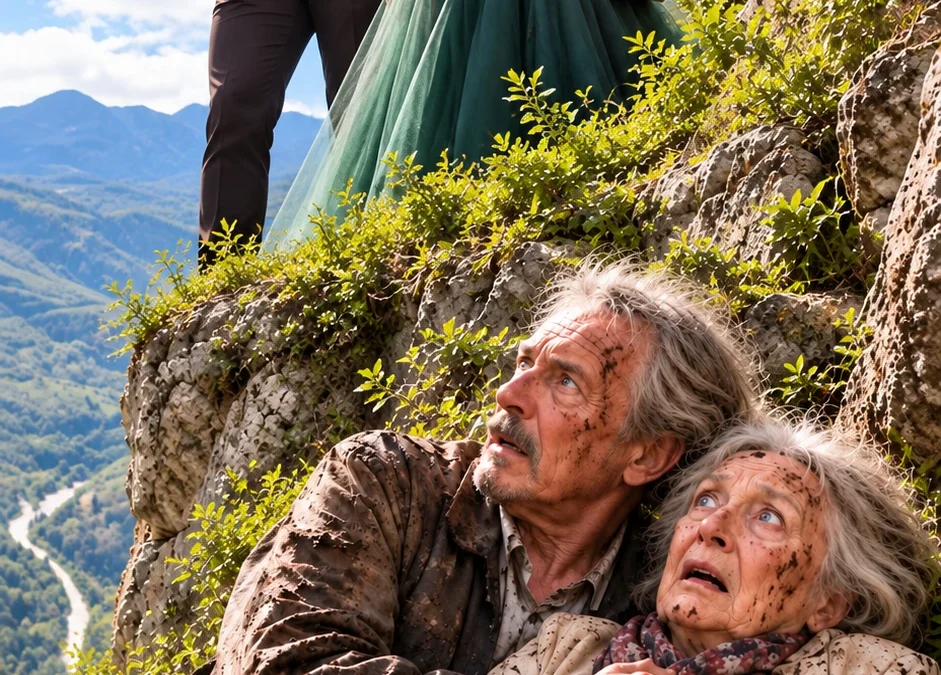
“Are the Old Folks Dead Yet?” My Own Son Pushed Us Off a Cliff for the Insurance Money. He Never Knew My Husband Had a Recorder Running. 😱
Part 1
“Are the old folks dead yet?”
I heard my son say it from the top of the ravine.
I would know Daniel’s voice if a hundred years passed. It was the same voice that used to whisper “Mamá” when he had a fever as a boy. Now it was talking about our deaths as casually as someone asking if the trash had been taken out. 💔
I was lying among rocks, branches, and wet earth, several meters below the overlook in the Sierra Gorda of Querétaro. My hip burned with a pain I can’t describe. My hands were slick with blood.
Beside me, my husband Roberto was breathing in short, ragged gasps. His forehead was split open, and his shirt was torn to pieces.
Then I heard my daughter-in-law.
“Finally, we can breathe. We sell the house, collect the insurance, and we’re done supporting these two.”
Daniel laughed. A short, easy laugh.
“We’ll say they got too close to the edge for a photo. After last night’s rain, anyone could slip here.”
Something inside me broke.
Only hours earlier, Daniel had shown up at our house in Juriquilla with a box of sweet bread and a smile I hadn’t seen in months.
“I want to make it up to you both,” he’d said. “I’ve been a terrible son. Let’s all go to the Sierra Gorda together.”
I was so happy I cried a little in the kitchen.
I packed leg-of-pork sandwiches, coffee, and fruit for the road. I even dressed up, as if we were going to a party. Roberto barely said a word during the whole drive.
I thought he was just tired.
At the overlook, a cold wind came up from the valley. Paola took out her phone.
“Stand a little farther back. The view is gorgeous from there.”
Those were the last words I heard before I felt two hands shove me forward.
The ground vanished.
I remember the sky spinning. I remember Roberto’s arm locking around me, and the sound he made when he twisted his body to take the worst of the fall for me.
We rolled through stones, thorns, and mud until a tree trunk stopped us.
That tree is the only reason we’re alive.
Up above, a car door slammed. An engine started. The sound faded down the mountain road.
I opened my mouth to scream for help.
Roberto clamped his hand over it.
“Quiet, Elena.”
“They tried to kill us!”
“I know.”
His voice was strangely calm. That frightened me almost as much as the fall.
He slid a hand inside his torn shirt and pulled out a small black device. A tiny red light was still blinking.
A recorder.
I stared at it. My whole body was shaking.
“Why do you have that?”
Roberto closed his eyes for a moment, like a man about to confess something heavy.
For weeks, he told me, he’d noticed strange things. Daniel slipping into his study when he thought no one was looking. Daniel asking too many questions about the deed to our house. About the land we bought twenty years ago near San Juan del Río. About where we kept our insurance policies and our IDs.
So Roberto had hidden a small camera in his study.
He caught our son photographing our documents.
“I didn’t know he planned to kill us,” he whispered. “I thought he wanted us to sign something. Some kind of fraud. That’s why I wore this today. And I asked Tomás to track my phone.”
Tomás is an old friend of Roberto’s, a former investigative police officer.
I started to cry.
I thought of everything we had given that boy. Roberto managed a little hardware store in downtown Querétaro, and I sewed school uniforms at night to make the money stretch. We paid for Daniel’s university degree. When his import business collapsed, we lent him money. When he married Paola, we helped with the down payment on their apartment.
And this was our reward.
A push into a ravine. 🥀
Then I saw it.
Headlights, through the trees above us.
Two beams of white light stopped at the edge of the road.
“That’s Tomás,” Roberto breathed.
A flashlight beam swept over our faces. A rope came down. Two paramedics from Civil Protection climbed toward us, and Tomás came behind them, his voice thick with emotion.
It took almost an hour to get us out. I had a fractured pelvis and deep cuts everywhere. Roberto had two broken ribs and a concussion.
As they strapped me onto the stretcher, he squeezed my hand hard.
“Elena,” he whispered. “If Daniel was willing to kill us for a house and a piece of land, he owes far more than we ever imagined.”
He was right.
I just didn’t know how much yet.
I didn’t know that the little recorder had captured a conversation that would tear apart the perfect life our son had built on our backs.
And I had no idea what we would find waiting for us in our own home that very night.
What I found waiting for us at home that night still gives me chills. Part 2 is in the comments—or leave any word below and I’ll send it to you privately.
Part 2
What I found waiting for us at home that night still gives me chills. Part 2 is in the comments—or leave any word below and I’ll send it to you privately.
Tomás wouldn’t let us go to the police.
“Not yet,” he said in the ambulance. “If Daniel thinks you’re dead, he’ll keep acting like it.”
So the clinic in Querétaro recorded our injuries as a fall, and Tomás called a lawyer he trusted, Licenciada Adriana Salgado. Then he went to our house with two agents.
At three in the morning, he walked into my hospital room with a face I’d never seen on him. Hard. Gray.
“I need to show you something.”
He laid photographs across my blanket. Copies of our IDs. Bank statements. The deed to our house. Our insurance policies.
Then he placed one more page on top.
A form to change the beneficiary on two life insurance policies. It had our signatures on it.
But I had never signed it.
Daniel was listed as the only beneficiary. Together, the policies were worth 3.8 million pesos.
My stomach turned over.
“No,” I said. “Daniel wouldn’t…”
Roberto looked at me in silence.
Even then, I was still defending the man who had just pushed me off a mountain.
“There’s more,” Tomás said.
Daniel owed money. Not to a bank, but to private lenders. He’d signed promissory notes for almost two and a half million pesos. On an old computer, Tomás’s agents found messages.
“Friday is your last deadline.”
“Your apartment doesn’t cover it all.”
“We know your parents own property.”
And Daniel’s reply:
“Give me one week. After the trip, I’ll have the money.”
The room swam.
I remembered his smile at our door that morning. The sweet bread. The I want to make it up to you.
He hadn’t come to reconcile.
He had come to take us somewhere to die.
The next day, Daniel called my phone seventeen times. We didn’t answer. By noon, he’d filed a missing-persons report, and he cried in front of the police.
“My parents went for a walk near the overlook. When I came back for them, they were gone.”
Paola sobbed into a local TV camera. “Please, if anyone saw them, help us.”
I watched from my hospital bed with my hands shaking.
“Turn it off,” I begged.
Roberto didn’t.
“Look closely, Elena. We need to understand who our son is now.”
That hurt worse than the fall.
Tomás had one more thing for us. The cameras Roberto hid in his study were still recording.
That evening, we watched Daniel and Paola walk into our house like they already owned it.
“I can’t find the original policies,” Paola said.
“Doesn’t matter. The death certificates will be enough.”
“And if the bodies turn up?”
Daniel went quiet. “After a fall like that, even if they’re alive, they won’t climb out alone.”
Paola pulled open a drawer, almost bored.
“You should have done it the moment your father started asking about the signatures.”
I stopped breathing.
It wasn’t a moment of panic. It wasn’t a bad decision made in desperation.
They had talked about killing us before.
If you want to know what happened when I heard my son’s voice on the phone, LIKE this post and comment “RECORDER.” When enough people comment, I’ll post Part 3.
Part 3
The police wanted to arrest them immediately, but Daniel vanished.
He turned off his phone and left the apartment. Paola was found at her sister’s house in Celaya. She denied everything.
“Daniel forced me,” she said.
But the recorder told a different story. I’ll never forget the sound of her voice on it. “Make sure they don’t climb out.”
For thirty-six hours, nobody knew where my son was.
I couldn’t sleep. And the worst part, the part I’m still ashamed of, is that some stupid corner of my heart kept picturing him alone and scared somewhere, maybe crying.
“He’s our son,” I whispered to Roberto in the dark.
“Yes.”
“How did we get here?”
He stared at the hospital window. “We didn’t get here, Elena. He chose this road.”
On the third day, my phone rang from an unknown number.
“Mamá?”
My blood turned to ice.
“Daniel. Where are you?”
Silence. Then, in a small voice, “Are you alive?”
I couldn’t answer. I heard him start to cry.
“I didn’t want to… Paola pushed me… I owed so much… They were going to kill me…”
“You pushed us.”
“Mamá, listen…”
“I saw your face before I fell, Daniel.”
A long pause. When he spoke again, the crying was gone.
“If you give them that recording, they’ll put me in prison.”
My whole body went cold.
“You tried to bury us without even checking if we were breathing.”
“I’m your son!”
That sentence nearly destroyed me.
“That’s exactly why it hurts so much,” I said.
I hung up.
Minutes later, Tomás and Adriana rushed into the room. They’d traced the call. Daniel was at a bus terminal, about to board a bus to San Luis Potosí.
They arrested him before he could climb the steps.
I waited to feel relief. It never came. Only an enormous, hollow ache. 🥀
Two weeks later, I saw him at the hearing.
He wore a detainee’s uniform. His face was hollow, his eyes swollen. When he saw me, he whispered, “Mamá…”
I looked down at my hands.
The prosecutor played the recording.
“Are the old folks dead yet?”
Those words filled the courtroom like a bell. Daniel bowed his head. Paola stared straight ahead, rigid as stone.
The defense tried to call it an accident followed by panicked remarks. Then the prosecution laid out the forged signatures, the insurance messages, and the footage from our home.
That was when I finally understood that this hadn’t started at the edge of a cliff.
It had started months before.
But the worst news came that same afternoon.
A doctor asked to speak with me alone. Roberto had been complaining of chest pain. His broken ribs had caused a serious lung complication.
“We need to operate now.”
They wheeled him away that night.
I sat alone in the corridor with my aching hip, staring at a pair of closed doors, and a terrible thought crept in.
I survived my son’s attempt to kill me. But I might lose the man who saved my life.
For the first time since the ravine, I thought maybe Daniel had won after all.
Four hours later, the surgeon came out. He pulled down his mask.
“The operation is over.”
He paused.
“Your husband is alive.”
I cried so hard my legs gave out.
Roberto took weeks to recover. We came home at the end of October. That first day, neither of us could bring ourselves to open the door of his study.
I stood in the kitchen, looking at Daniel’s favorite mug still sitting on the shelf.
I picked it up. Roberto limped over with his cane.
“If you want to throw it away, do it.”
I couldn’t.
I packed it in a box. Not to forget what he did. But because I couldn’t erase the little boy who once ran through this house with scraped knees, either.
The trial lasted months. Daniel and Paola faced charges of attempted homicide, fraud, and forgery. Paola tried to bargain by blaming Daniel completely. Daniel swore it was all her idea.
But the recorder wouldn’t let either of them hide behind the other.
I testified once. When I finished, Daniel asked me to look at him.
I did.
“Forgive me, Mamá.”
I’d imagined that moment a hundred times. I thought I’d feel rage. Instead, there was only sadness.
“I hope someday you understand what you did,” I said. “But understanding it doesn’t mean I have to save you from the consequences.”
He cried. So did I.
Then I walked out of that courtroom on Roberto’s arm.
We didn’t speak to Daniel for a very long time.
We sold the land he’d wanted so badly and used part of the money for our medical bills. The house in Juriquilla we kept.
“We grew up in this house together,” Roberto said. “I won’t let the worst day of our lives steal all the good ones too.”
Slowly, we rebuilt a routine. I learned to walk without the cane. Roberto went back to his hardware store on some mornings, just to greet the employees and argue about soccer with his regular customers. On Sundays we went to the market, bought barbacoa and warm tortillas and flowers.
For months, I refused to travel. Every mountain road brought back the fall.
Then, a year later, Tomás invited us back to the Sierra Gorda.
“Not the same spot,” he promised. “A different overlook.”
I said no.
Roberto took my hand. “Elena, we can’t let them have the mountains too.”
So we went.
The peaks were wrapped in thin fog, and the air smelled of wet pine. My knees were trembling. Roberto walked me to a safe spot far from the edge.
“Ready?”
“No.”
“Me neither.”
So we just stood there. Not moving forward. Not retreating.
After a few minutes, I breathed. And for the first time, I remembered the Sierra Gorda without hearing Daniel’s voice.
Tomás held up his phone. “Want me to take your picture?”
Roberto and I looked at each other.
The last time someone asked us to pose in front of a mountain, our son had pushed us over the edge.
I started crying. Roberto did too. But we held each other.
“Yes,” I said. “Take one.”
Tomás grinned. “Stay right there. Don’t move an inch.”
The three of us laughed. It was clumsy and wet with tears, but it was ours.
I printed that photograph. In it, Roberto and I are hugging, our hair tangled by the wind, the mountains of Querétaro behind us. It hangs in our living room now.
Not to remind us that we survived a fall.
To remind us of everything that came after.
One morning, a letter arrived from prison. Daniel didn’t ask for money. He didn’t ask us to drop the charges. He said he was working in the library and had started therapy.
At the end he wrote:
“I know you may never call me your son again the way you used to. But every night I hear my own voice saying that sentence, and I understand that man wasn’t the son you raised. I’m not asking you to forgive me. I only wanted you to know I’m still alive, and for the first time I’m trying to find out who I became.”
I folded it carefully.
“Are you going to answer?” Roberto asked.
I looked at the photograph of the Sierra Gorda.
“Someday.”
There was no miracle reconciliation. No way back to the past. But there was no hatred either. Just wounds closing slowly. Two old people having breakfast every morning, arguing over who forgot to buy milk, celebrating every anniversary like it was borrowed time.
And a small recorder in a drawer that Roberto never used again.
Sometimes I think about that red light blinking in the mud and the stones. My son believed he had left us there to die.
He never knew he’d left the one thing running that would keep our truth from dying with us.
When guests ask about the photo of the mountains, Roberto squeezes my hand and smiles.
“That’s the day my wife learned to trust life again.”
I always correct him.
“No. That’s the day I understood I still had a life ahead of me.”
And we smile.
Because after hearing our own son ask if we were dead yet, we learned to celebrate, quietly, every morning we wake up alive. ❤️
Disclaimer: This story is entirely fictional and created for entertainment purposes only. It does not represent any organization or individual, nor does it encourage inappropriate behavior. The content was generated with AI assistance.








