At 2:17 A.M. My Son Called From Boarding School and Whispered: “Mom, Hide. Dad Is Coming Home and Thinks You’re Asleep.”
At 2:17 A.M. My Son Called From Boarding School and Whispered: “Mom, Hide. Dad Is Coming Home and Thinks You’re Asleep.”
Part 1
My phone lit up at 2:17 in the morning, and my son’s name was on the screen.
Daniel was sixteen. He was at boarding school in Segovia, two hours away. He never called at that hour.
“Mom.” His voice was low and fast. “Don’t turn on any lights.”
I sat up. “Daniel, what’s wrong?”
“Dad is on his way to the house. He thinks you’re asleep.”
I almost laughed, because it didn’t make sense. Forty minutes earlier, my husband Álvaro had texted me that his investor meeting had run late and he’d be staying at a hotel in Alcobendas.
“He’s at a hotel,” I said.
“He isn’t. Mom, please. Hide. Don’t tell him I called.”
“What did you see?”
“I’ll explain later. Please.”
Sixteen years of motherhood taught me one thing. When your child says please like that, you don’t argue. You move.
I switched off the hallway light and the bedside lamp and stood in the dark, listening to my own pulse.
Our house in El Viso had belonged to my father, a restorer of historic buildings. He had left me one strange feature that Álvaro never understood: behind the bookshelf in the study was a narrow hidden archive where Dad kept his blueprints, deeds, and old photographs.
I slipped inside, slid the panel shut, and left a gap the width of a finger.
Then I waited.
Six minutes later, I heard the garden door open.
No lights came on. No keys jingled. Just the soft click of someone who knew exactly how to enter a house without being heard.
Footsteps climbed the stairs, slow and careful.
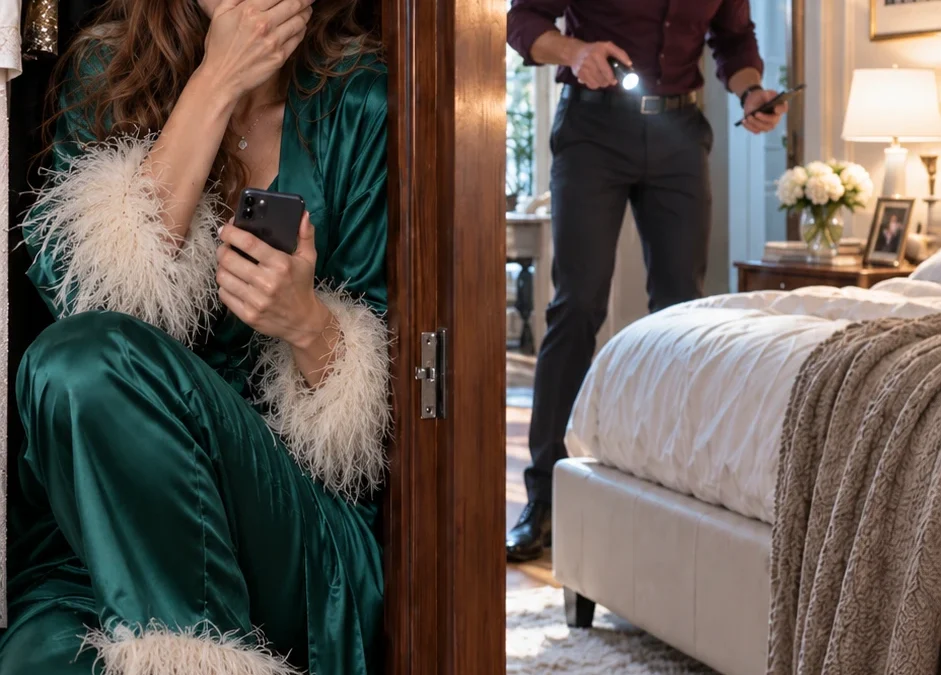
Through the crack, I saw him walk into our bedroom. Cap pulled low. Gloves on. A small flashlight in one hand.
My husband. In my bedroom. At night. Dressed like a burglar.
Then the flashlight beam caught what he was holding in the other hand, sealed in a clear plastic bag.
A syringe.
My breath stopped.
Álvaro touched the sheets on my side of the bed. He checked the bathroom. He opened the walk-in closet and swept the light across my dresses.
“Clara,” he whispered.
I have heard my husband say my name thousands of times. Never like that. Not tender. Not worried. He said it the way you call a pet you’re about to take to the vet.
My phone buzzed against my palm. I had silenced it, but the screen glowed, and I covered it with my hand.
Daniel had sent screenshots.
I read them in the dark, with my husband twenty feet away.
“Collecting insurance after a domestic accident.”
“How long does a sedative take to work.”
“How to prove someone has episodes of confusion.”
“Medical report to declare incapacity to manage assets.”
My hand flew to my mouth to trap the sound crawling up my throat.
Below me, a beam of light slid across the library and the bookshelf.
It stopped.
For three seconds, maybe four, my husband stood on the other side of that panel. I could hear him breathing. I could smell his cologne through the gap.
I thought, This is how it ends. Behind my father’s blueprints.
Then the light moved on. Footsteps went down the stairs. The garden door clicked shut.
I didn’t move for an hour.
At 7:41 the next morning, the front door opened, and Álvaro walked in wearing his gray suit and a smile I knew by heart. A paper bag was in his hand, grease already spotting the bottom.
“Churros,” he announced. “What a mess with that power outage. Did you sleep at all?”
I held my coffee cup with both hands so he wouldn’t see them shaking.
“I got scared,” I said. “I spent a few hours at the neighbor’s.”
He hugged me. He smelled of expensive perfume.
And underneath it, something sharp and clean.
Disinfectant.
I stood in my own kitchen, in the arms of the man I’d been married to for seventeen years, and I understood that I had no idea who he was.
While he talked about his imaginary meeting, my phone buzzed again against my thigh. Daniel had found more. Three life insurance policies, signed in the last five months. I was the insured. Álvaro was the primary beneficiary.
Total coverage: €1,950,000.
I looked at my husband buttering a churro, and I thought I might be sick.
At 8:06, Daniel sent one last message. Just a photograph. No words.
It was a folder on a family cloud drive, created by Álvaro, with a name so cold I read it three times.
“WHEN C. CAN NO LONGER DECIDE.”
C.
That was me.
What happened next still gives me chills. Part 2 is in the comments—or leave any word below and I’ll send it to you privately.
Part 2
What happened next still gives me chills. Part 2 is in the comments—or leave any word below and I’ll send it to you privately.
I didn’t cry.
I want you to know that, because I always thought I would. I imagined that if I ever learned my husband wanted me dead, I’d fall apart on the kitchen floor.
Instead, something in me went cold and very quiet.
I excused myself, locked the bathroom door, turned on the faucet, and called my lawyer.
Irene Salas answered on the second ring. I told her everything in under two minutes. She was silent for a moment.
“Clara, listen carefully. Do not confront him. Do not change your behavior. From now on we are not looking for explanations. We are looking for proof.”
“He’s sitting in my kitchen, Irene.”
“Then act like it’s a Tuesday.”
So I did.
I learned how to fake a normal life in front of a man who wanted me erased. I kissed him goodbye. I asked about his day.
Daniel told me how he’d found everything. Álvaro had asked him to organize files on the family cloud because “nobody understands this stuff like you.” My son opened the wrong folder, and the world ended.
Mauricio León, my late father’s old business partner, installed a hidden camera in the garden. Within days it showed Álvaro approaching the house on foot, having parked three streets away to avoid the neighborhood cameras.
Then I did something Irene told me not to. I drove to Álvaro’s company in Las Tablas without calling first.
I didn’t go inside his office. I only stood in the corridor outside the half-open conference room.
I heard his CFO first. “The hole is over €710,000. The board will find out.”
“I need four days,” Álvaro said.
Then a woman’s voice, calm and familiar. Patricia Montalbán, the outside consultant who had been at every corporate dinner for months.
“And Clara’s house?”
“Once we have the report on her instability, we can move everything.”
I leaned toward the gap in the door.
Patricia was pregnant. Visibly. I had thought she’d gained weight.
My husband rested his hand on her stomach, gently, the way he used to touch mine when Daniel was still inside me.
“After that, it’s ours,” he said.
Patricia smiled. “And Clara?”
“Clara,” Álvaro said softly, “is going to stop being a problem.”
I walked out of that building without anyone seeing me. In the elevator, my legs finally gave out, and I slid down the mirrored wall.
That afternoon, my mother-in-law Mercedes appeared at my door.
“Álvaro needs you to guarantee a loan with the house,” she said. “A wife shouldn’t keep property separate.”
I smiled. I said I’d think about it.
I had just learned from Irene that someone had forged my signature on a bank application. The witness listed on the document was a member of Álvaro’s family.
They weren’t only stealing from me. They were building a story where I’d stop being believable before I could defend myself.
And I had no idea yet how deep the story went, or that the person closest to me would be the one who finally broke it open.
If you want to know what the rest of that folder revealed, LIKE this post and comment “HIDE.” When enough people comment, I’ll post Part 3. 🕯️
Part 3
The next few weeks taught me a skill I never wanted: how to lie to a man who shared my bed.
When Álvaro asked why I seemed distracted, I stared at my hands. “I’m exhausted lately. I don’t know why.”
When he suggested I might need to see a specialist, I nodded. “Maybe you’re right.”
That answer relaxed him. He even booked me an appointment with a private psychiatrist recommended by a doctor who worked with one of his partners.
He thought everything was proceeding according to plan.
He didn’t know I had already seen independent professionals on my own. He didn’t know Irene was building a timeline of every document, transfer, and call connected to me.
Daniel came home from Segovia for a few days. I sent him to stay with my sister Rebeca, because I didn’t want my son living under the same roof as a man who kept walking in and out as if nothing had happened.
The first night, he barely spoke. Then, quietly:
“I found that folder two days before I called you.”
I turned to him. “Why did you wait?”
He stared at the floor. “Because I thought I was misunderstanding it. It was Dad.”
Those three words hurt me in a way I hadn’t expected.
It was Dad.
Of course he’d looked for an innocent explanation. I had spent years doing the same thing. The mood swings, the unexplained trips, the sudden obsession with exactly what I’d inherited from my father. I had excused every one of them.
I sat beside my son. “Taking two days to understand something horrible doesn’t make you responsible for it.”
“But if I’d called sooner…”
“You called when you understood the danger. Because of that, I was able to hide.”
He tried to hold back tears and failed. I held him.
Then I asked something he didn’t expect. “Stop investigating. You’ve done enough. Now you get to be my son, not your father’s detective.”
He nodded against my shoulder.
The professionals uncovered the true size of the deception.
I run a studio that restores historic hotels and protected buildings. My father and I built it from nothing into a company of thirty-four people.
One of our administrators noticed five contract modification requests carrying my signature. I hadn’t signed any of them.
Three involved our projects in Málaga, Valencia, and Bilbao. One concerned turning an old Madrid palace into a cultural residence. The last authorized an outside company to collect commissions.
Together they were worth more than €3.6 million.
The company receiving the money was called Horizonte Gestión Urbana. It had been created eight months earlier.
Its sole administrator was Patricia Montalbán.
Irene hired a handwriting expert. Her conclusion was unambiguous: the signatures were imitations.
Then an unexpected witness walked into Irene’s office carrying a laptop in a backpack. Her name was Eva Robledo, and she had spent seven years as Álvaro’s administrative manager.
“Months ago he asked me to delete emails and invoices,” she said. “I refused and kept copies. I thought he was hiding money. I never imagined this.”
The laptop held internal conversations, duplicate invoices, and files tying Álvaro directly to Patricia.
One email, sent thirteen days before that night, read:
“We need to prove Clara isn’t fit to make decisions. That lets us justify the changes without looking hostile.”
Patricia’s reply:
“The chalet guarantee first. Without enough property, we depend too much on the policies.”
The €710,000 missing from Álvaro’s company hadn’t vanished in bad investments. It had left through fake supplier contracts. Part ended up in accounts Patricia controlled. Part went toward a 170-square-meter penthouse on Calle Velázquez, where they’d already paid €215,000.
After that, it’s ours.
Now I understood which “ours” he meant.
Then there was Mercedes.
For years, my mother-in-law had defended her son even when nobody was attacking him. When I spoke about financial independence, she heard distrust. When my father died and I inherited the house, she insisted I put Álvaro’s name on it too.
“A real marriage doesn’t keep separate accounts.”
I had always refused.
Irene called me two days later. “Come to the office. I won’t explain this over the phone.”
Six months earlier, Mercedes had co-signed a €460,000 loan, using her own apartment in Pozuelo as collateral. She had lived there for twenty-four years. She believed the money would cover payroll for her son’s company.
Forty-eight hours after the loan was approved, €380,000 left for another account. Its destination was a company tied to Patricia. From there came the €215,000 for the penthouse.
Mercedes had been pressuring me to mortgage my house while her own home was already on the line.
“Do you think she’s involved?” I asked.
Irene shook her head slowly. “I think she helped her son get money and chose not to ask too many questions. That doesn’t mean she knew the rest.”
I felt anger. And, uncomfortably, pity.
Mercedes had spent her life turning women’s sacrifice into a moral duty. Now she had been caught in her own idea.
I chose not to warn her. It was no longer my job to save everyone from trusting Álvaro blindly.
Álvaro was preparing a major presentation at a hotel on the Paseo de la Castellana. His company needed investors. Shareholders, suppliers, advisers, and financial journalists would attend.
Irene learned that he planned to announce publicly that I was stepping back from certain duties “for health reasons.” He would then present several of my contracts as part of a new business alliance.
The authorities already held the documents: the signatures, the transfers, the policies, and the nighttime entry to our house.
“Can I go to the gala?” I asked.
“You can stop him from using your name,” Irene said. “But don’t turn it into an improvised investigation. What matters is already delivered.”
On the night of the event I wore a navy dress and silver earrings that had belonged to my mother.
Álvaro saw me cross the room. For one second, his smile disappeared. Then he opened his arms.
“Clara. I thought you’d be resting at home.”
“I’ve rested enough.”
Patricia stood near the stage, her pregnancy impossible to hide. Mercedes came to me, whispering.
“You shouldn’t be here if you’re going through a difficult time.”
I held her gaze. “Tonight, a big part of that is about to pass.”
At 9:22, Álvaro took the stage. He spoke about growth. Trust. Responsibility. Then he spoke about his wife.
“Clara has been going through a delicate personal period for months. On professional advice, she will temporarily step back from some management duties.”
I stood up.
The room slowly went silent.
“That’s false.”
His jaw tightened. “Darling, you don’t have to do this.”
I walked to the stage and took a second microphone. “If you’ve just used my health to justify business decisions in front of investors, I have the right to clarify the facts.”
“You’re confused.”
I smiled slightly. “You’ve written that sentence in your messages so many times it should be a registered trademark.”
A forged authorization appeared on the screen behind us.
“This signature would transfer contracts from my studio to Horizonte Gestión Urbana. I didn’t sign it. An independent expert confirmed it was imitated.”
An investor lifted his head.
Álvaro tried to interrupt. “These are private matters of our marriage.”
“A forged business signature isn’t a marital problem.”
Transfers appeared next. At a table, the CFO went pale.
“Does this relate to the €710,000 that’s missing?” he asked.
Álvaro said nothing. Across the room, Patricia began edging toward a side door.
“There are also three life insurance policies on me,” I continued. “Total coverage: over €1.95 million. Álvaro is the primary beneficiary.”
Mercedes rose. “What are you saying?”
“Exactly what the contracts show.”
“She’s proving in front of everyone that she’s unwell!” Álvaro shouted.
So I showed a selection of his search history. Sedatives. Asset incapacity. Domestic accidents. Creating a record of confusion.
The murmur died.
“In the early hours of July 9th,” I said, “Álvaro entered our house believing I was asleep.”
The garden footage played. His cap. His gloves. His flashlight.
He breathed hard. “Entering my own home proves nothing.”
“Correct,” I said.
I changed documents.
Days after that night, Álvaro had insisted on personally preparing a drink for me at dinner. I’d already been warned. I never drank it. I kept it.
The lab found a sedative no doctor had ever prescribed me.
“The report is with the authorities,” I said.
Patricia burst into tears. “I didn’t know any of that!”
Álvaro whirled on her. “Don’t open your mouth.”
“Don’t talk to me like that!”
I didn’t have to say a word. She had just shattered the discreet-couple image they’d both worked so hard to maintain.
Then Mercedes’s loan appeared on the screen. €460,000.
It took her a few seconds to recognize her own address.
“Álvaro… why is my apartment there?”
“Mom, we’ll talk later.”
I showed the path of the money. €380,000 diverted. €215,000 to the penthouse.
Mercedes looked at Patricia. Then at her son.
“You told me it was for payroll.”
“Partly it was.”
“It says Velázquez!”
From across the room Patricia snapped, “I didn’t force anyone to sign that loan.”
Mercedes trembled. “But you knew where the money came from.”
“Álvaro said we’d repay it once we collected the policies.”
Patricia froze. She had just understood what she’d admitted.
Álvaro stepped down from the stage. “Do you realize what you just said?”
“You said Clara would stop being a problem!” she screamed.
The doors opened.
Police officers entered, accompanied by financial crimes investigators. They hadn’t come for the spectacle. The investigation had been open for days.
Before they led him away, Álvaro looked at me.
“You’ve destroyed our family.”
I didn’t raise my voice.
“A family isn’t broken when someone discovers the truth. It breaks when one person decides to use his wife, his son, and even his own mother as tools.”
Mercedes was crying. “Álvaro, tell me you weren’t carrying that syringe for her.”
My husband said nothing.
And Mercedes stopped asking.
The months that followed were hard. Audits. Expert reports. Testimonies. Trials.
The forged contracts were annulled. The house remained mine alone. The policies became part of the case. Álvaro’s company lost its investors when the fake invoices surfaced.
In the end, the evidence proved the fraud, the forged documents, and the preparation of an act meant to cause me gravest harm. Álvaro was sentenced to prison. Patricia was convicted for her role in the financial operations, though she insisted she’d known only part of the plan.
Mercedes wasn’t found to have participated. She had defended her son, pressured me unfairly, and signed without checking anything. But nothing proved she knew what happened that night.
Her finances were ruined all the same.
Five months later, she called me.
“The bank can seize my apartment.”
I listened.
“I wouldn’t ask if I had any other way out. I’m Daniel’s grandmother.”
Years ago, that sentence would have been enough. I would have felt guilt.
Not now.
“I’ll send you the contact of a debt renegotiation specialist and the city services that can guide you.”
She paused. “That’s all?”
“Yes.”
“You could pay it.”
I closed my eyes. “For years you called me selfish for protecting my father’s house. If I’d done what you asked, Álvaro would have had access to it too. Daniel could have lost far more than a property.”
She began to cry.
I felt no satisfaction. I only understood something I’d taken too long to learn: compassion for someone doesn’t oblige you to rescue them from every consequence of their choices.
Seven months later, I drove to Segovia to bring Daniel home. He came out with his backpack and ran to me.
“Is it over?”
I hugged him. “The worst of it, yes.”
He was quiet. “Sometimes I still miss Dad.”
I didn’t correct him.
“You can miss the father you thought you had,” I said. “What you don’t need is to invent excuses for what the real man did.”
Back in Madrid, I avoided sleeping in the house for months. Every creak on the stairs dragged me back to that night. Eventually I returned. I changed the locks. Installed new cameras.
But I never considered selling. My father had built our family’s story in those walls. Álvaro had almost turned them into a prison.
I wanted them to become something else.
I opened the hidden archive behind the bookshelf. Removed the boxes, deeds, and blueprints. Set up a big worktable, tools, and shelves.
Daniel took over the space. He builds robots there, small vehicles for school competitions.
A year later, I received an award for converting an old Madrid market into a library, workshops, and rooms for neighborhood associations. A journalist asked how I could trust again after such a betrayal.
I thought of Álvaro. But also of Daniel, Irene, Eva, and Mauricio, and everyone who spoke up when looking away would have been easier.
“Trusting doesn’t mean handing yourself over with your eyes closed,” I said. “And loving someone doesn’t mean giving them power over your dignity, your property, or your future. Boundaries don’t destroy a family. Sometimes they just reveal what was really behind the word family.”
That night I came home. Daniel was sitting on the floor of my grandfather’s old archive.
“Mom, look.”
A little robot rolled between the boxes, turned too early, and crashed into a table leg.
I laughed. “It needs better direction.”
Daniel grinned. “Like us a year ago.”
I opened the garden doors. Cool air drifted in. The curtains lifted.
For a moment I looked at the staircase Álvaro had climbed that night.
This time I felt no fear.
No sentence could return seventeen years to me. No one could erase the ache in Daniel of still loving a father whose true face he’d seen far too soon.
But we had recovered something more important: the right to choose what to do with our lives.
At 2:17 that morning, my son saved me by telling me to hide.
Much later I understood that surviving was never about staying behind a wall. It was about walking out. Refusing to justify. Refusing to hand over more. And knowing that no promise made on a wedding day obliges anyone to stay still while another person tries to erase them from their own story.
Now, when I lock the door at night, I no longer think about who might come in.
I look at the light still glowing in Daniel’s workshop, and I remember something simpler.
For the first time in a very long time, nobody in this house needs to hide to feel safe. 💛
Disclaimer: This story is entirely fictional and created for entertainment purposes only. It does not represent any organization or individual, nor does it encourage inappropriate behavior. The content was generated with AI assistance.








