At Her Brother’s Wedding, a Drunk Toasted “the Ladies Who Were Not Chosen” While the Whole Room Laughed. Then the Most Hunted Duke in England Held Out His Hand and Whispered Four Words, and It Cost Him Everything
At Her Brother’s Wedding, a Drunk Toasted “the Ladies Who Were Not Chosen” While the Whole Room Laughed. Then the Most Hunted Duke in England Held Out His Hand and Whispered Four Words, and It Cost Him Everything 💍
PART 1
The marquee at Lowel Priory had been dressed with white roses and green ribbon until it looked, Alistair Dunore thought, like a chapel that had forgotten it was meant to be solemn.
Two hundred wedding guests sat beneath golden bars of June light. They had eaten too much and drunk more, and they had entered the particular cruelty of the English gentry at leisure: they were beginning to look for sport. 🥂
Alistair, seventh Duke of Darnley, had not wanted to come. He was thirty-three, unmarried, possessed of eleven thousand a year and a face mothers described to their daughters in the tone usually reserved for weather forecasts. Fair. Changeable. Worth watching. He had been hunted since he was twenty-five. He had learned to sit very still in rooms like this one, his expression arranged into the pleasant blankness of a man who has mastered being present without being available.
He had not expected to notice her at all.
She sat almost directly across the table, in a green gown that had clearly been remade at least once. He could see, even at that distance, where the trimming had been unpicked and reset. She was not eating. A single strawberry sat untouched on her plate, and she held her wine glass in both hands, the way a woman does when she needs somewhere to put them that is not her lap, not the tablecloth, not the eyes of the room.
Alistair had spent a decade learning the postures of the hunted, because he had become an expert in his own. He knew the shape of it at once. She was not there as a guest. She was there as an exhibit.
“Winifred Lowel,” said Lady Frost beside him, not troubling to lower her voice, for the wine had made her indiscreet. “The groom’s sister. You won’t remember. It was two seasons ago, and you were in Yorkshire. Horace Tulliver was publicly engaged to her, banns read and all. And three weeks before the wedding, he cried off. No reason given. She has not had an offer since. Not so much as a second dance, poor creature. And now she must sit and watch her brother marry the very cousin of the man who jilted her.”
She nodded down the table. “That is Tulliver, three seats past the bride. Foxed already, if I am any judge.”
Alistair found him: a big, florid man with the loose, satisfied face of someone who had never once had to account for his conduct, laughing too loudly, cravat askew, a full glass sloshing as he gestured. Precisely the kind of fool who mistook cruelty for wit.
The toasts began. The bride’s father spoke. The groom spoke a few kind and useless words. And then, before anyone could close the matter out, Horace Tulliver pushed back his chair with a scrape that cut through the murmur of the tent, and stood, swaying, glass aloft.
“A toast,” he said, too loudly, “to the ladies who were not chosen.”
The tent fell entirely silent. The silence of a room that understands exactly what is about to happen and is too well-bred, or too cowardly, to stop it. 😶
“We think so much of the bride today, and rightly so. She is radiant. She does her family credit. But I think it only fair, only Christian, that we spare a thought for those ladies less fortunate. Those who, through no great fault of their own, I’m sure, whatever fault there might be, find themselves still waiting. Still hoping.” His gaze did not waver from where it had landed. “Still sitting at the tables, while better women are led to the altar.”
He looked directly at Winifred Lowel as he said it.
Somewhere down the table, a woman gave a small, involuntary laugh. Not meant unkindly, perhaps. The reflexive laugh of someone startled by audacity. And that laugh was worse than anything Tulliver had said, because it caught the way laughter catches, moving down the table in a ripple of averted eyes and half-smiles.
Alistair watched Winifred’s face.
She did not flinch. It struck him with something close to violence. She did not put a hand to her mouth or her throat. She went very still, the way something goes still when it has decided that stillness is the only defense left. She looked down at the single strawberry, and her knuckles whitened around the stem of her glass. He understood that this was not the first time. She had built, out of long practice, a wall for exactly this occasion, and the wall was made of nothing but her refusal to give them the satisfaction of watching it fall.
He thought of every ballroom in which he himself had stood while some fortune-hunting mother paraded her daughter past him like livestock at a fair. He had hated all of it. But he had never once been made to sit at a table and watch two hundred people decide, in a single indrawn breath, that his humiliation was the evening’s entertainment.
Tulliver had not sat down. He was gathering himself to say more, buoyed by the response. And something turned over in Alistair’s chest. Not only pity. Something harder and quicker. An old, simple fury at watching a thing be done that ought not to be done, in a room full of people content to let it happen because stopping it would cost them something.
He did not decide to act. He would think of that later, many times. There was no weighing of consequence. There was only the sudden clean certainty of a man who has found, after years of stillness, something worth moving for.
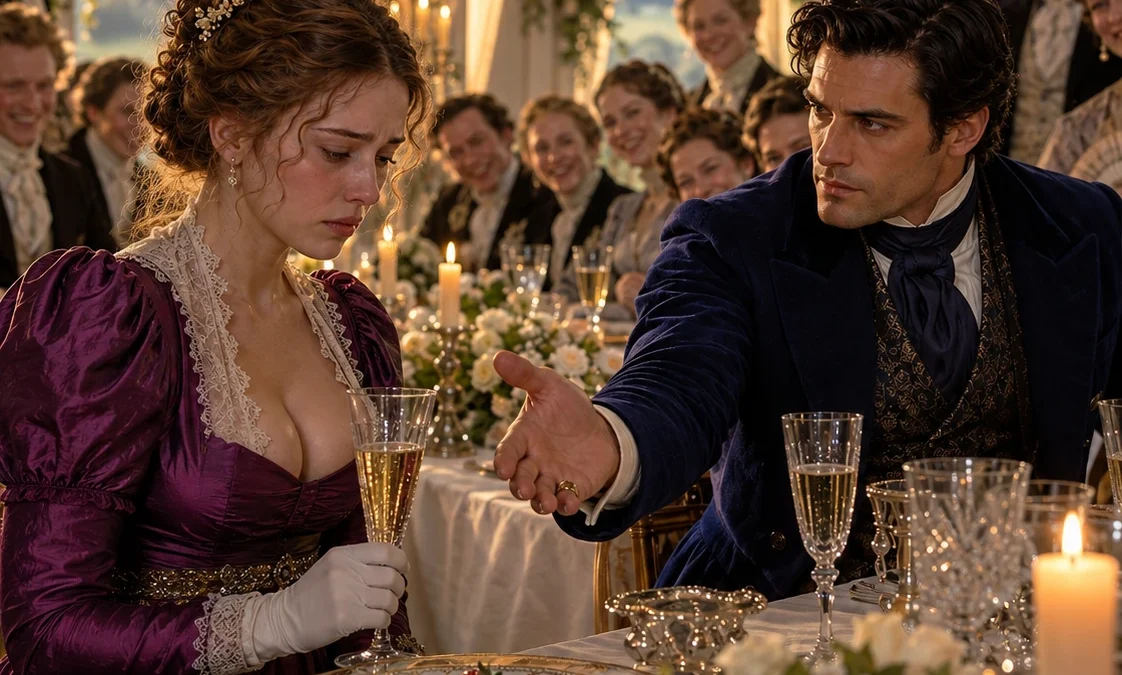
He set down his glass. He leaned across the corner of the table, past the startled matron seated between them, close enough that his voice would carry no further than the two of them. And he said, low and even, in the tone he might have used to remark on the weather:
“Pretend you’re mine.” 💔
She turned to look at him. Her eyes were gray and startled, rimmed with a brightness she had clearly been fighting for the better part of the toast. She said nothing. She looked at him as though he had spoken in a language she had once known and half forgotten.
“Just for today,” he said. “Take my hand.”
He held it out across the corner of the table, palm up, in full view of anyone who cared to look, which by now was nearly everyone. The tent had gone quiet again in a different key: the quiet of an audience that senses the play has taken an unscripted turn. He was aware of Tulliver’s toast dying in his throat, of the bride’s mother’s fork pausing halfway to her mouth, of two hundred people recalculating, in real time, everything they thought they understood about this breakfast.
Winifred looked at his hand for two or three seconds that felt very long. He saw the calculation in the small movement of her throat, in the flicker of her eyes toward Tulliver and away. Rescue, or a second, crueler joke. A duke’s hand held out across a wedding table might be sincerity, or sport of an even higher order. And she had, in either case, very little left to lose.
She put her hand in his.
Her fingers were cold, and they trembled slightly. He closed his own around them and did not let go.
“Your Grace,” she said, so quietly he had to lean to hear. “I do not know what you are doing.”
“Neither do I,” he said, and was surprised to find it true. “But I find I would rather be doing it than watching that man finish his toast.”
Tulliver looked from Winifred’s face to Alistair’s hand wrapped around hers and back again. Something moved behind his eyes that was not quite alarm and not quite anger, with elements of both. He sat down rather more heavily than he had stood.
He did not finish his toast.
And from the head of the table, the bride, Lady Cresca, lovely and dark-haired, lifted her glass with the smooth recovery of a woman well practiced at commanding a room. “Well. It seems we have two announcements to celebrate today, though only one of them was planned.”
The tent laughed, with relief in it. Alistair noticed, even then, that her expression of careful surprise did not quite reach her eyes. 😏
He did not let go of Winifred’s hand. He held it beneath the edge of the table and felt her fingers, slowly, slowly, stop trembling.
I have just done something I cannot undo, he thought. He did not, in that moment, regret it.
In the garden afterward, he asked her to dance. “Once, Your Grace, would be kindness,” she said. “Twice would be talked of.”
“Then we had better dance a great many more times than twice, so that no one is left in any doubt as to which it is.”
By the fourth dance, he told her the truth: that he was hunted, that she was avoided, and that their complaints, though not the same size, might for one season solve each other. A pretense. One season of being seen together. The hunters would withdraw from him. The doors closed to her would open again. And at the end of it, they would part as friends.
“And what does the Duke of Darnley require of a woman pretending to be his, beyond the pretending?”
“Honesty. Between the two of us, at least, no performance. Let the performance be for the rest of the world.”
She held out her hand, steady now, offered rather than taken. “Then I agree. One season, Duke of Darnley. And the truth between us for as long as it lasts.”
He did not know it yet, but he had just made a bargain whose true cost he had not begun to calculate. 🌅
By midsummer, London was at their feet. Invitations poured into Curzon Street. And Alistair, who had agreed to one season of convenient fiction, found himself standing in doorways, watching her unnoticed: reading Homer in the original Greek in her brother’s study, or fencing in the long gallery with the curtains drawn and a flush of laughter on her face. He found he had stopped counting the days until the season’s end.
But the bride, now Mrs. Edmund Lowel, called at Curzon Street with increasing frequency, and Alistair found himself disliking her more with each visit. There was a quality to her attention that he could not name, and then could: the patient interest of a woman robbed of a source of amusement, who means to find it again.
“Horace does so love a wager, you know,” Cresca said one afternoon over tea, with great lightness. “He is forever placing them at White’s over the silliest things.”
The word lodged behind Alistair’s ribs. And it would not come out.
Weeks later, at a ball in Grosvenor Square, with two hundred bodies pressed against the open windows for air, Horace Tulliver stood at the center of a small crowd with a folded paper in his hand and an expression of drunken, triumphant malice that turned Alistair’s stomach cold.
“I have here an entry from the betting book at White’s,” Tulliver announced, his voice pitched to carry, “which I think this company will find of considerable interest.”
Winifred’s hand went rigid on Alistair’s arm.
“Darnley wagers Ashworth one hundred guineas that he can make the season’s saddest spinster fashionable inside a fortnight. Dated the very week of my cousin’s wedding. Signed,” he paused, savoring it, “D.”
The ballroom gasped, two hundred throats at once.
“That is a lie,” said Alistair, startled at how level his own voice came. “I have never written an entry in that book.”
“The book says otherwise.” Tulliver’s smile was wide and cold, with none of the drunken looseness of the wedding breakfast. This was a man who had planned this moment.
Alistair turned to Winifred. And what he saw in her face would stay with him for the rest of his life. Not tears. A whiteness around the mouth, a stricken stillness in the gray eyes. She was doing the same arithmetic as every other soul in that ballroom, and it did not currently favor him.
“Winifred. I swear to you, on my father’s grave, I have never…”
“Don’t.”
It struck him harder than any accusation, because there was no anger in it. Only the ancient weariness of a woman made a public fool once before, who had just learned that it could happen twice.
“Please. Not here.”
She withdrew her hand from his arm, gently, almost apologetically, and walked from the ballroom with her spine very straight and her chin high, through a crowd that parted for her with avid, whispering curiosity.
And Alistair stood rooted at the center of the floor, understanding that everything he had built, the dances, the laughter, the truth she had finally trusted him with, had been demolished in thirty seconds by a piece of paper he had never signed. 💥
PART 2
He did not chase her. A more romantic man would have. But Alistair understood that nothing he said in that room, with two hundred pairs of eyes cataloging every word, would reach her. She needed proof, not protestation.
So he turned instead to Tulliver, and something in his voice made the nearest onlooker step back.
“Where did you get that entry?”
“Ashworth will confirm it, Your Grace…”
“I did not ask who signed it. I asked where it came from.” He stepped close, close enough that only Tulliver could hear. “You have shown me twice now the shape of your character. Once over a woman you jilted for refusing to lie for you, and now over a woman you have apparently decided to ruin a second time because the first ruining did not satisfy you. I do not believe this entry appeared in that book by accident. I will find the steward tonight, and when I have the truth, you will discover that a duke’s patience, once fully spent, is a far more dangerous thing than a duke’s wager.”
A flicker crossed Tulliver’s face. Not quite alarm. Its near cousin.
Alistair did not wait for an answer. By the time he reached the street, Winifred’s carriage was already rattling away into the dark, and he stood alone on the marble steps of Elsmere House, understanding exactly how much he stood to lose. 🌃
He was at White’s within the hour. The club held only a scattering of late drinkers and half-asleep porters. He demanded the betting book, and a startled steward brought it, and Alistair turned the pages with hands that were, he noted distantly, entirely steady.
There was the entry. The same words. The same date. A flourished, careless D at the foot of it that any man in London might have taken for his own initial.
“Who witnessed this being made?”
The steward, a thin, gray, careful man named Prout who had served the club thirty years, studied it a long moment. “I did not see the writing of it, Your Grace. I was called from the desk that evening. But I recall who was in the room when it was discovered the following morning. Mr. Tulliver was present. He was the gentleman who first drew the room’s attention to it. He remarked upon it loudly, as though surprised to find it there. I thought at the time it an odd thing to remark upon with quite so much relish.”
“Would you swear to that?”
“I would swear to what I observed, and gladly, for I have kept that book honestly for thirty years and do not care to have its honesty questioned by a forger’s mischief.” His mouth went thin. “I have Mr. Tulliver’s correspondence on file, Your Grace. If you wish, I will compare the hands.”
They did it that same night, by candlelight, in the club’s empty back office. And what they found, Alistair had already known in his bones. The flourish of the D, the particular slant of the letters, matched not his own careless scrawl but the looping, self-satisfied hand of Horace Tulliver, filed not two shelves away. 🕯️
He did not sleep. He spent the small hours composing and discarding the words he would need, and understood only near dawn that they did not need to be clever. They needed only to be true.
The following afternoon he called at Curzon Street with Prout beside him in the carriage. He found, in the drawing room, more of an audience than he had planned for: Edmund, determined not to leave his sister’s side, and Cresca, arrived an hour earlier on some pretext of family duty, her eyes bright with the anticipation of a woman who suspects she is about to witness either a triumph or a humiliation and does not much care which.
Winifred sat very straight by the window, her hands folded in her lap. When he entered, she looked at him with an expression that struck him harder than any accusation: not anger, but an exhausted, guarded hope. The look of a woman who wants very badly to believe, and has been taught at great cost not to trust the wanting.
“Tell them what you told me,” Alistair said.
The old steward laid out all of it. Tulliver’s suspicious enthusiasm. The comparison of hands. The flourish that matched Tulliver letter for letter and did not match the Duke’s recorded signature in a single particular. He laid the papers on the table with the unhurried precision of a man giving sworn testimony.
Alistair crossed the room and stood before her.
“I did not place that wager. I have never in my life wagered on you, Winifred. Not for a single guinea. What I asked of you at your brother’s wedding, and what I have done every day since, was never a performance for anyone’s amusement. It was a plain wish to see you looked at as you deserve to be looked at.” His voice went rough, stripped of every careful habit ten years of hunted seasons had taught him to wear. “I asked you to pretend. And I have come to understand, watching you read Greek in your brother’s study and disarm him in the long gallery and tell me the truth about Tulliver with your chin held high, that I was the only one of the two of us who was ever truly pretending. You have been entirely, unguardedly yourself since the day I met you. I am the one who told a lie, Winifred. Not the lie Tulliver accused me of. My lie was in calling it pretense at all.”
The room had gone very quiet. Even Cresca had stopped smiling.
“I do not want one season of convenient fiction. I never truly did. I want a lifetime of the truth you have already given me, more freely than anyone has ever thought to offer it. With no wager attached to it, and no pretense left standing between us.” He went down on one knee, and drew from his coat a ring he had commissioned three weeks before, in a fit of hope he had not allowed himself to examine. A single deep sapphire, chosen because it was the gray-blue of her eyes in the last light over Lowel Priory’s lake. “Will you marry me?”
Winifred looked at the ring, then at his face. And Alistair watched two years of careful armor visibly begin to come apart. 💎
“You mean it,” she said, not quite a question.
“I have never meant anything so entirely in my life.”
“Well,” said Cresca into the silence, her voice bright, with sourness beneath it this time. “I confess I did not think, when I brought that entry to Horace’s attention, that it would end in a proposal witnessed by the whole family. How very tiresome of you both to turn my little joke into a romance.”
Every head turned.
“Your joke,” Edmund said slowly, and something dangerous had entered his voice.
“I only meant…”
“You meant,” said Winifred, rising from her chair, her voice quiet but carrying a weight it had not carried before, “to see me humiliated twice, Cresca, because the first humiliation amused you, and you were sorry to see it end.”
Cresca’s composure cracked, for the first time since the wedding breakfast. And then Winifred turned back to Alistair, and for the first time since he had known her, her voice was not careful at all.
“Ask me again. Without the ring in your hand this time, so I know you mean the question, and not merely the gesture.”
He set the ring down on the table beside her chair. He took both her hands in his, still kneeling, and asked her again, plainly, with nothing between them but the truth they had promised each other in a garden two months before.
“Winifred Lowel. Will you marry me?”
“Yes,” she said. And her face broke at last into an unguarded, radiant smile.
But Cresca had not finished. She turned slowly, and in a voice no one in the room had heard from her before, she said one more thing, a name, a place, and a sum. And Edmund went white as paper. 😨
PART 3
“Ten thousand pounds,” Cresca said, with a brittle, almost relieved little laugh. “Since we are all being so very honest. Ask your husband, Winifred. Ask Edmund who it was that settled your father’s gaming debts in the spring of last year, when old Mr. Tulliver’s inquiries became too dangerous to ignore.”
The room turned to Edmund. He had gone the color of ash.
“I did not know it would come to this,” he said hoarsely. “Cresca said she had a means of settling the matter quietly. I did not ask how. I did not want to ask.”
“Her dowry?” said Winifred.
“No.” Cresca lifted her chin. “Not dowry. I wrote to Horace. I told him that if he would keep his father quiet about the mortgage, the Lowel estate would be his cousin’s by marriage, and therefore in the family, and nobody need foreclose. I said that if he could bring your brother’s debts into the Tulliver family and make them disappear, there would be gratitude.” She smiled, thin and bright. “I did not think he would be so theatrical about it afterward. He wanted you humbled, Winifred. He took a good deal of pleasure in it. And I confess, so did I.”
Winifred stood very still. Alistair rose and stood beside her, and did not touch her, because he understood this was hers to carry.
“So all of it,” she said slowly. “The jilting. The two years. The toast. You and Horace arranged my ruin as the price of keeping my brother’s debts quiet.”
“Not arranged,” Cresca said. “Arranged is such a vulgar word. Let us say it was convenient.”
Edmund was weeping openly now. “Winifred, I swear to you, I did not know. I would never…”
“I know,” said Winifred. And that, Alistair would think afterward, was the most remarkable moment of the whole season. She crossed the room and took her brother’s face in both her hands, as she must have done when they were children. “I know you did not. You were so afraid of losing the house that you stopped asking what the price was. That is a human failing, Edmund, and I forgive it.” She released him. “I do not forgive her.”
She turned to Cresca, and her voice was quite steady.
“You will leave this house. You will not call at Curzon Street again, nor at any house where I am received. And you will keep the ten thousand pounds out of my brother’s fortune to the last penny, because I will not have it said that a Lowel was bought and sold. The debts will be repaid with interest. His Grace has already offered.” She did not look at Alistair. “I merely want it understood that I am not paying for your cruelty. I am refusing to be its currency.”
Cresca opened her mouth. Closed it. For the first time in her pampered life, she had nothing at all to say. She gathered her skirts and went out, and the drawing room door shut behind her with a soft, final click.
London heard the whole of it within the week. By the following evening, it was known in every drawing room from Mayfair to Bloomsbury that the Duke of Darnley had proposed to Miss Winifred Lowel before her assembled family, ring, steward, and all. And that the wager which had seemed for one dreadful hour to expose a cruel deception had instead exposed a far crueler one, committed not by the Duke but by the very man who had claimed to discover it. ⚖️
Prout’s testimony did not stay quiet. The Duke’s solicitor called upon the committee of White’s within the week, sworn statement and handwriting comparison in hand. The club, jealous above all things of the integrity of its own betting book, upon which a great deal of gentlemanly trust and gentlemanly money both depended, did not trouble itself with half-measures. Horace Tulliver was summoned, confronted, and, finding no plausible denial left once Prout’s memory and the matching hand were laid side by side, expelled within the fortnight. His name was struck from the books with the particular finality London reserves for men caught cheating not merely at cards but at the far more serious game of reputation.
He did not remain long in town. A man expelled from White’s for forgery finds very few doors still open. Alistair heard some months later that he had retreated to a distant property in the north, and was not expected to trouble London again for a good many seasons. He found he could summon very little pity.
As for Cresca, her punishment was subtler and, in some respects, crueler: the plain arithmetic of English rank laid bare. When Winifred became Duchess of Darnley, she outranked her former sister-in-law by the ordinary law of precedence. The woman who had once arranged her humiliation for sport now walked behind her into every room, was seated below her at every table, and gave the deeper curtsy at every introduction. A reversal so complete, and so entirely beyond the reach of malice to undo, that Cresca found herself for the first time in her life on the receiving end of precisely the careful, watchful deference she had once dispensed so freely.
Winifred extended toward her nothing cruder than the correct civility rank required, and not one ounce more. Alistair privately thought it a far more elegant revenge than anything Cresca could have devised, being entirely beyond reproach, and entirely impossible to answer. 👑
They were married in September, when the last of summer’s heat had softened into the gold, unhurried light of early autumn. When Alistair pressed her about where the ceremony ought to be held, Winifred chose the one place he had not expected.
“Lowel Priory. The chapel where I was christened, and where I sat through two years of being pitied at every gathering the county held. I should like to be married in the same rooms that once watched me humiliated, so that the last memory those walls hold of me is a happy one.”
So it was that on a bright September morning, Alistair stood once more beneath the roof of Lowel Priory, in the small stone chapel rather than the great striped marquee, waiting at the altar rail with his hands clasped rather too tightly behind his back and his heart beating in a manner he privately considered undignified for a man of thirty-three who had faced down forgers and gossiping matrons without visible tremor.
He had risen before dawn, unable to sleep, and walked out alone into the gardens while the grass was still silvered with dew. He had found Edmund already there, seated on the same low stone balustrade above the lake where Alistair had first proposed his bargain of pretense, a cup of coffee cooling forgotten in his hands.
“I owe you an apology,” Edmund said. “I ought to have protected her better these past two years. I let her carry the whole weight of what Tulliver did, without ever once asking what it had truly cost her. I have a sister who chose my honor over her own happiness, and I very nearly let the whole of London believe she deserved what came of it.”
“She chose quite deliberately to spare you the knowledge. That was her own particular courage.”
Edmund looked at him, direct and searching. “You understand what you are taking on. She has spent two years learning not to trust good fortune. She will test you, Alistair. Not out of unkindness, but because she has been taught at great cost that happiness is generally the opening move of some cruel joke.”
“I have been tested by her a good deal already, and found each time that I wanted nothing more than to be tested again. I spent ten years perfecting patience for people I did not care for in the least. I find I have a very great deal more of it in reserve for someone I do.” 🌿
The chapel had been dressed simply with late roses and trailing ivy. Lady Septon sat in the second pew dabbing her eyes with a lace handkerchief and pretending she was not. Old Prout himself, invited at Alistair’s particular insistence, sat near the back in his best coat, with the solemn satisfaction of a man who had played his own small part in setting the whole matter right.
When the doors opened and Winifred appeared at the head of the aisle, Alistair felt every careful, guarded habit of ten hunted seasons fall away from him all at once, as though they had never been anything more than a coat he had worn too long and finally, gratefully, set down.
She wore ivory silk, plain and beautifully cut, with a single strand of her late mother’s pearls at her throat and a wreath of white roses. She carried herself up the aisle not with the careful, defensive stillness he remembered from the wedding breakfast, but with her chin lifted in the old proud way he had come to love best in her. Edmund walked her the length of the aisle himself, his eyes suspiciously bright, and when he placed her hand in Alistair’s, he held the grip a moment longer than the ceremony required.
“You came prepared this time,” Winifred murmured, low enough for only him to hear. “No wager. No pretense standing between us.”
“None. Only the truth, exactly as I promised you at your brother’s wedding. And I find I have grown rather fond of keeping that particular promise.”
When her voice caught just once on the word obey, which he suspected she had privately resolved to observe rather less faithfully than the clergyman intended, he found, to his considerable amusement, that he did not mind in the least. The sapphire was set upon her finger. They were pronounced man and wife. And Alistair kissed her before the small assembled company with an unguarded warmth that would have scandalized every watchful matron of ten London seasons, and did not care in the smallest degree who witnessed it. 💍
The breakfast that followed was held in the Priory’s long dining hall, windows thrown open to the September garden, the lake in the distance gone the deep burnished bronze of autumn rather than the gold of June. Edmund rose and lifted his glass.
“To my sister, who was made to sit through one wedding as a warning to others, and who has today become, by every measure that matters, the finest match in the family. I am only sorry it took the rest of us so long to see it as plainly as I always did.”
Warm laughter. Applause. Winifred’s eyes went bright with the careful tears of a woman who, after long practice guarding against disappointment, had rather less practice guarding against joy.
Then, well into the second hour, one of the older guests, a cheerful, florid gentleman of Lady Septon’s acquaintance, well into his cups and entirely without malice, rose unsteadily to his feet in an unconscious comic echo of the toast that had begun this whole long season.
“A toast,” he announced, beaming down the table, “to the ladies who were chosen! For there is nothing finer in this world than to watch a good woman finally get the match she deserved!”
A ripple of easy laughter. No cruelty in it, this time. Alistair, rising to his feet beside his new wife, felt the whole shape of the season come full circle. He remembered another toast, in another tent. A drunken, cruel man on his feet. A table of laughing strangers. A woman with a single untouched strawberry on her plate and her knuckles white around a wine glass, bracing for a blow she had learned through long and bitter practice that no one in that room would trouble themselves to stop.
He looked down at Winifred, now laughing, radiant, her hand warm and sure in his, no trace left of the careful, guarded stillness he had first read across a wedding table as the posture of the hunted.
“To the ladies who were chosen,” said Alistair, and his voice was steady and clear and carried the length of the table without effort. “Though I confess, looking about this table, I find I can only truly speak to one.”
He turned to her, and the whole room went quiet.
“I have been told at more balls than I care to count that a duke may have his pick of any woman in England. I have found, since a wedding breakfast very like this one two months ago, that there was never truly a choice in it at all. Only one woman in England worth choosing. And the very great good fortune, which I do not for one day intend to take lightly, that she chose to take my hand in return.”
He raised his glass a final inch, his eyes never once leaving his wife’s face.
“So let the toast stand corrected. There was only ever the one lady who was chosen. And I have loved her, I think, since the very first moment I asked her to pretend.” 🥂
Winifred laughed, a real laugh, low and warm, entirely without the restraint two years of watchfulness had taught her to keep. She rose on her toes and kissed him in front of the whole assembled table, in front of Edmund’s delighted applause and Lady Septon’s happy tears, in the golden, unhurried light of a September afternoon falling soft across the long dining hall of Lowel Priory.
And Alistair Dunore, Duke of Darnley, who had spent ten hunted seasons believing himself a man built only for stillness and careful distance, understood, with his wife’s hand warm in his own and the whole bright remainder of their lives laid out before them like an unopened book, that he had never in all his life been so entirely, so gratefully, so permanently found. 🤍
What would you have done if you were Winifred, forgiving a brother who never asked the price, but never forgiving the woman who named it? Tell me in the comments. 👇
Disclaimer: This story is entirely fictional and created for entertainment purposes only. It does not represent any organization or individual, nor does it encourage inappropriate behavior. The content was generated with AI assistance.








