At Nineteen, Her Husband’s Family Threw Her Out With Nothing but a Spade.
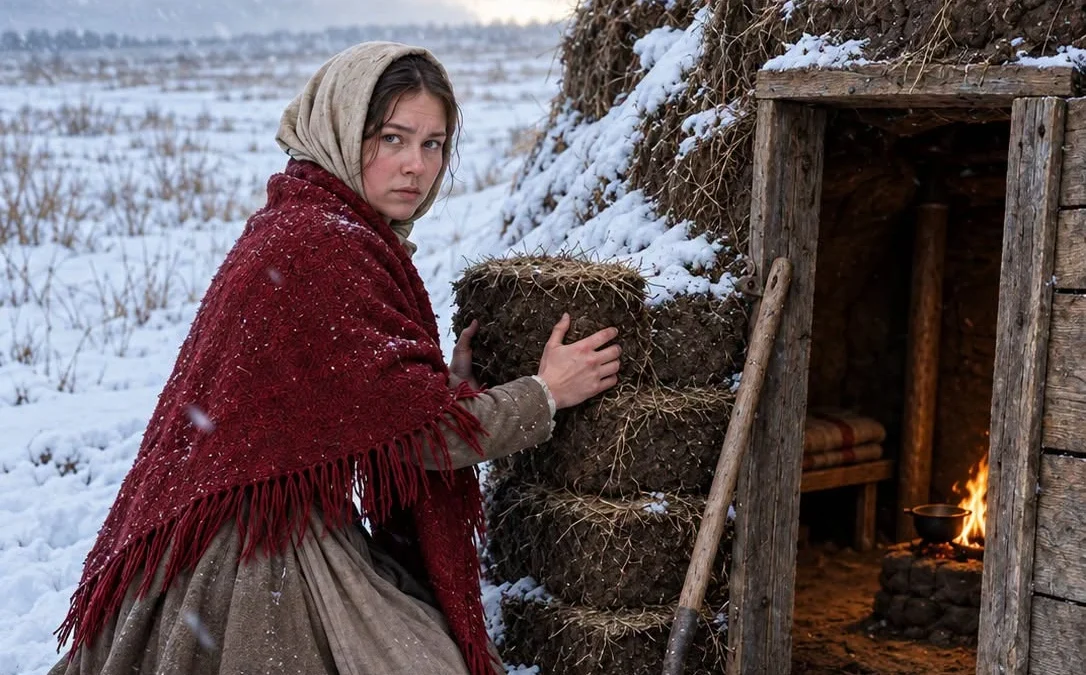
At Nineteen, Her Husband’s Family Threw Her Out With Nothing but a Spade. Twelve Days of Blizzard Later, Those Same People Crawled Through the Snow to Beg at the Door She Dug Beneath the Prairie…
Part 1
The morning they took Ingrid Pruitt’s home away, her mother-in-law was making bread. 🍞
That was what Ingrid remembered most clearly afterward. Not the paper Amos laid on the kitchen table. Not the cold satisfaction in his voice. It was the smell of bread rising beside the stove. She had mixed that dough herself before sunrise, with hands still rough from washing her dead husband’s clothes. A kettle whispered over the fire. Beyond the window, September wind moved through the Dakota wheat stubble beneath a sky the color of old pewter.
Then Amos Pruitt told her she had to leave.
“The claim belonged to Elias,” he said. “And Elias is gone.”
Amos was thirty-two, broad through the shoulders, with the same brown eyes as his younger brother. Those eyes had once made Ingrid feel safe. Now they watched her with the impatience of a man explaining something obvious to a child.
“The land office has rules about these things. Family inheritance. Proper heirs. Mother and I cannot have you staying here indefinitely.”
Ingrid looked toward her mother-in-law, who stood at the stove turning a loaf onto a board, her gray hair pinned so tightly it pulled at the corners of her eyes. “Is that what you want?”
“Amos knows what is best.”
Four words. Ingrid had washed this woman’s bedding, rubbed liniment into her aching hands, and sat beside her through sleepless nights. Now Mrs. Pruitt would not even meet her eyes.
“There is work in Sioux Falls. A widow your age can start over.”
Ingrid was nineteen. She had been married seven months and widowed for eighteen days. Her husband lay beneath a wooden cross she had helped carve. His boots still stood beside their bed.
She looked at the paper. Her parents had been Norwegian immigrants, and she had left school at nine when her father fell ill. She could read a hymn or a simple letter if she took her time. The language of land offices was another matter. Amos knew that. She would remember the way his thumb rested over the upper portion of the document long after she forgot almost everything else about that morning.
“Will you at least read the whole thing to me?”
“I have explained what it says.”
“Please.”
For the first time anger entered his face. “Do not make this harder than it needs to be.”
“Ingrid, the bread will burn,” said Mrs. Pruitt.
That was the end of the discussion. No raised voices. Just a woman being quietly pushed out of a home she had believed was hers. 💔
She had come to Dakota Territory that spring as a bride. Elias Pruitt was twenty-four, awkward with compliments and hopeless at remembering where he put his tools. On their second walk together he told her about the prairie. Land as far as you can see. Room to build something that belongs to us. They worked side by side through the spring, Elias guiding the plow while Ingrid walked behind with the seed. At night he described the barn, the larger kitchen, the bedroom facing east so the morning sun would wake her.
In June he gave her a spade. The blade was dark iron, the handle polished by another man’s hands. Every farm wife ought to own one tool nobody can take away from her. She laughed. She had not known she was being handed the instrument that would save her life.
On August 22 he waded into the Big Sioux to unhook a trace chain for a neighbor’s stuck wagon. By morning he had a fever. For twelve days she barely slept. Once, just before dawn, he gripped her wrist. “The east window. In our room. Do not forget.”
“I will not.”
He died on September 3. She washed his face herself. Afterward, she kept setting four places at the supper table because she did not know how to set three.
On September 21 she packed what she could carry. Two blankets. Her mother’s cast-iron skillet. A knife, a crock of lard, a jar of sourdough starter, a tin of matches, a lamp. A split-handled hatchet, a Bible, her mother’s letters, and a blue ribbon Elias once tied around prairie flowers. Two silver dollars sewn into her hem. Her red wool wedding shawl. And the spade.
Amos watched her carry it out. “You are taking that old thing?”
“Elias gave it to me.”
Mrs. Pruitt stood in the doorway. “There is no sense lingering.” Then she closed the door, not angrily. Just a small, decisive click.
The road to Sioux Falls ran east. Ingrid went west. By noon the anger that had held her back straight was fading, and the wind stung her cheeks. She could turn around. She could beg. Then Elias’s voice: one tool nobody can take away. “No,” she whispered.
A mile and a half southwest, she reached a dry creek with a steep earthen bank facing south, sheltered from the northwest wind. She remembered Norwegian families in Minnesota who survived winters in homes dug into hillsides. The earth remembers summer, an old widow had once told her. She set down her mother’s box, chose a spot near the base of the bank, and pushed the blade into the soil.
She had no idea how close that first day’s digging would come to killing her. And she had no idea that four months later, the people who turned her out would kneel in the snow above that same bank, begging her to let them in. 😨
Part 2
The first two days nearly broke her. Prairie sod was a dense mat of roots that made the spade bounce against her boot. By the next morning blisters had opened across both palms, and she wrapped them in strips of petticoat gone dark with blood.
Her first mistake was tunneling inward beneath an overhanging wall of earth. On the third afternoon, she was kneeling near the back of a shallow hollow when she heard a faint crack overhead, like a dry branch breaking. A thin line appeared in the soil. Then the ceiling fell.
A slab struck her shoulder. Her lamp toppled. Something heavy slammed against her legs, pinning them. “Help!” The dry creek and open prairie heard her. The nearest house was more than a mile away, and nobody there had any reason to come looking.
She thought of Elias behind the plow in June. Whatever needs doing. Then she began digging with her bare hands, scraping loose soil from her knees, breaking clods apart with her fingers while the pain shot up her leg. “Come on,” she whispered, again and again. When her left leg finally came free, she crawled out and lay on her back under the sky until the light faded. 🌅
She cried that night harder than she had since the funeral, her shin raw from knee to ankle. For a few minutes she genuinely considered walking to the railroad. But she had spent her whole life serving households that were not hers. And if she left, Amos’s version of events would become the only one anyone knew. She touched the red shawl. “My mother did not raise me to crawl.”
She remembered the Norwegian dugout. The old widow’s husband had cut the bank back in steps so no unsupported shelf of soil hung overhead. The earth had not betrayed her. She had asked it to hold more weight than it could bear. For five days, limping, she reshaped the face of the bank, slicing sod in long straight lines and levering up thick blocks that held together like coarse woven cloth. By early October the room took shape. Ten feet deep, eight wide. Barely large enough for a bed, a hearth, and her belongings. But hers.
She stacked sod across the front, grassy sides inward. She cut a hearth and a flue upward through the earth, because a fire without a way for smoke to escape was worse than no fire at all. She found the broken oak tailgate of an old wagon in the creek gravel and dragged it upstream inch by inch. With leather straps cut from her mother’s box she hung it as a door. She stepped outside, closed it, opened it again. For the first time since September 21, she stood before an entrance no one could order her to leave. “Well, Elias,” she said softly, “it is not the east window. But it is a start.” 🚪
The roof was worse. The nearest cottonwoods stood a quarter mile downstream. She had only the hatchet. Some days she managed one pole, her hands so swollen she tied them to the handle with cloth. By October 14 the poles lay across the room, uncovered.
That evening geese flew low under the clouds. The wind shifted, carrying a bitter smell. A dark wall was moving toward her from the northwest.
The October blizzard hit before she could finish. She dragged the tailgate into the back corner as a shield and crawled beneath it with her blankets and a crock of lard against her body. Snow drifted in white ribbons through the roof poles. On the second night she spoke to Elias, not because she believed he could hear, but because the silence frightened her more than the storm. “You said we would build it together. I am trying.” For three nights the poles overhead groaned and held.
On the morning of October 18, she woke to silence. She covered the roof one sod block at a time, overlapping and packing earth between the seams. Near the rear she built something unusual, a narrow escape hatch framed between doubled poles with a lid of woven willow held by two removable pegs, and a low platform inside to reach them. The Norwegian settlers had understood such dangers. By the end of the month the room was enclosed, thick with sod, the oak door shut tight.
She lit a small fire and watched the smoke climb the flue. For the first time in weeks she could sit without wind on her face. Alone beneath the prairie, she let herself believe she might survive. 🕯️
Her savings were gone by November. A storekeeper named Mr. Keller at the railroad siding gave her a coil of snare wire. “Winter does not care much for pride, miss.” She burned dried cattle chips. She twisted prairie grass into hard ropes of hay, folded and tied, stacking them on a shelf. She baked her first loaf of sourdough in the skillet and wept quietly over the crust, remembering her mother. Good bread forgives a hard day.
Late in November she nearly died in the fog, wandering a quarter mile from the dugout and turning in circles until her father’s old advice, do not let fear choose your direction, made her stand still for three hours. The next morning she cut the fringe from her red shawl and tied strips to willow stakes twenty paces apart, leading from home to her fuel grounds. A trail of tiny red flags across the snow.
In December Amos rode by and laughed. “It looks like a badger hole. Elias would be ashamed.” Ingrid kept twisting hay. “Mother says the offer still stands.” “Tell her thank you.” On January 10, she counted four hundred and eighty hay twists. Eight nights, maybe more.
The next day, the sky turned a greenish black, and the wind struck the prairie in one tremendous blow. She had no idea the storm approaching would last twelve days, or that she would soon hear a terrible groan from the direction of the Pruitt farm. 😱
Part 3
By the second morning, packed snow sealed the oak door. On the third night she woke with a pounding head, the flame weak and smoky. The chimney had buried under snow, and fumes had nowhere to go. She crawled to the fresh-air passage, pulled the plug, smothered the coals with earth, and worked a long cottonwood pole up the flue until the obstruction broke and wind rushed down. Only when the air cleared did she relight a very small fire. After that she checked both passages through the night.
By January 17 she had counted twelve spent matches in the tin cup and only one hundred and twenty hay twists left. Twenty a night, no more. Without a steady fire her breath showed in the lamplight, yet the water jar did not freeze. The same earth that had nearly buried her was keeping her alive. She thought of Amos’s tall farmhouse with its windows facing every direction, and wondered whether it was as safe as he believed. She felt guilty. Whatever he had done, she did not want him dead. Keep them safe, she whispered. Hatred, she was discovering, required warmth she could no longer afford.
On the eighth day she heard voices outside the door. On the ninth, the chips were gone, and she burned spare poles, saving the longest to clear the chimney. On the twentieth, near midnight, a long low groan rolled from far to the northeast, then a cracking sound like a great timber giving way. She sat very still. Something much larger than her roof had failed. Please, she whispered.
On the eleventh night, she burned the last twists. Hungry, cramped, she thought of Elias lifting her down from the wagon. There is our future. “You had better be proud of me,” she said. “Because I do not know how much more I have.” Then her mother’s voice, from some winter long ago: Morning first, Ingrid. You only have to get to morning. 🕊️
On January 22 she woke to silence. The storm had stopped. The front door was buried solid. She dragged herself onto the platform, worked out the two pegs, and dug upward with Elias’s spade through narrow packed snow, resting, rising again. “One more.” At the top, a crack of white light opened. She climbed out onto the roof of her own house.
The prairie had disappeared. Snow filled the creek almost to the bank’s top. And to the northeast, where the Pruitt farmhouse had stood, half the roof lay collapsed in the snow beside the building. She pressed a hand to her mouth. The sound she had heard in the night had come from there.
She could barely stand. A few red strips still fluttered above the drifts. She picked up the spade and followed them to gather chips before dark. That evening she lit a small fire and cried at the sight of it. 💛
Two days later, two figures moved slowly across the snow from the northern rise. Amos broke trail with a shovel. Behind him came his mother in two quilts, her hands wrapped in dirty cloth. No horse. No wagon. They had not come to laugh. They had nowhere else to go.
Ingrid could have shut the hatch. No one would have blamed her. Instead she added fuel to the hearth and put the last of her beans in a pot.
“You are alive,” Amos said, his arrogance gone. “The roof went on the tenth night. One of the main supports broke. We got into the root cellar before the rest came down. We burned the chairs, then the shelves. On the last night, I broke up the kitchen table.” Ingrid thought of Elias’s boyhood initials carved beneath its edge. “Mother’s hands are bad.”
Mrs. Pruitt looked directly at her for the first time since September. There was fear in that look. And beneath it, shame.
Ingrid thought of Elias. His clumsy smile. His hand over hers on the spade. Then she moved aside. “Come down. Mind the step.”
They stayed nine days, three people in a room ten feet by eight. Mrs. Pruitt stared at the sod walls, the oak door, the air passage. “You built all this? By yourself?” She closed her eyes. Ingrid warmed the swollen fingers gradually, kept them wrapped, and whispered, “Sorry,” when the woman winced. Mrs. Pruitt stared, astonished that she was the one apologizing.
Amos learned to twist hay. “Grass has a grain?” “Everything has a way it wants to bend.” He counted her stacked twists and looked at the scarred palms. He said nothing. He carried salvaged boards from the ruined house, and Ingrid recognized one with a notch where Elias had used a dull saw. “He cut this.” The farmhouse was keeping the hidden dugout warm.
On the sixth evening she found her red shawl folded neatly at the head of her blanket, edges matched, exactly as her mother had folded it. “Your shawl was getting damp,” Mrs. Pruitt said. She never said she was sorry. But from then on, she pushed her bread portion toward Ingrid, and when Amos complained of the cramped room, she said, “Your sister-in-law built this with her own hands. It kept us alive.”
On the last morning, Amos offered, “You could come back with us.” Ingrid thought of walking through those damaged rooms, waiting for another decision to be made without her. “This is my home.” He nodded. “Then I will bring you more wood.”
“You are welcome to bring wood. But that does not mean you get to tell me what to do with it.”
A faint, embarrassed smile. “I suppose it does not.”
Spring came all at once, the creeks rushing with broken ice. Ingrid washed her dress, took the spade, and walked to the land office in Sioux Falls. The spectacled clerk opened the ledger, then looked at her more carefully. “Under the homestead provisions, a surviving widow may have the right to continue her husband’s claim. Here. The widow’s position comes before the other heirs.”
She looked where he pointed, above the line Amos had covered with his thumb, and recognized the word. Widow. “Are you saying he had no right to make me leave?”
“You had rights he did not explain.”
She walked to the Pruitt farm two days later. “You did not think I could survive without you.”
He stared at the ground. “No. I thought you would go to Sioux Falls. Find work. Marry again. And then the land would be mine.”
She wanted to shout about the collapse, the fog, the twelve nights. But his silence told her he knew enough. “I do not want a future that depends on what you or your mother think I deserve. I will settle the claim properly, and I intend to file on the land around my creek bank. I would rather keep the home that kept its roof.”
When the paper finally came, she held it with both hands and read her own name, slowly, twice, inside her mother’s Bible. In the summer she added a small window where the morning light reached. The east window. Do not forget. She had not forgotten. 🌅
Amos brought wood, flour, potatoes, and asked before offering advice. Mrs. Pruitt came sometimes, and they sat in a silence that had changed. Years passed, with other hard winters. Neighbors caught in storms stumbled to her door and were let in. She taught every visitor what she had done wrong, and why proper support and ventilation mattered.
Many years later, a young woman asked, “Is it true they left you with almost nothing? And you saved them anyway? Why?”
Ingrid rested her hand on the old spade. “Because they were standing outside my door, and I knew what that felt like.”
She had believed losing a home meant losing everything. The winter taught her otherwise. A home was not always the building with the highest walls. Sometimes it was a small room beneath the earth, built from sod and salvaged timber, where a forgotten widow discovered that her own hands were enough to begin again. “That house belonged to the life I thought I was going to have. This one belongs to the life I made.”
She opened the oak door. “Come inside. There is coffee on the fire. Mind the step.” 💛
She had been left on the prairie at nineteen with a spade, a red shawl, and almost no money. When the twelve-day blizzard came, the proud farmhouse broke beneath it. Her little shelter endured. And when the people who abandoned her stood outside begging for warmth, she gave them what they had refused to give her. A place to belong.
The strongest thing Ingrid built was not the roof above her head. It was the dignity no one could ever take from her again. 🌅
This story is entirely fictional and created for entertainment purposes only. It does not represent any organization or individual, nor does it encourage inappropriate behavior. The content was generated with AI assistance.








