At the Hospital I Learned I Had an 18-Month-Old Daughter. Hours Later, Invoices Showed My Grandfather Paid €46,000 to Take Her Mother Away From Me.
At the Hospital I Learned I Had an 18-Month-Old Daughter. Hours Later, Invoices Showed My Grandfather Paid €46,000 to Take Her Mother Away From Me.
Part 1
“She has my eyes.”
My voice cracked through the corridor of La Fe Hospital in Valencia before I could stop it.
“Tell me I’m wrong, Clara. Tell me I haven’t spent eighteen months as a father without knowing it.”
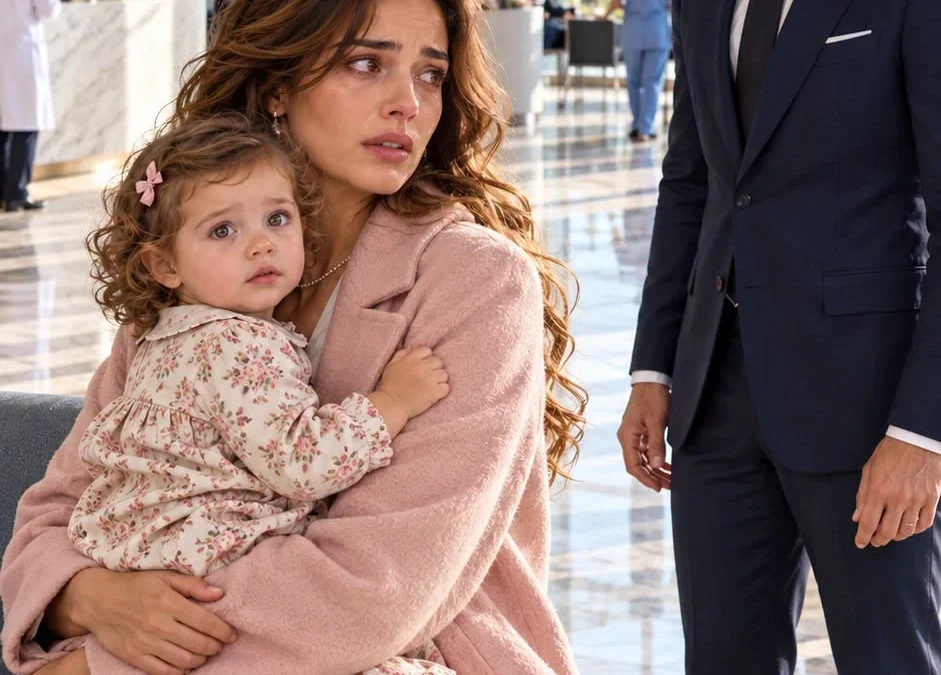
She was standing ten feet from me, holding a little girl against her chest. The child clutched a pink cloth bunny and stared at me with enormous, serious eyes.
My eyes.
I hadn’t seen Clara Montes in twenty-seven months.
Twenty-seven months since she vanished. Her apartment emptied. Her job abandoned. Her phone dead. No note. No explanation. Just a hole in my life exactly her shape.
I had searched everywhere. I had even gone to her aunt Adela’s door eleven times, hat in hand like a beggar, and eleven times Adela had looked at me with such sadness and said only, “I’m sorry, Gabriel. I promised her.”
And now, on the day I’d heard Adela was in the hospital with a heart complication, I turned a corner and found Clara.
With a child.
“Gabriel, please,” she whispered. “We’re in a hospital.”
“I just need to know if she’s mine.”
Clara looked away. “You have no right to demand anything from me after what happened.”
After what happened.
I stood there, the heir to the Beltrán Group, a man who could sit across from men signing hundred-million-euro contracts without blinking, and I couldn’t make my mouth work.
What had happened? That was the question that had hollowed me out for over two years.
The little girl reached out and held her bunny toward me.
An offering. From a stranger who wasn’t a stranger at all.
“Thank you, little one,” I said, and my voice broke on the last word.
“Her name is Martina,” Clara said quietly.
“She’s beautiful.”
A nurse appeared and led Clara away toward Adela’s room. She glanced back once, and in her face I saw something I couldn’t read. Fear, maybe. Or grief.
I stood alone in that corridor with my heart slamming against my ribs. 💔
I did the only thing I could think of.
I called Rubén.
Rubén Salas has been my closest friend since university, and now he’s head of legal for the Group. He’s the one person I trust to tell me the truth even when I don’t want it.
“I need you to look into everything that happened before Clara disappeared,” I said. “Everything.”
There was a long silence on the line.
“Gabriel,” he said carefully. “I’ve actually been looking into something for the last few days. I didn’t want to say anything until I was sure.”
My stomach turned over. “What is it?”
“Come to my office. Now.”
I drove there with my hands strangling the steering wheel.
Rubén had the blinds drawn. A stack of papers sat on his desk, and his face was the color of paper itself.
“Sit down,” he said.
“Just tell me.”
He slid the first sheet toward me.
An invoice. From a photographer I’d never heard of.
“There are payments,” Rubén said. “Several of them. All connected to a set of photographs. Do you remember a model named Natalia Ferrer?”
I frowned. “She was at a company gala. We spoke for five minutes.”
“Gabriel.” He laid out a second page. A third. “These pictures were circulated to Clara shortly before she left you. Pictures of you kissing Natalia.”
The room tilted.
“I never kissed her.”
“I know.” He tapped the invoices. “They were fabricated. Edited. And somebody paid for them, quietly, through accounts that were supposed to be closed.”
My mouth had gone dry. “Who?”
Rubén didn’t answer right away.
Then he pulled up an email on his laptop. Something he’d recovered from the company’s old archives.
“I didn’t want to show you this one,” he said.
I leaned forward.
I knew the signature before I read a single word. I’d known that signature since childhood. It was the one on the birthday cards, on the letters from boarding school, on the deed to the house where I’d learned to ride a bike.
Octavio Beltrán.
My grandfather.
The man who raised me. The man I admired more than any other man alive.
I read the message. Then I read it again, because my brain refused to hold it.
If that woman reports a pregnancy, no document is to reach Gabriel’s hands. He must never find out.
What happened next still gives me chills. Part 2 is in the comments—or leave any word below and I’ll send it to you privately.
Part 2
What happened next still gives me chills. Part 2 is in the comments—or leave any word below and I’ll send it to you privately.
I don’t remember leaving Rubén’s office.
I remember the night. We stayed there until the windows turned gray, going through everything. A photographer’s invoices. Transfers totaling €46,000. Messages sent to Natalia Ferrer. And the original photographs, which Rubén had tracked down: Natalia simply hugging me at a gala, nothing more. Every kiss had been added digitally.
My grandfather had bought the destruction of my life with a bank transfer.
At eight in the morning, I drove to the family house in Rocafort.
Octavio was at the breakfast table in his pressed shirt, spreading marmalade on toast like it was any other Tuesday.
I threw the photographs down in front of him.
“How could you do this to me?”
He glanced at them, then at me. Not a flicker.
“I spared you a mistake.”
“You destroyed the woman I loved!”
“Clara had neither the education nor the standing to represent this family.”
I put the email on the table.
“Did you know she was pregnant with my daughter?”
Slowly, he lowered his cup.
“I knew she claimed to be. That proved nothing.”
“And you decided I shouldn’t know either.”
“I was protecting our name.”
Our name.
Years of admiration for that man collapsed in my chest like a building.
“She’s eighteen months old,” I said, and my voice shook. “You let my daughter grow up without me.”
“We can fix this discreetly,” he said, reaching toward me.
“My child is not a problem you can solve with money.”
I walked out and told him I was done with every family matter under his personal control.
That afternoon, I found Clara and Martina in the Turia gardens. The baby sat in her stroller, fascinated by a toy butterfly. I approached slowly and asked permission to speak.
Then I showed Clara the original photographs.
She studied them for a long time.
“So you were never with Natalia?”
“Never. My grandfather arranged everything.”
Something moved across her face. Twenty-seven months of grief rearranging itself.
“I thought you’d replaced me.”
“And I thought you’d stopped loving me.”
Neither of us spoke. Finally I looked at Martina.
“I need to hear it from you. Is she mine?”
Clara closed her eyes.
“Yes. Martina is your daughter.”
I covered my face with my hand. 😢
“I wish I could have been there for the pregnancy.”
“I tried,” she said.
I looked up. “What?”
“When I was seven months along, I sent a certified letter to your office. I enclosed an ultrasound and my address. I never got a reply.”
I called Rubén from the garden bench. Within hours, he’d traced the postal records. A receptionist had signed for the envelope and passed it to my grandfather’s personal secretary.
That night, we got into Octavio’s private archive.
And there it was, tucked in a drawer.
The envelope.
Sealed. Never opened.
My hands trembled as I broke it. Inside was the ultrasound, with a few handwritten lines I will carry until I die.
But Rubén was already holding up a second page from the same drawer.
I saw my grandfather’s signature at the bottom.
And I saw the first line.
If you want to know what that second page said, LIKE this post and comment “LETTER.” When enough people comment, I’ll post Part 3.
Part 3
I read Clara’s note first, because I couldn’t bear to read the other page.
I’m not writing so you’ll come back to me. I just want you to know you’re going to be a father. Even if our story is over, this little one deserves to know you.
And beneath it, in smaller handwriting:
Today I heard her heartbeat, and I thought about how much you would have loved to be there.
I sat on the floor of my grandfather’s study and wept like a child.
Then Rubén cleared his throat and handed me the other paper.
It was an order to withhold my correspondence, signed by Octavio. And beneath it, one more instruction.
If the child is born, offer the mother financial compensation in exchange for keeping her away from the family.
I read it three times.
My grandfather hadn’t just tried to separate two people in love.
He had planned to erase his own great-granddaughter from our family history.
I went to Clara’s the next morning with the letter in my hands. I hadn’t slept. I felt ten years older.
“I read what you wrote,” I said. “Forgive me for not being there.”
She let me in. Martina was asleep, curled around her bunny.
“You didn’t know,” she said.
“But I let my grandfather steer my life for too long. I should have drawn a line years ago.” I sat across from her. “I’m not asking you to forget. I only want to know our daughter. And if one day you decide to give me another chance, I want to deserve it.”
She studied me in silence.
“You can know her, Gabriel. But don’t try to change our lives overnight.”
“We’ll do it your way.”
That was how it started.
I learned Martina hated peas. I learned she adored animal stories and couldn’t fall asleep unless she held that bunny. I learned that changing a diaper is harder than negotiating an international contract.
And Clara started laughing again.
Eventually she told me what had happened that night, the night she left. Octavio had invited her to dinner at a restaurant downtown. He’d laid the photographs on the table. My grandson will marry someone of his category, he’d said. You were a pleasant distraction. Nothing more.
Then he’d mentioned her aunt Adela’s home. An old debt, he said, that he had the power to call in.
“That was what broke me,” Clara said. “Not the pictures. The threat to Adela.”
So she ran. To Castellón. She found out she was pregnant weeks later and raised Martina alone, working at a small accounting firm in a tiny rented studio.
I listened, and I didn’t interrupt once.
But there was one problem neither of us could ignore.
I was engaged.
Marina Valcárcel, daughter of well-known Valencian businesspeople. Our relationship had started after Clara disappeared, and both families had been planning the wedding for months.
I met Marina at a terrace café in Mercado de Colón.
“Clara is back,” I said.
She was quiet for a few seconds. “I know. I also know you have a daughter.”
“I never wanted to hurt you.”
“But you never loved me the way you loved her.”
I didn’t deny it.
“Then let’s end this before we turn our wedding into a lie,” she said.
It was discreet and painful, and we both knew it was necessary. Before she left, she warned me: “Be careful, Gabriel. You’ve spent your whole life around people who think money can solve everything. Don’t repeat their mistakes.”
I didn’t understand what she meant.
Days later, I did.
I arrived at Clara’s to see Martina and found documents spread across the table. Emails. Printouts.
“Did you decide where I should live and work, too?”
My blood ran cold. I recognized every page.
An apartment in Valencia. A recommendation for an administrative position. Inquiries about a nursery.
“Marina brought them to me,” Clara said. “She thought I should know.”
“I only wanted to help.”
“Without asking me?”
“I thought you’d refuse anything that came from me.”
She shook her head slowly.
“Your grandfather destroyed us because he believed he could decide for us. And now you’re doing exactly the same thing.”
I opened my mouth to defend myself, and nothing came out. She was right.
“I was afraid you’d disappear again,” I admitted.
“You can’t build a family by making someone feel trapped.”
Nothing anyone had ever said to me hurt more.
The next day I canceled everything I’d arranged without her consent. I agreed to a plan for supporting Martina that Clara designed herself. She kept her job. She chose her own home.
And I stopped trying to impress her with gifts. I picked up Martina whenever Clara asked. I made snacks. I learned to listen without interrupting.
One afternoon I tried to cook paella. The rice came out mushy.
“Your Valencian grandmother would be scandalized,” Clara teased.
“Then I’ll keep practicing.”
We laughed while Martina banged her spoon on the table. For the first time, it felt like a family.
Then the hospital called. Adela had suffered another complication.
I drove Clara there myself and waited in the corridor. When she came out, her face was streaked with tears and something else. Astonishment.
“Aunt Adela told me something,” she said. “I need to sit down.”
My father-in-law, Clara’s father, Manuel Montes, hadn’t been just a factory worker in Castellón. He came from a wealthy family in Jerez de la Frontera, the Montes de Villalba, owners of old vineyards and agricultural businesses. He’d given it all up to marry Clara’s mother, a humble woman his parents never accepted.
When both of them died, Adela raised Clara. The paternal family tried to make contact. Adela blocked them.
“She was afraid they’d take me away,” Clara said. “She told me, I confused protecting you with stopping you from choosing.”
I held her hand. “She acted out of fear.”
“Like you,” she said gently. “Like your grandfather used fear to justify the cruelest things.”
Adela recovered slowly. Clara found Rodrigo Montes de Villalba, her late father’s uncle, seventy-eight years old. He traveled up from Jerez carrying a folder of old photographs.
When he saw her, he wept.
“You have Manuel’s smile.”
He showed her a picture of her father as a young man, sitting on a white wall beside the vineyards. Clara recognized his eyes at once. 🍇
Rodrigo offered her a place in the family business.
“I don’t need to recover a fortune to feel I belong,” she told him. “I just want to know where I come from.”
“Then we’ll start with the house where your father grew up.”
When the news reached my grandfather, he asked to see me.
“I understand Clara belongs to the Montes de Villalba. A respectable family. Perhaps I was hasty in judging her.”
I stared at him.
“You haven’t learned anything.”
“I’m only acknowledging that circumstances have changed.”
“Clara was exactly the same person when she worked at an accounting firm in Castellón. Her worth never depended on an inheritance.” I stood. “I lost eighteen months with my daughter because of your pride. I won’t let Martina grow up believing money decides who deserves respect.”
He lowered his eyes.
Some time later, Octavio stepped down from his role at the Group and acknowledged in writing what he’d done. He helped untangle the financial pressure he’d put on Adela. He sent Clara a letter of apology.
She answered weeks later, accepting his words without promising anything more.
And then came the morning I’ll never forget.
Martina was playing in the living room when I walked in with her snack. She lifted both arms.
“Papá!”
I froze.
“Papá, ven!”
I scooped her up, and I couldn’t stop crying. Clara watched from the kitchen doorway. For so long she’d grieved everything father and daughter had lost that she’d barely let herself enjoy what we were building.
That night, after putting Martina to bed, I took Clara’s hand.
“I still love you.”
She rested her head on my shoulder.
“I love you too. But this time I don’t want fear to decide for us.”
“Then we won’t rush.”
And I kept my word. Months passed before she agreed to live with me. Not in the family mansion, but a bright little house with a garden where Martina could play. Adela came every Sunday. Rodrigo traveled whenever he could.
When I finally proposed, there was no show. Just a simple dinner and the first photograph we ever took with our daughter on the table.
“I don’t want to get back what we had,” I said. “I want to keep building what we are now.”
“Then yes,” Clara said, smiling through tears.
We married six months later at an orange-grove estate outside Valencia. Adela sat beside Rodrigo. Rubén stood with our closest friends. Marina came too, her own life rebuilt far from other people’s expectations.
Octavio stayed quietly among the guests. No speeches. No attention-seeking. He’d finally understood that respecting our boundaries was the only way he might ever earn back our trust.
Martina came down the aisle in a white dress with a basket of petals. When she saw me at the altar, she let go of Clara’s hand.
“Papá!”
She ran straight to me. I swept her up and held out my other hand to Clara. The guests burst into applause.
In my vows I said something I will never forget: “There was a time when I confused love with the need to keep someone from leaving. Today I know that love is to accompany without imposing, to listen without judging, and to stay when things get hard.”
Clara said, “I’ve learned that secrets can separate us even when we think we’re protecting the people we love. I promise I’ll never let fear speak for me again.”
That night we stood over Martina, asleep beside her inseparable cloth bunny.
“We’ll never get back her first eighteen months,” I whispered.
Clara laced her fingers through mine.
“No. But we have a whole life to be there for her.”
For years I believed the Beltrán fortune was my greatest inheritance. Now I know the most valuable thing I own is this small family I almost lost forever.
And Clara, who once left Valencia convinced she wasn’t worthy of a powerful man’s love, finally understood she never needed an important surname to deserve anything.
The next morning, Martina woke and found us having breakfast together. She toddled over with her bunny, took one of my hands and one of Clara’s, and led us out to the garden.
We walked beside her without trying to steer her steps.
Because I’ve learned that real love isn’t the kind that locks someone in to keep them from leaving.
It’s the kind that gives them enough reasons to stay. 🤍
Disclaimer: This story is entirely fictional and created for entertainment purposes only. It does not represent any organization or individual, nor does it encourage inappropriate behavior. The content was generated with AI assistance.








