At the Military Gala, My Sister Laughed in My Face: “What’s Your Rank, Sweetheart?”… Minutes Later, FOUR Generals Stood Up and Saluted Me in Front of the Entire Room
🎖️ At the Military Gala, My Sister Laughed in My Face: “What’s Your Rank, Sweetheart?”… Minutes Later, FOUR Generals Stood Up and Saluted Me in Front of the Entire Room 😱
PART 1
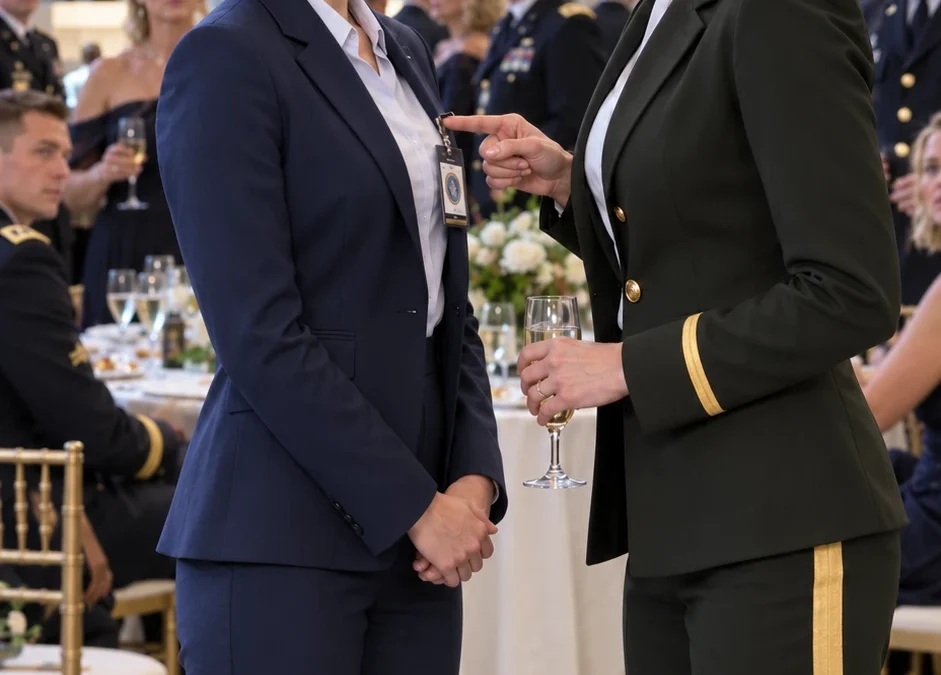
I wore a simple gray suit to the ceremony. No medals. No ribbons. No insignia. Just a Department of Defense badge clipped to my jacket.
Most people glanced at it once and decided exactly what my sister decided.
Paperwork. Desk job. Nobody important.
Rebecca folded her arms and laughed softly. “I knew it.”
“Knew what?”
“You never did stay in the real military.”
Ten years gone, and that was the first thing she said to me. 💔
She hadn’t changed at all. Perfect posture. Confident smile. The kind of woman who expects to be admired before she opens her mouth. A retired lieutenant colonel. The highest-ranking member of the Carter family. At least, that was the story she’d been telling for a decade.
She turned to the small group around us. “Everyone, this is my little sister, Naomi. She always wanted a military career.” A dramatic shrug. “I guess things didn’t work out the way she hoped.”
A man chuckled politely. A woman smiled awkwardly.
Rebecca tapped my badge. “Department of Defense. Probably paperwork.” She smiled sweetly. “Well, someone has to keep the files organized.”
More quiet laughter.
Nobody meant to be cruel. They were just following her lead. Rebecca had always been good at making people believe her version of reality.
I could have corrected her in five seconds.
Instead, I asked, “How have you been?”
She blinked, surprised I hadn’t defended myself. Then she launched into stories: command posts, leadership schools, awards, important colleagues. Every story ended with Rebecca in the center.
Then she turned back to me. “So what exactly do you do?”
“I work for the Department of Defense.”
“I can see that.” She laughed. “Doing what?”
“I help where I’m needed.”
She rolled her eyes. “So mysterious.”
“It isn’t.”
She waited. I said nothing more. And my silence bothered her more than any argument could have.
“See?” she told the group. “She always did this as a kid. Half-answers to everything.”
“Did you two always compete?” someone asked.
Rebecca answered before I could. “Not really. You have to be close for it to be competition.”
A louder laugh this time. I recognized that line. She’d used it in high school. Apparently she’d been saving it for ten years.
“Dad always worried about Naomi,” she sighed. “She never had the confidence for leadership.”
Out of the corner of my eye, I noticed a young Army captain a few feet away. He wasn’t laughing. He studied my face, frowned slightly, like he was trying to remember where he’d seen me. Then someone called his name, and he disappeared into the crowd.
Rebecca never noticed. She was having too much fun.
She stepped closer and looked me dead in the eyes. “I’ll ask one more time, sweetheart.”
The group went quiet.
“What’s your rank?”
I gave her the same calm smile I’d worn all evening. “I don’t think that’s important tonight.”
She laughed loud enough that people two tables away turned around.
“Translation,” she announced, “no rank.”
She patted my shoulder like she was comforting a child. “That’s okay. Not everyone gets there.” 😔
I let it pass.
Because standing there, I could suddenly hear another voice. One I’d spent ten years trying to escape.
“Good. Rebecca scored higher.”
My father must have said those four words a hundred times while we were growing up.
He was a Gulf War Marine, and our house ran like a barracks. Beds made before breakfast. Shoes shined. Excuses treated like lies. Rebecca thrived in it. Fearless, athletic, a born leader. Dad looked at her the way people look at the flag during the anthem.
He looked at me differently. Not with disappointment. With comparison.
In seventh grade, I studied for two weeks and got a 90 on a math test. I ran home to show him. He glanced at it.
“Good.” Then he turned. “Rebecca, what did you get?”
“Ninety-five.”
He smiled. “Rebecca scored higher.”
End of conversation.
The only person who ever celebrated me without mentioning my sister was Mom. When I made the honor roll, she baked my favorite apple pie. When my college acceptance came, she hugged me before I even finished opening the envelope. “You earned this.”
Then Mom got sick.
One afternoon, near the end, she pressed something cold and heavy into my palm. My grandfather’s Marine challenge coin, its edges scratched from years in uniform.
“What about Rebecca?” I asked.
Mom smiled softly. “She already has your father’s approval.” She closed my fingers around it. “I want you to have something that reminds you your worth isn’t measured by comparisons.”
A few months later, she was gone. 🕊️
And after that, home stopped being a place where I rested. It became a place where I was graded.
Back in the ballroom, the master of ceremonies stepped up to the microphone. “Ladies and gentlemen, the ceremony begins in five minutes.”
People drifted toward their tables. Across the room, near the entrance, aides quietly escorted senior officers toward the reserved seats by the stage.
Then the doors opened again.
A man in uniform stepped inside. The two stars on his shoulders changed the air in the room instantly. A Major General.
His eyes swept the crowd, table by table…
And stopped on me.
He didn’t smile. He didn’t speak. He just gave the smallest nod. Recognition.
Rebecca was still talking. She didn’t see it.
She had no idea that in five minutes, the whole room was about to find out who I really was. 😮
👇 Part 2 is in the comments! Can’t find it? Leave any word below and I’ll send it to you privately. ❤️
PART 2
She had no idea that in five minutes, the whole room was about to find out who I really was. As guests found their seats, my mind drifted back ten years, to the night I finally stopped trying. A Department of Defense envelope had arrived: I’d been selected for an elite leadership program for future senior leaders in special operations oversight. Almost no one got in. And the first people I wanted to tell were my family. Maybe this time would be different. I drove home holding that envelope like it was made of glass. Dad was reading the newspaper. Rebecca was pouring coffee. “I’ve got news,” I said, smiling. “I was selected.” Rebecca skimmed the first line, laughed, and slid it to Dad. He didn’t even unfold it. He rested two fingers on it, then pushed it back across the table to me. “Let me guess,” Rebecca said. “Another paperwork assignment?” Dad finally spoke. “If it’s real, it’ll still be real tomorrow.” Then he picked his newspaper back up. Nobody said congratulations. Nobody even asked a question.
That’s when I understood: it didn’t matter what I brought home. In that house, I’d always be the version of me they’d already decided I was. So I quietly placed my house key on the kitchen counter beside a note: When you’re ready to see me for who I really am, I’ll come home. Then I walked out. Nobody followed. The next morning I requested a transfer and changed my number. Not out of anger. Out of clarity. For ten years, I just worked. No one in my new units cared whose daughter I was. They cared whether I could do the job. I took the messy assignments nobody wanted. Investigations. Operational reviews. Broken units that needed fixing. Promotions came slowly, steadily, quietly. I never announced a single one. Meanwhile, back home, Rebecca kept telling everyone the same line: “I’m the highest-ranking Carter.”
Back in the ballroom, the lights dimmed slightly. Rebecca clapped politely as decorated veterans and retired commanders were introduced, whispering comments to the people beside her, comfortable again in a world of titles she understood. Then the MC’s voice slowed. “And now, we’d like to recognize a leader whose work has had a lasting impact across multiple commands and operational structures.” Rebecca stopped whispering. People leaned forward. “Please join me in welcoming… Brigadier General Naomi Carter, Deputy Inspector General for Special Operations.” For one second, nothing in the room moved. Rebecca didn’t react. The name didn’t match the story in her head. Then, slowly, she turned. Her eyes found me before her mind caught up. “No,” she whispered. I pushed back my chair and stood. And across the room, the first general began to rise to his feet… 😱
👍 Want Part 3? LIKE this post and comment “SALUTE” below! Once we hit enough comments, I’ll post the ending right here. 🔥
PART 3
He stood with precise, deliberate movement, faced me fully, and raised his hand in a formal military salute.
The room didn’t react. Not yet.
Then a second general stood. No hesitation. Same salute.
A third.
Then a fourth.
Four generals. Four raised hands. No announcement. No explanation. Just recognition. 🎖️
The whole ballroom went silent. Not because anyone commanded it, but because no one knew what to say.
Rebecca stayed frozen in her chair, hands still resting on the table exactly where they’d been seconds earlier. Her eyes darted between me and the four generals, trying to make it make sense. The people around her weren’t laughing anymore. They were staring.
I returned the salute and walked toward the stage. My pace steady. My face calm. Every step landed in absolute stillness.
The same silence I had lived with for years.
Only now, it belonged to her.
At the podium, the MC said only two words. “General Carter.”
I didn’t look at my notes.
“We talk a lot about leadership in rooms like this,” I began. “Rank. Authority. Responsibility. But those things don’t define leadership. They reflect it.”
The room leaned in.
“Leadership is what you do when no one is watching. It’s the standard you keep when lowering it would cost you nothing. In my experience, the strongest leaders are rarely the loudest people in the room. They don’t need to be. They’ve already done the work.”
I paused.
“Respect isn’t something you ask for. It’s something you build, quietly, over time, in ways most people will never see.”
I stepped back. “Thank you.”
The applause started soft. Then grew. Then didn’t stop.
I didn’t look for Rebecca. I didn’t need to.
After the ceremony, officers came up one by one. “Ma’am, good to see you again.” Short, familiar exchanges. Nothing performative.
Across the room, Rebecca stood with the same group as before. But now, nobody was following her lead. They were listening to others.
“I worked with her during the restructuring review. She was the one who pushed for those changes.”
“Didn’t she lead the investigation on that unit out west?”
“Not just led it. Fixed it.”
“The Pentagon brought her in after that. She’s been there for years.”
Rebecca’s jaw tightened. Someone asked, “You know her?”
She hesitated. “She’s… my sister.”
The word didn’t sound confident anymore.
A senior officer joined the group. “General Carter’s been behind some of the most important internal reforms we’ve seen in the last decade.”
Rebecca stared at him. “Since when?”
He didn’t even blink. “For years.”
Then he turned to another conversation, as if it needed no further explanation. Because it didn’t.
For the first time that night, Rebecca had nothing to say. 😶
That night, alone in her kitchen, Rebecca typed my name into her phone.
Not one result. Pages of them. Official Department of Defense releases. Announcements. Photos. One showed me standing beside senior officers, not in the background, but in the center.
She kept searching, looking for an exaggeration. Something inflated. Something she could dismiss.
She found nothing.
Across town, my father sat in his living room. A local news segment had mentioned the ceremony. Just a name. A title. He turned the TV off and sat in the silence a long time.
Then he went to his old desk and typed the same name.
Official. Documented. Clear.
Not a single result suggested failure.
He opened the bottom drawer and dug through old receipts and papers until he found it. A small, folded note. The crease still sharp after ten years.
When you’re ready to see me for who I really am, I’ll come home.
For ten years, he’d treated those words as a tantrum. Something that would pass.
Now he finally understood. It wasn’t a reaction. It was a conclusion.
His grip tightened on the paper. His shoulders dropped.
And for the first time in a very long time, the old Marine had no response at all. 💔
Rebecca didn’t sleep. By morning, she’d convinced herself there had to be an explanation. “Titles get inflated all the time,” she said out loud to the empty kitchen.
But the words didn’t settle the way they used to.
So she called people she’d served with. People who wouldn’t guess or gossip.
“Naomi Carter? You mean General Carter? Of course I know her. She led the restructuring review. Fixed problems nobody else would touch.”
Another call. “She’s been advising at the Pentagon for years. She’s who they bring in when something’s broken.”
Three more calls. All the same truth.
Rebecca set the phone down. The room felt smaller.
She thought back on every conversation. Naomi never argued. Never corrected her. Never tried to prove anything. Rebecca had always taken that silence as weakness.
Now she saw it for what it was. Confidence.
Her eyes drifted to a small wooden box on the shelf. Their mother’s keepsake box. She opened it. Old photos. Letters. And one empty little space.
The challenge coin.
She’d never thought twice about Mom giving it to Naomi. Now she understood. Mom hadn’t chosen randomly. She’d chosen the daughter who had no recognition. The one nobody else was celebrating.
Rebecca leaned against the counter and lowered her head.
She hadn’t misunderstood her sister. She’d never tried to understand her at all.
“I was wrong,” she whispered.
A few days later, a message appeared on my phone from a number I hadn’t seen in a decade.
Can we meet?
I read it many times before replying with the name of a small café nearby.
Rebecca was already there when I arrived. She stood up. The confidence was still in her posture, but something underneath had shifted.
“Hi,” she said quietly.
“Hi.”
We sat. For a few seconds, neither of us spoke. It used to feel uncomfortable. Now it just felt honest.
“I didn’t know,” she said. Not an excuse. A statement. “I thought I understood everything about you. I didn’t. I made assumptions, and I never once checked if they were true.”
She held my gaze.
“I told people you left because you failed. I told them that for years.” Her voice didn’t break. “I was wrong.”
No justification. No “but.” Just the truth.
“I don’t expect you to fix anything,” she added. “I just needed to say it.”
I nodded. Not agreement. Acknowledgment.
Then the café door opened behind me.
I didn’t turn around. I knew those footsteps before I heard his voice.
“Naomi.”
Ten years, and his voice hadn’t changed at all.
My father stood a few feet away, not stepping closer, as if unsure how much distance he was allowed to cross. The man who had always been certain of everything was hesitating.
I stood. Out of respect, not obligation.
“I wasn’t sure you’d agree to see me,” he said.
“I wasn’t sure either.”
He looked at me for a long moment. No uniform. No insignia. Just me. And for the first time in my life, it felt like he was seeing me without comparing me to anyone.
“I’ve read everything,” he said. “Everything I could find.” His voice roughened. “You didn’t fail, Naomi. You never did. I should have seen it years ago.”
Then he said four words I had waited my entire childhood to hear.
“I’m proud of you.” 🥺
They were clear. Direct. Exactly the way he always spoke when something mattered.
For so long, those words were all I wanted.
Now they felt different. Not meaningless. Just late.
He seemed to understand that. He didn’t repeat them.
Then something shifted in him. His shoulders squared. His spine straightened, the way it had when he wore the uniform. He took a small step back.
And my father, the Gulf War Marine, raised his right hand in a crisp, formal salute.
To me.
For a moment, everything faded. The café. The people. The years.
I returned his salute, just as precisely. I’d done it hundreds of times. But never like this.
Our hands lowered together.
Nothing was fixed. But something was finally acknowledged.
I met his eyes and spoke calmly.
“I stopped needing your approval a long time ago, Dad.”
He nodded slowly. And I think, for the first time, he truly understood his younger daughter. 🇺🇸
Months have passed since then.
Nothing changed overnight. There were no perfect conversations, no movie-ending hugs.
But things shifted.
Rebecca listens more now. Speaks less. And when she talks about me, there’s no comparison in her voice. Only respect.
Dad still doesn’t say much. He never did. But he stopped measuring every conversation. Stopped turning silence into judgment.
We didn’t go back to who we were. We moved forward as who we’ve become.
Not every family story gets repaired. Some just become honest.
I turn my grandfather’s coin over in my hand. Worn edges. Faded engraving. The same coin Mom pressed into my palm when I still thought I had something to prove.
For a long time, I believed this story was about proving them wrong.
It wasn’t.
Sometimes the people who hurt you most are family. Not because they hate you, but because they think they already know you. And once someone decides who you are, they stop looking.
Not every insult needs a reply. Sometimes the strongest thing you can do is keep going. Build something so real it speaks for you long after the conversation ends.
Respect isn’t demanded. It’s earned in the way you show up every single day, especially when no one is watching.
And forgiveness doesn’t mean forgetting. It means refusing to let the past control what happens next.
The day my sister finally respected me wasn’t the greatest day of my life.
The greatest day was ten years earlier, when I stopped begging for approval I never needed. ❤️
THE END.
Disclaimer: This story is entirely fictional and created for entertainment purposes only. It does not represent any organization or individual, nor does it encourage inappropriate behavior. The content was generated with AI assistance.








