BE A DEAR AND TAKE THE COATS, ALICE,” HER SISTER SMILED ON HER WEDDING DAY… BUT THE LAST GUEST AT THE DOOR WAS A DUKE, AND WHAT HE DID WITH THOSE COATS EXPOSED A LIE THAT HAD STOLEN HER LIFE
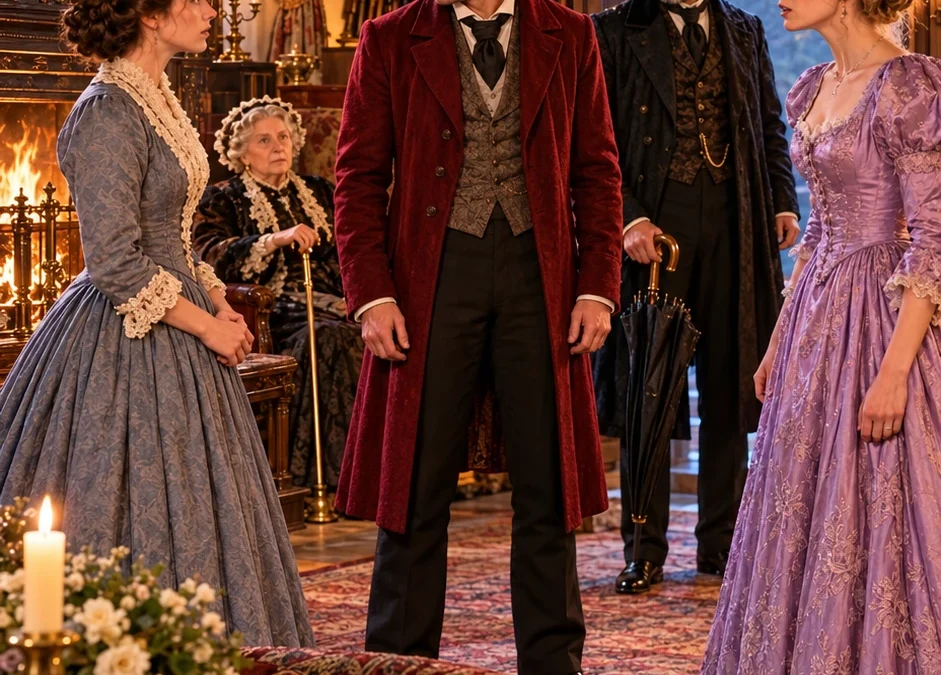
“BE A DEAR AND TAKE THE COATS, ALICE,” HER SISTER SMILED ON HER WEDDING DAY… BUT THE LAST GUEST AT THE DOOR WAS A DUKE, AND WHAT HE DID WITH THOSE COATS EXPOSED A LIE THAT HAD STOLEN HER LIFE 😱
Part 1
“Be a dear and take the coats, Alice,” her sister said. “You’re so good at being useful.”
Cecily said it at the front door of the house on her wedding day, in front of eleven guests. She said it sweetly. She said it with a smile. Then she dropped her own wet cloak into her sister’s arms and walked away down the hall in her white silk dress, laughing at something the vicar had said. 💔
Alice Fenwick stood in the doorway with the cloak in her arms.
It was raining, the kind of September rain that does not fall so much as hang in the air. The guests were coming up the path from the church in twos and threes beneath umbrellas, shaking water from their hats. The maid who should have been at the door was in the kitchen crying, because Cecily had shouted at her about the flowers.
So Alice took the coats.
Gray coats. Black coats. A green shawl with fringe. A gentleman’s cape that smelled of pipe smoke. She hung them on the pegs until the pegs were full, then laid them over her own arm, then over the chair by the door. People said thank you without looking at her. A few said, “Thank you, dear,” the way you say it to a servant. One woman she had known since childhood handed her a wet umbrella and said, “Oh, Alice, I didn’t see it was you.”
Nobody asked why the bride’s sister was standing at the door. Nobody needed to. 😶
Everybody in that parish knew Alice Fenwick had nursed her father for eleven years. Everybody knew he had died in March. And everybody knew that the man her sister was marrying today, Mr. Julian Hart, had once walked Alice home from church every Sunday for a whole year, carrying her prayer book, looking at her as if she were the only woman in the world.
Now he was her brother-in-law. And the house she had been born in, the house she had kept for eleven years, belonged to her sister.
It had happened in six months. And Alice still did not understand how.
Two summers ago, on a warm June evening, Julian Hart had asked Alice to marry him.
He asked her in the garden by the old wall where the pears grew. He was thirty-four then, a quiet, clever lawyer’s son who had just been offered work in the north, managing the farms and lands of a great duke. A very good position. It would take him away for two years.
Come with me. Marry me before I go, and come with me.
Alice wanted to say yes more than she had ever wanted anything. But her father lay upstairs. He had been ill for nine years by then. He could not walk. He could not dress himself. On bad nights, he did not know who she was. Her mother had been dead a long time, and her sister Cecily, only twenty, did not like the sickroom. Cecily said the smell made her faint.
“I can’t,” Alice said. “Not while he’s alive. I can’t leave him.”
“Then I’ll wait.”
“Julian, it could be years.”
“Then I’ll wait years.”
She laughed. She cried a little, too. Then she said the thing she would remember every day for two years.
“Ask me again when he’s gone. Ask me again, and I’ll say yes before you’ve finished the question.”
He kissed her hand. He went north the next week. He wrote every month. She kept every letter in a box under her bed.
She did not know that her sister had been standing on the other side of the garden wall that evening, picking pears.
Cecily had heard every word. 😨
Their father died on a cold night in March, with Alice holding his hand. Near the end he woke, the way people sometimes do, and knew her.
“You’ve been good to me, Ally.”
Then he slept, and a little before dawn, he stopped breathing.
The will was read the week after the funeral. It was an old will, made years before, when he was still well. The house and everything in it would go to whichever of his daughters married first. The other would have a home in it for as long as she lived.
“He was worried that neither girl would ever marry,” the lawyer explained. “He wanted to give you a reason. He was thinking of you, Miss Fenwick. Mostly of you, I think. He knew about Mr. Hart.”
Alice smiled. She was thinking of June, and the pear tree, and Julian coming home in two months and asking her again.
Cecily did not smile. She sat very still in her black dress and looked at her own hands.
Julian Hart came home at the end of May. He did not write first. He wanted to surprise her. He rode up to the gate of the Fenwick house on a bright afternoon with his heart going like a drum.
Alice was not at the gate. She was in the village, paying the last of her father’s bills at the old doctor’s house.
Cecily was at the gate, cutting roses, in a pale blue dress that was not quite mourning. She heard the horse. She saw who it was. She put down her basket.
What Cecily said to Julian Hart took four minutes. Nobody else heard it. Alice would not learn of it for four more months.
With tears in her eyes, Cecily told him that her sister had changed. That the long years in the sickroom had altered her. That when their father died, Alice had sworn on his coffin that she would never marry. Never. That she would keep the house as he liked it for the rest of her life.
“She asked me to tell you. She didn’t have the heart to say it herself. Please, please don’t make her say it to your face. It would break her.”
Julian stood by his horse a long time without speaking.
“I see,” he said, very quietly. “Thank you for telling me.”
He did not come up to the house. He rode back to the inn and did not come out for two days.
On the third day, Cecily walked down to the village in her pale blue dress to see how he was. She went again the next day. And the next. 💔
Six weeks later, Julian came to dinner. He was polite to Alice. Very polite. He did not look at her once. And at the end of the meal, he stood, cleared his throat, and asked Cecily to marry him.
Cecily said yes before he had finished the question.
Alice did not make a scene. She said, “I’m so happy for you both.” She kissed her sister on the cheek. Then she went upstairs, took the box of letters from beneath her bed, and sat on the floor with it in her lap until the candle burned down.
His last letter had come in April. Two more months, Alice. Two more months, and then I’ll ask you again.
And then he came home, and did not ask.
She could think of only one reason. He had seen her in the village. He had seen what eleven years in a sickroom had done. She was thirty-four, with a streak of gray over her left ear she could not hide. Her hands were red and rough from washing sheets. She had forgotten how to dance.
And Cecily was twenty-two, and golden, and laughed at everything.
I don’t blame him, she told herself. Not at all.
The wedding was set for September. And at breakfast, Cecily buttered her toast and said brightly:
“Of course you’ll have a home, Ally. You’ll keep house for us, won’t you? The way you did for Papa? You’d be such a help.”
“You mean as your housekeeper.”
“Don’t say it like that!” Cecily laughed. “As my sister, who happens to be very good at it. And you’ve never been idle a day in your life.”
It was true. Alice said she would think about it.
Then Aunt Mab arrived for the wedding. Seventy-two. Widowed for thirty years, deaf for twenty, armed with four hatboxes and a brass ear trumpet she pointed at people like a pistol.
“Well!” she bellowed in the hall. “Which of you is getting married? It had better be Alice. It’s about time.”
A small, terrible silence.
“It’s me, Aunt,” said Cecily. “I’m the bride.”
Aunt Mab lowered the trumpet. She looked at Cecily. She looked at Alice. She looked at Cecily again for rather a long time.
“Are you? Are you indeed?”
And later, upstairs, she caught Alice by the wrist with a hand like a bird’s claw.
“Last Christmas, you told me there was a young man in the north. You told me you’d promised him.”
“He changed his mind.”
“Did he now?” said Aunt Mab.
She watched Julian all through dinner the way a cat watches a hole in a skirting board.
And on the night before the wedding, in the kitchen at midnight, old Mrs. Tilly said something that Alice could not stop thinking about for a single hour of the wedding day itself… 😳
Part 2
“It should have been you tomorrow.”
Mrs. Tilly had cooked for the Fenwicks for twenty-six years. She had cooked the soup Alice carried up to her father every night for eleven years. At midnight, she sat by the range in her nightcap, and put the kettle on with her back to Alice.
“I’ll tell you something, and then I’ll never say it again. It should have been you tomorrow. Everybody in this kitchen knows it. I watched that young man walk you home from church every Sunday for a year. And I’ve watched him with her all summer. He doesn’t look at her the way he looked at you. Not once. Something’s wrong with it, Miss Alice. I don’t know what. But something’s wrong.”
“He’s chosen,” Alice said quietly.
They drank their tea by the range until the clock struck one.
So now it was the wedding day, and Alice stood at the door with her arms full of wet coats. Behind her, the breakfast had begun. Glasses. Laughter. A spoon tapping for a toast.
She had not been given a place at the table. She had checked the cards that morning. Her name was on none of them. When she asked, Cecily had said, “Oh, Ally, I thought you’d want to be in and out, keeping an eye on things.”
The last guest came up the path alone.
A tall man, perhaps forty-five. No umbrella. The rain had soaked his dark coat and flattened his black-going-gray hair against his head. He walked slowly, as if he were not sure he wanted to arrive.
Alice did what she had done for every guest that afternoon. Before he could even take off his hat, she reached out and brushed the rain from his shoulders. First one. Then the other. Quick and firm, as she had brushed her father’s coat a thousand times.
“There. You’re soaked. Let me take that.”
The man went completely still.
He looked down at her hand on his sleeve. Then at her face. He looked so long that Alice withdrew her hand, cheeks burning.
“I’m sorry. I didn’t mean to be familiar.”
“No.” His voice was deep and rather quiet. “Don’t apologize. Nobody has done that for me in a long time.”
He took off his hat and held it, turning it by the brim.
“You’re not a servant. Then why are you holding eleven coats?”
“Twelve. The green shawl is Mrs. Hope’s. She had a cloak underneath.” She tried to smile. “I’m the bride’s sister. Our maid is crying in the kitchen. Somebody had to.”
“Then you’re Miss Alice Fenwick.” He glanced down the hall toward the toasts, then back. “My name is Henry Lisle. I’ve come from the north. Julian works for me. He’s managed my farms for two years.”
Alice knew the name. Everyone in England knew it. She had read it on the outside of twenty-four letters.
“You’re the Duke. The Duke of Kelbrook.”
“I’m afraid so.”
She had never met a duke. She had certainly never brushed rain off one with her bare hand. “Your grace, forgive me. They’ll have kept you a place at the top table…”
But the Duke of Kelbrook had already hung his own wet coat on the banister. Now he held out his arms.
“Give me half.”
“I beg your pardon?”
“The coats. You can’t hold twelve. Nobody can.”
“Your grace, you can’t…”
“I can. I’ve been holding things for other people all my life. I’m very good at it.”
And he simply took them. Six coats, one after another, laid over his own arm. Then he turned to face the door beside her, as if he were the footman, as if it were the most ordinary thing in the world.
“Now. Who else is coming?”
Nobody else was coming. Nobody told the Duke.
So for ten minutes the Duke of Kelbrook stood in the front hall of a small country house in his shirtsleeves, six wet coats over his arm, beside the bride’s sister. People came out of the dining room to look. First one, then a crowd in the doorway, whispering. A duke. A real duke. Holding coats. 😱
Aunt Mab came out on her stick. She looked at the Duke. At Alice. At the coats.
“Good!” she announced to nobody. “About time somebody had some manners in this house!”
Then Cecily came out fast in her white silk, her veil pushed back, her cheeks bright pink. She saw the Duke. She saw what he was holding. She saw who he was standing beside.
Her face did something Alice had never seen it do.
“Your grace!” She curtsied very low. “Oh, you mustn’t. Alice, how could you let him? Give those to me at once!”
“Mrs. Hart,” the Duke said pleasantly. “Congratulations. I was told the Fenwicks were famous for their hospitality.” He shifted the coats. “I didn’t realize they meant it quite so literally.”
Behind Cecily, somebody laughed and turned it into a cough.
Cecily went from pink to red. “Alice, would you see to the kitchen? I think Mrs. Tilly needs you.”
“She doesn’t,” said the Duke. “I came through the kitchen by mistake. Your cook is sitting with her feet up, drinking your wine, telling your maid she should have been cooking for a different bride today.” He smiled. “She seemed very happy.”
Aunt Mab cackled like a crow.
Cecily turned and went back into the dining room without a word. The crowd parted for her. They did not close up quite as quickly as they had opened. 🔥
An hour later, Alice stood in the garden by the old wall where the pears grew. The rain had stopped. Thin lines of sun came through, and everything dripped. She had not meant to come here. Her feet had brought her.
She knew his step on the path already, strange after one hour.
“You shouldn’t have done that,” she said without turning. “She’ll never forgive me.”
“She’ll never forgive you anyway. I watched her face. She decided not to forgive you a long time before I arrived.”
Alice turned. He stood a few feet away, careful about coming closer.
“Why did you do it?”
He thought before he answered. She liked that.
“For two years, a young man sat at my table three or four evenings a week and talked about a woman called Alice Fenwick. How clever she was. How brave. How she gave up eleven years for her father and never once complained. I came to this wedding because I wanted to see the woman he’d waited two years for.” He looked at the pear tree. “I thought I’d find her in a white dress. Instead I found her at the door, holding twelve coats, while he was inside marrying her sister.”
“He changed his mind. It happens.”
“It didn’t sound to me like a man who would change his mind. It sounded like a man who’d have walked through fire.”
“Then maybe I changed. Maybe he saw what the sickroom had done to me. I wouldn’t blame him.”
The Duke was quiet a long time.
“Miss Fenwick, I’ve been a widower six years. I was married fourteen before that, to a woman who did not like me very much. I’m not a man who notices much about women. I haven’t had the practice.” He turned his hat in his hands. “But I noticed you at the door before you knew who I was. You brushed the rain off me as if I were worth the trouble. Nobody who does that has been ruined by anything.”
He bowed, and went back up the path.
But he did not leave the next morning, as everyone expected. And on the fifth evening, at dinner, he picked up his plate halfway through the soup and walked the whole length of the table to sit beside her… 🥹
Part 3
The wedding breakfast went on until six. Then the carriages came one by one, and Alice handed back every coat in the right order. The green shawl and the cloak beneath it. The cape that smelled of pipe smoke. The umbrella belonging to the woman who had not seen it was her.
Aunt Mab watched from the stairs.
“You could have left,” she said, quietly for her. “At any point this afternoon. You could have put the lot of them on the floor and walked out the door. Nobody would have blamed you.”
“I know.”
“Then why didn’t you?”
“Because Papa always said you finish the job. Whatever it is. Even if you hate it. You finish it, and then you decide.”
“And now it’s finished,” said Aunt Mab. “So what have you decided?”
Alice did not know yet.
The Duke did not leave. He took a room at the village inn and said he had business with Julian about the northern farms. Nobody in the parish believed it for a moment, and everybody talked about nothing else.
On the second day he found Alice in the still room, making quince jelly, and asked if he might sit. On the third, she was digging the last potatoes in the garden. He took off his coat and helped, and was dreadful at it, putting the fork through four potatoes in a row. Alice laughed, then clapped her hand over her mouth, because you do not laugh at dukes.
He did not seem to mind.
On the fourth day, Cecily stopped him in the hall in a new lilac silk.
“You’re so kind to take an interest in my poor sister. But you mustn’t let her bore you. She’ll never marry now, of course. She swore she wouldn’t, after Papa died. She’s devoted to his memory.”
“She swore that,” said the Duke. “To whom?”
Cecily’s smile did not move, but something behind it did. “To all of us. It’s quite well known.”
“Is it?”
He bowed and went into the garden. Cecily stood watching him go. On the landing above, Aunt Mab sat in the window seat with her ear trumpet in her lap, watching Cecily.
On the fifth evening, Cecily seated Alice at the far end of the table, below Aunt Mab, where she could reach the kitchen door. Everyone knew it was deliberate.
The Duke said nothing. Halfway through the soup he picked up his plate and glass, walked the length of the table, and sat down in the empty chair beside Alice.
“The draft at the other end was terrible,” he told the table in general.
Julian looked at his plate. Cecily put down her spoon. Aunt Mab laughed until she had to be patted on the back. 😂
After dinner, he asked Alice to show him the garden by lamplight. Cecily said it was far too cold. The Duke said he was from the north, and this was summer.
At the old wall, the lamp made a small yellow circle on the wet path.
“Your sister told me you swore on your father’s coffin never to marry. Is it true?”
Alice stared. “No. Why would she say that? I never swore anything. I was going to…”
“Going to what?” he asked gently.
She looked at the bare pear tree with its last yellow leaves.
“I was going to marry him. Julian asked me two years ago, here, by this tree. I told him I couldn’t leave my father. I told him to ask again when Papa was gone. I promised I’d say yes.” She pressed her hand against the cold stone. “Then Papa died, and Julian came home, and he never asked.”
“Miss Fenwick. Where were you the day he came home?”
“In the village. I never saw him come.”
“And your sister?” said the Duke. “Where was she?”
Alice turned slowly. 😨
Aunt Mab was waiting on the landing in the dark, wrapped in a shawl.
“Sit down. Here, beside me. I’m deaf. Everybody knows it. And because I’m deaf, nobody lowers their voice when I’m in the room.” She tapped the trumpet. “I’m not as deaf as all that. Not when it suits me.”
“Aunt Mab…”
“Your sister was in the drawing room this afternoon with your brother-in-law. I was behind the screen. They thought I was asleep. He asked her about the Duke. Why he was always with you. He sounded jealous. Not of the Duke. Of you.” She looked straight at her niece. “And your sister said, Don’t be silly, Julian. Alice swore on Papa’s coffin she’d never marry. I told you at the gate.”
Alice did not move.
“And he said, I’ve never asked her about it. Not once. I couldn’t bear to hear her say it. And your sister said: Then don’t. Please don’t ever. It would break her heart.”
The landing was dark except for the moon.
“At the gate,” Alice whispered. “In May.”
“While you were in the village paying your father’s doctor.”
Alice sat looking at the door of the best bedroom across the landing. Her father’s room. Where her sister now slept beside the man who had waited two years for Alice Fenwick, and had been told by the one person he had no reason to doubt that she had sworn never to have him.
“He’s married her. It’s done. It’s too late.”
“It’s too late for that.” Aunt Mab laid her claw of a hand over Alice’s. “But not for you. You’re thirty-four, not a hundred, and there’s a duke at the inn who picked up his soup and walked the whole length of a table to sit beside you. I’m deaf, child. I’m not blind.” 🥹
Alice found her sister in the still room the next morning, searching for rose water. Cecily did not know where anything was kept. She had lived in that house twenty-two years and never opened the cupboards.
“Top shelf. Left. Behind the vinegar.”
Cecily jumped, then laughed. “Oh, Ally, you frightened me. I don’t know how you find anything in here.”
“Cecily. What did you say to Julian at the gate?”
The laugh went out of her sister’s face as if someone had blown out a candle.
“What gate?”
“In May. The day he came home. Aunt Mab heard you yesterday, behind the screen. She isn’t as deaf as you think.”
Cecily’s hand stopped on the bottle. A fly bumped against the window. The kitchen clock ticked through the wall.
Then she turned around, and said it.
“I heard you. Two summers ago, by the pear tree. I was on the other side of the wall. I heard him ask you. And I heard you say, Ask me again when Papa’s gone. So when he came home, I got to him first.” Her voice was quite steady. “I told him you’d sworn never to marry. I told him you’d asked me to tell him.”
“Why?”
Cecily laughed, but there was nothing in it. “Because it was always you, Ally. Papa’s good girl. Papa’s nurse. Everybody in this parish said, Isn’t Alice wonderful? Isn’t Alice a saint? Nobody ever said one thing about me except that I was pretty. And then there was Julian, the only man who ever came to this house who was worth anything, and he was yours, too.”
“He wasn’t a thing to be had.”
“No. He was a person. And in the end, he chose me.”
“Because you lied to him.”
“Because you weren’t there!” Her eyes were very bright. “You were upstairs for eleven years. When you finally came down, it was too late. And whose fault is that?” Her hand shook on the bottle. “If you tell him, you’ll ruin me. You’ll ruin him, too. He’ll have married the wrong sister in front of God and the whole parish, and live with it fifty years.”
Alice looked at her little sister. Cecily had been four when their mother died. Eleven when their father fell ill. For eleven years, she had lived in a house where every ounce of love went up the stairs to the sickroom, and she had never once been asked to carry anything, and never once been thanked.
Alice had never thought about that before. She thought about it now. It did not make what Cecily had done any smaller. But it made it easier to understand.
“I’m not going to tell him. Not for your sake. For his. He made promises in that church, and I won’t be the one to break them for him.”
“Oh, Ally, thank you. You’ll stay, won’t you? You’ll keep the house. It’ll be just the same. I’ll be so much kinder…”
“No.”
Cecily stopped.
“You wanted the house. You have it. You wanted Julian. You have him. You wanted me to hand you your coat at your wedding, and I did.” Alice untied her apron, folded it neatly, and laid it beside the rose water. “But I’m not staying to keep your house, Cecily. Not for one more day. I finished the job. Now I’ve decided.” 🔥
She packed that afternoon. It did not take long. One trunk. Her father’s silver watch. Her mother’s prayer book. A pair of gardening gloves worn through at the fingers. And from the back of the cupboard, behind the winter blankets, the box of Julian’s letters.
She carried it to Aunt Mab’s room. “Will you keep these? I don’t want them. But I can’t burn them.”
Aunt Mab put the box in her trunk beneath the shawls. “I’m going home tomorrow. There’s room in the carriage for two. And a spare room above my house that holds nothing but my late husband’s fishing rods and a very rude bird. You’d be doing me a kindness. Somebody has to feed the parrot. He bites me.”
Alice laughed. The second time in a week.
Mrs. Tilly cried. Then dried her eyes and packed a basket that would have fed a regiment. “I’ve given my notice. Told Mrs. Hart I’m too old to learn a new mistress’s ways. My sister keeps a lodging house in town. I’ll be twenty minutes’ walk away. I’ll bring you soup.”
The maid gave notice that evening. The gardener, the next morning. Cecily stood in the hall in her lilac silk and watched them go, one after another, hands pressed together. There was nothing to say.
The Duke came at ten the next morning. The house stood empty. The still room was locked. The pear tree dripped onto the path. Mrs. Tilly sat on her trunk in the stable yard, waiting for the carrier’s cart.
“Gone, your grace. To her aunt’s in town. The house with the green door and the parrot in the window. The parrot will tell you exactly what it thinks of you.” She folded her arms. “Twenty-six years I’ve been in that kitchen, and I’ve never once seen that girl put herself first. You mind. She’s worth it.”
“I’ll try,” said the Duke of Kelbrook. And he meant it.
The parrot’s name was Admiral. Gray, red-tailed, one bad eye, forty years old. He had belonged to Aunt Mab’s husband, a ship’s purser, and knew every word a ship’s purser might know.
The Duke knocked at four.
“Clear off,” said Admiral. “Clear off, you lubber!”
Alice opened the door with flour on her hands. “I’m so sorry, he’s very old, he doesn’t mean it…”
“He means every word!” Aunt Mab shouted from the back. “I’ve never heard him wrong yet!”
“He may be right,” said the Duke. “May I come in, Miss Fenwick, or has the bird the casting vote?”
He came every day after that. He folded his long legs into a chair far too small for him among the fishing rods and hatboxes, and drank Aunt Mab’s dreadful tea, and talked to Alice as nobody had talked to her in eleven years. As if she had a mind. As if what she thought was worth hearing.
He told her about the north, the rain that came sideways, the stone walls that climbed the valleys for miles. About the school he’d built that no child attended, because it stood too far to walk.
“Then build three smaller ones,” said Alice. “Closer together. Children won’t walk four miles in the rain. I wouldn’t.”
“Nobody has ever suggested that.”
“Nobody has ever had to walk four miles in the rain for you.”
He laughed. The first time she had heard it, a deep, surprised sound, as if it had been kept in a cupboard a long time. Admiral laughed back at him, exactly the same laugh, and the Duke stopped, astonished, then laughed harder. 😂
On the fourth day, Mrs. Tilly arrived with soup and found the Duke of Kelbrook on the too-small chair, holding a skein of wool between his hands while Alice wound it into a ball.
“Well,” said Mrs. Tilly. “I never did.”
“Miss Fenwick says I’m doing it very badly.”
“He keeps moving his hands.”
“I don’t know what else to do with them.”
Mrs. Tilly looked at them both. Then she set down the soup firmly. “Leek and potato. Miss Alice’s favorite. Every Michaelmas since she was six.” She fixed the Duke with a look. “You’ll want to remember that. No pepper.”
“No pepper,” said the Duke gravely. “I’ll remember.”
On her way out, she paused by the parrot’s cage. “That’s the one,” Alice heard her murmur. “You mark my words.”
“Lubber,” said Admiral, rather fondly.
On the sixth day, it was raining. Aunt Mab was asleep, or pretending, in the corner. By the fire, the Duke spoke of his wife.
“Caroline. Our fathers arranged it. She was beautiful and clever, and never forgave me for not being someone else. She wasn’t cruel. Simply cold. For fourteen years we ate at the same table, and I don’t believe she touched my hand a dozen times, except in public.” He looked at the fire. “At her funeral I thought, I don’t know what it is to be cared for. I had never found out. And then a woman I’d never met brushed the rain off my coat at a wedding, without thinking.”
“I did it for everyone,” Alice said softly.
“I know. That was what undid me.”
She knew what he was not saying. She could feel it in the room like a storm before it breaks. And she knew why he held back. He had heard her at the pear tree. He thought she still loved Julian. He was a careful man who had been told for fourteen years, without words, that he was not wanted. He would not step one inch toward a woman who might be grieving for someone else.
On the eighth day, he told her he was leaving.
“My steward writes that the barn roof has come off and the river’s over the bottom meadow. I’m needed.”
“Of course,” said Alice, lightly. She was proud of how lightly. She went to the window so he could not see her face.
“Miss Fenwick. If you ever come north, if you ever want to see the stone walls, or the sideways rain, or the children who won’t walk four miles, there would always be a door open for you. And somebody at it to take your coat.”
She pressed her forehead to the cold glass. Ask me, she thought. Just ask. I’ll say yes before you finish.
He did not ask. He took his hat, said good afternoon to Aunt Mab, who was not asleep at all, and went out. Admiral called him a lubber on the way.
She watched him cross the churchyard in the rain, no umbrella, his shoulders soaked before he reached the gate. There was nobody there to brush them off. 💔
“Well,” said Aunt Mab from her corner. “That was a mess. He was waiting for you to give him a sign.”
“I know.”
“Then why on earth didn’t you?”
“Because I’ve done this before. I told a man to ask me again, and I’d say yes, and I waited two years, and somebody else got to the gate first.” Alice pressed her hands together. “I haven’t got another two years in me.”
Aunt Mab looked at her over her spectacles.
“Then don’t wait. Nobody said it had to be him that asks.”
On Sunday morning, Alice put on her bonnet. She had not slept. By dawn she had decided for good: she would walk to the inn, ask for the Duke of Kelbrook before the landlord and the whole taproom, and not care who heard.
She got as far as the front door.
When she opened it, Julian Hart stood on the step. No hat. Coat buttoned wrong. A man who had not slept or eaten in a very long time.
“Alice.”
Behind her in the window, Admiral opened his one good eye and, for the first time anyone could remember, said nothing at all.
In the parlor, Aunt Mab did not offer to leave. Julian did not seem to see her. He stood among the fishing rods and looked at Alice as if she were a ghost.
“We quarreled last night. About you leaving. About the servants. About the Duke. And she screamed it at me on the stairs. She said, She never swore anything, you fool! She was waiting for you! I made it up. I made all of it up at the gate.” He put his hand over his eyes. “Is it true? Alice, I have to hear you say it.”
The front door opened again. Nobody had knocked.
The Duke of Kelbrook stood in the narrow hall with a black umbrella in his hand. Aunt Mab’s. He had borrowed it on Friday and forgotten it, and had come on his last morning to return it. He saw Julian. He saw Alice’s face. He stopped in the doorway, and did not come in, and did not go away.
And behind him, up the path in the rain, in her lilac silk with no cloak, came Cecily.
She came in past the Duke without looking at him. She stood inside the parlor door, rain dripping from her hair. She looked at her husband. Then at her sister.
“I’ll say it. Don’t make her say it, Julian. She’s never had to say anything in her life.” She took a breath. “Alice never swore on Papa’s coffin. She never said she wouldn’t marry. She never asked me to tell you anything. She was in the village that day paying Dr. Webb. She didn’t know you were home.” Her voice was flat and very clear. “I heard you ask her by the pear tree. I heard her say yes. When you came back, I got to the gate first, and I lied to you. That’s the whole of it.”
Julian sat down on Aunt Mab’s footstool as if his legs had gone. 😶
“Why are you telling him?” Alice asked. “I promised you I wouldn’t.”
“I know. That’s why.” Cecily looked at the floor. “You walked out of that house with one trunk, Ally. Not the silver. Not the pictures. Not Mama’s pearls. Papa’s watch and a pair of old gloves. And every single person who worked there walked out after you. I stood in the hall on Saturday night, and it was so quiet, and I thought, This is what I did it for. This house. And it’s empty.” She swallowed. “I don’t know how to be good. I never learned. You were always the good one. But I know how to stop lying. That much I can do.”
Julian looked up. “You were waiting for me. The whole time. You were going to say yes.”
“I was.” She did not soften it. He had the right to hear it plainly. “Two years ago I would have walked north with you on bare feet. I won’t pretend otherwise. But you married my sister in a church, and I heard the promises. And she has just stood in this room in the rain and told the truth when she didn’t have to. It’s the first brave thing I’ve ever seen her do.” She looked at Cecily. “So you’ll keep those promises, both of you. Not the way it should have been. The way it is.”
“And you?” Julian’s voice broke. “What about you?”
Alice turned her head.
The Duke still stood in the doorway, the dripping black umbrella in his hand. He had not moved or spoken. He was looking at the wall very carefully, as if he had no right to be in the room at all.
“I don’t love you now, Julian,” Alice said, still looking at the doorway. “I did. I stopped. I didn’t notice when. I think it was somewhere between a pear tree and a coat.” 🥹
Before the hired carriage took them away, Julian stood stiffly in Aunt Mab’s hall, like a lawyer’s son. The house had become his when he married Cecily, he said. He would not live in it now. He would have it signed over to Alice, every stick and stone, before the week was out.
“I don’t want it.”
“I know you don’t. That’s exactly why it should be yours.”
Cecily stopped at the door. “Ally. At the wedding. The coats.” She swallowed. “I’m sorry.”
Then she went out to the carriage.
Aunt Mab rose with a great deal of groaning and fuss with her stick. “I’m going to the back room to lie down for a very long time. With the door shut.” She plucked the umbrella from the Duke’s hand as she passed. “Thank you for bringing it back, your grace. You can go in now. I’m sure she won’t bite. That’s the parrot’s job.”
The door closed.
The Duke stood in the parlor doorway. Alice stood in the middle of the room. He still did not come in. She understood. He had heard her say she once promised another man she would say yes. He had heard her say she did not love that man now. But he had not heard her say anything about him. And he was a careful man who had been cold for a very long time, and would stand in that doorway until the carriage came to take him north rather than take one step she had not asked for.
So she did not wait to be asked.
She crossed the room herself. Six steps. She had never walked six steps that felt longer.
She stopped before him. His coat was wet across the shoulders again. He had walked from the inn in the rain with an umbrella in his hand and never thought to put it up.
Alice reached up and brushed the rain from his shoulders. First one. Then the other. Slowly this time. Not the way she did it for everyone.
He did not move. She felt him not move. She felt what it cost him.
Then she laid her hand flat against his cheek and made him look at her.
“Henry.”
It was the first time she had said his name. He closed his eyes as if it hurt.
“I’ve waited at a window for someone to ask me before. I’m not going to do it again. So I’m asking you.” She took a breath. “Take me north. Show me the sideways rain. Let me build you three small schools instead of one big one. And let me be the one who stands at the door.”
He opened his eyes. “Alice.” His voice was not steady at all. “I’m forty-six. I don’t know how to be cared for. I told you, I never learned.”
“Then I’ll teach you. I’m very good at being useful. Everybody says so.”
And she rose on her toes and kissed him.
For one second he stood perfectly still, the way he had stood still for fourteen years in a cold house. Then something in him gave way all at once. He dropped his hat. He put both arms around her and held on as if she were the only warm thing in all the north of England.
In the front window, Admiral cleared his throat, the way the old purser used to before a toast.
“About time,” said Admiral. 💍
The house came to Alice in October, signed and sealed. She never lived in it. She gave it to Aunt Mab and Mrs. Tilly for as long as either lived. Aunt Mab moved in with her four hatboxes, her brass ear trumpet, and Admiral, who took one look at the drawing room and called it a lubber. Mrs. Tilly moved back into her kitchen, and her knees improved at once. They quarreled every day. They were perfectly happy.
Julian and Cecily went to London, where Julian did well, quietly. Cecily wrote to Alice at Christmas, a short letter. Again at Easter. Again in summer. Each a little longer than the last. In the third, she wrote: I have learned where the rose water is kept. I thought you would want to know.
Alice kept that one.
They were married in December, in the little church across from the house, in the snow. Not a grand wedding. Alice would not have one. Perhaps forty people. Mrs. Tilly made the breakfast. Aunt Mab gave the bride away, because there was nobody else, and because she said she would hit anyone who tried.
The old guests came up the path from the church in twos and threes, stamping snow from their boots. And at the front door of the house, they found somebody standing to take their coats.
The bridegroom.
The Duke of Kelbrook stood at the Fenwick door in his wedding coat and took every coat and cloak and shawl himself. He hung them on the pegs. When the pegs were full, he laid them over his own arm. He brushed the snow from every pair of shoulders, the way his wife had once done for him.
People stared. Then people smiled.
Then Mrs. Hope came up the path, the woman who had once handed Alice a green shawl with a cloak beneath it and never looked at her face. She saw who stood at the door and stopped dead in the snow.
“Good morning, Mrs. Hope,” said the Duke. “May I take your shawl, and the cloak underneath it?”
Mrs. Hope gave them up without a word and went inside very pink.
The last to arrive were Mr. and Mrs. Julian Hart, from London. Cecily stopped at the foot of the steps in a heavy gray traveling cloak, snow on the hood. She did not seem to know what to do.
The Duke came down to meet her. He lifted the cloak from her shoulders himself and shook off the snow. Then he held out his arm.
“Mrs. Hart. Your sister is inside. She’s been watching for your carriage since eight.”
Cecily took his arm. Her eyes were very bright. She did not need to say anything. 🤍
At the drawing room window, Alice watched him do it all. The coats. The shawls. The snow on shoulders. Her sister on his arm. Aunt Mab came and stood beside her, leaning on her stick.
“Would you have stayed that day at the door, if you’d known what was coming?”
Alice thought of the wet coats and the green shawl and the umbrella and the pegs that filled up too fast. She thought of a tall man coming up the path alone with no umbrella, walking slowly, as if he were not sure he wanted to arrive.
“Yes,” she said. “Every minute of it, if it meant he’d come up that path.”
They went north in the new year. It rained sideways, just as he had said. The stone walls climbed the valleys for miles. The house was very big and very cold, and nobody had cared for it in a long time.
Alice changed that. She opened the shutters. She lit the fires. She built three small schools instead of one big one, and the children walked to all three, even in the rain.
And every evening, when her husband came in from the hills with the weather on his shoulders, she was at the door. She took his coat. She brushed the rain off him. First one shoulder, then the other.
He never got used to it. Not in thirty years. Every single evening he stood perfectly still and let her do it, eyes closed, like a man standing in the sun. ✨
Tell me in the comments: have you ever been the one who always carries the coats? And share this story with someone who deserves to hear “thank you” today. 👇
This story is entirely fictional and created for entertainment purposes only. It does not represent any organization or individual, nor does it encourage inappropriate behavior. The content was generated with AI assistance.








