Buried Alive Up To Her Neck For Four Days, She Expected Death… Then A Widowed Cowboy Dug Her Out, And The Secret She Carried Could Bring Down The Most Powerful Man In Arizona
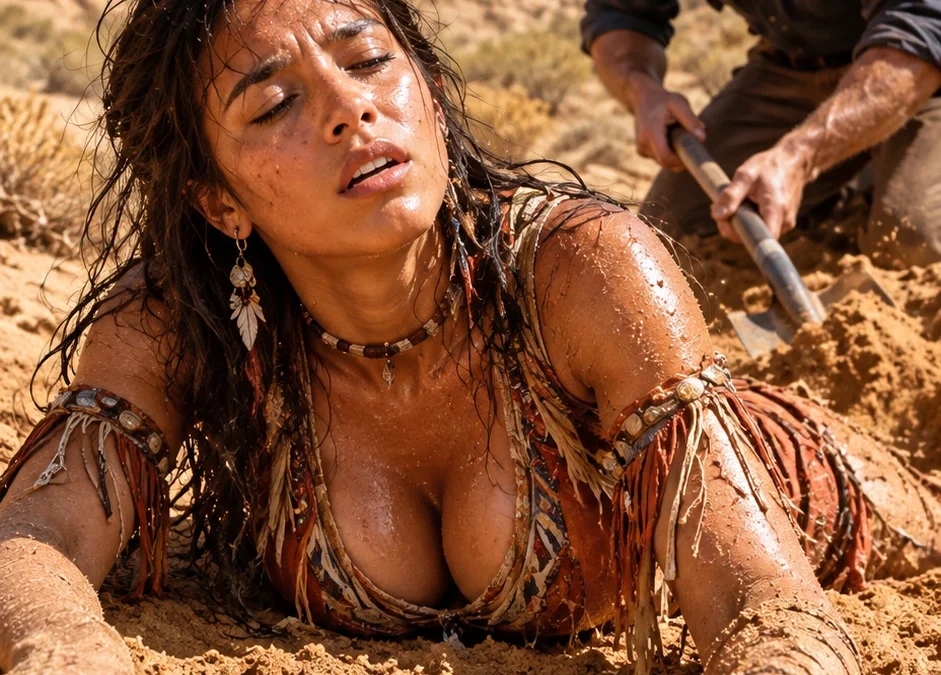
Buried Alive Up To Her Neck For Four Days, She Expected Death… Then A Widowed Cowboy Dug Her Out, And The Secret She Carried Could Bring Down The Most Powerful Man In Arizona 😱
Part 1
The earth did not give her up easy.
Four days it held her, packed hard around her ribs and hips beneath the white Arizona sun.
Buzzards turned low over the wash. Not hunting. Just waiting. 🦅
A rider on a roan horse stopped at the rim. He smelled it before he saw the black hair spilled across the cracked ground like ink. Then the face. Eyes cracked open, watching him.
A flat wooden sign hung from her neck on a rawhide cord. Apache words, carved deep. A sentence the earth had been ordered to keep.
Two warriors stepped onto the ridge above, one arrow already drawn.
The rider swung down anyway.
Wade Hollister had lived in this country long enough to stop arguing with the sun.
He was forty, though he did not feel it. He felt like a man who had been left out too long and had dried into the shape he happened to be standing in. Not broken. Just fixed.
His ranch, Dry Mesa, was seventy acres of hard earth at the foot of a ridge the old-timers called Widow Ridge, because the rock at the top bent forward like a woman bowed under a heavy load. Most mornings, Wade looked at it and thought, Yeah. I know how you feel.
His coffee was bad. It was always bad. He knew that his late wife, Clara, would have fixed it in thirty seconds and had opinions about it.
He did not think about Clara. Five years of practice.
He had fourteen head of cattle, a big roan named Sergeant with the calm of a man who had made peace with most things, and a mule named Abner who had opinions about everything and expressed them through pointed silence. His neighbor, seventy-one-year-old Pete Callaway, rode over twice a week on a horse as old as the territory and considered himself a man of few words.
On the twelfth of July, Wade rode east toward the trading post at Red Fork, crossing the pale dry basin. Then Sergeant stopped.
Not the stop of a thirsty horse. The other stop. The one that said something here has ended badly.
Seven buzzards circled low and patient to the northwest. Low meant waiting.
Wade nudged Sergeant toward the wash. He smelled it first. Then he saw black hair against the cracked dirt, and below it, a face.
A human face, baked red, lips split. Around her neck, a carved wooden sign.
And the eyes were open.
They did not plead. They measured. As if she were adding him up and deciding which column to put him in. 😳
He knelt and tilted his canteen to her lips. She drank slowly, each swallow deliberate, never looking away.
“How long?”
“Four days,” she said, in English.
Wade blinked. Something adjacent to a smile touched her cracked mouth.
“I am full of surprises,” she said, her voice like gravel dragged over rock. “Get me out of here.”
He pulled his knife. An arrow hit the dirt an inch from his knee.
Two Apache warriors on the ridge. Eight years of cavalry and twelve years alone had made his reflexes into something beyond decision. He rolled, drew his Colt, and came up behind a boulder.
They were not shooting to kill. The arrow was a warning. They were guarding what their people had decided was a lawful sentence, and he had no wish to kill men doing what their world required.
But the woman in the ground was breathing.
He fired wide, deliberately. They answered wide, deliberately. A standoff, and the woman still buried.
So he holstered the Colt and dug with his knife and bare hands. The earth was packed hard. This had not been done carelessly. Someone had taken time. Someone had made sure.
Another arrow struck two feet away. He fired twice at the rock face to buy six seconds, then dug again. Her shoulders came free. Her chest. Her hips. He got his hands under her arms and pulled.
She was light as something emptied out. Her legs would not hold her. She gripped his forearm with surprising firmness and helped him move her.
He got her onto Sergeant, climbed up behind, one arm around her.
“Hold on.”
“Obviously,” she said.
They came out of the wash at a full gallop with three arrows cutting the air behind them. 🐎
He did not know yet that the men on the ridge had been posted there on purpose. That someone had anticipated interference and planned for it. That the woman against his chest carried knowledge that would change everything.
He just rode.
That night, she told him her name. Chenoa. She told him what the sign said: Barren woman. Cursed. Return her to earth. Four years married to a war leader named Koda, three years of drought, and a medicine man named Absaloka who had looked at her and seen something useful.
And at dusk, three riders came up the trail. At their head sat Harlan Briggs, owner of eleven thousand acres and the most powerful cattleman in the territory, who had already made Wade three offers for his creek.
He had not come about the offer.
💬 Part 2 is waiting in the comments! Can’t find it? Leave any word below and I’ll send it to you privately.
Part 2
Briggs stopped at the fence, white-haired, his suit coat pressed even in July heat.
“Hear you have had some excitement today, Hollister.”
“Supply run to Red Fork.”
“Word reaches Red Fork fast. Somebody saw you ride out of the basin with something across your saddle.” He said it without embarrassment. “I have people in most places. The Apache woman is on your property now. Her people will want her back. You have put yourself between a white rancher and Apache law, which makes the territorial marshal very uncomfortable. I can smooth that over. For a consideration.”
“The creek.”
“The water rights, at minimum.”
“Get off my land.”
Briggs smiled, patient and cold. “Sleep on it.”
He rode away. Inside, Chenoa had watched from the shadow of the back room. She told Wade what she knew.
“Koda will come. Not because he wants to. Because honor leaves him no choice.”
And more. Briggs had been quietly negotiating with Koda’s band for a year, trading water access for cooperation in the basin, pressuring small ranchers until they sold. Wade’s creek was the last piece.
“If anyone pulled me out of the ground, Koda was to be told within hours. Briggs came here to confirm you had me, so he could send word north tonight.”
“Before I found you,” Wade said.
“Before you found me,” she said. “You were made into a problem he already had a solution for.”
Later that week, Pete rode in with news. Briggs had filed a basin-wide claim on water rights back in April, three months before Chenoa was ever buried. The fence-line offer had been theater. Briggs needed Wade distracted while the deadline for a counterclaim ran out.
“I need to file,” said Wade. “Five years of continuous use and documented improvements.”
“Red Fork opens at eight,” said Pete.
Over the next days, Wade taught Chenoa to hold the spare Remington. She taught him to read dust signatures and tell one rider from three, and which plants along the creek healed infection. Her tea was better than his coffee. She swept his floor without being asked. And one afternoon she said, quietly, “Does it matter to you that I have no children?”
Wade thought of Clara, and the two pregnancies she had lost, and the blame he never said aloud.
“No. It does not matter to me.”
“All right,” she said, and filed it, and moved on. 💔
On the seventh day, seven riders appeared on the ridge. Koda rode down alone and stopped twenty feet from the yard.
“You took the woman.”
“I found a woman dying in the desert. And you know who arranged that sentence, and what he arranged it for.”
Something moved behind Koda’s eyes.
The cabin door opened. Chenoa walked out, straight and unhurried, the Remington at her side, not raised, not hidden. She spoke in Apache, low and steady. Wade understood none of the words, but he understood the shape of it. Not a plea. A verdict.
Koda listened. His face changed twice. Then he turned his horse, said one word, and the riders vanished over the ridge.
Two nights later, past midnight, Abner stopped moving in the corral. 😨
Wade was at the window before he was fully awake. Five men in the dark. Not Apache. Briggs’s men, closing from three sides on the cabin where Chenoa slept.
But he had moved her three days ago to the small larder behind the kitchen. Nobody looked in the larder.
What happened next took less than three minutes, and it was nothing like the stories men told in saloons.
💬 Want to know what happened in the dark, and the secret Chenoa finally revealed? LIKE or COMMENT “REVEAL” to unlock Part 3! It will be posted as soon as we have enough comments. 🔥
Part 3
The man at the east window got it halfway up. Then Chenoa slammed it down on his wrist from the inside, and he got the sound of the Remington from three feet away. She aimed for his shoulder and hit his shoulder. He went down and stayed down.
Wade came through the front door as two men broke from the barn. He took the first with a rifle stock across the jaw. The second caught him with an elbow that turned his vision white, and he dropped to one knee.
And Abner kicked the man in the ribs.
It was not a small kick. It was a mule’s back legs, applied with a mule’s conviction, and the man’s air left him all at once. The last two men rounded the corner, saw three of their own down, saw Wade with his rifle steady, and did the math. They were gone back into the dark.
Abner looked at Wade from the corral with an expression that said you are welcome. 🫏
Chenoa cleaned the cut on his forearm at the kitchen table.
“You aimed for the shoulder,” he said.
“I know where I aimed.”
“Could you have aimed elsewhere?”
“Yes.” She tied off the bandage. “Things that are not necessary cost something, even when they seem free.”
Three days later, standing at the window, she told him what she had not yet told him.
The night before the burial, she had walked to the edge of camp and overheard Absaloka and Briggs. Briggs had offered a written guarantee of permanent access to the western springs, enough water for the band through any drought, in exchange for one thing: Absaloka formally pronouncing her death sentence. The band needed the water. Absaloka needed to keep his position. And Chenoa was the cost.
“How long have you carried this?” Wade asked.
“Since that night.”
Four days in the ground, knowing. Fourteen miles on a horse, knowing. Sweeping his floor, learning to shoot, writing down everything she knew.
“Why did you not tell me?”
“Because I needed to know what you would do with it. Whether you would decide it made things too complicated and hand me over to make them simpler.”
He thought of the measuring eyes in the basin. Of what it cost to hold something that important and not know whether the person you handed it to would use it for you or against you.
“Is that still a question?”
She held his gaze. “No. It is not.”
They needed someone Koda trusted to carry it. “Pete Callaway,” they said together.
Pete listened on his porch without interrupting. When Wade finished, he looked at his coffee. “I had a quiet winter planned.” Then, after a pause: “I will ride at first light.”
He came back two days later. Koda had read the papers and gone still. He asked one question. Is she alive?
Then he called Absaloka before the whole band and asked him directly whether he had made an arrangement with a white rancher. Absaloka denied it. But Koda held the document, and the denial looked like exactly what it was.
Koda suspended the sentence. When Absaloka claimed Koda had no authority over spiritual matters, Koda answered, “When spiritual matters become transactions, they become mine.”
Absaloka left that night with three men. 😮
Briggs, who had people in most places, knew his Apache side had collapsed. And men like Briggs pushed harder on the parts that still worked.
The next morning, a rider brought bad news. The Garner barn had burned. The family was safe. And Deputy Marshal Cole was in the territory with a writ to take Chenoa into custody, based on Absaloka’s sentence, the one Koda had suspended but not yet revoked.
Forty-eight hours.
The plan was desperate. Wade would file the water counterclaim the moment Red Fork opened. Koda’s suspension had to become a formal revocation, notarized and in Cole’s hands before the deadline. Chenoa rode Sergeant to Pete’s at midnight. The big roan decided about her in the first mile.
Wade filed at five past eight. Pete came that afternoon with news. Koda had already written the revocation before Pete arrived. And fourteen families would file jointly against Briggs.
Briggs had built his strategy against individual challenges. Fourteen families with a barn burning behind them was a federal matter. 🔥
That night, they sat at the kitchen table with tea.
“Tell me about the war,” she said.
He told her about scouting. Reading ground. Knowing what was coming. Sometimes right, sometimes wrong, and living with what you got wrong.
She told him about the night before the burial. Not what she overheard. Before that, sitting by the fire, realizing she had spent four years trying to fit a shape that was rigged not to fit her.
“We have both been trying to fit things that were not built for us,” Wade said.
“Yes,” she said.
And they sat, not trying to fit anything, which was considerably more comfortable.
Cole arrived at dawn on the last day with four men.
Wade stood in the yard with his rifle across his arm. Pete Callaway stood on his left with a shotgun. Beside him, the Garner brothers. Old Walt Beal at the fence like a feature of the landscape. Twelve men. Twelve rifles.
Cole counted. It took four seconds.
“Hollister. You are under writ.”
“The writ’s jurisdictional basis was Absaloka’s sentence.” Wade held up the paper. “Koda, war leader of the band that issued it, has formally revoked it. Certified by the territorial court in Santa Fe. The basis for your writ no longer exists.”
Cole read it. He was doing different counting now. Legal arguments. Files kept by careful people in offices. What happens to a deputy marshal who executes a writ with no legal basis in front of twelve witnesses.
“This is not finished,” Cole said.
“I know. But it is finished today.”
Cole turned his horse and rode out at the same controlled trot he had arrived at. ✊
Chenoa had stood in the cabin doorway the entire time. Not hidden. Not inside. The doorway, where she could see the yard and be seen. Their eyes met. Neither smiled, but something passed between them that was better.
“You do not always win the fight,” she said afterward, “but you make the record, so the next fight has somewhere to stand.”
That afternoon, Koda came alone. He told Wade the sentence was revoked. She could return, her standing restored. Wade said nothing, because it was not his answer.
“I knew,” said Koda quietly. “Not about Briggs. But Absaloka is never certain. Certainty in him meant something had already been decided that should not have been. I told myself it was tradition. I chose to believe that because the other choice was harder.”
“You failed her,” said Wade. Not cruel. Just true.
“Yes. I did.”
“You can tell her yourself.”
She walked out to the fence. Wade went to the south fence and turned his back and watched the creek. He heard their voices, low and continuous, covering a lot of ground. Not arguing. Something harder and quieter.
When she came to stand beside him, he did not turn.
“He apologized. Honestly. Which is rarer than good.”
“Are you going back?”
She looked at the creek, the south pasture, the garden she had planted against the cabin wall. “I know who I was there. I do not know who I am now. Not today. I do not have to decide today.”
“No,” he said. “You do not.”
Briggs went quiet, which was not the same as gone. The joint filing reached Santa Fe. Pete rode there himself, knee complaining, and came back satisfied. His lawyers challenged the standing, which buys time but does not win.
October came. The Garner barn went up in six days, rebuilt by the whole community. Chenoa and Mabel Garner laid the floor together and agreed on nothing and got along perfectly.
“You planning to stay?” Mabel asked at the saw table.
“I was buried in the ground three months ago,” said Chenoa. “I am working on one thing at a time.”
Mabel Garner laughed, a sound her son had not heard in fifteen years.
A letter came from Koda: discussion had started in the band about what authority a medicine man should hold. It was not finished, but it had started. Chenoa’s letters to the women of the band had planted something. And Koda offered a place if she chose to return, not as his wife, but as herself.
“It is possible there,” she told Wade. “I believe him. It is also possible here.”
In November, she carved her name on the door beneath his. Four minutes. She had practiced the letters on paper for a week, because if you put your name somewhere, the letters should be right. 🏠
In December, by the fire, Wade said what he had been carrying.
“I came out here five years ago to stop feeling things. I did a reasonable job of it. I am not telling you to stay. That is always your decision. But this place is different with you in it, and I am different, and I had stopped thinking that was possible. I was wrong, and I do not say that often.”
She looked at the fire a long moment.
“In the ground, I made a decision. Not with God. Not with tradition. With myself. That if I came out, I would never again live in a way that did not fit.” She looked at him. “This fits. I do not know exactly what that means yet. But I am not walking away from something that fits.”
And that was enough for now.
By April, the creek ran honest and generous. Briggs dropped the water challenge. The basin claims were voided. The joint filing stood in the record, and so did the barn burning, and records do not go away.
“Pete got onto the Red Fork Town Council,” said Chenoa, handing Wade a carved pine cup of coffee she had made herself.
Wade laughed. The real one, not the almost one.
And she laughed too, fully, the sound of a woman who had waited a long time for the moment to arrive. Abner watched from the corral with something adjacent to approval.
“What are you thinking?” she asked.
“East field needs reseeding.”
She gave him the look that meant I have catalogued every evasion you use.
“That I am glad I rode past those buzzards.”
“So am I,” she said. “Now go fix your fence.”
There is a ridge above Dry Mesa the locals call Widow Ridge, because the rock at the top bends forward, heavy-shouldered, head down. Wade looked at it for five years and recognized something in himself.
He looks at it still, every morning. But now he thinks maybe she was never bent under a weight. Maybe she was bent toward something. Watching over it. The way you bend toward the things that matter.
Inside the cabin, two carved cups sit on the windowsill. On the door, two names, each carved by a different hand.
It is not what either of them had before. It was never supposed to be. It is what came after the ground, after the loss, after the years of existing instead of living.
Most mornings, that is enough. ❤️
💬 If this story touched your heart, tell us in the comments: which moment gave you chills? Wade pulling her from the ground, Chenoa walking out to face Koda, or Abner’s legendary kick? Like and share this with someone who needs to know that what comes after can be enough. 🙏
This story is entirely fictional and created for entertainment purposes only. It does not represent any organization or individual, nor does it encourage inappropriate behavior. The content was generated with AI assistance.








