Chained to a Tree at Dawn, She Told the Cowboy to Leave… He Picked Up a Chisel Instead. Then the Outlaws Came Back.
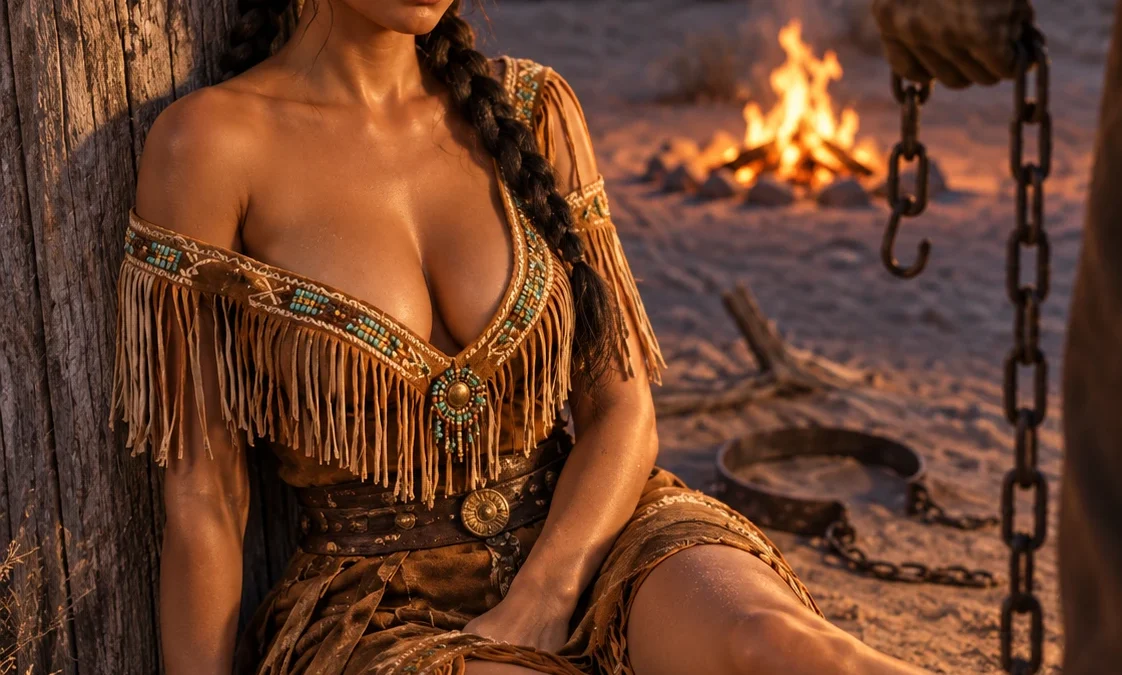
🔥 Chained to a Tree at Dawn, She Told the Cowboy to Leave… He Picked Up a Chisel Instead. Then the Outlaws Came Back. 🔥
PART 1
Chained to a cottonwood at dawn, Nayeli waited for the outlaws to come back and finish what they had started.
She could not have guessed that the lone cowboy about to cross into her canyon would make a choice that decided whether she lived free or died in iron. Nor that it would cost both of them everything the frontier believed about courage, debt, and who a person is allowed to belong to.
The canyon sat forty miles north of the Gila, a crooked seam of red rock that trapped the night’s cold against the stone long after the sky had gone gray. Wyatt Calloway had been riding since before first light, chasing strays that had wandered off his line camp two nights back. He almost rode past the sound entirely.
It was small. A dry click of metal against stone. A pause. Then the click again, patient and steady, like someone testing a lock they already knew would not give.
He was twenty-six that spring, six years into cattle work on a spread along the river bottoms. He was a man more at home with horses than people, and careful the way men get careful when the country has taught them that carelessness gets a body killed. He had grown up in Missouri and come west after his father’s farm failed. Nothing in that flat, fenced-in boyhood had prepared him for a land this wide and this quiet, a land that could hide a person’s whole fate behind one shoulder of rock.
Settlers pushed their fences a little further west every season. Army patrols came through twice a year making promises that rarely outlasted winter. The Apache bands who had lived in these canyons since long before any of it had learned, hard and repeatedly, that a treaty written in a fort office meant very little once it reached open country. Wyatt had grown up on bunkhouse talk about raiders and savage country, the kind that made a man’s world smaller without him noticing. He had never once asked himself how much of it he believed.
He reined in behind a shoulder of boulders and listened a long moment before swinging down. Curiosity killed more cowboys than rustlers did. For a breath he thought about riding wide and pretending he’d heard nothing.
Then the click came again, and under it, so faint he almost missed it, a woman’s breath. Even and controlled, the breathing of someone working hard not to make any other sound.
He came around the boulders slowly, one hand on his rifle stock, and stopped cold.
A young Apache woman sat with her back against a cottonwood. Her wrists were chained in front of her and her ankles chained together. An iron collar circled her throat, fixed by a short length of chain to the trunk. Her deerskin dress was torn at one shoulder and dusted with canyon dirt. A raw, chafed line circled each wrist where the iron had bitten through the night.
She was not crying. She was not straining against the chains. She was watching the sun come up over the canyon rim as if she had chosen to sit there.
Her name was Nayeli. She had spent the night counting stars instead of praying for rescue, tracing the shapes her grandmother had taught her, making herself small and still and patient rather than wasting strength on chains that wouldn’t move for wanting. Fear had come in waves through the dark hours, but she had not let it settle. Fear given too much room only helps the men who put it there.
“You should leave.”
Her voice was even, almost gentle, as though warning him off were a kindness.
He hadn’t expected English, clean and unaccented, and something in his face must have shown it. The corner of her mouth moved, not quite a smile.
“My father wanted me to learn the trader’s tongue. It keeps a person alive longer than a rifle does, most days.” Then she added the rest, plainly, the way a person reports a fact. “The men who did this will be back before the sun clears the ridge. If they find you here, they will kill you for what you are about to do. And they will do worse to me for wanting you to do it.”
She told him quickly, not for comfort, but because she judged he would move faster with the full shape of the danger in front of him. Two evenings ago a party of men calling themselves horse traders had ridden into her family’s grazing camp, offering good prices and better whiskey. By the time anyone noticed two mares missing, the traders were gone. Nayeli had ridden out alone at dusk to check a broken fence line and ridden straight into four of them waiting in the rocks.
They weren’t traders. They ran stolen horses south to buyers who didn’t ask questions. A captured Apache woman, they had decided, made good insurance against pursuit and better sport than horses did. They had chained her to the cottonwood and ridden off before dawn to scout the trail south, confident no one would look for her in a canyon that belonged to nobody.
Wyatt was already crouched at the base of the tree, running his hand along the chain to find the anchor. “How long ago?”
“Before first light. They could return any minute.”
He pulled a hammer and cold chisel from his saddlebag, tools he carried for loose horseshoes and had never imagined using on manacles, and set the edge against the first rusted link.
“If they come while you work, they will kill you before the second lock opens.”
He didn’t look up. “Then I’d better work fast.”
For the first time since he’d rounded the boulders, something shifted in her face. Not surprise. A small recalculation, as if she had expected him to argue about the danger and was adjusting for a man who agreed with it and kept working anyway.
The chisel bit into the rusted iron slower than either wanted. He kept the strikes short and sharp so the sound wouldn’t carry. Nayeli held her wrists steady without being asked, without flinching when a strike landed close to skin. Somewhere in that working silence she told him her name wasn’t owed to him yet. Names were kept for people who had earned the right to use them.
He didn’t argue that either.
The wrist chains fell first, link by rusted link. Then her ankles. The collar was last and hardest, its lock fused nearly solid by rust and weather. When it finally sprang open and dropped in the dirt, Nayeli stood in one smooth motion, rolling her shoulders back, rubbing the raw line at her throat. She didn’t thank him. She looked at the broken chain coiled in the dust like a shed skin.
“No one owns me.”
It wasn’t aimed at him. It was aimed at the chain, and at the men who had put it there, and at whatever idea had let them believe they ever could.
Wyatt was still gathering his tools when the first sound reached them: the drum of hooves on hardpack, coming up the canyon from the south. Four riders, moving at a pace that said they weren’t simply passing through.
Nayeli went still in a different way than she had against the tree. Every part of her narrowed onto the sound.
Four riders came around the canyon bend and reined up hard at the sight of the empty chain and the broken collar lying in the dirt where their captive should have been.
💬 Part 2 is waiting in the comments! Can’t find it? Leave any word below and I’ll send it to you privately.
PART 2
Four riders came around the canyon bend and reined up hard at the sight of the empty chain and the broken collar lying in the dirt where their captive should have been.
Nayeli had already moved. “They are early,” she breathed, slipping toward the rocks at the canyon wall. Wyatt followed without arguing, pulling his horse’s reins behind him. She found a shelf of stone barely big enough to hide both of them and the horse, if the horse stood perfectly still, and they pressed into it as the outlaws split up. Two rode wide along the canyon floor. Two dismounted to search the brush near the cottonwood on foot.
Their leader was a lean man in a gray duster, Silas Crane. He stood in his stirrups scanning the walls with the flat patience of a man who had hunted people before and knew patience, more than speed, won in the end.
Wyatt’s hand found his rifle and began to bring it up. Nayeli’s hand closed hard over the barrel and pressed it back down. Her grip was surprisingly strong for someone who had spent the night in chains.
“If you fire, every man down there will know exactly where to look. We move, or we die here.”
She led him not toward the canyon floor but up, along a game trail so narrow and overgrown he would have ridden past its mouth a hundred times without seeing it. It climbed the wall at an angle that seemed too steep for a horse. She sent his horse ahead on a loose lead, trusting the animal to find its own footing, and they scrambled up the loose shale behind it with their hands as much as their feet.
They were three-quarters of the way up when a shout went up from below. An outlaw on foot had spotted movement on the ledge.
A rifle cracked. Then another. The reports were flat and huge in the enclosed canyon, and rock chips sprayed off the wall inches from Wyatt’s shoulder as he hauled himself over a lip of stone and reached back for Nayeli’s hand. She took it without hesitation, without wasting half a second on surprise, and came up beside him.
They ran the ledge in a low crouch, the trail barely wide enough for one body, gunfire chasing them in ragged bursts that never quite found their range. The wall dropped away sharply on their right. Nayeli moved along it with a sure-footedness that told Wyatt this land was hers in a way it would never be his, not if he rode it the rest of his life. Twice she caught his sleeve and pulled him wide of a crumbling edge he would have trusted his weight to a moment too late.
It struck him, even in the middle of it all, that she wasn’t running blind out of panic. She was running the way a person runs when they have decided, calmly and completely, to survive the morning. Every choice she made along that ledge served that one decision.
Behind them, Crane’s furious orders drove his men on. Boots scrabbled on shale, closer than Wyatt liked.
The ledge ended at a ravine, a raw gash in the rock thirty feet across with a river running fast and white far below. The only way over was a single fallen pine, its trunk stripped bare by weather, spanning the gap at an angle that made Wyatt’s stomach drop.
Behind them, individual voices carried now.
He sent his horse scrambling down a lower switchback alone, unwilling to trust the animal’s weight to that trunk. Then he turned to the pine. “I’ll go first. Test it’ll hold.”
Nayeli didn’t argue, which told him more than words could have about how little time was left.
He went out at a careful crouch, arms spread, feeling the wood flex and creak, the river roaring loud enough to drown his heartbeat. He reached the far side and turned, already reaching back.
“Now. Quickly.”
She started across, faster than he had, sure-footed even on the bouncing wood. She was two-thirds over when Crane and his riders broke onto the ledge behind her and opened fire.
A shot took a chunk out of the trunk inches from her foot. The old wood, already strained past what it should have borne, gave way with a crack that echoed off both walls at once.
She dropped.
One hand caught the splintered end of the trunk. Her body swung out over the churning river, feet finding nothing but air, and for one long, terrible second the only thing between her and the rocks forty feet down was her own grip on rotted wood that was already cracking.
Wyatt threw himself flat at the edge and caught her wrist just as her fingers failed. The whole world narrowed to his hand locked around her arm and the river screaming beneath her boots.
“I have you.”
The words came through his teeth. But the loose rim was giving way under him inch by inch, and both of them were sliding slowly toward the drop. His arm burned. His fingers began to slip against the sweat and blood on her skin.
For one terrible instant he knew his strength alone would not be enough.
💬 What do you think happens next? Will one cowboy’s grip be enough, or is help already on its way? LIKE or COMMENT “REVEAL” to unlock Part 3! It will be posted as soon as we have enough comments. 🔥
PART 3
It was not his strength that decided it.
Above them, a dozen mounted shapes crested the far rise at a dead run. In a few heartbeats a weathered hand closed around Nayeli’s other arm, and then another. Between them, Wyatt and three Apache warriors hauled her up over the broken lip of the ravine and set her down on solid stone.
The rider who reached her first was an old man, spare and straight-backed, with the bearing of someone whose authority needed no announcing. Nayeli looked up at him from the ground, still catching her breath, and something in her face eased for the first time since Wyatt had found her chained.
“Thank you, Elder Chato.”
Around them the warriors were already fanning out along the ravine’s edge, bows drawn and steady, aimed across the gap at Crane and the two riders who had made it onto the far ledge before the trail collapsed. Crane looked across at a dozen Apache warriors, at the broken pine that made pursuit impossible, and at the cowboy and the woman he had lost. His face soured into open hatred, even as his hand moved slowly away from his rifle. He spat into the ravine, a small and useless gesture against everything arrayed against him now.
“This isn’t finished,” he called across the gap, his voice thin over the rush of the river. Then he wheeled his horse and rode back the way he had come, his two remaining men behind him, leaving only the fading echo of hooves down the canyon.
Elder Chato did not watch them go. He turned to Wyatt, who was still on his knees at the edge, breathing hard, his hands scraped raw from stone and the crossing. The old man studied him with the unhurried attention of someone who had learned, across a long life, to read character in a single look. Chato had led his band through three treaty councils and buried more kin than he cared to count to raiders and soldiers alike. He had long ago stopped expecting much good to walk into this valley uninvited.
That made the stranger kneeling at the ravine with a young woman’s life still fresh in his shaking hands worth a long, careful look.
The warriors had come not by luck but by watchfulness, Chato explained later, once the camp was settled and the story could be told by a fire. A young herder had spotted strange riders crossing the flats before dawn, men who moved like hunters and not traders. He had carried word back fast enough that Chato had already set out along the high trail before the first gunshot echoed off the canyon walls.
“You risked your life this morning for a stranger, a woman whose name you did not even know. Among our people, that is not a small thing. That creates a debt of honor, and a debt of honor is not repaid with words alone.”
Nayeli spoke next, and for the first time that morning something like warmth crept into a voice that until then had held only steadiness and calculation.
“My name is Nayeli. You gave me my freedom before you even knew what to call me. That is worth more than most men give a stranger in a lifetime.”
She held his gaze a moment longer than the sentence required. Wyatt, still catching his breath at the edge of a river that had nearly taken her, found he had no ready answer, only a long, quiet look back that said enough on its own.
They walked out together, warriors flanking them, Wyatt’s recovered horse falling in behind, along a trail that climbed out of the canyon system and down into a wide valley. A scatter of dwellings sat beneath tall pines, smoke rising from cookfires in the cool air. Word had somehow outrun them, and people were already stepping out of their doorways. Children ran ahead of the adults to be first to see.
A woman broke from the crowd and caught Nayeli in an embrace so fierce it nearly knocked them both off their feet. Wyatt understood without being told that this was her mother. News of a daughter taken by outlaw traders must have reached the camp before dawn and left every family in it afraid of the worst through the long night. Old women pressed their palms together and murmured words he didn’t understand but didn’t need to. An older man, Nayeli’s uncle, gripped his shoulder once, hard and wordless, carrying more gratitude than any speech.
Someone brought him water and dried meat before anyone thought to ask if he wanted it. Cookfires built back up. Nayeli’s mother pressed a bowl into his hands without a word and nodded toward a spot by the fire. That small kindness settled his nerves more than anything said aloud all morning.
That afternoon Elder Chato called the camp together beneath the tall pines. Families arrived from grazing camps up and down the valley. Wyatt stood at the center, hat in his hands, certain only of the respect owed to hold still and listen.
“This man found one of our daughters chained by men who believed they could own her, believed her life was worth less than the horses they had already stolen. He had every reason to ride past. No one would have known. Instead he knelt in the dirt beside her and worked iron loose with his own hands, knowing that if the men who chained her returned even a minute sooner, he would likely have died for it.” The pause let the weight settle. “He chose compassion over fear, and honor over his own safety. There is no gift our people can give that repays that choice fully. But we do not let a debt like this go unspoken. This man is a friend to the Chiricahua, welcome at our fires for as long as he lives.”
Nayeli stood beside him through all of it, close enough that her shoulder brushed his. When the elder finished, she stepped forward.
“This man did more than break iron from my wrists. He reminded me of something I already knew but had let those men make me forget in one long, terrible night. Freedom does not begin with a lock breaking. It begins in the heart, in the moment a person decides that no one, whatever chains they hold, has the right to own another person.” Her eyes stayed on the faces of her family. “The men who chained me tried to take something else in the dark, something they could never put a lock on. They failed at that long before Wyatt found the trail into that canyon.”
A murmur of approval moved through the families. Standing in the middle of it, Wyatt found himself thinking about the careless bunkhouse talk he’d grown up hearing, the kind that painted an entire people with one flat, fearful brush and never once imagined a woman like Nayeli inside it, or an elder like Chato. He felt something close to shame at how easily he’d let it go unchallenged for six years. And something close to gratitude that one morning in a red-rock canyon had burned it out of him for good.
That evening, the men carried the broken chain and ruined collar to the camp’s old smith, whose forge had shaped arrowheads and cook pots for longer than most of the children present had been alive. He built the fire hot and worked the twisted iron down slow, hammering out the rust and the old shape. Children gathered to watch the sparks. By the time the stars were out, the chain that had held Nayeli to a cottonwood had become a simple bell, rough from the hammer but already clear and true when the smith struck it once to test the tone.
Nayeli sat by the forge all evening and told Wyatt, quietly, that she had half expected to feel some rush of triumph watching the chains destroyed. Instead she felt a settled, ordinary peace, as though the iron had stopped mattering the moment it hit the ground beneath the cottonwood, and everything after was the world catching up to a decision she had already made.
Wyatt thought it was the truest thing anyone had said to him in twenty-six years, and didn’t try to improve on it.
They hung the bell the next morning on a post at the camp’s entrance, beside the trail every traveler used. Elder Chato struck it himself and told the camp that from this day it would be rung for every guest who arrived in honor and every child born into freedom, so that the sound of what had once been chains would only ever mean welcome.
Wyatt stayed longer than he planned. First a few days while his knuckles healed, then longer, because there was no good reason to leave and a great many quiet reasons to stay. He learned which elders liked their coffee strong and which children could be talked into showing him their fishing holes. He learned the songs the young men sang while breaking horses. He learned that Nayeli’s laugh, once she allowed herself to use it freely again, was nothing like the flat careful voice that had told him to leave her chained beneath the cottonwood.
Her mother, Halona, took a particular interest in teaching him the plants along the creek bottoms, the ones that eased a fever or closed a wound clean. He took the lessons more seriously than he expected, kneeling in the mud beside a woman old enough to be his mother, understanding that she wasn’t just teaching him plants. She was deciding, slowly and on her own terms, whether he belonged.
On a hunt with the young men he was good-naturedly outclassed at everything he’d thought himself decent at, laughed at gently when his horse spooked at a rabbit. He came back with empty hands and found it didn’t bother him. For the first time in longer than he could remember, he’d spent an entire day being taught rather than proving himself.
He and Nayeli fell into walking the ridge above camp in the evenings, when the light went soft and long across the valley. She taught him words in her language, laughing at his flat cowboy vowels. He told her about the line camp and the strays he’d never found. Neither mentioned that neither much wanted him to ride back for good.
On one of those evenings she asked why he’d stopped that morning instead of riding wide around the sound, the way most men would.
He turned his hat over once in his hands. “Figured if I rode on and left you there, I’d spend the rest of my life wondering what kind of man that made me. Seemed easier to just find out.”
She was quiet, turning it over, slow and thorough. Then she told him that was exactly the kind of answer a man gives when he’s never had to lie about his own character, and that somewhere on the ledge trail, with bullets chasing them, she had decided to trust every word.
There were harder talks too. Nayeli told him plainly about cousins lost to soldier raids and broken promises signed at forts that never held, about watching her people’s grazing lands shrink every season while men in distant offices decided their fate without asking. Wyatt listened without trying to argue any of it smaller than it was. He had learned in one canyon morning that the best listening needed no defending.
Once, watching the sun drop behind the ridge, she told him that no man would ever again decide the shape of her life, and that whatever grew between them now would grow only because she chose it.
Near the end of that first week, word reached the valley that Silas Crane and what remained of his gang had been run to ground two counties over by a federal marshal who had spent a year building a case against the horse-trading ring. The stolen stock was recovered. The men were bound over for trial in a proper courtroom instead of left free to chain another traveler to another tree. Nayeli received the news with a quiet nod. Men like Crane had stopped having power over her life the moment Wyatt’s hand closed around her wrist.
No ceremony marked whatever it was that grew between the cowboy and the woman he had freed. No single moment either could name as the beginning. It had begun when she pushed his rifle barrel down and told him to trust her instead of his instincts, and it kept growing in every shared meal and evening walk and small kindness. Elder Chato, watching from a respectful distance, remarked to Nayeli’s mother that a debt of honor sometimes repays itself in ways no one predicts, and that this one seemed intent on repaying itself for a good long while yet.
Wyatt did ride back to his outfit eventually, because wages were owed and strays still needed finding. But he returned to the valley often enough that the camp’s children stopped treating his arrival as a novelty and started expecting it, like the seasons or the ring of the bell at the trail’s edge. He learned to sit a horse the Apache way. He learned to read sign the way Nayeli had in that canyon. He learned to sit through a story by the fire without rushing anyone toward its ending. Without a formal word, he became less a visitor and more a part of the place.
Nayeli never forgot that night in chains, and spoke of it sometimes with clear-eyed gratitude for what it taught her about her own resolve. She hadn’t begged. She hadn’t wept. She had watched the stars and decided, long before any cowboy came riding in, that whatever happened to her body, her spirit belonged to no one but herself. Wyatt’s arrival hadn’t given her that resolve. It had proven it was worth having.
She told him once, on the ridge, that she thought less now of the chains and more of the choice: hers to sit still through that long night, and his to kneel down with a hammer at dawn. A story worth telling was never really about the iron.
In the seasons that followed, young women in the valley sought her out when trouble came looking, and she talked them through hard nights the way she had once talked herself through one. She never told her story as a warning to stay small. She told it as proof that a spirit could survive a night in chains with its dignity intact, and that the right kind of help would recognize that dignity and not try to erase it.
The bell at the camp’s edge kept ringing, season after season, for every traveler who came through, its voice clean and untroubled, carrying no trace of the iron misery it was forged from. Children not yet born the morning Nayeli sat chained beneath the cottonwood grew up believing it had always hung there. Only the oldest remembered, and told the story on quiet evenings when the fire burned low: of the young woman chained at dawn, and the cowboy who could have ridden past and chose instead to kneel in the dirt with a hammer and a chisel.
Years later a weary trader, half-lost after a hard week on the trail, stopped beneath the bell at dusk and asked an old woman why a length of iron hung at the entrance to an otherwise unremarkable camp. The woman, who had been a girl the morning the chains came off, told him the whole of it, unhurried, ending the way it always ended.
With a woman who decided in the dark that no one owned her, and a man who proved, with a hammer and a chisel and his own two hands, that she was right.
💬 If you had been Wyatt, would you have stopped for the sound, or ridden wide? Tell me in the comments. I read every one. ❤️
This story is entirely fictional and created for entertainment purposes only. It does not represent any organization or individual, nor does it encourage inappropriate behavior. The content was generated with AI assistance.








