“Come at Midnight. Come Alone.” Two Years After His Wife’s “Accident,” a Grieving Rancher Found a Note Under His Door, From an Apache Woman Who Knew the Truth He’d Been Too Afraid to Face…
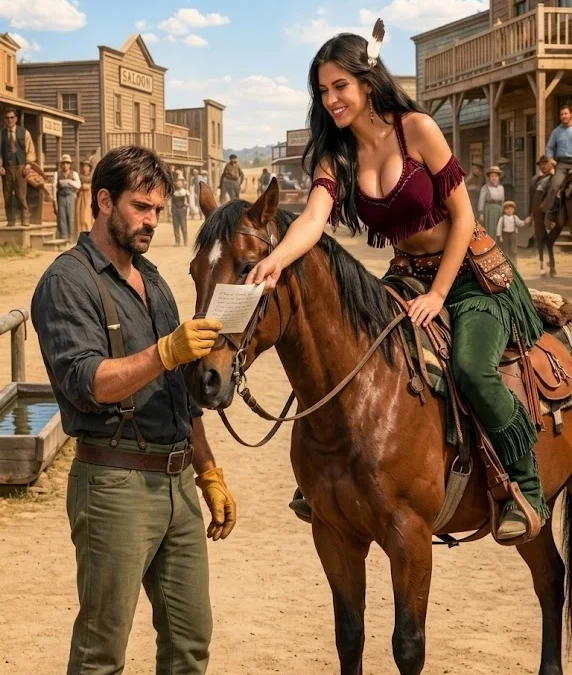
“Come at Midnight. Come Alone.” Two Years After His Wife’s “Accident,” a Grieving Rancher Found a Note Under His Door, From an Apache Woman Who Knew the Truth He’d Been Too Afraid to Face… 🌵🕯️
PART 1
I don’t know why I still come here every morning.
Ruth can’t hear me. She’s been gone two years, and I know better than most men that the dead don’t wait around for the living to find the courage to speak.
But I come anyway.
I stand at the wooden marker I hammered into the ground beside the North Creek, where they found her horse that October afternoon. Rough-cut pine. I made it myself the week after the funeral, because I didn’t trust my hands with anything more careful that week.
Ruth Whitfield. 1847–1881.
The letters are crooked. She would have laughed at them. Ruth had beautiful handwriting, and she’d have looked at my uneven letters and shaken her head and smiled at the same time, the way she did whenever I fell short but meant well.
I never moved her to the cemetery in town.
People asked. Vera Dunmore, who runs the boarding house in Cobre Wells, asked twice. The preacher asked once and then had the sense not to ask again. I told them all the same thing: the ground out here was fine, and Ruth always liked the sound of this creek.
Both true. Neither one the reason.
The reason is this: if I put Ruth in the town cemetery, I’m closing a story I still don’t understand.
So she stays here. And every morning I stand with my hat in my hands and try to make sense of something that has never made sense, not for a single day in two years.
That morning I couldn’t stay long. I needed wire fencing and a new plow blade from Cobre Wells, two hours’ ride away. I hadn’t been to town since January. The delay had nothing to do with the distance.
Ruth, I thought. I’m going to town.
She didn’t answer. She never does. But talking to her is still the most honest conversation I have on any given day.
Cobre Wells sits in a shallow valley between two red-rock ridges: two dozen buildings, a church at one end, a livery at the other. The people are mostly decent, the kind of decent that comes from necessity rather than virtue. Ruth and I had traded here for eleven years, ever since we came west from Missouri with two horses, a wagon, and the kind of optimism that only survives if the land cooperates.
In Dunmore’s general store, I was hunting for wire when I heard voices at the front counter.
Four Apache people stood there, three men and a woman. The woman was speaking to Ambrose Cole, who minds the store when Vera is busy, in English considerably better than Ambrose’s own.
Ambrose was pointing to a price scribbled on a scrap of paper. It wasn’t the price on the shelf tag behind him. She knew it. And he was counting on her not pushing back, because pushing back takes a particular kind of nerve in a room that isn’t on your side.
I’ve watched that transaction more times than I can count. Most people on the receiving end swallow the loss, because the alternative costs more than the difference.
She didn’t swallow it.
She didn’t argue. She didn’t raise her voice. She simply turned, looked at the shelf, reached out with a calm steadiness, and set the shelf tag on the counter beside his paper.
She didn’t say another word.
Ambrose looked at the tag. At her. At the tag again.
Then he picked up his pencil and wrote a new number.
Something shifted in my chest. I understood it later, walking back to my horse.
Ruth would have done exactly that. Not the same gesture, maybe, but the same principle: no shouting, no performance. Just place the truth on the counter and let it speak for itself.
I had been inside my grief so long that Ruth had become only an absence. The empty side of the bed. Not the living woman who could change a price without saying a word.
I stood there with the wire under my arm and breathed carefully for a moment.
I took my usual room at Vera’s boarding house: second floor, front window over the main street. Ruth had loved that room. She liked watching the whole life of the town from above.
I went down for supper.
When I came back up, there was an envelope under my door.
Plain paper. A blank wax seal. My name in handwriting I didn’t recognize: educated, careful, quick.
Inside was a short note.
“I know who you are. I know about Ruth Whitfield. And I know her death was not an accident. If you want the truth: the dead juniper at the fork of the North Creek, after midnight. Come alone. — S.”
I read it three times. The third time because my hands had started to shake and I needed something to do with them.
Her death was not an accident.
I want to be honest here, because I’ve never been honest about it anywhere else:
I had thought it too.
On the morning she died, Ruth told me she was riding to Flagstaff to see a lawyer. She kissed me at the door, said she’d be back by nightfall, and rode off on her gray mare with a leather satchel over her shoulder.
Flagstaff is west.
The North Creek is north.
I’d known that simple fact for two years. And I had never let myself ask the question that followed from it, because I didn’t know how to bear the answer.
If Ruth didn’t go west… where was she really going? And what was she carrying?
I thought about traps. A man alone, called to a dark creek at midnight. In this territory, the distance between a misunderstanding and a catastrophe can be covered in seconds.
Then I looked at my gun belt hanging by the door.
I left it there.
If I was walking into something tonight, I’d walk in unarmed. The only kind of meeting I was willing to have was the kind where both people come in peace and tell the truth.
Downstairs, Vera was wiping glasses behind the counter. Her eyes went to the envelope in my hand, then flicked away so fast that if I hadn’t been watching, I’d have missed it.
But I was watching.
The North Creek fork was four miles out. The moon was nearly full, more light than was comfortable. I rode slowly, thinking about the morning Ruth left. Had there been something in her face? Something she was holding back? Or was I painting that onto the memory now?
I reached the fork just before midnight.
The old dead juniper stood pale against the sky, its bleached branches spread like something frozen mid-gesture.
A figure was already standing beside it.
I recognized her even in the moonlight. The woman from the store.
And in the shadows behind her, his right hand loose at his side, stood a man.
She hadn’t come alone. 🌙
👉 Part 2 is in the comments! Can’t find it? Leave any word and I’ll send it to you privately. 👇
PART 2
She hadn’t come alone. I dismounted slowly and looped my reins over a juniper branch. “You came,” she said. “I came. Without a weapon.” She studied me the way you study someone you’ve thought about for a long time and are finally checking against the picture in your head. “My name is Saya. My father is Chief Tahaeso of the Western Apache. The man behind me is my brother, Duran.” He didn’t nod, but he didn’t reach for anything either, and that was its own kind of greeting. “Your note says you know who killed my wife.” “It says I know her death was not an accident. That is what I know.” “That’s a careful distinction.” “I try to be careful with words. They do enough damage when people aren’t.”
Then she told it straight, with no softening. Duran had been near the North Creek that afternoon. He saw Ruth on her gray mare, riding the way a person rides when something is behind them. Then a second rider came out from the direction of the Pruitt ranch, faster. Duran called out, but the wind was against him. He heard one shot. When he came over the ridge, Ruth was on the ground beside her mare, and by the time he reached her, she was gone. The mare’s leg was broken from the fall, so Duran put her down himself, because it needed doing and no one else was there. The second rider had vanished. Hearing something you’ve half known for years doesn’t feel like surprise. It feels like the ground finally settling under you. “Why did you wait?” I asked. Duran stepped into the moonlight, maybe thirty, his face older than his years. “Could I ride into Cobre Wells and tell the deputy I watched a white woman shot dead and a white man ride away?” I understood exactly what that report would have produced, and the understanding shamed me. “No,” I said. “I understand.” “I have carried it for two years.” “Thank you,” I said. “For staying with her.” He looked down. Then he nodded once, the nod of a man accepting something he didn’t expect.
Saya turned to me. “On the day she died, Ruth told you she was going to Flagstaff. Flagstaff is west. The North Creek is north. Did you ever ask yourself where she was really going?” “Yes,” I said. “And then I stopped asking.” She nodded without judgment. “She was coming here. To meet my father.” For six months before she died, Ruth had been working secretly with Vera Dunmore to gather evidence against Warren Pruitt, the biggest landowner in the valley. His land papers were forged. On paper he had moved the treaty boundary lines fifteen miles east, and for four years he had been selling land that wasn’t his to sell. My father held the old records and was going to sign a document confirming the true lines. With what Vera had, it would have been enough for Judge Aldrin in Prescott, the one judge Pruitt couldn’t reach. I thought of Ruth at her desk late at night, sliding papers into her satchel when I came into the room. I never asked. “She was protecting me,” I said quietly. “She thought whoever was caught looking at Pruitt’s papers would become a target. She didn’t want it to be you.” I turned away to look at the dark creek, because I needed a moment with no one’s face in it. “So Pruitt knew where she was going,” I said. “Someone told him. Not Vera. Someone else who knew.” “Who?” Saya held my gaze. “I don’t know. Not yet. But that person is still in Cobre Wells, and until we know who it is, anything we do with Ruth’s evidence can be stopped again.” I thought of Vera’s quick glance at the envelope. Someone in that town had betrayed my wife, and that person was still walking the same streets I walked…
🔥 Who betrayed Ruth, and what had Vera been hiding for two years? Comment “JUNIPER” and hit LIKE to see Part 3! Once we reach enough comments, I’ll post the ending! 🌵👇
PART 3
I was up before the sun.
Vera was already behind the counter with coffee going, wearing the face of a woman who had spent the whole night making peace with the conversation that was coming.
“You knew about the note,” I said.
She poured my coffee with steady hands. “I helped Saya choose the moment. I’ve watched you come and go from this town for two years, Jonas, waiting to see whether you’d keep your head down forever, or finally look up.”
“Saya told me most of it. I need three things. Who told Pruitt. What you’ve been keeping. And whether you’ll help finish what Ruth started.”
She went into the back room without a word and returned with a brown paper envelope, soft at the corners from two years in a drawer.
“Ruth came here the morning she died,” she said, “before anyone was up. She left me the originals. Everything we’d gathered. She said if she didn’t come back by nightfall, I was to get it to Judge Aldrin by a private courier I trusted with my own life.”
“She didn’t come back by nightfall.”
“No.” Her voice stayed even, but it was costing her. “And I didn’t send it. I was afraid. If Pruitt killed Ruth for what she knew, what would he do to me? So I kept it. I hated myself for keeping it, and I kept it anyway. I’m not asking you to understand. I’m asking you to let me be useful now.”
I asked myself honestly whether Ruth would have hated her. She wouldn’t have. Ruth understood people too well to hate them for the size of their fear. She would have grieved it, but not hated it.
That helped me not hate Vera either.
I opened the envelope. The original treaty boundaries. Pruitt’s filings with every discrepancy marked in Ruth’s handwriting. Signed statements from two families he had cheated. A formal letter to Judge Aldrin, careful and perfectly clear.
And at the very bottom, one more page.
It was written to me.
“Jonas. If you are reading this, I did not come back. I’m sorry I kept this from you. You’ll say I wasn’t protecting you, only myself from the argument we would have had. You’d be right. But I’d do it the same way again, because that argument would have ended with you involved, and I couldn’t watch you carry this risk. You have already given enough to this land.
The man you need is Warren Pruitt. The person who can help you finish this is Chief Tahaeso. The person in this town I trust above all others is Vera, whatever her fear may cost us both.
And Jonas, whatever else you do or don’t do with any of this: you have been a good man. I have always known that. I needed you to know that I knew.
Your wife, Ruth.”
I read it twice. Then I folded it and put it in the inside pocket of my coat, over my heart, where it would stay for a very long time.
“She trusted you,” I told Vera.
Her eyes shone, but she didn’t let the tears fall. “I know she did.”
“Then let’s be worthy of it.” I stood. “Who told Pruitt?”
Vera hesitated. “Three weeks before she died, Ruth asked one man one question: how to file a legal challenge to a land document. She asked it as if it were hypothetical. He wasn’t foolish enough to believe that.”
“Who?”
“Deputy Harker.”
I found Harker alone at the sheriff’s office, burying himself in paperwork.
“Your daughter Lucy,” I said, sitting down uninvited. “She’s at the Saguaro Sanatorium in Tucson. That’s an expensive place for a deputy’s wage.”
Something flickered in his face. Then he got up, closed the door, and sat down beside me, close and on my level.
“What do you know?”
“That Pruitt’s been forging land papers for four years. That Ruth died because someone told him what she was doing. And that your investigation into her death found nothing, which took a great deal of not looking.” I paused. “I’m not here to break you, Harker. I’m here to understand where you stand.”
He was quiet a long time. When he spoke, his voice sounded like something that had been crushed under a heavy weight for years.
“Lucy is six. She’s been sick most of her life. The Saguaro is the only place that can help her. In the spring of ’81, Pruitt came to me. Said he’d heard about Lucy. Said he’d arranged a payment for her care. He didn’t ask for anything. Not out loud.” He swallowed. “A few weeks later, he asked whether I’d noticed any unusual legal business in the valley. And I told him Ruth had asked me one question. One question. I told myself it meant nothing.”
“And when she died?”
“I knew.” He said it flat and final. “I knew what my answer had cost. And I ran the investigation the way I did because I didn’t know how to run it any other way without becoming the next accident on the North Creek.”
There it was: a chain of small, acceptable choices that ended with Ruth on the ground beside a creek.
“If I take this to Judge Aldrin,” I said, “where do you stand?”
“My daughter needs the Saguaro.”
“I know she does. Stand on the right side of this, and I’ll personally pay Lucy’s fees for three months. I have a ranch, savings, and no one left to spend either on. You have my word.”
The clock measured out half a minute.
“What do you need me to do?” he said quietly.
“Come to Vera’s tonight. And if Pruitt asks, I’m just in town running errands.”
At the door, I turned back. “The rider who chased Ruth that afternoon. You know who it was.”
He met my eyes.
“Wade Pruitt. Warren’s son. He was twenty-one.”
Duran met me on the East Ridge and led me to his father’s camp.
Chief Tahaeso was old, his back straight because he had decided it would be, his eyes clear. He spoke in Apache, and Saya translated.
“He says your wife came to him with clean hands and a straight question. That is rarer than it should be.”
“She was that kind of person,” I said.
He handed me a folded leather case containing decades of careful records, and at the back, in Ruth’s hand, the document with the space for his signature that had waited two years.
“He kept it because a right thing doesn’t stop being right just because the person who began it is gone,” Saya said. “He says people make the mistake of believing that waiting is the same as doing nothing.”
“Tell him I won’t let it end here.”
As I left, I touched my chest over Ruth’s letter. Something in the old man’s face softened. He said a few quiet words that Saya didn’t translate right away.
“He said,” she told me softly, “‘She chose well.’”
That night, six of us gathered around Vera’s kitchen table: Vera, Saya, Duran, Running Fox, an old tracker named Sekot, and finally Harker, in plain clothes without his badge.
The plan had two parts.
First, the evidence would go to Judge Aldrin, but not through anything that passed through Cobre Wells. A freight carrier named Asa Merritt, who owed me a debt, would carry it overnight and put it directly into the judge’s hands.
Second, the ancient boundary stones by the North Creek, the markers Pruitt’s men had been working toward removing, had to be documented and witnessed before anyone could touch them.
And Harker would do the hardest thing of all: stay visible on Main Street, doing his ordinary rounds, so Pruitt’s watchers would watch him instead of us.
Afterward, Saya and I were alone in the kitchen.
“You’re afraid,” she said. Not an accusation. An observation.
“Yes. Of being one more thing that starts and doesn’t finish.”
“My father says Ruth did everything a person with courage and good judgment could do, and she was still stopped. Not because she wasn’t enough, but because what she was doing was big enough to draw the attention of people willing to do what she wasn’t.” She held my gaze. “He says that’s the cost of doing right in places where wrong has become normal. Just be sure that if you pay it, you don’t pay it blind.”
“I understand it.”
“Good,” she said.
We rode north at 2 a.m. with no torches, only the moon.
At the North Creek fork, Duran stopped short.
Lanterns were moving slowly along the slope where the boundary stones lay, the deliberate rhythm of men at work.
Pruitt had moved first.
Sekot slipped off silently into the dark to circle above them. The rest of us climbed on foot. Fifty yards from the lights, I heard a young man’s voice, too loud, wearing authority he wasn’t comfortable with:
“Get the south one first, then work up the line. We need to be done before sunrise.”
Wade Pruitt.
I stepped into the lantern light.
“Wade.”
Five men turned. Wade’s eyes jumped from me to Duran and Running Fox, then up into the dark slope where he couldn’t tell who else might be waiting.
“These are on Pruitt land,” he said.
“These are on treaty land your father’s papers have been lying about for four years. That’s why you’re here at 2 a.m. with shovels instead of paperwork.”
“You can’t prove anything.”
“The documents are already on their way to Judge Aldrin. And I know what you did on this creek one afternoon in October of 1881. I know who saw you.”
The calculation drained out of his face, and what was left looked younger and rawer.
“He told me she was just going to ruin us,” Wade said, almost whispering. “He said if I stopped her on the road and scared her, she’d quit. He said it wouldn’t come to anything serious.”
I stood very still.
“I’m not going to tell you what to do with that,” I said. “But the markers stay. The documents go to Aldrin. And what you just said is going into the deputy’s report.”
He turned to his men. “Put the tools down. We’re going back.”
The shovels dropped. The lanterns drifted away down the slope.
Saya was standing just behind me. I hadn’t heard her come up. “You let him go.”
“Tonight. He’s not going anywhere. What happens next is for the judge to decide.”
For two hours, under moving stars, Duran and Sekot documented every stone with a knowledge older than any filing office in the territory, and I stood witness.
At 4 a.m., Harker rode up with his notebook. He wrote down everything, including Wade’s words. Then he turned to Duran.
“Your name and your account are going into this official report. Do you understand?”
“I’ve been willing for two years,” Duran said. “I just had no reason to believe the document would be honest.”
Harker took that without flinching. He deserved to.
“This one will be,” he said.
Asa Merritt reached Prescott in eighteen hours and waited outside Judge Aldrin’s office until he could put the package directly into his hands.
Aldrin’s note back included one line that wasn’t legal language at all: the most thorough voluntary submission I have received in fourteen years on the bench. Whoever assembled the original materials clearly understood what was required.
He meant Ruth. I read that line many times.
The judge came to Cobre Wells himself with two federal marshals. He froze every one of Pruitt’s land deals. Six weeks later, Warren Pruitt was arrested. The trial took four days. He was convicted of land fraud and as an accessory in the death of Ruth Whitfield, and sentenced to twelve years at Yuma. The stolen land went back.
Wade didn’t fight the charges. He told the court exactly what he’d told me on that slope, with no excuses. His sentence was lighter. I’m not sure “justice” is the right word for anything that comes after the irreversible thing has already happened. But it was what the law could do, and that isn’t nothing.
Harker filed his report, kept his word, then resigned and moved to Tucson to be near Lucy. I paid the three months I’d promised.
Then, quietly, I paid three more.
He found out anyway and rode out to my fence line one afternoon. “You didn’t have to do that.”
“I know.”
“I’m not going to say it makes things right.”
“It doesn’t,” I said. “Lucy needed the Saguaro. That’s all.”
Vera finally wrote to her son in Denver and told him everything. Whatever he wrote back, I could see it in her afterward: she was sleeping again.
And at a gathering of his own people, Tahaeso honored his son Duran for the weight he had carried for two years. Not lifted, maybe. But seen.
In late May I visited Tahaeso once more.
“You came back,” Saya translated. “Not everyone does. He wants you to know he noticed.”
“Tell him Ruth would have done it better.”
The old man answered, and Saya’s voice softened. “He says Ruth did what she could, and you did what you could, and together it was enough. Right things usually get done that way, not by one complete person, but by several people who each carry a piece.” She hesitated. “He also says his daughter has good judgment. He says he trusts it.”
He was looking straight at me. I understood exactly what he was telling me.
“I know she does,” I said. “I’ve seen it.”
Three months after the trial, I was rebuilding the north fence line when I heard a horse I already knew.
“You need more hands,” Saya said.
“Do you know how to build fence?”
“No.” She picked up a post. “So teach me.”
I handed her the mallet. “About two feet deep.”
“How do I know when I’ve reached two feet?”
“You stop. You look. If it seems right, it probably is.”
“That isn’t a very exact method.”
“No,” I said. “But it works.”
We worked until the light began to leave the valley, the North Creek threading its dark line through the pale grass below. On the first evening we claimed this land, Ruth had stood at this very fence and said this was a place worth staying in.
She was right.
When the last post went in, the whole new line ran straight and solid from corner to corner.
“It’s straight,” Saya said.
“It is.”
At her horse, before she rode back to the camp, she said something I’ve thought about every day since.
“My father asked me this morning what I think of you. I told him you’re a man who pays attention.”
“And the rest of it?”
She considered it with the same honesty she brings to everything.
“I told him I’m still learning.”
Some things that are taken from you never come back. Ruth isn’t coming back. That October afternoon can’t be undone.
But some things last.
Ruth built what she built out of honesty, patience, and a quiet refusal to accept that the gap between how things are and how they ought to be is too big for one willing person to close. She built it knowing she might not be the one to finish it.
She built it anyway.
And I carried it the rest of the way.
Tomorrow morning, I’ll ride out to the wooden marker by the creek, the way I have every morning for two years. I’ll stand with my hat in my hands, look at those crooked letters, and say what I came to say.
“Ruth. We finished it.”
She won’t answer.
But I think she’ll know. 🕊️
Some debts can never be fully repaid, but they can still be honored. Have you ever finished something someone you loved began? Share your story in the comments. 👇💬
Disclaimer: This story is entirely fictional and created for entertainment purposes only. It does not represent any organization or individual, nor does it encourage inappropriate behavior. The content was generated with AI assistance.








