“CRY ONCE AND I’M SENDING YOU BACK,” THE CAPTAIN TOLD HIS BRIDE ON THE DOCK… BUT SHE FOUND A SECRET RECEIPT IN HIS HAND THAT CHANGED EVERYTHING
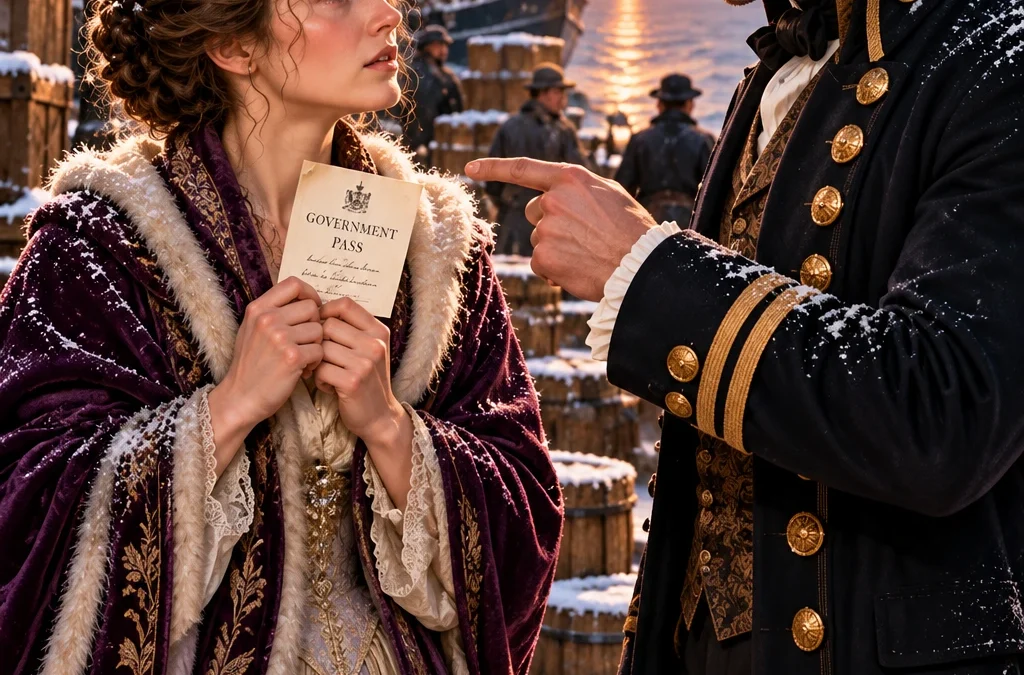
“CRY ONCE AND I’M SENDING YOU BACK,” THE CAPTAIN TOLD HIS BRIDE ON THE DOCK… BUT SHE FOUND A SECRET RECEIPT IN HIS HAND THAT CHANGED EVERYTHING 😱
Part 1
The receipt said five pounds and eight shillings.
One inside seat from Portsmouth to York, paid in advance on the ninth of September, 1815, in the name of Mrs. Lancelot Fairweather, to be used on any day the lady chose.
Thursa Fairweather read it standing on a wet dock with the wind in her face, and she understood it at once.
She thought she did.
She would be wrong about it for more than six months. 💔
She had been married to him for seven days. She had known him for eleven.
Captain Lancelot Fairweather of the Royal Navy was a tall man in a blue coat mended at both cuffs. His face was brown from twenty years of sun, and a pale scar ran from his left ear down into his collar. He did not smile. She had not yet seen him smile.
He was waiting at the top of the stone steps when her boat came in. Gulls cried. Men shouted from the boats. Behind her the gray water slapped the dock, and before her Portsmouth climbed the hill in brick and smoke.
He took a folded paper from his coat and held it out.
“Read it.”
She read it. £5 8s. Portsmouth to York. Paid any day the lady chooses.
“What is this?”
“Your way home.” His gray eyes were as flat as the water. “If you are unhappy here, you take that paper to the coach office in the high street and they put you on the next coach north. You need not ask me. You need not tell me.” He paused. “So I will say it plainly, once. Cry once, and I am sending you back.”
A sailor with a barrel stopped to stare, then thought better of it and walked on.
Thursa stood very still. She was the daughter of a Yorkshire schoolmaster. She had been taught to stand still when a thing hurt, and to think before she spoke.
He had married her in the little stone church at Ancliffe, five days after her father was buried. He had done it because her father asked him to. The old schoolmaster had taught him his letters thirty years ago, before the boy went to sea at twelve. And on his deathbed, he had asked his old pupil for one last favor.
Now the favor was done. And here, on the first morning, was the door out of it, already paid for.
It was a trial, then. One tear, and he could send her north with his duty done and his conscience clean.
“I will not cry,” she said.
“Good.”
“But there is a part you have not told me. Why this was bought before I ever stepped off the boat. I would like to hear that part.”
Something moved in his face, there and gone, like a fish under dark water.
“There is a part. You will have it when you need it.”
“And when will that be?”
He did not answer. He turned and walked up the dock toward the town. And after a moment, because there was nothing else to do, she followed him.
The house was in a narrow street above the harbor, tall and thin, with a brass knocker shaped like an anchor. The captain walked a full pace ahead of her the whole way up. He did not offer his arm. When the street grew crowded with paid-off sailors, he walked faster, and she had to hurry to keep his blue back in sight.
She noted it. She noted everything. It was a habit from the schoolhouse, where her father had kept a daybook of every pupil and every coin, and taught her to do the same.
He is ashamed to be seen with me, she thought. A plain girl from the north in a dyed black gown, trotting after him like a parcel.
She would be wrong about that for nine weeks.
The door was opened by a short, broad man with a gray pigtail and arms like ship’s cables. “This is Grout,” said the captain. “He was my coxswain for fourteen years. Now he does everything else.”
“Ma’am,” said Grout, touching his forehead. “Welcome aboard. Mind the step.”
In the narrow hall stood a woman of perhaps forty in gray silk, with the captain’s dark hair and the captain’s gray eyes. “My sister, Mrs. Chalcott. She keeps the house.”
“Winifred,” said the woman, and took both of Thursa’s cold hands in her warm ones. “Oh, you poor child. You are frozen through. Lance, you might have brought her up in a chair.”
“She walked,” said the captain.
“I wished to walk,” said Thursa.
Winifred looked from one to the other, and her face softened into pity. Thursa did not like it.
That first evening they ate a boiled fowl in a small dining room over the harbor. When the cloth was drawn, the captain stood. “I’ll be out.”
“Out where?” said Thursa, before she could stop herself.
He looked at her. Then he took his hat from the hall and was gone. The front door shut with a sound like a gun.
Winifred sighed and poured two cups of tea. “You must not mind him. He has been at sea since he was twelve. He has no idea how to be in a house. He walks the Hard at night, down by the water. He always has, since he came ashore. Most nights.” She stirred her tea. “He was a fine captain, you know. The Wakeful was a fine ship. She was paid off in July when the wars ended, and Lance was put on half pay like all the rest. Ten shillings and sixpence a day. That is what a post captain is worth to his country, once there is no one left to fight.”
Thursa did the sum without meaning to. A little under two hundred pounds a year. Enough for a narrow house and a coxswain and a sister. Not enough for much more. And five pounds eight shillings kept aside for a coach seat.
That night she lay in a strange bed and listened to the ships creaking in the harbor. She heard him come in a little after two. His step went slowly up the stairs and past her door without stopping.
She did not cry. She counted the strokes of the church clock instead.
On the fourth day, Winifred found her in the little back parlor, unpacking her father’s books onto an empty shelf. There were forty-one of them. She had carried them three hundred miles in a tin trunk.
“May I?” Winifred sat on the window seat and folded her hands. “I am going to say something, because I think no one else will, and I think it is unkind to let you guess. My brother is a good man. I love him better than anyone alive. But he did not want a wife, Thursa. He married you because a dying man asked him, and Lance has never in his life refused an order.” Her voice was gentle. “He told me so himself the night he came back. He sat in that chair by the fire and said, She will be on the York coach by Lady Day.”
Thursa’s hands stopped.
“The twenty-fifth of March. The end of the quarter. He has written to the Admiralty for a ship. If he gets one, he will sail in the spring and let this house, and I will go to our cousin in Chichester. And you will have your ticket.” She kissed Thursa’s cheek. “I would not have you hope for something that is not coming.”
It was the thirteenth of September. Thursa counted on her fingers, the way her father had taught the smallest boys.
One hundred and ninety-four days.
“Thank you,” she said. “That was kind of you to tell me.”
Winifred went down the stairs believing she had done a good and loving thing. And every word she had said was true. Her brother had sat in that chair. He had said that sentence.
But Winifred had gone to bed before he finished it.
Thursa would not learn the end of that sentence until March.
On the fifth morning, she took a clean daybook from her trunk and wrote at the top, in her father’s neat schoolroom hand: Household, from the 14th of September, 1815. Beneath it she wrote:
193 days.
She would not spend them crying in a back parlor. She would not give him the tear. And she would leave the house better than she found it, so that when she went north, nobody could say the schoolmaster’s daughter had been nothing but a parcel.
She went down to the kitchen to find Grout, who was peeling potatoes as if they had insulted him.
“Mr. Grout, I should like to see the household books.”
There was a slate. It hung on a nail by the door, and on it, in chalk, in a hand like a spider in a fit, were the words Tapsel. Tea. Sugar. Candles. There was no number anywhere.
“Mrs. Chalcott does the money,” said Grout. “Mr. Tapsel sends up his bill on the quarter day, and she pays it, and we’re square.”
“Who is Mr. Tapsel?”
“Chandler, ma’am, down by the Point. Supplies half the navy wives in Portsea. Very respectable. Sings in the church.”
“Does he weigh what he sells?”
Grout looked at her as if she had asked whether the sea was wet. “On his scales, ma’am. In front of you. Proper brass weights.”
Thursa went to find her bonnet.
Tapsel’s shop smelled of tar and cheese and wet rope. Coils of cable hung from the ceiling. A long counter of dark wood held a fine pair of brass scales, polished until they shone. Mr. Obadiah Tapsel was a round, pink, cheerful man with a bald head and very clean hands.
“Mrs. Fairweather! The captain’s new lady. What an honor.”
She bought a pound of sugar, a pound of tea, and half a pound of candles. He weighed them in front of her. The little weights went click, click into the pan. He smiled the whole time.
At the counter beside her stood a thin young woman in a faded black gown with a baby on her hip, buying a quarter-pound of tea with a printed paper ticket instead of coins.
“Relief ticket, ma’am,” said Mr. Tapsel. “From the Naval Widows’ Fund. The Port Admiral’s committee gives them to the poor women whose husbands were lost in the war. I am the fund’s appointed supplier. Proud to do my bit.”
“How good of you,” said Thursa.
She did not go home. She walked up the hill to the apothecary, a dry old man named Mr. Flood, and asked very politely to borrow his scales for two minutes. An apothecary’s scales had to be true to a grain.
The pound of sugar weighed fourteen and a half ounces. The pound of tea weighed fourteen and a quarter.
Mr. Flood looked at the scales. Then he looked out of his window toward the Point.
“Well, well,” he said. “Well, well, well.”
She did not say anything to anyone for three weeks. Every day she sent Grout to Tapsel’s, and every day she weighed what he brought back on a small pair of scales bought secondhand from a jeweler’s widow. She wrote every figure in her daybook. At the end of three weeks, she sat at the kitchen table with Winifred’s old receipts, tied in tape in a drawer, and did the sum for the whole of the last year.
The house had paid Mr. Tapsel for a little over nine pounds’ worth of goods it had never received.
She closed the book and sat with her hand flat on the cover. Nine pounds from a household of four. And the widows, with their printed tickets, buying a quarter-pound at a time with no scales and no daybook and no Grout to carry anything home.
The next morning she went back to Tapsel’s alone, with the daybook under her arm. She did not raise her voice. She opened the book on his polished counter and showed him the figures one line at a time. She showed him Mr. Flood’s name at the foot of each page.
Mr. Tapsel stopped smiling. His pink face went a little pinker. Then a little white.
“The weights are old, ma’am. Brass wears.”
“It does,” said Thursa. “It is strange that it only ever wears in your favor.”
He counted out nine pounds four shillings from his money drawer and slid it across the counter. “I trust this will be the end of the matter.”
“For my house it is,” said Thursa.
She did not say what she meant by that.
That evening, Winifred told the story at dinner, with the scales and the villain and Mr. Flood’s eyebrows, and Grout nodded hard behind the captain’s chair at every line. The captain listened without a word. When it was finished, he put down his knife and fork and looked down the table at his wife.
“Nine pounds four shillings.”
“Yes.”
“From Tapsel.”
“Yes.”
He looked at her a moment longer. Then he picked up his fork again.
“Well done,” he said.
It was two words. She had been in the house twenty-seven days. They were the first words he had spoken to her that were not about dinner or the weather or where he was going.
She wrote them in her daybook that night, and then felt foolish, and did not cross them out.
He went out to the Hard at nine. He came back at a quarter past two.
Part 2
He went out to the Hard at nine. He came back at a quarter past two.
On the thirtieth of October, a gale came up the Channel and struck Portsmouth in the middle of the night. Thursa woke to the windows shaking in their frames. The narrow house leaned and groaned like a ship. Bells were ringing, men were shouting, and somewhere a gun fired twice.
She lit her candle and went down to the kitchen. Grout was already there in his shirt and breeches, building up the fire.
“Boats loose in the harbor, ma’am. The captain’s gone down. He went the minute the gun went. In this, or in anything. That’s the captain.”
She sat at the table with her shawl around her and found that her hands would not keep still.
He came in at twenty minutes to four, soaked to the skin, his hat gone, water running off his coat onto the flagstones. He was holding his right hand against his chest, and there was blood on his cuff.
“A rope ran. It is nothing. Grout, find me a rag.”
Grout had gone to the cellar for coal. There was no one in the kitchen but the two of them.
Thursa stood. She took the handkerchief from her sleeve, a plain square of white linen with a T and a C worked in the corner in blue thread. Her mother had stitched it the winter before she died.
“Sit down.”
He looked at her as though she had given an order on his own quarterdeck. Then slowly, he sat.
She knelt on the wet floor and took his hand in both of hers. The rope had torn across the palm. It was raw and ugly, and bleeding freely. His hand was very cold. It was hard and square, with old white scars across the knuckles, larger than both of hers together.
She began to wind the linen around it.
One second. Two.
She felt him go still. Not the stillness of a man sitting quietly. A different stillness. Every part of him stopped at once, the way a ship’s sails go slack the moment the wind dies.
Three. Four.
His breathing had stopped. She could not hear it at all over the wind.
Five. Six. Seven. She tied the first knot. Her fingers touched the inside of his wrist where the pulse was, and she felt it going very fast.
Eight. Nine. She tied the second knot and drew it tight.
Ten. Eleven.
He took his hand back. He did it gently, but all at once, the way you would take your hand out of a fire. He stood so quickly the chair scraped on the flags.
“Thank you,” he said, his voice rough. “That will do.”
He went up the stairs. She heard his door shut.
Thursa stayed on her knees on the wet floor for some time.
Eleven seconds. That was how long he had been able to bear it. She had held his hand for eleven seconds, and he had not breathed for any of them, and then he had fled from her as if she were something he could not stand to have near.
When Grout came up from the cellar, she was sitting at the table with her daybook open, her face perfectly calm. She did not cry. She had promised.
But that night she wrote under the thirtieth of October a single line she was ashamed of afterward, and could not bring herself to tear out.
Eleven seconds. He cannot bear me to touch him.
She would not know how wrong she was until spring. 💔
In the morning the handkerchief was gone. His hand was bound in a strip of clean sailcloth. He did not mention it, and she did not ask. She thought he had thrown it into the fire.
In the second week of November, Thursa walked down to the Point with Grout to carry the household basket. The lanes near the water were full of paid-off men with money in their pockets and nowhere to go. A great red-faced fellow with gold rings in his ears stepped out in front of her, made a low, slow bow, and said something she did not wish to understand.
Grout stepped between them so fast she hardly saw him move.
“Not this one, mate. This is the captain’s lady. Captain Fairweather of the Wakeful.”
The man stopped bowing. He took off his hat and backed into the tavern.
“Does the captain’s name always do that?” Thursa asked, her heart beating hard.
“Down here it does, ma’am. That’s why he walks out in front. Like a frigate ahead of a convoy. Every drunk on the Point sees him coming and gets out of the road before you ever get near. He won’t give you his arm in the street because then he’d have to walk beside you, and a man beside a lady can’t step in front of her quick enough.” Grout shifted the basket. “He’s been clearing the road for you since the first morning off the boat.”
Thursa stopped in the middle of the lane. She had noticed it. She had noticed it, and written it down, and she had written it down wrong.
That night she turned back to the first page of her daybook, and under He walks a pace ahead and will not give me his arm, she wrote in small letters: Wrong. See the 11th of November.
It did not change the receipt. It did not change Lady Day. A man could be kind about the road and still not want a wife.
Her father had always said that one wrong sum did not make the whole page wrong. It only meant you had to check the others.
So she checked the others.
In December, Winifred caught a cold that settled in her eyes, and could not read the small figures in the household book without a headache. One evening, the captain came into the back parlor and set a ring of keys on the table beside Thursa.
“Win says you should have the accounts. All of them. The house, and mine. She says you are better at it than either of us. Your own accounts too. The desk in my room, second drawer. I keep a book.” He looked at the keys, not at her. “There is nothing in it you should not see.”
She remembered that sentence later. She remembered it very clearly.
The next morning, while he was out, she unlocked the drawer and took out a long, narrow account book bound in green leather. His hand was small and square and neat, like a ship’s log. Most of it was plain enough. Rent. Coal. Grout’s wages. Half pay drawn at the quarter.
And on the ninth of September, in the same neat hand: Coach office, one inside seat to York, for Mrs. F., £5 8s.
And on the twenty-ninth of September: Quarter day. Coach office. Seat to York renewed for the quarter.
She sat with her finger on that line. He had renewed it. Twenty days after she arrived, he had walked down to the coach office and paid to keep her ticket ready, as if afraid it might lapse before she used it.
She turned the pages. Twice a month, sometimes three times, there was an entry with only an initial and a sum. To M., £1. To K., 15s. To M. and P., £1 10s. To the R. house, 2s. There was no word of what any of it was for. She added it up. Over seven pounds a quarter, out of less than fifty.
Where did a man on half pay send seven pounds, and never write down why?
She put the green book back exactly as she found it. She was not proud of it. But she was her father’s daughter, and when a sum did not come out, she could not leave it alone. She started a new page in her own daybook and wrote at the top: Nights.
He went out on seventy-one nights of the ninety. When she asked where, the answer was always the same. The Hard.
On Christmas Day, the house ate a goose, which Grout carved as if he were boarding an enemy. Winifred wore a lace cap. And the captain gave his wife a small brass pocket compass, very old and very fine, in a case of black shagreen.
“It was my first captain’s. He gave it to me when I made lieutenant. I thought, with your arithmetic…” He stopped. “It seemed a thing you would like.”
She held it in her hand. The needle swung and settled, pointing north, toward York.
“Thank you. It is very beautiful.”
The next morning, she found a paper on the hall table where he had left it with his gloves. A coach office receipt. Seat to York renewed for the quarter. Mrs. Fairweather. To Lady Day.
She read it twice. She put it back exactly where it had been.
In the middle of January, the captain went up to London on the coach. “The Admiralty,” said Winifred at breakfast, with a kind of sad pride. “He will sit in the waiting room with fifty other captains and hope the First Lord remembers his name. There are a hundred captains for every ship.”
“And if he gets one?”
Winifred did not look at her. “Then he will sail in the spring. As I told you.”
He was gone eleven days. When he came back, he came in late through the kitchen, and said not a word about London to anyone. He did not need to. Thursa saw his face under the hall lamp, and knew there had been no ship.
After that, he went to the Hard every night.
She laid it out in her mind the way her father had taught her. He did not want a wife. He had said so on the dock. He had bought her ticket before she landed and renewed it twice. He had told his sister she would be gone by Lady Day. He could not bear her touch for longer than eleven seconds. He had given her a compass that pointed north. He spent his nights anywhere but in the house. And every month he put aside small sums he would not explain, the way a man saves for a voyage.
He was waiting for the spring. For a ship, and for Lady Day, and for the coach that would take her away, so he could go back to the only life he had ever wanted.
It all fit. Every fact fit.
She did not cry. She kept the accounts. In February, she began to go down to Tapsel’s in the mornings and stand quietly at the end of his counter while the widows came in with their printed tickets. She only watched the weights and wrote in her book. And once or twice, when a young woman came out with a twist of tea, she stopped her in the lane and asked very kindly if she might borrow it for one minute. Grout carried the small scales in his coat.
The widows’ tea was short by two ounces in the pound. The bread was short. The candles were short.
Mr. Tapsel saw her there, morning after morning. He did not smile at her anymore.
And on the eighth of March, she accused her husband. She had not meant to. She had meant to wait until Lady Day and go quietly, with her ticket and her forty-one books, and leave a clean set of accounts on the table.
But that evening, he came into the back parlor as she was ruling a page. He stood by the fire with his back to her and said, without turning round:
“The coach goes from the George at seven in the morning, if you should ever want it. The office will send a boy for your trunk the night before.”
She put down her pen. “Seventeen days.”
“What?”
“It is seventeen days to Lady Day.” She stood, and her hands were steady. She was surprised how steady. “You need not tell me about the coach, Captain. I have known where it goes from since the ninth of September. Shall I tell you what I have?”
He did not answer. She took it as a yes.
Part 3
“On the dock, you gave me a paid seat home and told me one tear would send me back. You were not threatening me. You were showing me the door so I would know it was there.” She held the daybook against her chest like a shield. “On the thirteenth of September, your sister told me you had said I would be on the York coach by Lady Day. On the twenty-ninth, you renewed my seat. On Christmas Day, you gave me a compass that points north. The morning after, you renewed my seat again, to Lady Day, to the very day. You go out to the Hard seventy-one nights in ninety, and you come home after two. You put by seven pounds a quarter in little sums, with letters instead of names, as a man puts money by for a voyage. You went to London for a ship. You will try again. And when you get one, you will need the house shut and your wife gone north. And you will need it all to be my choice, so that you have kept your promise to my father, and nobody can say you did not.”
She drew a breath.
“And on the thirtieth of October, I bound your hand, and you could not bear it for longer than eleven seconds. I counted.”
The fire cracked. Out in the street, a cart went by over the stones. He stood very still, the same stillness as the night of the gale. This time, she did not look away from it.
“Is any of it wrong?”
He was quiet for a long time.
“No. None of it is wrong. Every date is right. Every sum is right.” He looked at the daybook in her arms. “You would have made a fine purser.”
“That is not an answer.”
“It is the only one I have.” He took his hat from the chair. “The seat is paid. Go whenever you like. I will not stop you. I gave my word I would not.”
He went out. The front door shut behind him.
She stood in the back parlor with her book in her arms and waited to cry. She had kept her promise for a hundred and eighty-one days. Surely now, with him gone, it would not count.
She did not cry. She found, to her surprise, that she was angry. Not with him. With the sum. A sum that came out right should feel finished, and this one did not.
She sat down at the table and opened the daybook to the first page, and began again from the beginning, the way her father had made the boys do when a sum would not come right. Not the answer. The working.
Every fact was true. She did not doubt one. But she had put them together in a hurry on the first morning, with the wind in her face, and she had never once gone back to check the first line.
The first line was the receipt.
She took it from the back of the daybook, where she had kept it pressed flat for six months, and read it slowly, as if she had never seen it. To be used on any day the lady chose.
Not Lady Day. Any day. Her choice. Not his.
A man who wanted her gone would have bought a seat for a date. He would have named the day. He had named nothing. He had only made sure the door would never be locked.
And he had renewed it. She had read that as a man afraid the seat would lapse before she used it. But a coach office sold seats by the quarter. Of course it ran to Lady Day. Every quarter ran to a quarter day. He had not been counting down. He had been keeping it open. Every three months, he had walked to the high street and paid again, so that she would never once be trapped.
She turned the compass over in her hand. His first captain’s. A man did not give the most precious thing he owned to a woman he was getting rid of. It pointed north because compasses do.
And then the nights, and the initials.
She took down the slim book where, in February, she had copied the name of every widow who came into Tapsel’s with a printed ticket. Next to each, because she wrote everything, she had written the name of the husband’s ship. She ran her finger down the page.
Mrs. Hebb. Wakeful. Mrs. Kurslake. Wakeful. Mrs. Pardew. Wakeful.
Three widows sharing one room in an old house by the rope walk. M. K. P. The R. house.
She closed the book. Her hands had begun at last to shake.
She took her shawl and went down to the kitchen, where Grout was sitting up by the fire, as he always did until the captain came home.
“Mr. Grout. How many men did the Wakeful lose in the war?”
Grout looked at her for a long time. Then he put down his pipe.
“Eleven, ma’am. Off Ushant, in the year eleven, boarding a French brig in the dark. The captain led the boarders. He got that scar on his neck. He got the brig. He didn’t get the eleven back, nor their widows.” He rubbed his face. “The fund gives them tickets for Tapsel’s, which you know about, ma’am, being as you’ve been standing at his counter every morning like the wrath of God. It’s not enough. It’s never been enough. So the captain goes down of a night. He takes them what he can. Coal. A bit of money. He mends things. He sits with old Mrs. Kurslake, who’s not right in her head since, and lets her talk about her Jem till she sleeps. That’s the Hard, ma’am. That’s where he goes.”
“Why did he never tell me?”
Grout looked at the fire. “He’d say it’s nobody’s business but his. But I’ll tell you what I think, and you can have me flogged for it. I think he’s ashamed. He thinks if he was a better captain, there’d be no widows to visit. And I think he thought if you knew, you’d look at him the way they all look at him down there. Like he owes them. Which he does. He’s always paid.”
Thursa sat down at the kitchen table. There was one fact left in her case. The eleven seconds.
She had felt him stop breathing. She had felt his pulse going fast as a bird’s. And she had written it down as horror.
She thought about a man who had gone to sea at twelve, and led eleven men over the side of a ship in the dark and come back without them. How long since anyone had knelt beside him and taken his hand only to make it better?
Not horror. She had never seen horror in his face at all. She had only been sure that was what it must be.
Every fact had been true. The answer had been wrong from the first line. 💔
He came in at twenty past two, quietly, through the kitchen door, and stopped, because she was sitting at the table with the lamp lit and the daybook open before her.
“You should be asleep.”
“I have been doing a sum.” She did not stand. “I was wrong. Not about the facts. About the answer. Any day the lady chooses. Not Lady Day. M. is Mrs. Hebb. K. is Mrs. Kurslake. P. is Mrs. Pardew. And the R. house is the rope walk. Eleven men from the Wakeful.” She drew a breath. “I would like the part you have not told me now, please. I think I need it.”
He did not move for a long moment. Then he came and sat down across the table from her, slowly, like a much older man.
“Your father. Two days before he died, he made me sit by his bed. He said, Lance, if you marry her, you will promise me one thing. If she is ever unhappy, you will send her home, paid, and she is never to have to ask you for it. I promised. I bought the seat the morning you landed, before you ever stepped off the boat. I keep it paid.” He looked at his hands. “That was his. The line on the dock was mine.”
“Why?”
“Because I knew you would be unhappy. I am not a man a woman is happy with. I am fit for a quarterdeck and nothing else. I do not know how to talk in a parlor. I do not know how to be gentle. I thought, if she cries, I will know, and I can let her go at the start.” His voice was very low. “And what I said to Win, the night I came back, you asked about the end of it. I said, She will be on the York coach by Lady Day. Win, mark it. And then I said, And when she goes, I shall have nothing. No ship, no men. Half pay and an empty house and eleven widows I could not save. Win had gone up by then. I said it to the fire.”
He looked at her at last.
“They will not give me another ship. I knew it in London. I sat in that room eleven days and knew I am to be left ashore for the rest of my life. And I could stand that. I think I could have stood it, if I had not had you in the house for six months first.”
The lamp hissed. Neither of them moved.
“And the eleven seconds?” she said.
He put his hand into the breast of his coat, took something out, and laid it on the table between them. It was her handkerchief, washed and ironed and folded small. T and C in blue thread in the corner.
“Nobody had touched me like that in twenty years,” he said. “Not since I was a boy. I could not breathe. I thought, if I sat one second longer, I would never be able to let you go.”
Thursa looked at the handkerchief for a long time. Then she held out her hand across the table, palm up.
“May I?”
He looked at her hand. He looked at her face. Very slowly, he laid his scarred hand in hers.
One second. She felt it. She did not let go.
Five. Six. Seven. Ten. Eleven. Twelve.
At thirteen, he breathed out a long shaking breath, as if he had been holding it since the thirtieth of October. At twenty, he turned his hand over and held hers back. She stopped counting somewhere after that.
She stood and came around the table. He stood too. She laid her other hand very lightly against the scar on his neck.
“May I?”
“Yes,” he said. “God help me. Yes.”
She kissed him. It was a short kiss and a careful one, the kind you give a man who has not been kissed in a very long time. And then he kissed her back, and it was not short at all. 💛
She did not cry. But he did, a little. And she decided that did not count, since nobody had made any promises about him.
On Lady Day, the twenty-fifth of March, the committee of the Naval Widows’ Fund met in the long room at the George, as it did every quarter, to pay Mr. Tapsel and renew his appointment. The room was full. Officers in blue, their wives in good bonnets, the vicar, Mr. Flood. And at the back, standing against the wall in their faded black, a row of widows with printed tickets in their hands.
Admiral Sir Godwin Larkham sat at the head of the table. Mr. Tapsel sat beside him, pink and smiling, with his bill.
Thursa heard the whispers as she came in on her husband’s arm. He had offered it on the doorstep, and she had taken it.
Isn’t that Fairweather’s wife? I heard she goes north today. On the seven o’clock. Poor Fairweather. No ship, and now no wife.
Winifred heard them too. Thursa saw her face go white.
The admiral read the minutes. He thanked Mr. Tapsel for his faithful service. He asked if anyone had anything to say before the appointment was renewed.
Thursa stood. The room went quiet. Ladies did not stand up at the George.
“I have something to say, Sir Godwin.” Her voice was not loud, but she had read lessons aloud in a Yorkshire schoolroom for ten years to forty boys and a stove, and it carried to the back wall. “My name is Thursa Fairweather. I keep accounts. I have kept these since September.”
She opened her daybook. She read the date, the article, the weight paid for, the weight given. Mr. Flood’s name at the foot of every page. The widows’ tea, short two ounces in the pound. The bread. The candles. And at the end, the sum. Thirty-eight pounds a year, taken out of the mouths of women who had already given the Navy everything they had.
Mr. Flood stood at the side of the room. “Every figure is true, Sir Godwin. I weighed them myself.”
At the back, Mrs. Hebb stepped forward. “It’s true, sir. We always knew it. We’d no way to prove it.”
The admiral looked at Tapsel for a long time. Then he took the bill and laid it face down on the table. 😶
“And one more thing,” said Thursa. “I hear it said in this room that I leave on the York coach today.”
She took the receipt from her daybook, walked to the head of the table, and laid it before the admiral.
“My husband has kept this paid since the ninth of September because he promised my father I should never be trapped. I am not trapped. I choose to stay. The coach office will give back the money, and I should like it given to the fund. And I should like this room to know that for five years, since the night off Ushant, Captain Fairweather has been keeping eleven widows out of his own half pay, at night, and telling nobody.” She looked at her husband, standing at the back with his hat in his hands. “I think that is the kind of man you want in charge of this fund. Not the man with the brass weights.”
Nobody spoke.
Then at the back of the room, one of the widows began to clap. And then they all did. 👏
Captain Fairweather never got another ship. He was made treasurer of the Naval Widows’ Fund at Portsmouth that summer, and he kept the post for twenty-two years, and his wife kept the books.
In the spring of 1831, their daughter Phoebe, aged nine, fell on the dock steps and cut her hand. Her father knelt on the wet stone and bound it with a plain linen handkerchief, very old now and very soft, with a T and a C in faded blue in the corner.
“Eleven seconds,” said Phoebe, when he had tied it. “Mother says that is how long you lasted the first time.”
“Your mother,” said the captain, “talks too much.”
But he was smiling. By then, he smiled most days.
Winifred lived with them until she died. She never quite forgave herself for the thirteenth of September. She had only wanted to save her brother from a broken heart by making sure it broke early.
Some people would call that loyalty. Some would call it the worst thing you can do to someone you love.
The receipt still lies in a drawer in the house above the harbor, folded and worn soft. It was never used. 💌
THE END
This story is entirely fictional and created for entertainment purposes only. It does not represent any organization or individual, nor does it encourage inappropriate behavior. The content was generated with AI assistance.








