“Don’t Drink That, Your Grace!” the Maid Screamed. They Laughed at Her. Three Seconds Later, His Brother Was Dead, and the Killer Was Sitting at the Same Table
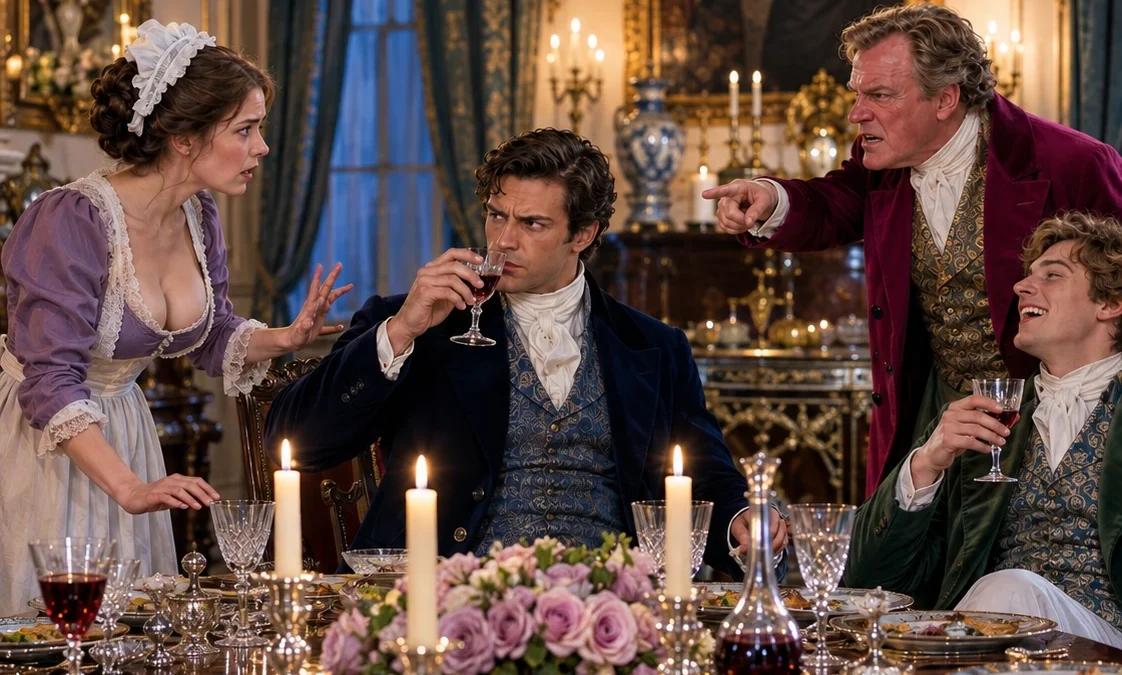
“Don’t Drink That, Your Grace!” the Maid Screamed. They Laughed at Her. Three Seconds Later, His Brother Was Dead, and the Killer Was Sitting at the Same Table ☠️
PART 1
A crystal goblet shatters against the marble floor.
A young lord drops, clutching his throat, his face turning an impossible shade of gray.
But just three seconds before the screaming starts, the grand dining hall rings with laughter. Cruel, aristocratic laughter, aimed straight at a maid in a starched apron who had just dared to step out of the shadows and warn the Duke not to drink.
She told them the wine was poisoned. They called her mad.
Now a man is dying. 🍷
At Wikliffe Hall, maids were expected to be invisible. You did not make eye contact. You did not speak unless spoken to. You certainly did not involve yourself in the family’s affairs.
Tessa knew her place in the machine. She was twenty-one, a cog that polished silver, her hands cracked from lye soap and her spine already aching on damp mornings.
On a Tuesday afternoon, the Duke came home from six months on the continent. Colin Street James, twenty-eight, built like a cavalry officer, with a gaze so flat and calculating that kitchen maids crossed themselves when he passed. He had inherited a title mortgaged to the hilt and spent four years ruthlessly tearing down his family’s excesses to save the estate from ruin. His younger brother Thomas was his opposite: twenty, reckless, quick to laugh, hopeless with money. He rode in on a sweating bay, tossing silver to the stable boys and shouting for a hot bath.
Tessa watched them from a second-floor window with a dust rag idle in her hand. She felt no loyalty to either. They were simply weather.
Her real problem began two hours later, in the study of their uncle, Lord Charles, who had been “managing” the estate in Colin’s absence. Or, more accurately, mismanaging it. She knelt on the Persian rug, scooping ash into a brass bucket. The room stank of stale cigars and nervous sweat.
Her brush struck something hard.
She dug through the soot and pulled out a small, thick glass vial. No cork. Fire-cracked, but not melted. She held it to her nose, and a sharp, bitter scent hit the back of her throat. Not soot. Not tobacco.
Crushed peach pits and damp earth.
It dragged a ghost up out of her past. Before the workhouse, before the lye soap, Tessa had been an apothecary’s daughter in Cheapside. Her father had died in a debtor’s prison, but he had taught her the smell of every herb, powder, and tincture in his shop. Bitter almonds. Prussic acid. 💀
She looked at the desk. Ledgers lay scattered open. The carpet fibers were crushed in a tight, repeating circle where a man had been pacing. The Duke was home to audit the books, and Charles was drowning in debt.
She shoved the vial deep into her apron pocket, her heart hammering.
Tell someone, a voice urged. Who? her cynical side shot back. The housekeeper would box her ears for stealing rubbish. The constable would lock her up for having ideas above her station. A maid holding an empty bottle was not proof of murder. It was an excuse for a beating.
So she told herself to keep quiet. Let the rich eat the rich.
But as she carried the ashes down the servants’ stairs, she remembered Thomas tossing that coin to a stable boy. Thomas, who always rode too fast. Thomas, who would inevitably sit beside his brother at tonight’s welcome banquet.
She gripped the bucket handle until her knuckles went white. She was invisible. But tonight, she would have to watch.
The dining hall was suffocatingly hot. Three dozen beeswax candles dripped from the chandelier. Tessa stood in the shadows by the oak sideboard, a linen napkin over her forearm, her calves burning from two hours of standing rigid.
Only four sat at the table. Colin at the head, exhausted, in a dark, severely cut coat. Thomas at his right, already flushed with wine. Lord Charles on the left, drumming his fingers. And at the far end, the dowager aunt, a woman who seemed composed entirely of powder and malice.
“A toast,” Charles announced, his voice a little too loud, a little too strained. He gestured to the head footman. “Bring the reserve port. The vintage from ’52. I saved it specifically for your return, Colin.”
Tessa’s gaze snapped to the footman. He carried a silver tray with one ornate decanter and two glasses. His hands did not shake, but his grip on the decanter’s neck was white-knuckled. He poured a heavy measure for Colin. Another for Thomas.
He did not pour for Charles. He did not pour for the dowager.
Just the Duke, Tessa thought, her chest tightening. And the brother.
The vial in her pocket felt like a burning coal against her thigh.
“To Wikliffe,” said Charles, raising his plain claret. “May your reign be long and your ledgers balanced.”
Colin did not smile. His long fingers closed around the stem. He lifted the glass.
You will be fired, her mind screamed. You will be arrested. You will be hanged.
Colin brought the rim toward his lips.
Tessa moved. 🕯️
Her heavy boots thudded across the hardwood. “Your Grace. Wait.” It was not a shout, but in that hushed aristocratic silence it cracked like a whip.
Colin froze, the glass an inch from his mouth. Charles’s face drained of color, then flushed crimson. “Get back to the kitchens, girl!”
“Do not drink that, Your Grace. Please.”
Thomas barked a laugh and leaned back. “Well, this is novel. Have we hired seers for the scullery now?”
“Get this lunatic out of here!” Charles spat.
Colin raised a hand to silence him. He looked at Tessa. Really looked. His gaze dissected her. “Why shouldn’t I drink my own wine?”
“Because it smells of crushed pits,” she said in a panicked rush. “Because I found a cracked vial in Lord Charles’s hearth. It’s poisoned.”
Silence fell like a lead weight. For two seconds, nobody breathed.
Then the dowager snorted, a small, ugly sound, and it broke the dam. Thomas roared with laughter. “Poisoned by Uncle Charles! God above, Colin, your staff has been reading too many penny dreadfuls!” Charles joined in, high and nervous. “Deranged, or drunk, or both. She’s been at the pantry sherry.”
Even Colin’s hard mouth twitched. He looked at her not with anger but with cold, dismissive pity. “You are dismissed. Report to the housekeeper for your wages.”
“I am not lying!”
“Enough.” He set the glass down with a sharp clink. “Get out.”
Thomas wiped a tear of mirth from his eye. “Oh, let her stay, Colin, she’s the best entertainment we’ve had all evening. If you’re too afraid of a little vintage port, brother, I shall happily take your share.”
He reached across the table and snatched his own glass, poured from the same decanter.
“To the maid’s wild imagination!”
Tessa lunged, but a footman seized her arm and wrenched her back.
Thomas threw his head back and swallowed the dark wine in one long gulp. He slammed the empty glass down. “Excellent. Not a hint of crushed pits.”
The table chuckled.
Tessa stood paralyzed in the footman’s grip, her eyes locked on Thomas.
One second. Two seconds. Three.
Thomas’s smile slipped. 😨
PART 2
It did not happen the way it does in the theater. There was no dramatic clutching of the chest, no poetic last words. Thomas simply stopped breathing. His eyes widened, the pupils blowing out until they swallowed the blue entirely. He let out a wet, choked gasp like a drowning animal, his hands clawing at his throat, tearing his silk cravat and ripping the skin beneath.
“Thomas!” Colin’s voice was sharp, annoyed. “Stop playing the fool.”
Thomas tried to stand. His legs were gone. He pitched forward into the table’s edge, tipping his chair, and crashed to the floor in a wreck of linen and silver and half-eaten pheasant. His body arched violently, heels drumming against the boards. Pink-tinged foam bubbled over his lips where he had bitten through his own tongue.
The laughter vanished. What replaced it was absolute silence, torn only by the sound of a boy choking on his own fluids.
Colin shoved back so violently that his oak chair shattered against the wall. He dropped to his knees. All the cold calculation, all the aristocratic distance, was gone in an instant. “Tommy. Look at me. Fetch a doctor! Fetch a goddamn doctor!”
The dowager was screaming, a high, piercing siren.
Tessa wrenched free of the stunned footman and fell to her knees across from Colin. “Turn him on his side.”
Colin glared, ready to strike her for touching his brother. But the commanding panic in her voice bypassed his pride. He helped her roll the convulsing boy over. “What is it? What do I do?”
“Nothing,” Tessa said, her voice cracking. “There is no cure for this. You can’t do anything.”
Thomas’s convulsions slowed. His chest hitched once, twice.
Then his body went entirely slack, his blown-out eyes staring up at the underside of the dining table.
Dead. 💔
Colin knelt in the puddle of wine and gravy, his hands hovering over his brother’s chest like a man who had stepped off a cliff in the dark and was still waiting to hit the ground. Three minutes ago, they were laughing.
“Seize her!”
Charles’s voice cracked through the room, shrill and hysterical. He was backing toward the far wall, pointing a trembling finger. “She did this! You heard her! She knew about the poison! She spiked the decanter and tried to pin it on me to play the hero!”
Two footmen, roused by the familiar tone of command, dragged Tessa away from the body. She did not fight. Her eyes stayed locked on Colin.
He raised his head slowly. His face was bloodless. The flat, calculating look had returned, but sharpened now into something deeply terrifying. He looked at the shattered crystal. At his uncle, sweating, edging toward the door. And at the maid in the cheap cotton dress.
“Take her to the cellars,” Colin said, his voice a dead rasp. “Lock the door. Speak to no one. And let no one leave this house.”
“Colin, listen, she’s a known thief, she must have…”
“I said, let no one leave.”
They dragged her down three flights into the damp smell of earth and old potatoes, and shoved her into an empty root cellar. The iron bolt slammed home. Total darkness.
Tessa slumped against the cold stone, knees to her chest, shaking so hard her teeth rattled. She had tried to save them. She had broken the rules, stepped out of the machine, and now a boy was dead and she was going to hang for it.
Hours passed. Boots thudded overhead. A distant shout. Slamming doors.
Then a heavy footstep on the stairs. The bolt scraped back.
Colin Street James stood in the doorway with a brass lantern. He had shed his coat. His white shirt was stained with his brother’s blood and the spilled wine. He did not look like a duke anymore. He looked like a man who had just realized he was standing in a room full of monsters.
He stepped inside and closed the door.
“The vial. You said you found it in my uncle’s hearth.”
With trembling fingers, she drew it from her apron and held it out. He did not take it. He stared at it, then lifted his eyes to hers.
“They laughed at you,” he whispered. “I laughed at you.”
“Yes, Your Grace.”
He lowered himself onto an overturned crate opposite her, harsh shadows carving his jaw. “Tell me everything. From the beginning. Because if I am going to tear my own family apart tonight, I need to know where to start.” 🔦
She told him. Her father, the apothecary. The debt. The workhouse. How Wikliffe Hall had bought her contract two years ago.
“Prussic acid,” Colin said softly. “I read of it in a Paris journal. They extract it from bitter almonds.”
“Seconds, Your Grace, if it is distilled properly.”
A violent tremor racked his frame. He squeezed his eyes shut, jaw locked so tight she heard his teeth grind. He did not weep. He strangled the grief into a hard knot of rage.
When he opened his eyes, the tremor was gone. “They weren’t aiming for Tommy. The footman poured the heavy measure for me. Tommy took my glass. Charles didn’t just murder his nephew. He murdered the wrong nephew.”
“He manages the estate ledgers while you are away,” Tessa said. “And you came home to audit them.”
“Four years I’ve been tearing down his excesses. He called it an embarrassment. I called it survival. He knew I would find the discrepancies by morning, so he decided I would not live to see sunrise.”
He stood. “Where is the footman?”
“O’Brien. One of Lord Charles’s own hires. He sleeps above the carriage house.”
“If Charles is smart, he’s halfway to London. If he’s desperate, he’s at the bottom of the estate pond.”
“Lord Charles is a coward,” Tessa said bluntly, shocking herself.
Colin did not reprimand her. A grim smile twisted his mouth. “You are remarkably bold for a woman locked in a cellar waiting to hang.”
“I am already dead, Your Grace. Your uncle accused me before half a dozen witnesses. By morning, the magistrate will have a confession beaten out of me. So forgive me if I skip the curtsy.”
He held the lantern higher. He saw the exhaustion around her eyes, the cracked hands, the fierce set of her jaw. She was terrified, but not broken.
“Nobody is hanging tomorrow.” He drew back the iron bolt. “Charles expects me to sit by my brother’s body and wait for the magistrate. We are going to disappoint him. Show me the servants’ stairs. The ones they don’t patrol.”
She led him through the pitch-black passages by touch, fingers trailing the rough plaster, boots silent on worn boards. Behind her, the Duke stumbled, a man built for ballrooms and cavalry charges, not for creeping through the dusty veins of his own home.
“Keep your voice down,” she hissed over her shoulder. Down here in the dark, she was the master of the house.
They slipped through a narrow door behind a faded tapestry into Lord Charles’s study, silvered by moonlight. The hearth had died to embers. Colin drew the drapes and unshuttered his lantern.
The desk was immaculate. Too immaculate. The ledgers were gone, the drawers locked.
“He hasn’t burned them,” Tessa said. “A man like your uncle never destroys his only leverage until he must.”
Servants noticed what lords ignored: which board creaked, which rug sat slightly off-center. She dropped behind the desk, pushed back the Persian rug, and found a thin straight seam in the oak. “Your pocketknife.”
He handed her a silver folding blade without a question. She wedged it into the seam. Click. A section of floor popped up.
Inside lay three leather-bound ledgers, a stack of promissory notes, and a small velvet-lined box.
Colin seized the top ledger and scanned the columns. His face changed from anger to something colder and deeply sickened. “Gambling debts. Syndicates. He’s borrowed against the northern tenant farms. Against the coal mines. He owes thirty thousand pounds to a man named Rossy in London. If Rossy calls it in, Wikliffe goes bankrupt. The title, the lands. All of it, sold at auction.”
“And if you were dead?”
“Thomas would inherit. Tommy didn’t know a ledger from a hymn book. Charles would have stayed steward, and Rossy would have owned us both.”
He opened the velvet box. Inside lay a single folded sheet of heavy parchment, a letter in elegant looping script.
The apothecary in Cheapside has been dealt with. The tincture is pure. Administer it with the vintage port, as the heavy tannins mask the bitter scent. Do not let your nerve fail you. The boy’s austerity will drown us all if you do not act. Burn this.
M.
“M,” Colin breathed, horror in his voice. “Margaret. My aunt.”
Tessa stared. The dowager. The woman who sat at the far end of the table complaining of drafts and smelling of lavender. She had orchestrated it.
A muffled thud echoed from the corridor. Footsteps. Heavy. Fast.
“They’re coming back!”
Colin did not hide. He placed the ledger on the desk in the center of the lantern’s beam and stood waiting, like the lord of a burning castle greeting the arsonists. “Stand behind me.”
The door slammed inward. Lord Charles stood in the threshold, sweating, cravat hanging limp. Beside him was O’Brien, out of livery, in a heavy tweed coat, a percussion pistol in his fist.
Charles’s eyes darted from the ledger to Colin to Tessa. For three agonizing seconds, no one spoke.
“Shoot him,” Charles shrieked at last. “Shoot them both. We’ll say she attacked me and you defended the family!”
O’Brien raised the pistol, aiming at Colin’s chest, his hand shaking violently. He was a man who poured wine and carried coats. He was not a killer.
Colin stepped forward. Directly into the path of the barrel.
“What does he pay you, O’Brien? Ten shillings a week? A warm bed above the horses?” His voice was smooth, almost conversational. “You poured the wine. I know it. You know it. If you shoot me, you hang for high treason against a peer of the realm. They’ll leave your body in a cage at a crossroads for the crows.”
Another slow step. The barrel was a foot from his chest.
“But lower that weapon and walk out that door, and you have my word as the Duke of Wikliffe that I will not hunt you. You have two seconds to decide what your life is worth.”
Behind him, Tessa’s hand crept across the desk until it closed around a heavy brass paperweight. If O’Brien fired, she would crush Charles’s skull. 🔥
The silence was taut and vibrating.
O’Brien lowered the gun.
“You coward!” Charles lunged for it.
Colin moved with sudden explosive violence. He seized his uncle by the lapels and slammed him against the oak bookshelves, rattling the glass. The pistol clattered to the floor. O’Brien did not look back. He bolted down the corridor and was gone.
Colin pinned Charles by the throat with his forearm. “You aimed for me and you killed my brother.”
“I had to!” Charles wept. “You were ruining us! Rossy was threatening to break my legs!”
“You did it to save yourself.”
“It wasn’t only me,” Charles gasped, eyes bulging. “Margaret! She orchestrated it. The syndicate. They promised to clear the debts if Wikliffe was under favorable management.”
Colin let him draw a ragged breath. Charles stared up with pathetic, desperate eyes. “Please. I’m your blood.”
Colin looked at him for a long time and realized the family name was just a rotting corpse in expensive clothes.
He let Charles slide to the floor, weeping, and turned to Tessa. “Pick up the gun.”
She blinked, startled by the use of her name. She walked around the desk and lifted the percussion pistol, heavy and cold in her palm.
“You will write a full confession, Charles,” Colin said. “Your embezzlement. Your debts. Exactly how Margaret procured the prussic acid. Or I will let Tessa shoot you where you sit and tell the magistrate you took your own life out of grief.”
Charles shuffled to the leather chair, an old, broken man.
Colin turned to Tessa and looked at her like a soldier who had survived a trench assault at her side. “Keep the gun. My aunt is still in this house. And if she is working with a London syndicate, she is far more dangerous than a cowardly man with a ledger.”
He stepped into the dark corridor, his shadow stretching long across the floral wallpaper.
“We are going to burn this family to the ground, Tessa. And we are going to start with her.”
He kicked open the dowager’s double doors, splintering the wood like a cannon shot. Tessa swept the room with the pistol.
Margaret was not asleep. She sat at her vanity, fully dressed in black silk, feeding parchment into the embers. She did not flinch. She stirred the ashes with an ivory poker until the paper curled to black flakes.
Only then did she turn her head. Her eyes were pale and sharp as ice.
And behind the velvet drapes of the alcove bed, something shifted. 😰
PART 3
“You bring a feral dog into my chambers, Colin,” said Margaret, her voice dry as autumn leaves, entirely without fear. “Put that crude thing away, girl, before you blow off your own foot.”
“Where is Rossy’s man?” Colin asked, setting the lantern on a side table.
“I have no idea who you are speaking of.”
“Charles has already confessed. He gave me the letters. The debt, the syndicate, the prussic acid you procured from London. The game is finished.”
A microscopic twitch pulled at the corner of her left eye. It was the only reaction she allowed. She let out a long, slow breath and dropped the facade of the outraged aunt, looking at him with hatred so pure it turned Tessa’s stomach.
“Charles was always a weak, sniveling creature. He hadn’t the stomach for necessary things.”
“Murdering your own nephew is a necessary thing?”
“Saving this family was necessary!” Her composure cracked and the venom seeped out. She rose, black silk rustling like dry scales. “You came back from your tour and gutted this house. You sold the silver your grandfather bought. You fired the staff. You starved us in our own home, forcing us to live like merchants.”
“I was keeping you out of debtors’ prison!” Colin roared. “Charles mortgaged the tenant farms to pay his gambling debts!”
“I am a Wikliffe. We do not count pennies. We do not scrape soot from chimneys. Rossy offered a solution. He clears the debt, and in return he receives a silent partnership in the northern coal mines.”
“Under Thomas’s name.”
“Thomas is a sweet, malleable boy.” A rare, genuine softness crept into her voice. “He understands how to live. He would have let Charles manage the estate. He would have let me live in peace. He only needed to inherit. And you were standing in his way.”
Colin went absolutely still. He looked at his aunt and saw the full depth of her delusion.
“You didn’t ask how Charles failed.”
She frowned. “The maid obviously warned you. I told Charles the tannin would mask the almond, but he must have botched the pour. It does not matter. You have no proof that will hold in a provincial court. Rossy’s men will see to that.”
“Tessa didn’t stop the pour,” Colin said quietly. “She tried. But you all laughed at her.” His chest hitched, a brutal, ragged sound. “Thomas took my glass. He thought it was a joke. He drank the heavy measure, Margaret. Your sweet, malleable boy. He choked on his own blood and died on the dining room floor.”
She froze. The sneer vanished, wiped away by catastrophic blankness. Her pale eyes searched his face for the lie, the cruelty of a trick, and found only the raw, bleeding hollow of a brother’s grief.
“No.” Her voice trembled, suddenly very old. “No. Tommy wouldn’t. He doesn’t drink port. He prefers claret.”
“He drank it to mock the maid. You killed him, Margaret. You killed the only thing in this family you ever loved.”
Her knees gave out. She collapsed onto the vanity stool, hands flying to her mouth, a wet, choking sound tearing from her throat. It was the sound of a soul fracturing down the middle. 💔
Tessa felt no triumph. Only cold, sweeping exhaustion. The machine had finally eaten itself.
Then the velvet drapes rustled.
“Colin!”
A man stepped out. Thick-necked, heavily scarred, in a dark wool suit that smelled of damp alleys and cheap gin. A short, wicked trench knife gleamed in his fist. Rossy’s insurance policy. He had been waiting to ensure the letters burned.
He did not waste time on speeches. He lunged across the rug, driving the blade at Colin’s kidney. Colin spun at Tessa’s cry, a fraction too late. The knife sliced his coat and grazed his ribs. Colin grunted, clamped down on the man’s wrist, and drove a short brutal punch into his throat. The man choked but did not drop the blade. He wrenched free, tearing a shallow line across Colin’s forearm. Dark blood sprayed the cream wallpaper.
“Shoot him!”
The man slashed again, forcing Colin back against the marble fireplace. Tessa raised the pistol, but her hands shook so violently the barrel wavered in circles. The lantern threw chaotic shadows. If I miss, I hit the Duke.
The man rammed his shoulder into Colin’s chest, slamming him against the mantel. Colin sagged, breathless. The knife rose for a downward strike at his collarbone.
Tessa did not think. She did not aim with her eyes. She aimed with the clawing instinct to survive. She stepped in, closed to five feet, leveled the barrel at the center of the dark wool back, and squeezed.
The explosion was deafening. A tongue of orange flame spat from the muzzle, followed by a choking cloud of sulfurous smoke. The recoil kicked like a mule, throwing her backward onto the floor. Her ears rang with a high, piercing whine.
“Colin!” she coughed, scrambling on her knees through the gray fog. “Colin!”
The smoke thinned. Rossy’s man lay face down on the Persian rug, a dark stain spreading across his coat. He did not move.
Colin was slumped against the fireplace, clutching his bleeding forearm, dragging in ragged breaths. He looked at the dead man. Then at Tessa. Through the haze, his dark eyes met hers, and there was no duke left in them. Only a man who had just watched a girl in a blood-spattered apron save his life.
Margaret had not moved from her stool. She stared at empty air, whispering Thomas’s name over and over in a broken, feverish loop. Her mind had retreated to a dark room where she did not have to face what she had done.
Colin pushed off the mantel, swaying, and crossed to Tessa. She was kneeling, staring at the empty pistol, the reality of taking a life crashing onto her chest. He did not offer a hand up. He dropped to one knee in front of her and gently took the smoking weapon from her trembling fingers.
“Look at me.”
She dragged her eyes upward. “I killed him. I shot him.”
“You stopped him. He was going to drive that blade into my neck. You did not murder a man tonight, Tessa. You saved a life. You saved mine.”
“But the law…”
“I am the law in this county.” The authority of his title returned, but this time he used it to shield her. “He was an assassin hired by a London syndicate who attacked the Duke of Wikliffe in his own home. You acted in defense of your lord. That is the story the magistrate will hear, and the story he will write down.” With his uninjured hand, he wiped a smear of black powder from her cheek. His touch was jarringly gentle. “Breathe. It’s over. The poison is drained.”
Tessa closed her eyes. And for the first time since she had found the cracked vial in the ashes, she let herself cry. It was not delicate. It was a harsh, ugly sob. Colin did not tell her to stop. He did not look away out of propriety. He knelt beside her on the floor, a silent, unyielding presence, until the trembling subsided. 🕯️
Dawn broke over Wikliffe Hall in a slow, creeping gray that revealed the wreckage of the night.
Magistrate Higgins, a nervous, balding man, arrived at six with four constables and found the great house in surreal, quiet horror. Thomas lay in the drawing room beneath a velvet drape, carried there by Colin himself. Lord Charles sat catatonic in his study beside a five-page confession detailing every embezzled pound and every treasonous plot. The dowager lay sedated in her ruined chambers, still whispering to a brother who was no longer there. Rossy’s enforcer lay wrapped in canvas in the carriage house.
Colin handled the magistrate with cold, terrifying efficiency. He handed over the ledgers and the confession. He gave a brief, emotionless account of the attack in the east wing, stating that he, the Duke, had fired the pistol.
Tessa stood in the shadows of the main hall, listening to him lie for her.
When the magistrate finally departed, taking Charles away in irons, a profound silence settled over the manor. The servants moved like ghosts, too frightened to speak.
Colin found her in the kitchens, sitting at the long pine table before a mug of cold tea. He wore a dark, plain wool coat, his left arm bound tightly in white linen, his face hollowed with exhaustion and a grief he had not yet allowed himself to feel. He sat on the bench across from her. Not at the head of the table. Eye to eye.
“The magistrate has accepted the confession. Charles will likely be transported to the penal colonies. Margaret will be moved to a private asylum in the north. The London syndicate will learn their man is dead and the debt is exposed, and they will scatter.”
“And Thomas?”
His jaw tightened. “Thomas will be buried in the family crypt on Friday with full honors.” He stared at the scarred pine. “I spent four years trying to save this estate for him. I tore down the drapes and sold the silver so he could have a future. And in the end, it was the very people I was protecting him from who poured the poison.”
“You couldn’t have known,” Tessa said, gentle but firm. “You cannot calculate the actions of desperate, greedy people, Your Grace. The ledger doesn’t account for madness.”
“No. It doesn’t.” He drew a heavy leather pouch from his pocket and slid it across the table. It clinked on the wood. “There is two hundred pounds in there. Enough for a carriage to London, secure lodgings, and a small apothecary shop, or whatever else you wish. It is yours, Tessa, with my absolute gratitude.”
She stared at it. Two hundred pounds. Freedom. The end of lye soap and bowed heads and being invisible.
She laid her hand on the pouch. It felt heavy. It felt like a dismissal. A sharp, cynical pang hit her chest. Of course. The crisis was over, the Duke was back in his manor, and the scullery maid was being paid to disappear and keep the family’s secrets. It was exactly how the machine worked.
“I see.” Her voice cooled. “Thank you, Your Grace. I will pack my things and be gone before noon. You won’t have to look at the reminder of what happened here.”
She started to slide off the bench, but Colin reached across the table and clamped his hand over hers. His grip was warm, rough with calluses, and entirely desperate.
“Don’t do that.” His voice cracked with an emotion he could no longer suppress. “Don’t hide behind the apron again. Not with me.”
She stared at him, stunned.
“I am giving you the money because you earned your freedom. So that whatever choice you make next, you make it as a free woman, not as my servant.” He slowly drew back his hand, leaving her fingers on the gold. “I am surrounded by people who smile at me and wait for me to die. I have a rotting estate to rebuild, a London syndicate to root out, and a family name that is effectively ash. I do not need a scullery maid.” He leaned in, the distance between them vanishing. “I need a partner. Someone who sees the poison before it’s poured. Someone who doesn’t flinch in the dark. I need you, Tessa.”
Her breath caught. She looked into the face of a man who held the highest rank in the county, who had everything on paper and nothing in reality. He was not offering a fairy tale, or a silk gown and a ballroom dance. He was offering her a war. And he was offering her respect.
She looked at the gold. She thought of London, of the lonely safety of an apothecary’s shop, mixing tinctures for strangers, invisible once more.
Then she looked at Colin. At the blood seeping faintly through the bandage on his arm. At the ghost of a boy who had died laughing on a dining room floor.
She pushed the pouch back across the table.
“Keep the gold, Colin.” It was the first time she had used his name, and she did not whisper it. She said it with the quiet, grounded authority of an equal. “Use it to fix the roofs on the tenant farms.”
He stared at the pouch. Then a slow, genuine smile broke across his exhausted face, stripping away the ruthless duke and leaving a man who had finally found one solid thing in a collapsing world.
“The north wing ledgers are a mess,” he warned softly.
“I can read.” A cynical smirk touched her lips. “And I know a thing or two about identifying rats. Show me the books.” 🌅
Outside, the gray dawn spread its pale cold light across Wikliffe Hall. The aristocratic machine was broken, its cogs scattered in the dust. But as Tessa sat at the pine table beside the Duke, the ashes of the old world settling around them, she knew they were going to build something entirely new.
And this time, they would build it together. 🤍
Can a duke and a former maid truly rewrite the rules of high society? Or will the shadows of London come back to collect their debts? Tell me what you think in the comments. 👇
Disclaimer: This story is entirely fictional and created for entertainment purposes only. It does not represent any organization or individual, nor does it encourage inappropriate behavior. The content was generated with AI assistance.








