“Don’t Pull the Arrow!” She Begged the Stranger Kneeling Over Her Dying Body… He Pulled It Anyway. But What She Didn’t Know Was That the Man Saving Her Life Was Already Bleeding Out From a Bullet He Never Mentioned
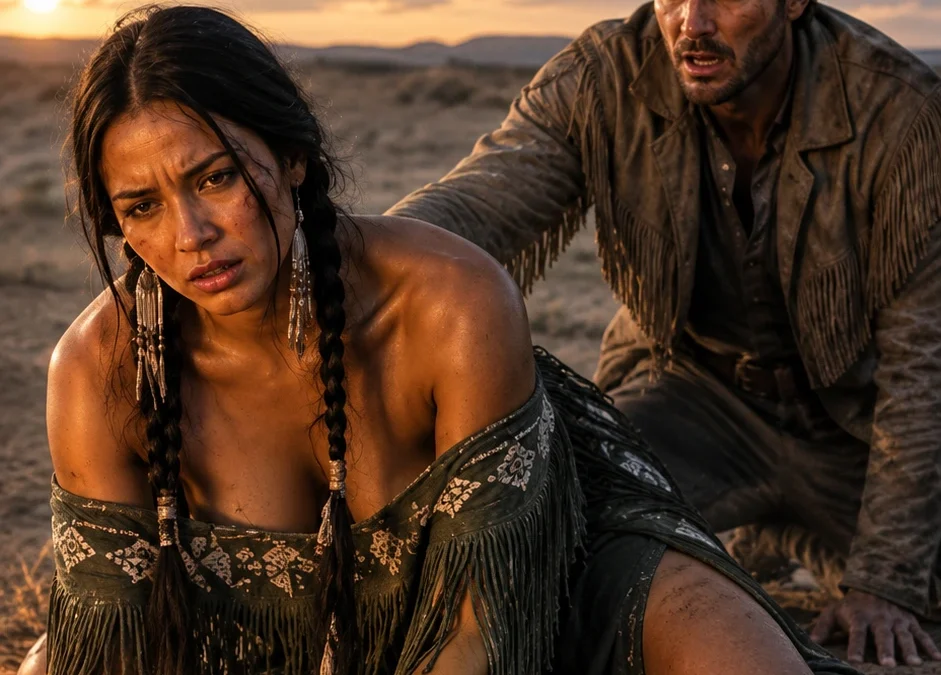
😱 “Don’t Pull the Arrow!” She Begged the Stranger Kneeling Over Her Dying Body… He Pulled It Anyway. But What She Didn’t Know Was That the Man Saving Her Life Was Already Bleeding Out From a Bullet He Never Mentioned 🩸
Part 1
“Don’t pull the arrow.”
She begged him.
He pulled it anyway.
And what happened next would cost him more than she would ever know. Because the man who saved her was already bleeding out himself, and he had never said a single word about it. 💔
Arizona Territory. Late summer, 1882. The San Pedro Valley.
His name was Cole Garrett, and he rode that stretch of high desert like a man who had made peace with being alone, and wasn’t sure whether to regret it.
Thirty-seven years old. Sun-dark. Quiet. With the kind of stillness in his face that comes either from grief or from a long time spent looking at empty country.
Both were true.
He had lost his wife Sarah to typhoid fever four years earlier. Two months after that, their infant son followed her. The ranch he had built near the Dragoon Mountains carried their absence the way a church carries the absence of people who no longer come to it.
Still there. Still shaped right.
Just emptied of the thing that made it mean something. 🏚️
He kept the place running. He mended fence, ran a small herd, did his own doctoring, and slept without dreaming much. His two ranch hands were good men who knew better than to ask questions.
He had arrived at a version of life that held together without hurting too much. And he was careful about it, the way a man is careful about a healed rib.
He knew exactly how far he could push before it gave out again.
He was riding the eastern fence line that morning, checking for breaks where the summer rains had undercut the posts, when he heard it.
Not a shout.
Something lower. A sound that was fighting not to be heard, like a person who needs help very badly but has been taught that asking for it is worse than dying.
He reined in the bay and sat still.
The sound came again, from beyond a low ridge choked with ocotillo and cholla. He tied his horse to a fence post and moved on foot, because the ground was too broken for a horse, and because something in his chest had gone very quiet.
He came over the ridge and stopped.
Two dead men lay at the base of the dry wash. Rough men. The kind who did other men’s dirty work and never lived long enough to grow old at it. Their horses had bolted.
And in the gravel between them, a woman lay face-down with two arrows in her back. 😨
Cole crossed the wash in six steps. Two fingers to her neck.
A pulse. Thin. Too fast. But there.
She was Apache. He could see it in the cut of her dress and the beadwork on the band that held her hair. But the arrows were iron-tipped trade arrows. The men who shot her hadn’t been Apache.
They had used Apache weapons to make it look otherwise.
He had seen that trick before. It moved a particular anger through him, the kind with nowhere useful to go.
The arrow in her shoulder hadn’t gone deep. The one in her lower back was worse. It had gone in at an angle, and the tip hadn’t come through. It was sitting against something inside her, and every breath she drew was teaching her what that felt like.
“Be still,” he said. “I’m going to help you.”
She might not have understood the words. But she went very still under his hands. She understood the tone.
He cut the shaft down close to her skin with his boot knife. Then he set both hands to the job and pushed the arrowhead the rest of the way through.
It was the only way. Pulling it back would have torn her apart.
She screamed. She couldn’t help it.
He finished the push, got the arrow clear, and pressed his bandana hard against the wound. She shook in the gravel, breathing like someone furious at the necessity of it.
And Cole said nothing about the thing he was hiding.
Ten minutes earlier, when the two men were still alive, one of them had put a pistol ball through Cole’s left side, just above the hip.
He had plugged it with a folded piece of shirttail and cinched his belt tight over it and told himself it was manageable.
It was the kind of wound that stayed manageable if you got proper treatment within a few hours.
And stopped being manageable if you forgot about it.
He was doing his best to forget it. Because she needed the attention more. 🩸
He got her onto her horse, which had stayed ground-tied near the wash, a sign she had trained it well. He rode beside her the four miles back to his ranch with one hand ready to catch her if she slid.
She stayed on.
Whatever she was made of, it was the hard kind.
He laid her on the cot in the spare room. She had passed out somewhere on the ride, which was probably mercy. He cleaned and packed both wounds, bandaged them, and then sat down in the chair beside her and felt the world tilt.
His own blood was running faster than he’d accounted for.
He re-tightened the belt. Then he started supper, because he was going to need his strength, and he was not the kind of man who sat around while things went wrong.
She woke the next morning while the sky was still more dark than light.
Cole was asleep in the chair. He came awake the instant she moved. He had slept light ever since the fever took Sarah.
She was looking at him.
Her eyes were dark and steady and carried an animosity that was not personal so much as architectural. The kind built over years, brick by brick, by everything her people had survived at the hands of other people. By the time you meet a stranger, it is just part of how you see the world.
He didn’t take it personally. He understood it as a reasonable position given the evidence available to her.
“Water,” he said, and held up a tin cup.
She didn’t reach for it.
“Set it there,” he said quietly, and placed it on the floor within her reach. “Food when you want it. I’ll keep clear.”
He moved toward the kitchen. He heard her reach for the cup behind him and chose not to look back, because he figured she’d find it easier to drink if he wasn’t watching.
Her name, he would learn, was Nalin.
She was Chokonen Apache, Cochise’s people, whose country had been the Dragoon Mountains for as long as there had been people to name a place. Cochise had been dead eight years. The band was scattered now between the reservation and the mountains and the memory of things that no longer existed in the form they once had.
She was twenty-four. Her mother had died the previous winter. Her two brothers were somewhere she was not allowed to say. And she had been traveling alone toward the mountains when two men found her and decided to prove something to themselves.
Cole learned all this slowly, the way you learn things when two people share almost no language. She spoke some Spanish. He spoke it poorly but earnestly. He learned exactly twelve words of hers, taught one at a time with the flat patience of someone who has decided to do a thing right.
She did not trust him.
She kept the cup close. She watched the door. The first two nights she slept with her hand wrapped around the knife at her belt, and he said nothing, because the knife was the correct decision given what she knew.
If he’d been in her position, he’d have done the same.
What she did not know was that he was running a fever. 🔥
He discovered it on the third morning, when he stood from the table and had to catch himself on the counter. The wound in his side had gone quiet in the way wounds sometimes do before they go loud.
Loud had arrived overnight.
The flesh around the entry point was hot and swollen. He stood at the counter and calculated with the same methodical calm he’d learned to apply to things he could not refuse to deal with.
Maybe two or three days before it became a question with a bad answer.
His nearest neighbor was eleven miles west. Town was twenty-two miles north. His two hands were out on the far range and wouldn’t be back until Friday.
It was Tuesday.
He went back to the cot he had moved into the main room, because the spare room was hers and he meant to keep it that way. He sat down carefully and picked up some mending, just to have something to do with his hands.
Twenty minutes later, she appeared in the doorway, one hand braced against the frame, her flat dark gaze fixed on him.
Then her eyes moved to his left side.
To the place where he’d been cinching his belt. To the way he was holding himself.
She crossed the room.
“I’m fine,” he said.
She crouched in front of him without a word, pulled his shirt aside, and looked at the wound.
He heard the breath she let out through her nose.
Not loud. But informative.
She stood, went to his kitchen, and began opening things. She found what she wanted, what she didn’t want, and what was missing. Then she came back, pulled the chair close to the cot, and went to work.
What she did was nothing like what he would have done. She used materials he’d never have chosen, in an order that made no sense to him.
Until the fever broke twenty hours later, and he understood she had known exactly what she was doing.
He slept nearly all of those twenty hours, the deepest he had slept in four years. When he woke, the fever was gone and the wound was dressed in a way that smelled faintly of sage and something else he couldn’t name.
She was asleep in the chair beside the cot, arms crossed, chin down.
He lay in the quiet of early morning and looked at her.
And thought about all the things he had assumed he was finished with. 🌅
👉 Want to know what happened when three riders appeared on the ridge looking for “something that went missing”? Find Part 2 in the comments, or leave any word and I’ll send it to you privately! 👇
Part 2
The storm that had been building since the end of August arrived on a Thursday.
It came the way summer storms do in that country, fast and total. The sky went from bruised purple to nearly black in an hour. The wind ate the heat out of the air and replaced it with a smell like the inside of a quarry. Lightning stood up over the Dragoons and walked slow. ⛈️
Nalin had been on her feet for two days. She read the weather better than he did, with the knowledge of someone whose survival depended on knowing what the sky intended. When she looked at the western horizon and began taking things inside, Cole followed her lead without a question.
When the storm broke, they were inside.
And they stayed there.
The ranch house was a good building. He’d built it himself, low and solid, with thick adobe walls. The sound of rain on the roof was almost domestic. Almost like something from a life he had stopped living.
That first evening, they ate at the same table for the first time. Beans, salt pork, corn bread, the plain cooking of a man whose cooking was purely functional.
She watched him from the kitchen doorway for a while. Then, without a word, she took over the corn bread and added a pinch of something from a small packet she kept in her things.
It was better than anything he’d put on a table in four years.
After supper, she taught him a word in her language. He repeated it badly. She corrected him. He tried again.
She made a sound that might, in a less guarded person, have been the beginning of amusement. 🤍
He tried a third time. The sound she made was clearer, though still brief.
He filed it away.
On the second day of the storm, they talked.
She told him about the Dragoon country as it had been when she was a girl. The way light came through the rock in the morning. The springs in the high country. The routes her father had walked her through the mountains.
She described it without sentimentality, which he respected. She wasn’t describing a paradise. She was describing a place she knew.
Then he told her about the ranch. About Sarah and the boy.
He had not said those names aloud to another person in longer than he could calculate. When he said them now, they did not break him the way he’d expected. They sat in his mouth like stones. Present. Heavy. But they destroyed nothing.
Nalin listened without making the face people make when they’re deciding what to say.
When he finished, she was quiet. Then she said a word he didn’t know. When she saw his face, she found the Spanish for it.
Those who stay with us.
He didn’t speak for a long while after that.
On the third day, she asked about the wound in his side. Not how he got it. She had pieced that together.
Why had he said nothing?
“You needed the attention more,” he said.
She considered that for a very long time.
“No one has done such a thing for me,” she said at last, in careful Spanish.
He shook his head. “Anyone would.”
She looked at him with something not quite pity, not quite anger, and not the flat wall she’d brought from the start.
“No,” she said. “They would not.”
The rain kept falling. They let it.
She taught him things throughout the storm without calling it teaching, which he understood was the polite way. She showed him how she had packed his wound while he slept, pointing to each step, making him repeat it in the right order. She corrected his hands by moving them into place, holding them a moment, then stepping back.
He understood. She was teaching him to look after himself if she wasn’t there to do it.
It was not a gentle thing to teach someone. But it was a real one. 💔
He showed her things too. The rain catchment on the roof. How he read the fence lines for deer. The accumulated logic of a man who had paid attention to one piece of ground for eleven years.
She paid attention to all of it. When she looked at something, she saw the specific thing, not just its general shape.
He suspected that quality had kept her alive more than once.
On the third day, she asked why he lived alone. Not the fact of it. The continuance of it.
“I’m not sure it was a choice,” he said, “so much as the absence of one. Grief takes up the space where choices usually live. And after a while you look up and realize you’ve been doing the same day over and over for longer than you intended.”
“After my mother died,” she said, “I went three months without making any decision larger than which direction to walk in the morning.”
“You seem like someone who makes decisions well.”
“Now, yes. Then, no.”
He thought of himself four years ago, standing in a doorway looking at a world that had stopped making sense.
“You came out the other side,” he said.
“So did you.”
He had never thought of it that way. He’d thought of himself as having arrived at a kind of stable damage. But she said it with such matter-of-factness that he wondered if the distinction was as large as he’d always held it to be.
By the fourth day, the rain softened to a drizzle. He found himself noticing the way she moved through the room, economical and certain, nothing wasted. He caught her watching his hands once, as he fixed a window shutter.
The way you watch hands when you are deciding what kind of person they belong to.
The silence between them had changed. It had been a wall. Then a gap.
Now it was something he had no name for. But it did not make him uneasy.
He poured the coffee and set a cup in front of her without asking. She wrapped both hands around it and looked at him over the rim.
That was all.
But it was something. ☕
On the fifth day, the sun returned and everything steamed. The desert showed its second face, the green underneath, the things that had waited all summer to open.
Cole walked the fence line to assess the damage. Nalin walked with him, uninvited. Three posts had gone down where the arroyo ran hard. She held them while he dug.
When they finished, she stood looking south toward the mountains, her expression both longing and calculation.
“When you’re healed enough,” he said. “You don’t need to keep me here, I know.”
“I don’t,” he agreed. “But you’re not ready yet. And the men who shot you may still be in the area. I’d like to know you got there.”
She studied his face. Then turned back to the mountains.
“My people believe there is a thread,” she said in Spanish, touching a small cord bracelet she’d braided and now wore on her left wrist. “Between people who have saved each other’s lives. It does not break.”
He looked at the bracelet. He looked at the mountains.
He said nothing. What he might have said was bigger than the moment.
On the eighth day, the riders came.
Cole saw them first, standing on the porch with his coffee at dawn. Three of them, working along the southern ridge, making no attempt to hide.
Men who move that openly are either lost or want to be seen. These did not look lost.
He went inside. She was already awake.
“Stay inside.”
“No.” She met his eyes. “I will not hide behind you.”
He studied her for one second. Then he took the smaller pistol from the drawer under the counter, the one that would fit her hand, and handed it to her.
“Kitchen door. If they come around the east side.”
She checked the load. “Yes.”
He walked out onto the porch and stood with his thumbs hooked in his belt as the three men came down the ridge at a walk, keeping their hands visible, the oldest trick there was, because it gave them something to lower when the time came.
He recognized one from town. A man named Houck, who ran with the Dalton outfit, or what was left of it.
“Rancher. We’re looking for something that went missing. Figure it ended up here.”
“Nothing missing here.”
“Apache woman. Wounded.” Houck’s eyes drifted to the windows. “Belongs to someone.”
The anger he had felt in the wash eight days earlier came back. He let it sit in his chest and kept it out of his face.
“She doesn’t belong to anyone.”
Houck smiled the way men smile when they’ve already decided how a thing will end. “Now, Garrett.”
“Ride out.”
The two men flanking Houck spread apart by three yards each, a tactical move meant to be noticed. Cole noticed. He also noticed that he could take the man on the right first, and the man on the left would need half a second to clear his holster.
He did not enjoy making these calculations. That was exactly why he was still alive.
“Last chance,” Houck said.
A shot cracked from the kitchen doorway.
Single. Precise. It took Houck’s hat off his head and put a hole through the crown that could not have been an accident. 🎯
All three men froze.
“Next one,” said a voice from the doorway, in clear, careful English that nobody had known she possessed, “is not the hat.”
Silence. Several seconds of it.
The man on the right looked at Houck. The man on the left looked at the hat in the dust.
“I’d take her at her word,” Cole said.
Houck slowly picked up the hat. He studied the hole. He looked at the doorway for a long moment.
Then he turned his horse around. The others followed without a word.
Cole waited until they were out of sight. Then he walked to the kitchen. She stood there with the pistol lowered, watching the ridge.
“Your English,” he said.
“Better than my Spanish. I simply chose not to use it.”
He looked at her for a moment.
Then he laughed. Short, unpracticed, the laugh of a man who hadn’t used it in a while and was surprised it still worked.
She looked at him with an expression he hadn’t seen before. Not quite amusement. Something quieter. Something that was deciding something.
“Come inside,” she said. “You are pale.”
He was. Standing on that porch had cost him more than he’d budgeted.
She checked his wound with the same exact attention she gave everything. “It is closing properly. But you need two more days before you do anything requiring that much stillness under pressure. One wound at a time.”
“I’m starting to hear that as a personal principle.”
The men would come back, he told her. Yes, she said. Or others.
“You should be in the mountains. With your people.”
“Yes.”
He was quiet. Then:
“I could ride with you. When you’re ready. Make sure you get there.”
She was silent so long he thought he’d misjudged the moment.
Then she touched the bracelet on her wrist. “The thread.”
“The thread,” he agreed.
Morning light fell across the table between them. The house did not feel empty in the way it had for four years.
“There is something I wish to ask you,” she said.
“Ask it.”
“If I return to the mountains. And if I do not want to go alone. And if you were to come not only to see me there safely, but because you wished to stay.”
She stopped. She was not a woman who said things she hadn’t already thought through. He understood the rest was in the space she’d left.
👉 What was Nalin really asking him, and what did a man who had buried his family answer? Like or comment “REVEAL” to unlock Part 3, which will be posted once we hit enough comments! 🔥👇
Part 3
He looked at his hands on the table.
He thought about Sarah, and how rare it was to have someone you could talk to, and how four years without it had felt like trying to read in bad light. You kept going, but something was perpetually strained.
He thought about the word Nalin had given him on the second day of the storm.
Those who stay with us.
“I don’t know the first thing about living in that country.”
“I know it.”
“Your people may not want a white rancher walking into the mountains with you.”
“That is for my people to decide. And for me to speak to.”
“I have a ranch to account for.”
“Yes. That is a real thing. I am not asking you to forget it exists.”
He was quiet. Then: “What are you asking?”
She looked at him steadily.
“I am asking if you would like to try.”
He had not been asked that in four years. Not since the morning Sarah said over breakfast, with total simplicity, I would like to try having a child.
And they had tried. And the child had come. And then the fever had come after it. And Cole had spent four years in the silence of a house that had tried and not gotten to keep what it was trying for. 💔
He looked at the woman across the table. Her eyes were steady and honest. Nothing in her face promised him more than exactly what she had said.
She was not offering him Sarah back. She was not offering him the life he’d had.
She was offering him something else. Something that was itself.
And the honesty of it was the most convincing thing about it.
“Yes,” he said. “I would.”
She looked at him a long moment. Then she looked down at the table, and something in her shoulders changed. The way a thing changes when it has been held up by effort for a long time and is finally allowed to rest.
She said a word in her language.
“What does that mean?”
She considered. “Something like, good. And something like, I was hoping.” 🤍
They left on the twelfth day, when both were well enough to ride without reopening what had closed.
Cole left a letter on the kitchen table for his hired men, explaining he’d be away for some time, and an envelope of money to cover the next several months. He packed light. He had been light all his life.
Nalin had her horse, her pack, and the small inventory of her knowledge, which weighed nothing and was worth more than everything he was leaving behind.
They rode south through the desert, green and strange after the storm. The distant mountains showed colors he’d never seen them show, purple and copper and ochre, shifting with the sun. She told him the names of those colors in her language. He mostly failed to say them. She corrected him.
Somewhere in the middle of his second attempt, he realized he wasn’t being careful anymore. Not moving like a man protecting a rib.
He was just riding. 🌄
The first night they camped near a spring she knew. She taught him to read the ground around it for signs of who had come and gone. He built the fire. She made the meal. A hawk rode the last thermal of the evening, and she told him its name in two languages.
“Sarah liked evenings,” he said, out loud, without planning to. “She would have liked you.”
Nalin looked at him. She understood who he meant.
“Tell me about her.”
So he did.
He had not talked about Sarah in four years. Not properly. Not the way you talk about someone when you want another person to see them.
He told her Sarah was fearless about practical things and afraid of thunderstorms, which she would never admit, so she pretended she simply preferred to watch them from inside. He told her Sarah made coffee stronger than it needed to be because she believed weak coffee was a character failing. He told her about the morning the boy was born, and the light in the room, and how he had known even then that he would carry that moment for the rest of his life.
Nalin did not hurry him past the grief. She sat with it the way she sat with most things, present and still, prepared to stay as long as it required.
“She sounds like someone who knew what she had,” she said at last.
“She did.”
“I think you did too.”
He had not let himself believe that for a long time.
He stored the thought somewhere he could reach later.
That night she told him about her own mother. The plants. The weather. The way the desert gave signals if you knew how to wait. She had learned it all the way children learn from someone they love, not as instruction but as conversation, as weather, as the ordinary texture of being in the same space.
Her mother had died in February. Since then she’d been alone in a way that was different from solitude. The way the absence of one particular person is different from simple aloneness.
He understood that distinction very well. 🕊️
They reached the Dragoon Mountains on the third afternoon.
Nalin rode the last mile with a certainty in her body that was different from her usual certainty. Less guarded. More open.
She was home.
Three miles in, two young men appeared from behind a rock formation and stood in the trail with their hands on their knives, looking at Cole with assessment that didn’t waste time on formalities.
Nalin spoke to them at length, direct and unhurried. One of them looked at Cole’s left side, at the place where the wound had been, as though she’d just mentioned it. Both looked at his face.
“You helped her,” one said in rough English.
“We helped each other.”
The young man looked at him a moment longer. Then he stepped aside.
They rode on up into the mountains.
The days that followed were unlike any Cole Garrett had lived.
He was conspicuous in that country. Some of the people he met read him with the same flatness Nalin had turned on him at the beginning. He didn’t argue. He didn’t perform. He helped with what needed helping, stayed out of what was not his business, and paid attention to everything, because Nalin had taught him that was the basic courtesy this country expected.
She was different here. Still precise, still economical, but opened. She talked more. She laughed sometimes, a sound so unguarded he had to consciously not look at her when it happened, the way you don’t look directly at something you don’t want to frighten away.
The older women spoke to her with a particular weight. The children moved toward her without thinking. She was someone here.
The children were the first to show him unfiltered warmth. They watched him half a day, then decided he was acceptable, on grounds that had everything to do with the fact that when a small girl tripped over a stone near the fire, he caught her without thinking, set her back on her feet, and said nothing.
She looked at him. Decided he was fine. Ran off.
By evening, three of them had figured out he would answer questions about horses.
Nalin watched this from across the camp. When he caught her eye, she looked away, but not before he noticed something in her face he hadn’t seen during the storm.
He didn’t analyze it. He let it be what it was. 🤍
She introduced him to her uncle, Nahilzay, an older man with the kind of authority that comes from being consistently correct for long enough that everyone starts paying attention when you speak. They had a long, deliberate conversation through Nalin, not adversarial, but not casual either. The kind that takes the measure of something carefully.
At the end, Nahilzay spoke to Nalin. She translated.
“He says that a man who keeps a wound to himself so someone else can be helped first is either a fool or someone with good values. He says he has not yet decided which.”
“Probably both,” said Cole.
When that was translated, Nahilzay made a sound like the one Nalin had made on the second day of the storm.
Amusement.
He had been in the mountains three weeks when the conversation he knew was coming finally came.
They sat above the camp, where the rock gave way to a view of a valley that stretched so far south he couldn’t see its end. It was one of those evenings at the end of summer in the high country, when the heat of the day is done, the air is exactly the right weight, and the light goes gold on everything it touches.
“You have a ranch,” she said.
“I do.”
“It is a real thing. I have been thinking about what it means.”
“So have I.”
“I cannot live on a ranch in the valley. Not now. What is here is mine, and I cannot leave it while it is what it is.”
“I know that.”
“But you could live some of your life there and some of it here. If you chose to.”
“I’ve been thinking about that.”
“And?”
He looked at the valley. He thought about the house with no one in it, and the fence line he’d ridden alone for four years, and the coffee that went cold in the pot because there was no one to drink it with.
He looked at her.
“I would like to talk to Nahilzay.”
She was quiet. “About what, exactly?”
“About whether a man in my situation would be allowed to ask a particular kind of question of someone.”
She looked at him. In the evening light, her face was very still, and he had learned to read that stillness well enough to know it was not the wall.
It was the other kind. The kind that was listening hard.
“And what question would that be?”
“The one I think you already know.”
The valley fell away below them in the last of the light. The mountains held them both in the silence of high places. She said nothing for so long that he had time to wonder whether he’d misjudged everything.
Then she reached across the space between them and laid her hand over the back of his, where it rested on the rock.
“Ask the question.”
“Will you marry me, Nalin.”
He didn’t say it like a question. It wasn’t really a question. It was a statement of the direction he intended to go, offered to her for her judgment, and he thought she would understand the difference.
She did.
“Yes, Cole Garrett.”
Then she took her hand back and looked out at the valley as she had before. Only something in the set of her shoulders was different. And after a while he understood what he was looking at.
A woman who had decided something a long time ago, and had only been waiting to see if the other person would catch up.
He supposed he was catching up. 💍
The ceremony came a month later, on a morning when the aspens at the upper elevation had turned gold and the air was cold enough that breath showed.
Nahilzay presided. It was in her language, and Cole understood only pieces. He stood through it paying attention the way she’d taught him, watching what the words meant on the faces around him rather than trying to decode them.
At one moment, Nahilzay bound their wrists together with a length of braided cord, not the bracelet she wore, but a new one made for this, and spoke a word Nalin translated in a murmur.
The same word she had given him on the second night of the storm.
Those who stay with us.
Cole repeated it in her language, imperfectly. The people around them made the sound of something landing right. 🤍
She looked at him. He looked at her. Nothing needed to be said that the looking didn’t say more cleanly.
Later, when the ceremony was done and the food was laid out and the camp had moved into the warmth of celebration, she rolled up the sleeve of her dress and showed him the healed scar on her shoulder from the arrow he had pulled.
He pushed up the tail of his shirt and showed her the scar on his left side.
She looked at his. He looked at hers.
“Matched,” she said.
“Matched.”
She took his hand. Not in the urgent way of danger, or the practical way of work, but in the simple way of someone who has decided this is where their hand belongs and is no longer making arguments about it.
He held on.
He would keep the ranch half the year and the mountain country the other half. It would not be a perfect arrangement, because no arrangement is. There would be years that were hard in the way years get hard.
But there would also be mornings like this one. Gold and cold and clear, with a woman beside him who had saved his life and let him save hers and had never once pretended that made anything simple.
It did not make it simple.
It only made it worth it. ❤️
Two wounded people, healed by the same hands that could not quite heal themselves alone.
Two scars, matched.
Two lives that had been torn open and closed again, not back into their original shape, but into something new that held.
He had ridden that San Pedro fence line looking for a break that needed mending.
He had found something else instead.
He had not been looking for it. That was the part he thought about in the years that followed, whenever the question of how a life changes direction came up. He had been doing the ordinary work of an ordinary day, and the world had opened up and offered him a different life, and all he had to do was stop and look at what was in front of him.
And hold the wound he couldn’t afford to.
And let someone else be the one who found it.
That was the whole of it.
Two people. Two wounds.
And the grace of a moment when neither looked away. 🌅
This story is entirely fictional and created for entertainment purposes only. It does not represent any organization or individual, nor does it encourage inappropriate behavior. The content was generated with AI assistance.








