Eighteen Men Were Trapped by a Killer Blizzard. The Cook They Called “Just Equipment” Had Been Secretly Preparing for Six Weeks, and the Superintendent Had Ignored Her Warning…
Eighteen Men Were Trapped by a Killer Blizzard. The Cook They Called “Just Equipment” Had Been Secretly Preparing for Six Weeks, and the Superintendent Had Ignored Her Warning… 😱
Part 1
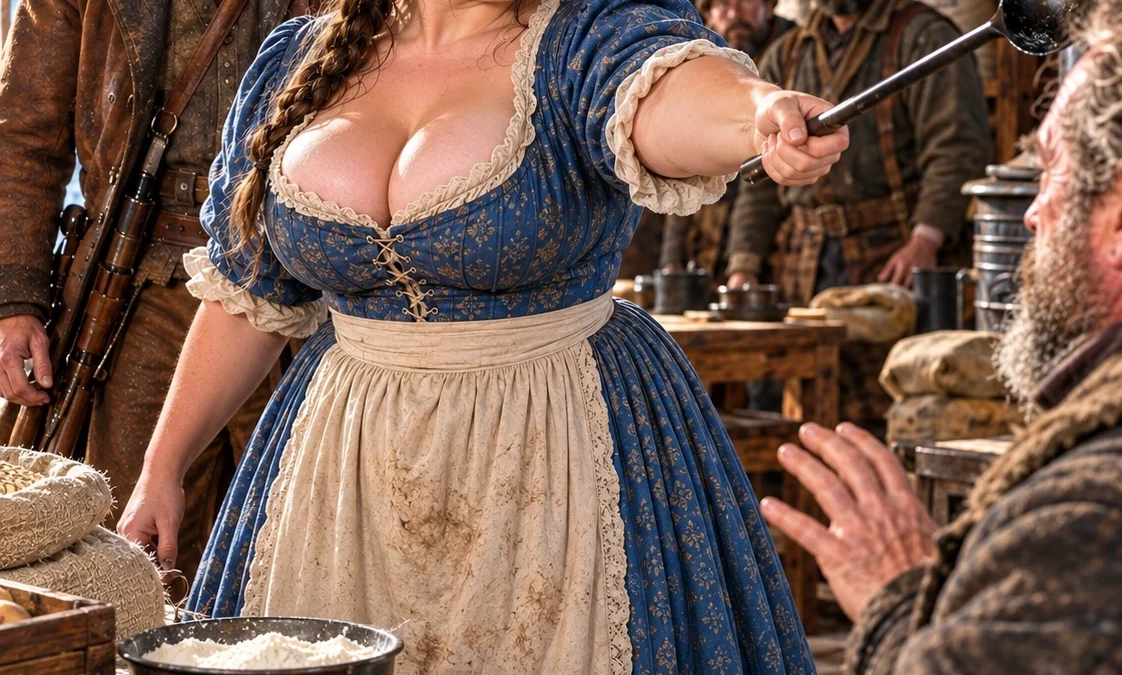
The cast iron ladle came down hard against the shelf edge. 🔨
Not across Wallace Mun’s reaching hand, but close enough that the crack of it rang off the timber walls like a rifle shot.
All eighteen men jammed into the Blackwater cookhouse went completely still.
Wallace pulled his arm back slowly. He looked at his own hand. Then he looked at Cordelia, at her broad shoulders filling the gap between him and the flour sacks, at her steady dark eyes, at the absolute absence of apology in her face.
“Step back from those stores,” she said. “I am not asking twice.”
Wallace straightened, trying to remember who he was.
He was the superintendent of Blackwater Timber Company’s Camp Number Four, deep in the British Columbia interior. He had held the post for four years. He had stared down company auditors, angry foremen, and one very persistent bear.
He was not accustomed to being stopped by the cook.
“Miss Frye,” he said, keeping his voice level. “Those men have been out in freezing temperatures since before sunrise. They need to eat.”
“They will eat. Tonight, tomorrow, and the day after.”
“Not if we empty those stores in one sitting.”
Dewey, a nineteen-year-old logger who had never seen a winter like this one, shifted his weight near the far wall. “She’s just the cook, Mr. Mun. Maybe we ought to…”
“Dewey.” Cordelia did not raise her voice or turn her head. “When did you last prepare a meal for yourself that didn’t come from someone else’s hands?”
His mouth opened and closed.
“That’s what I thought. You will let me do what I know how to do.”
She turned back to Wallace.
“I have enough flour, dried beans, salt pork, and oats to feed eighteen men for three days at careful rations. If we eat the way you’re proposing tonight, those stores are gone by morning. The storm won’t be.” She held his gaze. “Do you want to be the man who explains to the company why you overruled the cook and got everyone killed?”
Wallace’s jaw tightened.
Outside, the wind was doing something to the mountain that sounded less like weather and more like a decision. 🌨️
He stepped aside.
Cordelia turned to the room without pausing. “Everyone away from the outside walls. The north boards are the worst. Cold comes through those seams. Sheets in close to the stove.” She pointed at a broad man named Lemuel. “That gap under the door. Stuff it with anything you’ve got. Coats, rags, I don’t care.”
Lemuel looked at Wallace.
Wallace said nothing.
Lemuel moved.
That was how Cordelia took command of Blackwater Camp Number Four. Not with anyone’s permission. Not with a speech. With a cast iron ladle and a supply count she had been running in her head since October. 💪
She had not been hired for any of this. She had been hired in May of 1887, at three dollars and fifty cents a week, to cook three meals a day for a timber crew.
She had taken the post because it was practical. The work was steady, and the camp was remote enough that she could do it without constant observation.
And she was good at it. Not just the cooking, but the thinking that surrounded the cooking. The planning. The watching.
Cordelia Frye had been watching things other people didn’t notice since she was eleven years old.
She had grown up on a homestead in the Okanagan, the second of five children, the largest of them in every way that mattered and the quietest. She had learned early that a large girl who moved quietly through a room could hear and see almost everything happening in it.
People tended to look past her. Or through her. Or simply forgot she was there.
She decided somewhere between eleven and fourteen that this was not a disadvantage. It was a different kind of power.
The winter that taught her the rest was the winter of 1878, when the cold came in from the northeast and did not leave for six weeks. Her father had stored enough firewood for four, not six. Her mother had organized the root cellar by what looked tidiest rather than what would last longest. By the third week, her father was making decisions from fear rather than knowledge, and fear was the one resource that went bad fastest in a hard winter.
Cordelia had been fourteen. Nobody asked her.
She walked the perimeter of their property in the snow, counted the remaining wood, and quietly began redistributing what they had according to what they needed most. She moved the best root vegetables to the coldest corner. She convinced her mother to stretch the flour with cornmeal. She kept a private tally on a scrap of paper hidden under her mattress.
Her family ate because of it.
Her father never knew. She never said. 💔
At Blackwater, she arrived in May and did what she always did. She walked the perimeter. She counted what was stored and calculated what was missing. She noted which walls let the cold through and marked in her mind where the worst winter damage would come.
The men called her the cook. Not Miss Frye. Not Cordelia. Just the cook, as though she were a piece of equipment.
She made her peace with invisibility long ago. Invisible people could do an enormous amount of useful work without interference.
Six weeks before the blizzard, she began moving the critical stores to the interior walls. Two sacks of flour on a Tuesday. Three tins of salt pork on a Thursday. She said she was reorganizing for efficiency. Nobody asked further.
She mended the door frame herself. She reinforced the north window with an extra layer of oilcloth she had bought and carried in herself in September, because she had looked at that window and known it was not enough. She filled sealed crocks with water along the south wall, slowly, over weeks, so no single trip was remarkable.
Every morning, she stood at the cookhouse window and looked north at the ridge. Her knees had started aching in November, as they always did before serious cold. She trusted that ache more than any barometer.
She knew the storm was coming four days before it arrived.
She had tried once to tell Wallace Mun. He looked at her with the patient expression of a man who believed he had already processed all the information worth processing.
Supply decisions are handled at the company level, Miss Frye. Focus on what’s in front of you.
She did not try again. She finished her preparations instead, and she waited.
Then, before dawn on the morning the storm hit, a stranger stamped snow off his boots at the cookhouse door and said her name.
Not “the cook.” Her name. And what Burke Torrance told her over a cup of coffee made her blood run cold: someone else had been preparing for this storm too, in secret, and had left something hidden in the mountains. 😳
Part 2
Burke Torrance came through the camp twice a year, spring and early winter, to trade game for provisions. The loggers respected him the way men respect things they do not fully understand.
He was forty-one, wide through the shoulders, quieter than the trees. He read weather, tracked game through conditions that kept other men indoors, and knew every usable route through the mountains in a fifty-mile radius.
“Miss Frye,” he said.
She recovered before the surprise showed. “Mr. Torrance. Coffee’s on.”
He sat at the end of the table, wrapped both hands around the mug, and looked at the flour sacks along the south wall.
“You moved those.”
“Five weeks ago.”
He looked at the north window with its extra oilcloth. He looked at the sealed crocks.
“The storm,” he said. “My knees have been telling me for four days.”
“Mine too.”
“I tried to tell Mun yesterday.”
“I tried two days ago.”
They were quiet together, the way people are quiet when they have confirmed something neither wanted to be right about.
“How long can you hold the camp?”
“Three days at proper rations. Less if someone panics and overrides me.”
“There’s a trapper’s cache about two miles northeast. Up past the second draw. Whoever used it last left a full cord of firewood stacked.”
“I found it in September,” Cordelia said. “I walk the perimeter every week.”
Burke set down his mug. At the door, he stopped without turning.
“Miss Frye. You’re better prepared for this than anyone else in this camp.”
It was not a compliment. It was simply what was true. But it found a place in her she had kept sealed for a long time. 💛
“So are you,” she said.
The storm came in hard at midmorning. Not a gradual gathering of wind, but a wall of white that turned the camp from visibility to nothing in less time than it took her to cross the floor.
The men crashed in all at once, frost in their beards, wide-eyed, needing to believe they were somewhere safe. Cordelia was already at the stove with the fire at full heat and blankets stacked against the south wall.
“Every man in close! Lemuel, one blanket behind every man against an exterior board. Body heat matters more than the fire right now. The fire manages air temperature. Blankets manage you.”
Wallace Mun came through the door with snow in his graying hair and the look of a man who had not anticipated this. He opened his mouth.
“Mr. Mun,” Cordelia said without slowing, “sit down or be useful. Those are your only choices right now.”
For the second time that morning, Wallace Mun did what she told him.
Remy Caron had frostbite starting in two fingers. She had seen it before he said a word. She walked Lemuel through the treatment, firm wrapping away from the stove, slow rewarming, while managing the room with the other half of her attention.
Because the fear was building. She could feel it in the sounds men made when they were trying not to make sounds.
A logger named Witson, with a short fuse, broke first.
“We don’t have enough wood to last the night! We used half our split logs last week! I don’t know why nobody…”
“Witson.” Her voice was not raised, but it cut through the room. “Lower your voice and sit down.”
“You can’t…”
“I can, and I am.” She turned to face him fully. It was not anger. It was the complete steadiness of a woman who had considered the problem and decided not to be frightened by it. “Mr. Torrance is going for additional firewood. If you spend the next hour making every man in this room more afraid, you will make his job harder and our situation worse. Sit down.”
Witson sat. 😨
Burke was already pulling on his outer coat. Cordelia brought him what she had set aside for this. Rendered fat for his hands and face against the wind. Extra wool socks she had kept back from the general supply for three weeks. A length of oilcloth to wrap over his shoulders.
“Your current pair are wet through,” she said. “I’ve been watching you shift your weight for the last hour.”
“How long have you been watching?”
“Since October.”
He almost smiled.
At the door, she said his name. She had not planned to.
“You may not come back from this.”
He looked at her directly. “Neither will they, if I don’t go.”
She let him go.
The door closed. The cookhouse became a room in which eighteen people waited for a sound that would not come for a very long time.
Hours passed. The wind found the building with its full weight, and the whole structure shuddered in a long, low tremor. Dewey whispered, “Is it going to hold?” And then, from outside, through the howling dark, came the sound of boots on the step… 🔥
Part 3
Cordelia was at the door before anyone else heard it.
She pulled it open. Burke Torrance stood on the threshold with ice packed into every crease of his coat and a coil of rope over one shoulder that disappeared back into the blizzard behind him.
He was barely standing. But he was standing. 🕊️
“Rope’s attached to the load,” he said, his voice rough with cold. “Need two men.”
“Lemuel. Take the rope. Take Dewey.”
They went.
She got Burke onto a bench and his gloves off. He could not manage the second one himself. She worked the rendered fat into his hands with firm, steady pressure, starting at the fingertips, where the cold had gone deepest.
His hands were very cold against her palms.
“More at the cache,” he said after a moment. “Behind the wood pile. A lean-to, freshly built. The timber’s still pale. Stocked with canned goods, dried venison, cornmeal. Enough to double what you have.”
Cordelia’s hands went still.
“Someone built it this season,” Burke said. “Stocked it deliberately. Someone knew this storm was coming.”
She turned that over quietly. Someone else had looked at this mountain and this camp and made the same calculations she had. Someone had acted on them in silence, without being asked, in the same way she always did.
The thought of not being alone in that particular habit settled somewhere in her that had not been settled in a long time. 💛
Lemuel and Dewey brought the wood in four trips. The lean-to supplies came after. Cordelia counted each item as it crossed the threshold and revised her estimate upward.
It was not comfort. It was not safety. But it was survivable, and survivable was enough.
The storm peaked in the early hours of the morning. The north wall flexed, and Cordelia felt it through her palms. She and Burke braced a second timber into the corner together. She set the angle. He held it while she drove the pins.
The wall steadied.
Lemuel started clapping. Just Lemuel at first, his large hands making a genuine, unornamented sound. Then Remy, his good hand against his wrapped one. Then the others, a full, real sound that filled the cookhouse.
Cordelia stood with the mallet in her hand and did not quite know what to do with it, which was unusual for her.
“You might want to put that down,” Burke said quietly, “before they start throwing their hats.”
She set it on the shelf. She went back to work.
Dewey, minding the damper, spoke without looking up. “Miss Frye. I’m sorry about what I said. About you being just the cook.” His jaw worked. “I was wrong. I didn’t know what I was looking at.”
She looked at him. He was very young, and the honesty in it was complete, which was its own kind of courage.
“Keep the fire steady, Dewey. We’ll call it even.” 🔥
The storm eased before dawn. She felt it in the quality of the silence. She stood at the cookhouse window in the first gray light and looked at what remained of Camp Number Four.
The bunkhouse had a wall section down on the east side. The main shed had lost part of its roof. The cookhouse had held.
Wallace Mun came to stand beside her. He had been awake all night.
“You knew.”
“Yes.”
“You tried to tell me.”
“Yes.”
He was quiet for a long time. “The lean-to. Who built it?”
Burke answered from behind them. “There was a name scratched into the header timber. R. Galt.”
Wallace’s chin came down slowly. “Roderick Galt. He managed this camp before I did. Twelve years. He wrote me a letter in September about winter preparedness.” A long pause. “I wrote back that the company had updated its protocols.”
Nobody said anything.
“He built it anyway,” Cordelia said. “Because he knew someone would need it.”
Wallace looked at his hands. “Someone sensible,” he said, with no pleasure in it at all.
She let him sit with that. It was his to carry, and she was done carrying things that belonged to other people.
Eleven days later, Wallace brought a letter to the cookhouse and set it on the table without speaking while she read.
It was from the regional manager of Blackwater Timber Company, offering her a position. Camp preparedness consultant. Traveling the company’s operations across the British Columbia interior to write recommendations for winter management.
The wage was more than she had ever been paid for anything.
“It’s a real offer,” Wallace said. “I told them everything. The preparation, the rationing, the lean-to. Your name is on every page of my report.”
“Did you include Roderick Galt’s name?”
“I’m going to see him next week. I’m going to thank him and apologize. And then I’m going to include his name.”
Cordelia nodded. That was the right order to do it in.
That afternoon, Dewey appeared at the cookhouse door with his hat in his hands.
“Miss Frye. We’ve been calling you the cook for five months, and you were. You were also the reason this whole camp is still standing. We didn’t see it. We’re sorry. All of us.”
“Next time you’re in a room with someone doing work nobody asked for, you learn their name. You ask what they’re doing. You say thank you before the storm forces you to.”
“Yes, ma’am.”
The day before she was set to leave, Roderick Galt rode in on an old bay horse, careful in the snow. A large, weathered man with clear eyes and a way of looking at a camp that reminded Cordelia strongly of herself.
“I built it for whoever that was,” he told her over coffee. “Reckoned if someone was walking the perimeter in October to find a trapper’s cache, they’d know what to do with it in December.”
She looked at him for a long moment. The same quiet, thorough attention. The same willingness to prepare without recognition or permission.
She had thought for a long time that this was a lonely way to live. Sitting across from Roderick Galt, she thought perhaps it was only lonely until you found the others. 💛
“Your name is going in the report.”
“Hasn’t been a report with my name in it for twelve years.”
“It will be in this one. So that the next time someone sends a letter about winter preparedness, there is a record of what happened to the camp that didn’t listen, and what happened because one person prepared anyway.”
He was quiet. “Put it in.”
That evening, Burke came to the cookhouse. She poured coffee, and they sat at the end of the table together for the first time without a storm pressing the walls.
“The position moves,” he said. “You wouldn’t be here. Not always in the interior.”
“No.”
He looked at his mug. “I’ve been thinking about the cabin. Every time I go back to it, it’s the right thing to do. It was always the right thing to do.” A pause. “I’m not sure it still is.”
Cordelia held that carefully. She thought about what she knew of him. A man who had come to the mountains after a loss the mountains had never entirely healed, and built his life around solitude anyway, because sometimes that was all you had.
She thought about what she knew of herself. A woman who had made herself invisible for twenty-nine years and used it well, and who was done with it now.
“I am going to take this position,” she said. “I am going to do this work, and I am going to do it well, and I am not going to make myself small in rooms that have finally started making room for me.”
“I know.”
“You walked into that blizzard alone because there was no one else fit to go, and you came back. I have thought every day since about what it would have meant if you hadn’t. I don’t intend to spend the next year wondering whether I said the things I should have said while I had the chance.”
Burke was quiet for a long moment. “What things?”
“That I would like to know you better. The man who reads ridgelines and goes into blizzards alone because someone has to.” She held his gaze. “If that man wants to be known.”
Burke reached across the table and put his hand over hers. He looked at her the way she had felt him looking for days. Fully. Without needing her to be any different shape than she was. 💛
“The cabin gets quiet in February. I’ve been thinking I might need a reason to come to the city.”
“I imagine I could find you one,” Cordelia said.
She left Camp Number Four on a Tuesday morning in the first week of January 1888.
Lemuel was there to see her off. Dewey. Remy, his hand mostly healed, who gave her a long, respectful nod that said everything he would not say aloud. Wallace Mun shook her hand and told her the company was lucky and that he knew it, the most honest thing she had heard from him in six months.
Burke rode out with her as far as the first ridge. He said he was heading north anyway. She did not point out that north was the wrong direction for anything except the cabin.
At the ridge, he stopped his horse. The British Columbia interior stretched out below them, white and enormous and beautiful in the way hard places are beautiful, honestly, without flattery.
“February,” Burke said.
“February,” Cordelia agreed.
He turned his horse north. She watched him until the trees took him. Then she turned south, toward the city and the work that was waiting, toward the version of her life that had always been there but that she had not known how to claim until a blizzard stripped everything down to what was actually true. 🌅
She was Cordelia Frye. She had kept eighteen men alive through three days of the worst weather the interior had thrown at a human settlement in a decade. She had done it with flour sacks, oilcloth, a supply count, and the particular kind of attention most people never learn to pay. Without being asked. Without being thanked. Without anyone knowing it was happening until it became impossible not to know.
She was not just the cook.
She had never been just anything.
The mountain fell away behind her. The road opened ahead. And Cordelia Frye rode into the new year without looking back, because she had learned a long time ago, in a hard winter on an Okanagan homestead, that what mattered was not where you had been small.
What mattered was what you did the moment you decided to stop. 💛
This story is entirely fictional and created for entertainment purposes only. It does not represent any organization or individual, nor does it encourage inappropriate behavior. The content was generated with AI assistance.








