ELEVEN CATTLE GONE. A DEATH THREAT NAILED TO HER GATE. WHEN A STRANGER RODE OUT OF THE DARK, THE APACHE WIDOW RAISED HER SHOTGUN… THEN SAID FOUR WORDS THAT NEARLY BROKE HER PRIDE
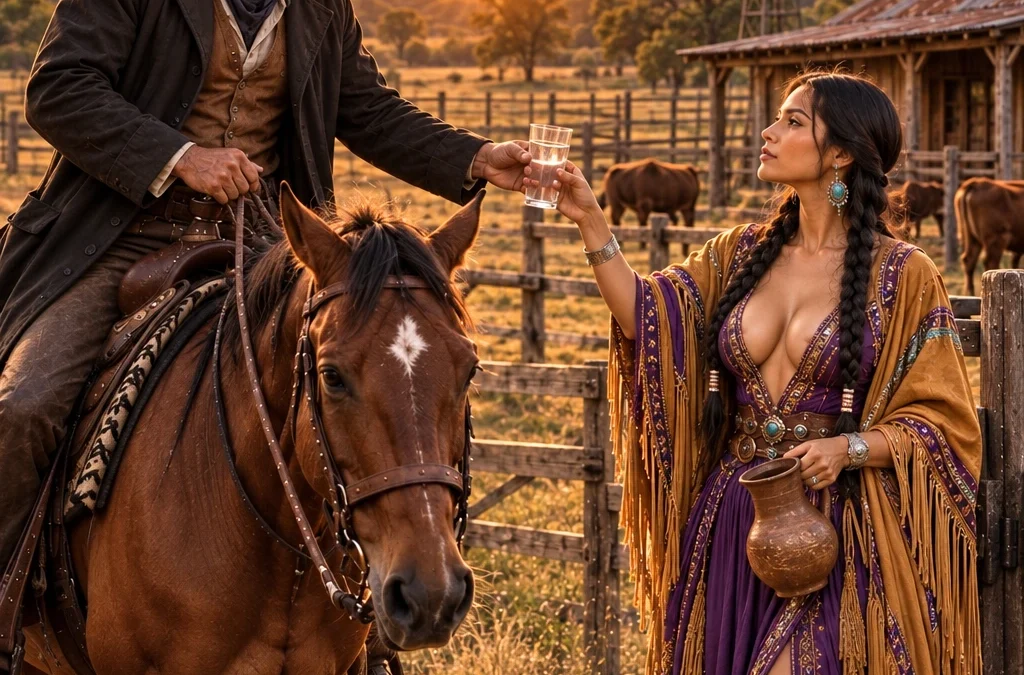
ELEVEN CATTLE GONE. A DEATH THREAT NAILED TO HER GATE. WHEN A STRANGER RODE OUT OF THE DARK, THE APACHE WIDOW RAISED HER SHOTGUN… THEN SAID FOUR WORDS THAT NEARLY BROKE HER PRIDE 😱🌵
Part 1
She had not slept in four nights. 🌙
Nia stood barefoot in the dirt with a shotgun trembling in both hands. Eleven cattle gone. And a note nailed to her own gate with a rusted railroad spike.
It had been driven so deep into the post that she needed both hands and a minute and a half to wrench it free. Four words, no signature:
Sell the ranch. Friday.
She stood in the dark holding that scrap of paper, and something shifted in her chest. Not exactly fear, though fear was part of it. It was the weight of a woman who has survived alone too long and has just been shown, clearly and deliberately, that someone has been watching.
Six weeks. That was how long since the first cattle vanished. Three animals taken cleanly from the outer pen while she slept. She had blamed the fence. The wood was old, the wire thin, and she had never managed the repairs her husband Thomas always handled.
She spent a full day fixing it. Four days later, two more animals were gone. This time the wire had not broken. It had been cut, the ends clean as a blade stroke.
That was when she understood she was dealing with people, not weather and bad luck.
She reported it to Deputy Marshal Franklin Sloan. He listened, wrote in his notebook, and promised to look into it. He did not. She went back twice. Both times he said the same thing in different words.
By the fifth week, eleven animals were gone. Her ledger told her what that meant in plain numbers: nearly a third of what she needed to carry the ranch through the dry season. If the losses continued, she could not pay the water rights fee on the spring. Without water, she would lose more cattle to the heat. By October, she would have nothing left to sell.
She understood numbers. Thomas had taught her, sitting beside her at the kitchen table on winter evenings, his finger tracing the columns. This is what we brought in. This is what we owe. This is the margin between keeping the ranch and losing it.
She had watched his hands and thought, I am learning this so I can help him. She had not known she was learning it so she could survive without him. 💔
A bull had come through the north fence one September, three years ago. Thomas went to drive it back. By the time she reached the pen, it was over. He lived three hours. She held his hand through all of them.
Several men offered to buy the ranch within that first year. The offers came too quickly and at prices too low, and she read both facts correctly. They assumed she would be desperate. They were wrong. She was grieving and exhausted and frightened, but she was not desperate. There is a difference, and Nia had always known it.
The ranch was hers, her name beside his on the original deed. She intended to keep it.
The note changed the calculation.
She was still at the gate when she heard the horse. Slow, from the east trail, the uneven rhythm of an animal near exhaustion. She stepped back and raised the shotgun.
A rider emerged from the dark and stopped twenty feet away. Broad shoulders. A slumped posture. A man who had ridden too long.
She stepped into the moonlight so he could see her, kept the barrels level, and said:
“Get off that horse, stranger. Keep your hands where I can see them.”
“Ma’am,” he said, his voice low and rough. “I’m not looking for trouble. I came for water.”
He dismounted slowly, hat in one hand, reins in the other. Tall, dark-haired, bearded, with the weathered face of years outdoors. His boots were cracked at the toe. His eyes moved to the shotgun, the gate, the note in her hand.
“Who wrote that?”
“Men who think a woman alone can’t defend what belongs to her.”
“And can you?”
She thought of the past six weeks. Three fence sections repaired. Two thefts driven off by noise and lamplight. Fifteen miles ridden twice to the marshal. Every night asleep with a loaded shotgun at her side.
“Eleven cattle gone. A death threat on my gate. And I’m still here.”
He looked at the empty pen, the broken fence. At the bruises of sleeplessness under her eyes.
“Your cattle went east,” he said. “Same direction I came from. I passed a dry creek crossing two miles out. Tracks. Cattle and at least three horses. Maybe four.”
“How do you know so much about thieves?”
“I’ve spent enough years trying to keep cattle where they belong.”
“That’s not an answer.”
“It’s the only one I’ve got tonight.”
She studied him. He had not moved toward her. He had not argued about the gun. He stood in the dark with his hat in his hands, waiting.
“Water the horse,” she said finally. “Then go.”
He led it to the trough without being told where it was. She filed that away. While the animal drank, he checked its legs, ran a hand along its back, adjusted a strap. Practical. Unhurried. The way a man moves who has cared for animals his whole life.
When he turned to thank her, Nia said the words she had been arguing with herself about for three minutes.
“How much do you charge for ranch work?”
He stopped.
“Depends on the work.”
“Cattle. Night watch.” She kept her voice level. “I have a bunk room unused for two years. I can offer meals, and a wage once the ranch is earning again.”
“So right now, meals and a bunk.”
“Yes.”
“And the shotgun?”
“Stays loaded.”
Something moved in his face. Not quite a smile.
“Fair enough. Three days. Call it a trial. Either of us decides it’s not working, we part without argument.” He set his hat back on his head. “Gideon Rusk.”
“Nia. This is my ranch. My rules. You make no decisions about this property without my agreement.”
“Your ranch. Your rules. I’m not here to take anything from you, ma’am. I’m here because you’ve got a problem and I’ve got time.”
She lowered the shotgun. Not all the way. Partway. 🕯️
That first night, over beans and cornbread, he said what she had known for two weeks but never heard spoken in her own kitchen.
“Someone wrote that note who knows about the spring. Someone who wants you gone by Friday. That’s not a hungry man stealing cattle. That’s a plan.”
“There’s a cattle broker named Orson Vale,” she said quietly. “He’s made three low offers on this land in eighteen months. He never says anything specific enough to accuse him of. But the thefts started six weeks after my last refusal.”
“Does the deputy know?”
“Sloan writes things in his notebook and thanks me for my time.” She looked up. “Mr. Rusk, I am an Apache woman alone on a ranch in Arizona Territory. I’m aware of what that means when I walk into a government office to report a crime against myself.”
He did not tell her the law would be fair. He did not offer the comfortable reassurances that would have shown he did not understand. He only nodded once, slowly, as if adjusting his understanding of the problem.
She appreciated that more than she expected to.
He took the first night watch. For the first time in six weeks, she slept.
Three hours later, his knock woke her.
“Mrs. Tso. Horse on the north fence line. Moving slow. Scouting the outer pen.”
She was on her feet before he finished. “How many?”
“One horse. I didn’t want to move on it without telling you first.”
Most men she had known would have handled it and informed her afterward, as a courtesy. He had waited in the dark to ask.
They went out separately and met at the north pen fifteen minutes later. Fresh tracks. The rider gone.
“They’re getting bold,” Gideon said, crouching. “Six weeks ago they were taking cattle. Tonight they’re measuring your fence.”
At dawn, she found something tied to the gate latch with a leather cord: a short strap of dark brown leather, tooled with a pattern of repeated diamonds.
She knew that strap. It had been part of Thomas’s saddle, the decorative piece along the right fender, made by a craftsman in Tucson the year before he died. She had looked for it after his death and assumed it was lost.
Someone had taken it from her barn. Months ago, perhaps. They had kept it. And now they had returned it as a message.
We have been inside your life.
The cold that went through her had nothing to do with temperature. 😨
Part 2
We have been inside your life.
She held the strap out without turning around. “This was Thomas’s.”
A long silence behind her. “Where was it?”
“Tied to my gate. Someone took it from my barn months ago. They kept it, and they returned it today.”
She watched his face work through the same calculation. “This isn’t about cattle.”
“It never was.”
She folded the leather carefully and put it in her coat pocket. She would keep it in her ledger beside the cattle records and the land deed and every other piece of evidence she had been building.
At the kitchen table she laid out what she knew. Eleven cattle. Five fence cuts, all on the northern and eastern borders. A threatening note with a deadline. And Orson Vale.
“I need evidence,” she said. “Not suspicion.”
“Who buys stolen cattle in this county?”
“A man named Silas Crowder. He runs a holding pen twelve miles east and doesn’t ask about brands. And not one of my eleven animals appears in the county sale register. Someone is moving them through a system that generates no paperwork.”
“Then someone needs to look inside that pen,” Gideon said. “Not you. Nobody knows I’m connected to this ranch.”
She looked at him across the table. Three days ago she had aimed a shotgun at him in the dark. She assessed people the way she assessed her ledger: not by what the numbers were supposed to say, but by what they actually said. His said competence, discipline, and the patience to wait. He had not overstepped.
That did not make him trustworthy. It made him worth watching.
“You look. You don’t ask about brands. You come back and tell me.”
He returned three hours before sunset. “Crowder has animals in the back section. Fresh brands, some still healing. But under the new mark on one cow, I could see the original.” He met her eyes. “A box T with a half circle.”
Thomas’s brand. The one they had registered together nine years ago.
“Crowder is re-branding your cattle and selling them. And over a whiskey, he mentioned Vale’s name first.”
She stood very still in the late heat. She had known. But knowing and having a man come back with direct testimony were different things.
“Can you testify to this?”
“Even knowing Vale has influence and would make it unpleasant for anyone who moved against him?” He held her gaze. “Mrs. Tso, I’ve been moving toward unpleasant things my whole working life.”
Deputy Sloan, for once, moved. He sent a man to Crowder’s that same evening. Two animals had been moved. Three remained, with the original box T still visible beneath the new brand. Crowder was in custody, answering questions he did not want to answer.
Progress. But Friday was two days away.
“The spring feeds the trough through a wooden line,” Nia said. “A knife and a good axe would be enough.”
They watched the water line two nights. Nothing came. She found that more unsettling than another theft.
On Thursday, three horsemen rode up the east trail at a deliberate pace, the pace of men who want to be seen. Orson Vale sat his gray horse ten feet from her fence, thick in the shoulders, silver at the temples, his hands clean, his eyes not kind.
“I understand you’ve had some difficulty with cattle loss.”
“The marshal’s office is looking into it.”
Something flickered in his eyes. Very brief.
“I wanted to reiterate my offer. It would free you of the financial pressure, the risk of further loss.”
“No. It’s a third below market and we both know it.”
“The trouble with land,” he said, his voice harder under its pleasantness, “is that it only belongs to you as long as you can hold it.”
Boots on hard ground. Gideon came around the barn at an unhurried walk and stopped three feet behind her left shoulder. He said nothing. He did not touch the rifle. He just stood there with the stillness of a large man who has made a decision.
“This is my foreman,” said Nia. “I have a ranch hand. A relationship with the marshal’s office. And a deed recorded in the county register with my name on it. So when you talk to me about holding land, understand that I have held this land for nine years. And I intend to go on.”
Vale studied her. “Of course. I meant no disrespect.” He turned his horse.
When he had gone, Gideon said quietly, “You didn’t need me there.”
“No. But it mattered that you were.”
That evening, a man came up the east trail on foot, hat in both hands, head bowed. She went to the gate with the shotgun. He stopped at fifteen feet.
“I’m not armed, Mrs. Tso.”
“State your name and business.”
“Hollis Mercer. I came because I owe you an accounting.”
Her grip tightened. “You’re one of them.”
He did not deny it. He did not look away.
“Three nights. I was part of three of the thefts.” He pressed his hat between his hands. “I came to tell you what I know, and to say I’m sorry. I understand if that carries no weight.”
“Why are you here?”
“Because Crowder’s been picked up. When Crowder’s backed against a wall, he’ll talk about whoever is easiest to talk about. That’s not Vale. It’s me.”
Gideon appeared from the barn, reading him. “How’d you get started?”
“Lost my work when the Delaney ranch shut down after the drought. My wife Ruth got sick. Lung trouble, going on eight months. Medicine costs. A man found me in a saloon in Benson. Said it was easy money, moving cattle that were going to be sold anyway. Said nobody was hurting.”
“Somebody was,” said Nia.
“Yes, ma’am. There’s no version of that story where I come out clean.” He met her eyes. “Vale organized it. Crowder ran it. The men doing the work were desperate or being threatened. I kept a log. In case I ever needed it. Turns out I did.”
She held the shotgun level a long moment. Then she lowered it.
“You’ll testify to everything. On the record. Names and dates. And you’ll repay what you took, on a schedule, starting with honest work.”
He blinked. “You’d hire me?”
“I’d hire a man who owes me a debt and has something to offer. I wouldn’t hire a thief. The question is which one you intend to be from this point on.”
“The first one, ma’am. I promise you that.”
“Don’t promise me,” she said. “Show me.” 🔑
She opened the gate.
But a letter arrived that night, delivered by Crowder’s lawyer, with one paragraph at the bottom in handwriting that was not a lawyer’s.
He knows about Mercer’s log. He has someone inside Sloan’s office. Leave tonight if you can. He won’t wait for Friday.
Part 3
Nia read the warning twice. She looked at the ranch: the repaired fence, the cattle secured, the water line running from the spring, Ruth mending in the lamplight, the east hill where Thomas lay.
“I’m not leaving.”
“Nia…”
“Not tonight. Not because Orson Vale sends me a warning through a frightened man’s lawyer. The question is what we do tonight.”
Gideon thought. “We need more people here.”
“Pike,” she said. “Amos Pike, our nearest neighbor. Thirty years in this county. He respected Thomas, and he’s had his own trouble with Vale.”
“Hollis, ride to Pike’s tonight. Tell him what’s in that letter. I’ll go to Sloan. If Vale has someone inside that office, Sloan needs to know now, and I want his response on the record.”
“Don’t be a hero,” Gideon said, swinging up into the saddle.
“I’m not a hero. I’m a property owner.”
They were gone. The ranch went quiet. Ruth appeared in the doorway. “I heard most of it.”
“Good. Then I don’t have to explain. Come help me move the cattle.”
They worked in the dark, doubling every latch. Then Nia sat on the fence rail with the shotgun across her lap, and Ruth sat beside her. The note had said Friday. The letter had said tonight.
They came at midnight.
She heard them before she saw them: horses moving in deliberate coordination from three directions. East trail. North fence. The dry wash on the south side, the route quietest in the dark.
Two women. One loaded shotgun. At least six horses.
She did not panic. Panic was a luxury she had trained out of herself the first weeks after Thomas died. She moved to the best defensible point, the corner where the barn wall met the fence, with solid wood at her back and a clear line to the gate.
A broad man rode up and called out. “Mrs. Tso, Mr. Vale asks me to give you one final chance to sign the sale agreement before this gets complicated.”
She said nothing. Silence has its own authority when used correctly. The man, whose name was Briggs, shifted in his saddle. He had expected fear, or argument.
“Open the gate.”
Another rider moved forward. Nia fired one barrel into the ground three feet before his horse’s hooves. The animal reared. The line along the north fence broke in thirty seconds of shouting and chaos.
“The marshal’s office has been notified,” she called from the dark. “Anything that happens here tonight will be witnessed and reported.”
“By who? I count one woman and one gun.”
“Then you’re not counting right.”
Inside the barn, a lantern flared. Ruth had lit it without being told, understanding exactly what was needed: not light, but the impression of people. A second glow bloomed in the upper window of the house where no one was, a slow-burning wick Nia had set the way Thomas taught her.
For twenty seconds, the ranch looked defended by five.
That was all she needed. Riders thundered up the east trail.
Gideon came through the gate at full speed. “Marshal’s riders two minutes behind me! Anyone who doesn’t want to be arrested will be on the other side of that gate in thirty seconds!”
Behind him rode Sloan’s deputy, and Amos Pike with two ranchers, solid men with rifles and the righteous anger of neighbors who had finally understood what was happening in their county. Briggs looked at the barn, the lamps, the riders, and made his calculation.
They went. Not running. Too professional for that. But within ninety seconds, the property was quiet.
Gideon was off his horse before it stopped. Nia came around the barn, shotgun lowered. He stopped when he saw her, upright, unhurt, and let out a breath he had been holding since he heard the shot half a mile out.
“You fired.”
“One barrel.”
Amos Pike, fifty-seven and built like a man who had never had the option to be soft, looked at her with something not quite apology.
“You held.”
“Yes.”
“I should have ridden over here six weeks ago.”
“You’re here now.” That was all she said. It was all either of them needed.
Sloan arrived forty minutes later and sat at her kitchen table. “I’m bringing Vale in tomorrow morning.” There was something different in his face, the careful political distance gone. “You came to me five times over six weeks and I gave you process when I should have given you action. That’s a failure I intend to correct.”
“Correct it,” said Nia.
At two in the morning, when the others had settled, she sat across from Gideon.
“I was frightened,” she said. It was late and she was tired, and honesty is easier when you’re both. “I kept thinking, what if Gideon doesn’t come back?”
He was quiet. “I’ve had that thought about a person before. Margaret.”
“Your wife.”
“Seven years married. She died in a fever epidemic. I was at the eastern pasture. I didn’t make it back in time.” He turned the watch chain in his fingers. “After that, I stopped. Kept doing the work, but stopped deciding. By the time I understood what I was doing, the debt was past recovering. I signed the papers and moved on.”
“But you kept the ring.”
“It wasn’t hers to lose.”
She looked at the grave marker on the east hill, straight against the stars. “I still talk to Thomas sometimes.”
“It seems like someone who loved a person.”
Nothing happened that night beyond that. But a door had opened. 🕊️
Vale came the next morning before Sloan reached him, with an attorney named Garrett and a folded set of papers. A boundary challenge filed in Tucson, citing an unpaid cattle loan taken in Thomas’s name in the spring of 1881.
“Thomas died in September of 1883,” Nia said, not touching the papers. “Any debt from 1881 would appear in the county tax records for 1881, 1882, and 1883. I have all three years in this house. Shall I get them?”
Vale’s expression did not change. Something behind his eyes did.
In the kitchen, she spread out the 1881 ledger beside Garrett’s document. Thomas had always recorded debts in the same order: creditor, amount, date. Every entry, for years.
Vale’s document read: date, amount, creditor.
“Whoever made this had access to county records but not to Thomas’s personal ledger.” She put her hand flat on the page. “They invented the format, and they invented it wrong.”
“That’s provable forgery,” said Gideon.
She almost smiled. “He used to read these entries aloud, so I could catch errors. He would have laughed about this.”
Sloan held both documents for four minutes without speaking. Then he sent writers to the territorial land office and the county records office.
That night, a warning arrived by an unnamed rider: Vale no longer needed the forgery. He meant to destroy the spring itself.
Without water, the cattle can’t survive August. Without cattle, I can’t pay September’s property tax. Without that, the county has grounds to seize the deed.
“He doesn’t need the forgery,” Nia said. “He just needs me to fail.”
She laid out the plan the way Thomas had taught her: clean, sequential, contingencies built in. Gideon closest to the spring because he was best with a rifle. Pike and his men on the western approach. Hollis with her at the midpoint. Ruth inside with the lamp signal.
“The goal tonight is not to win a gunfight. The goal is to protect the water long enough for the law to catch up. Nobody gets hurt for cattle or water rights. Is that understood?”
“Understood,” said Gideon.
At half past ten, four men came on foot from the west with an axe and a crowbar. Pike’s men held. Then Gideon moved in from the east.
“Put down the tools.”
The man with the crowbar dropped it. The man with the axe didn’t. The struggle was brief and brutal, ending with Gideon on top, the axe flung clear. The other three stood very still as Pike’s ranchers emerged from the dark.
Sloan’s deputy had them in custody within ten minutes. Hired laborers, none told whose property they were damaging.
Nia put her hand on the spring housing and felt the vibration of water moving beneath it. Still running.
Gideon came up beside her with a cut along his jaw, bleeding freely.
“I told you nobody gets hurt.”
“Nobody got seriously hurt.”
“You’re bleeding on my property.”
“I apologized for the inconvenience.”
She looked at him, exasperated, steady, reliable in the way she had not expected to find anyone reliable again. “Come inside and let me look at that.”
At the kitchen table, she cleaned the wound while Ruth held the lamp and quietly removed herself.
“I was afraid for you tonight,” Gideon said. “I kept thinking about you at the gate. I’m not good at saying this.”
“I’ve noticed. Say it anyway.”
“I don’t want to leave this place. And I think you know I mean I don’t want to leave you.”
She looked at her hands. “Ask me again when this is finished. When the dust has cleared and we can answer without fear making the answer for us.” Her voice was quieter, honest the way exhaustion makes honesty easier. “I’m not saying no. And Gideon, I’m glad you rode through that gate.”
He laid his hand over hers. She let him. 🕯️
Outside, Sloan’s riders came up the east trail with lanterns swinging. Orson Vale was placed under formal arrest at 11:47 on a Thursday night in July, 1884. The spring ran on beneath the Arizona dark, steady, cold, undamaged.
The story was not over. A territorial letter arrived days later: a second boundary claim against her eastern quarter, filed by a New Mexico landholding company called Consolidated Western Holdings. Vale had been only the county-level instrument.
She rode to the territorial office alone, wanting to know she could do it without a large white cowboy at her side. A young officer named Aldrich went white at the company name and returned with a senior officer.
“Consolidated Western has been under investigation by the Territorial Attorney General for fourteen months. Your property is the fourth parcel they’ve filed against this year.” He leaned forward. “You’ve produced more usable evidence in two weeks than my office has in fourteen months.”
At the four-day hearing in Tucson, she presented her own case. Nine years of tax records. The deed with both signatures. The ledger in Thomas’s hand and then hers. The forged debt document, with its reversed format. When the company’s attorney began asking vague questions about territorial land policy, she looked at him across the table.
“Mr. Presler, I notice you stopped asking about my property specifically. If you have questions about territorial policy, I’d suggest directing them to the territorial office, whose representatives are sitting at the next table.”
On the fourth day, the claim was suspended pending full federal investigation. Her title remained intact and uncontested.
Gideon was waiting in the corridor. “It held.”
“It held.”
“Let’s go home.”
Home. The way he said it, without ceremony, settled something in her chest that had been unsettled a very long time.
On the ride back, by a campfire, he told her about his ranch in New Mexico. About Margaret’s plans for a second spring house that he had never built. “It didn’t seem like something for one person.”
“Our spring housing is twelve years old,” said Nia. “Adequate. Not optimal.”
“I still have Margaret’s plans.”
They said nothing more. The conversation had moved something from perhaps to when.
In the weeks after, she studied the plans and made notes in the margins. He came in the next morning, read them, and added two of his own. They were building something together through the margins of a dead woman’s drawings.
One evening in the kitchen she closed the ledger. “The dust has cleared.”
He went very still.
“I need you to let me finish before you answer.” She looked at her hands, then at him. “I have spent three years being sufficient. I became very good at it. I also confused being self-sufficient with being closed. The first night, you came to get me before you acted on my property. That one decision told me everything I needed to know about what you thought of my authority here.”
“It was your ranch.”
“And I want it to remain mine. The deed, the decisions, the final word. That doesn’t change.” She pressed her lips together. “My husband gave me that. I didn’t think I’d find it again.”
“I’m not Thomas,” he said carefully.
“No. He laughed too easily and had no patience for ceremony. You’re careful and steady and you notice what other people walk past. You’re not the same. That’s not a problem.”
“What do you want, Nia?”
She looked at the gate, where the note had hung, where he had first stopped in the dark.
“I want the man who asked me for water to stop acting like he has nowhere to go.”
He took both her hands in his. “I love you.”
“Then I love you too. I’ve known it a while. I didn’t say it because I was finishing what needed finishing first.”
“That’s very you.”
“Yes. It is.” 💛
Three weeks later, on an October evening when the heat finally broke, he asked her to walk to the gate. He carried the old battered canteen he had arrived with.
“I came here for water. That’s the honest truth. I didn’t come looking for anything else. And I found the most complete person I’ve ever met.” His voice steadied, past the rehearsed part and into the real. “I don’t want your land. I don’t want your cattle or your ledger or your authority over this property. Those are yours. I want to build whatever years I have left beside you.”
“Are you asking me to marry you, Gideon Rusk?”
“If you’ll have me.”
“You should know that marrying me means you’ll be wrong about a third of the time, and I will tell you so.”
“I’m counting on it.”
“And it means this is my ranch, and you work it with me. Not for me. Not instead of me. And I’m not replacing Thomas. You’re not replacing Margaret.”
“No. We’re building on it. Thomas straightened everything that was crooked. He’d approve of the fence work.”
She laughed, the full laugh she had not used in three years. She took the canteen from his hands.
“Yes. I’ll have you.”
They married in November at the ranch gate. Sloan came, having decided to be a different kind of officer. Pike came with his quietly formidable wife. Hollis and Ruth came, Hollis in borrowed clothes, Ruth in a dress she had made herself. When the county justice finished, Hollis started clapping, and the others joined, and the sound scattered across the property like something that had been waiting a long time to be released. 🎉
Two years passed. Vale’s sentence was reduced by his lawyers but not eliminated, and Consolidated Western’s principals faced federal charges in two territories. Hollis testified at the federal level without flinching, the moment that closed the question of who he had become. The spring house was built the following spring, from Margaret’s plans with Nia’s topographical adjustments and Gideon’s construction. They argued twice and disagreed once about the secondary intake, which Nia won on the merits.
“You were right,” Gideon said when the flow improved exactly as she predicted.
“I know. You don’t have to sound so pleased.”
“I’m not pleased. I’m satisfied. There’s a difference.”
“There is. I’m still learning them.”
One hot afternoon, Hollis asked her at the fence line why she had hired him. She looked down the line. “Because someone once helped me when I was frightened. And I decided I didn’t want fear making every decision for the rest of my life.”
“You never looked afraid.”
“I was terrified. Every night for six weeks. Being afraid and showing it are different things. And being afraid and letting it control you is a third thing entirely. You came to my gate afraid and you told the truth anyway. That’s the only reason I opened it.”
“Thank you, Mrs. Rusk.”
On a hot afternoon in the second summer, a young traveler stopped at the gate with his hat in both hands, the same way Hollis had held his. Looking for work. Four days on the road. Gideon came up behind her and said nothing.
Nia looked at the young man. “We can offer meals and a bunk for tonight. We’ll talk about work in the morning.” She opened the gate. “Come water your horse.”
Gideon looked at her. “That’s how you got into trouble the first time.”
“No, Gideon. That’s how I got out of it.”
He smiled, the real one he used only when something had struck him fully.
The windmill turned above the trough. The cattle moved on schedule. Ruth’s lamp glowed steady in the barn. The spring ran cold beneath the Arizona earth, through the new housing built from a stranger’s plans, into the trough where a young man’s horse drank its fill.
Her ranch. It had been hers since 1877, and it was hers now, uncontested, entirely her own. But it was something else too. A place where frightened people were sometimes helped, always with judgment. Because Thomas had been right. Generosity without judgment is sentiment. Judgment without generosity is just cruelty.
She had survived long enough. Two years ago, at a gate in the dark, she had decided to live instead. It had looked like a trembling shotgun and four desperate words and a stranger’s hands raised in the moonlight.
It had felt like the hardest thing she had ever done.
It had been the beginning of everything.
She walked into her house. The door closed behind her. The windmill turned. 🌅
💬 Which moment hit you hardest: the strap on the gate, the forged ledger format, or Hollis walking up with his hat in his hands? Tell me in the comments, and share this with someone who believes the best decisions look impossible at first! 👇
This story is entirely fictional and created for entertainment purposes only. It does not represent any organization or individual, nor does it encourage inappropriate behavior. The content was generated with AI assistance.








