Every Doctor In England Swore The Duke Would Never Walk Again… Then A Muddy Stable Girl Walked Into His Dark Room And Said The One Thing No Doctor Dared To Say
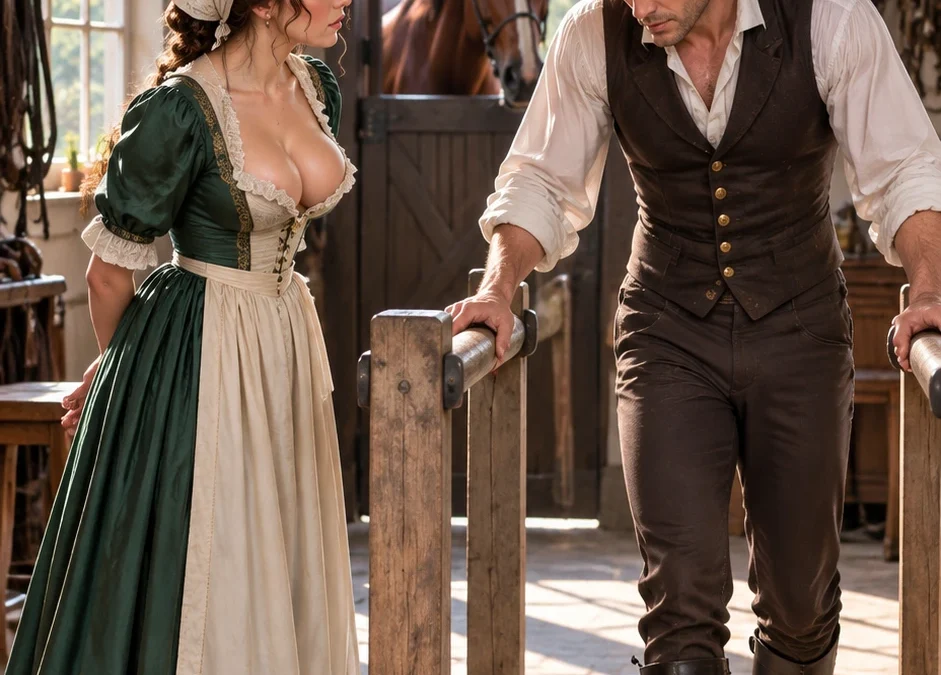
Every Doctor In England Swore The Duke Would Never Walk Again… Then A Muddy Stable Girl Walked Into His Dark Room And Said The One Thing No Doctor Dared To Say 😱
Part 1
Every doctor in England had said the same thing about the Duke of Brackenridge.
He would never walk again.
They said it in his bedroom with their voices lowered. They said it to the butler, the housekeeper, and the cook. By the end of the second month, even the lowest servant repeated it as plainly as the weather.
The Duke will never walk.
And nobody believed it more than the Duke himself. 💔
Nobody except one person. A girl who smelled of hay and horse liniment, who had never once been allowed through the front door of the house she worked beside, and who was about to climb the main staircase with mud on her boots and tell the Duke what no doctor had dared to say.
Because on the first morning of June, in front of three thousand people and a magistrate who had come to watch him fail, the Duke of Brackenridge was going to do something every doctor in England had sworn was impossible.
And it all began with a single step, taken in a stable very early one morning, with a stable girl counting out loud.
It was the second week of April, and the Marrow Valley was green all the way down to the river.
From the stable yard of Brackenridge Hall, a person could see all of it: the winding silver water, the little village of Little Marrow with its crooked church tower, and beyond them both, standing in the pale morning light, the bridge.
It was the most beautiful thing in the county. Seven tall arches of cream-colored stone marched across the river, each a little higher than the last. At the far end, a single wooden scaffold still leaned against the sixth arch like a tired old man.
The bridge was almost finished. It had taken three years to build.
And the man who had drawn every stone of it lay in the east room of the great house with the curtains pulled shut, refusing to look at it.
Ren Oliver stood in the stable yard with a bucket in one hand and a brush in the other, and she looked at that bridge every morning the way some people look at a candle in winter.
She was twenty-four, with a long brown braid tied up with a bootlace, freckles that never faded, and forearms as strong as a blacksmith’s. Her father had been a horse doctor who traveled from farm to farm with a leather bag, and he had taught her one lesson above all.
A body that has been told it can’t will usually believe it. But a body that is asked gently, every single day, to try one small thing will very often surprise everyone.
She had worked at Brackenridge Hall for two years, ever since her father died. She slept in the little room above the tack room. She cleaned twelve stalls before breakfast.
And not once had she been invited past the kitchen door.
On this particular morning, a black carriage waited in the yard, and a tall man in a long coat was climbing into it. Dr. Mercer had come all the way from London at enormous expense, the third famous doctor in two months to make the same journey. Behind him on the gravel stood Holloway, the old butler, white head bowed.
“Doctor, please. Is there truly nothing more to be done?”
“I am sorry, Holloway.” The doctor pulled on his gloves as though already thinking about his luncheon. “The bone in his spine has healed crooked, and the nerves below it are finished. He will not walk again. Keep him comfortable, keep him quiet, and above all, do not give him any foolish hopes.”
The carriage door closed. In the stable yard, Ren set down her bucket so hard that water splashed across the cobblestones.
“That is exactly what they said about Maple,” she told nobody at all.
Holloway turned. He was sixty-four and had served the family for forty years. “I beg your pardon, Miss Oliver?”
“A mare my father treated when I was twelve. She broke her hind leg in three places. Three horse doctors told the farmer to put her down. My father said no. He said, give me one month of small things.” She picked up the bucket. “Maple carried the farmer’s daughter to church every Sunday for eleven years.”
Holloway almost smiled. Almost. “A horse is not a duke, Miss Oliver.”
“No, sir. A duke is harder. A horse doesn’t mind being helped.”
The old man looked at her for a long moment. Then he looked back at the tall east window, where the curtains had not moved in nine weeks.
“His Grace has not left that room since the fall. He eats almost nothing. He sends away every visitor. Yesterday he threw a breakfast tray at the wall, and I have never seen him do such a thing in all my years. He is a man who built a bridge across a river, and he is lying in the dark, waiting to be forgotten.”
“Atlas knows it,” said Ren.
Out in the paddock, the Duke’s tall bay stallion stood alone at the gate with his white-starred face turned toward the house. He had stood there every day for nine weeks. He had stopped eating hay on Monday. He had stopped drinking on Wednesday.
“Mr. Holloway, that horse is grieving. I have seen it before. He will not last another week unless somebody gives him a reason.” She wiped her hands on her apron. “And if I am any judge of men, the Duke needs the same reason.”
A footman came running from the house with a letter on a silver tray. Holloway read the name on the seal, and something in his shoulders sank.
“Lord Sheldrake. He writes every week now. He is a very patient man.”
He folded the letter into his pocket and made a decision the way a man makes one when he has run out of better ideas.
“Wash your hands, Miss Oliver. Take off those boots. And whatever you do, do not say the word pity.”
“I wouldn’t dream of it, sir. Nor the word never.” She smiled, a wide, crinkled smile. “I haven’t said that word since I was nine years old.” 🐴
The east room was the darkest room Ren had ever stood in.
The curtains were drawn so tightly that a single thread of daylight could barely creep through. Papers lay scattered across the floor, hundreds of them, covered in drawings of arches and curves and tiny careful numbers. And in the middle of a great carved bed, propped against a mountain of pillows, lay the Duke.
She had seen him from a distance before, riding across the park on Atlas with his coat flying open. He had looked like a man who owned the whole sky.
This man was thin. His gray eyes had sunk into his face. His hands lay on the blanket, long and strong and stained with ink, perfectly still, as though he had forgotten they were his.
“Holloway,” he said, without turning his head. “I told you, no more doctors.”
“This is not a doctor, Your Grace.”
“Then I do not want her either.”
“It is about the horse.”
The Duke’s head turned. A small movement, but she saw something flicker in his tired eyes, quick as a bird crossing a window.
“Atlas.”
“He has stopped eating, Your Grace.” She had planned a dozen gentle ways to say it. In the end she said it plainly, because her father always said frightened creatures could smell a lie from a mile away. “He has not touched his hay since Monday. He has not drunk since Wednesday. He stands at the paddock gate all day and looks at this house. He will not move.”
“What is your name?”
“Ren Oliver, Your Grace. I work in your stables.”
“Then you should know better than to bring me bad news before breakfast.”
“It is nearly noon, Your Grace. And you have not eaten since yesterday.”
“Do you always speak to dukes this way?”
“I have only ever spoken to one, Your Grace. And I wanted to tell him the truth.”
He stared at her. In nine weeks, nobody had spoken to him without lowering their voice.
“Have him turned out to pasture. Let him run. He will forget.”
“He is not hungry for grass, Your Grace. He is hungry for you.”
“I cannot go to him.” The words came out hard and flat. “Do you not understand what has happened to me?”
“I heard. I only asked if you could send him something.”
The Duke said nothing. Then, very slowly, his eyes moved to the small table beside his bed. A worn brown riding glove lay there, cracked at the fingers, stained dark across the palm from years of use.
“Take it,” he said. “And then go.”
Ren picked it up carefully in both hands, the way you would carry a bird.
“Thank you, Your Grace. I will come back tomorrow and tell you how he is.”
“I did not ask you to come back.”
“No, Your Grace. But I will be here at seven.”
In the paddock, Atlas did not turn his head when she opened the gate. But when she held the glove to his nose, he did something she had not seen him do in three days.
He breathed in.
His whole huge body shuddered. Then he lowered his head and pushed his soft nose into the old leather like a child pressing his face into a mother’s shoulder.
“There you are,” Ren whispered, her eyes stinging. “He has not forgotten you. Not for one moment.” 🥹
By sunset, the stallion had eaten half a bucket of oats.
At seven the next morning, Ren climbed the great staircase again. This time Holloway did not even try to stop her.
The Duke was awake, propped against his pillows with his arms folded. He had clearly been waiting.
“Well?”
“He ate, Your Grace. Oats and hay, and two buckets of water.”
The Duke let out a long, slow breath he had plainly been holding since sunset. He put one ink-stained hand over his eyes.
“Good,” he said roughly. “That is good.”
Ren pulled the heavy chair from the window and sat down without being asked. “I could tell you about Maple, if you wish.”
“I did not ask for a story.”
“No, Your Grace. But you did not say no.”
It was the closest thing to a smile that had crossed his face in nine weeks.
So she told him. About the broken leg on a frozen February morning. About the three men who had said the same hard word, and her father standing in the cold barn saying no. About the canvas sling, and the one small thing asked every day. On the first day, lift one hoof. On the second, put it down. On the tenth, take a step.
“It hurt her terribly at first. I wanted to tell my father to stop. But he said something I have never forgotten. Pain is not always the enemy. Sometimes pain is only a body saying, I am still here.”
The room was very quiet.
“Maple was a horse,” said the Duke.
“Yes, Your Grace.”
“I am a man whose back is broken.”
“Yes, Your Grace. And you are a man who built seven arches out of nothing but stubbornness. I do not think you are easier to defeat than a mare.”
His fingers moved on the blanket, restless. She watched them tap three times, then stop. She would learn later that he always did this before making a decision. Three taps, then silence. A habit from his bridge-building days, when every beam had to be measured three times before it could be cut.
And then it happened.
Outside, Atlas let out a scream so loud the window glass shook. It was the sound of a horse who had caught his master’s scent through an open window.
And under the heavy blanket at the foot of the bed, the Duke’s left foot twitched. 😳
It was only a flick of the toes. But Ren saw it. She had spent her whole childhood watching legs, and she knew what a living muscle looked like when it spoke.
“Your Grace,” she said carefully. “Your foot moved.”
The Duke stared at the blanket. “It is nothing. Dr. Mercer told me. A reflex. A trick of the nerves.”
“Then do it again on purpose.”
For a long moment he did not move. Then he set his jaw and fixed his gaze on the bump at the foot of the bed. His face went white. The cords stood out in his neck. Sweat broke across his forehead.
Nothing happened.
“Again,” Ren said gently.
He tried again. And again. Nothing moved. And at last, with a cry of pure rage, he seized the pillow behind his head and hurled it across the room.
“Do you see now? It was a trick! I cannot do it! I cannot do anything!”
Holloway took a step forward, but Ren lifted one small hand. She did not flinch. She sat still and let him shout until the last echo died.
Then she said, in the same plain, gentle voice:
“That was three tries, Your Grace.”
“What?”
“Yesterday you could not even imagine trying. Today you tried three times. My father always said, you cannot lift a stone you have never touched. And you have touched it.”
He stared at her, breathing hard, eyes bright and wet and furious. And somewhere behind the fury, so faint she might have imagined it, something stirred that had been asleep for nine long weeks.
“Get out,” he whispered.
“Yes, Your Grace. Seven o’clock tomorrow.”
In the hall outside, she leaned against the wall and pressed her palm over her mouth and laughed softly in pure joy. 😭
At seven the next morning, she found something she had not expected.
The curtains were open. Only a hand’s width. But a long bright blade of sunlight lay across the carpet, and in it sat the Duke, shaved, hair combed back, a cup of tea going cold in his hands.
“Sit down, Miss Oliver.”
She sat. Holloway placed a second cup in her hands, and she saw his fingers tremble.
“I owe you an apology. I shouted at you yesterday.”
“You did not shout at me, Your Grace. You shouted at the blanket. I only happened to be sitting near it.”
The corner of his mouth moved. Then he looked out through the gap toward the seven pale arches glowing in the early light.
“When I was ten, my mother and I came home in spring when the river was high. There was no bridge then, only the old ford. The coachman said the river was too deep. My mother wished to be home before dark.”
His voice was perfectly steady. His knuckles had gone white around the cup.
“The carriage went in, and it did not come out. I was thrown clear. A farmer pulled me from the reeds. I stood on the bank and watched the river carry my mother away.”
Nobody spoke. Somewhere below, a clock struck the quarter hour.
“Every year, somebody drowns at that ford. A shepherd. A child on a pony. A woman with a basket of eggs. And every year, the men who own the ferry on the far side say a bridge would be too costly, too dangerous, too foolish.”
“Lord Sheldrake,” Holloway said quietly.
“Lord Sheldrake.” The Duke said the name as if it tasted of old iron. “I borrowed a great deal of money from him to build it. No other bank would lend me so much. And do you know what the old laws of this county say? That no bridge is lawful until its builder has crossed it, on his own feet, before the magistrate and all the people.”
“And the loan?” said Ren slowly.
“If the bridge is not lawfully opened on the first day of June, it passes to Lord Sheldrake. Seven arches, and every toll that will ever be paid. His ferry will keep running, and the ford will go on taking lives for another hundred years.” His gray eyes were very bright. “That is seven weeks from now. I cannot walk across a room, Miss Oliver. I have built a perfect bridge, and I cannot cross it.”
Ren set down her teacup. She did not feel pity. It was something sharper and warmer, the feeling her father used to describe when he looked at a broken animal and saw not the injury but the work ahead.
“Your Grace, may I ask you something? What did Dr. Mercer say about your toes?”
“Nothing.”
“He said you would never walk again. That is a very large sentence. But a very large sentence is made of very small words, and he never said one of them. He never said you could not move your foot. He never said you could not take one step.” She leaned forward. “I watched your foot move yesterday. That was not a trick. That was a muscle that has been told to sleep for nine weeks and has just heard its own name.”
His right hand began to tap on the blanket. One. Two. Three. Then it stopped.
“If I try and fail, I lose the bridge twice. Once to the law, and once to myself.”
“If you do not try,” said Ren, “you lose it only once. And you will never find out whether you could have kept it.”
Holloway cleared his throat, and his old voice was rougher than anyone had heard it in years. “Your Grace. Forty years ago, your father told me a Brackenridge never refuses a breach. I did not understand him then. I think I understand him now.”
The Duke looked at his butler. He looked at the girl in the stable apron with hay in her hair. And with deliberate calm, he lifted his hand and tapped the blanket three times.
“Seven weeks.”
“Seven weeks of small things,” said Ren. “That is all I am asking. And if it is too hard, we do it again tomorrow. And if it is still too hard, we do the smaller thing that comes before it.” She smiled, the wide freckled smile that had once calmed her father’s most nervous horses. “That is the only rule I know, Your Grace. You never have to do the whole thing. You only ever have to do the next thing.”
They made their plan that same morning. Nobody must know, for kindly gossips would carry the news to Lord Sheldrake within a week. They would work at dawn, in the old tack room behind the stables. Holloway would carry the Duke down the back stairs in a garden chair. And every morning, Ren would make a mark in chalk on the stable wall.
“Why chalk?”
“Because on the bad days, you will need to see how far you have come.”
And on the nineteenth morning, in the rain, with Ren standing three steps away with her hands behind her back, the Duke of Brackenridge would let go of both rails.
And Lord Sheldrake, who never forgot a thing, had just noticed a smudge of white chalk dust on the hem of a butler’s trousers. 😨
💬 Part 2 is waiting in the comments! Can’t find it? Leave any word below and I’ll send it to you privately.
Part 2
The first week was the hardest, and it looked like nothing at all.
Every dawn, Holloway carried the Duke down the back stairs while the house still slept. Every dawn, Ren waited in the old tack room with a lantern and a bucket of warm water. The Duke lay on a low bench covered in horse blankets, and she asked him to do one thing.
Wiggle your toes.
Some mornings, nothing moved. Some mornings, a single toe moved the width of a thread, and Ren drew a small chalk line on the stable wall as though he had won a battle.
“This is ridiculous,” the Duke muttered on the sixth morning, his face gray and slick with sweat. “I have built an arch that holds thirty tons, and I cannot move my smallest toe.”
“You moved it yesterday,” said Ren cheerfully.
“By accident.”
“It has accidentally moved twice now, Your Grace. Which is how everything good begins.”
By the second week, his ankles turned in slow circles. His knees bent a hand’s width. Ren hung a canvas sling from the great beam over the bench, just as her father had done for Maple. The Duke called it the hammock of humiliation. But on the twelfth morning, dangling in it like a very tall and very annoyed sack of flour, he pressed both feet flat against the cold stone and held them there for a count of ten.
“Ten,” Ren said, and her voice cracked. “Your Grace, that is ten.”
He looked down at his own feet as though he had never seen them before. 🥹
Holloway built two rails from old stall dividers, set a bar across each at the height of a man’s hip. They were crooked. The Duke, who could not look at a crooked beam without wincing, went white when he saw them.
But on the sixteenth morning, they lifted him out of the chair, and he stood.
For three seconds, gripping the rails with both fists, knees shaking, teeth clenched, the whole world swimming. Then his legs gave out, and he fell sideways into Holloway’s arms.
He lay on the cold stone, staring at the rafters, gasping like a man who had run ten miles.
“Three seconds. That is the length of a sneeze.”
“It is three seconds more than yesterday,” said Ren, crouching beside him.
“I fell.”
“Yes. And did the sky fall too? Is the roof gone? Are the horses on fire?” She held out her hand. “You fell, Your Grace. That is what happens when a body relearns a hard thing. Now I am going to count to five, and you are going to let us put you back on your feet. Do not think about the bridge. Think only about the stone under your heels.”
He closed his eyes. His fingers tapped softly against the floor. One, two, three.
“Count,” said the Duke of Brackenridge.
On the seventeenth morning, Holloway came hurrying in from the yard with a strange look on his face.
“Your Grace. A carriage is coming up the long drive. It bears the Sheldrake crest.”
The Duke’s face changed. It was like watching a door close. Ren saw the stubborn light go out of his eyes.
“Your Grace, you do not have to go in.”
“I do. If I hide, he will know something has changed. Holloway, the chair, and my dressing gown. I am going to be a very ill man for the next hour, and I shall need you both to play your parts.”
Lord Cecil Sheldrake was a tall man with silver hair, silver rings on every finger, and a voice as soft as warm butter. He arrived wearing a smile of deep and tender concern, carrying a basket of hothouse grapes. Ren watched from the servants’ passage as he took the Duke’s hand in both of his.
“My poor dear Elias! How dreadful you look!”
“I am improving,” the Duke said faintly.
“Of course you are.” Sheldrake patted his hand as one pats a dying dog. “But I come as a friend, to spare you a great burden. The doctors tell me there is no hope of you appearing at the bridge in June. Sign it over to me this week. Quietly. No shame, no scandal.”
“You are very kind,” said the Duke, with his eyes closed.
Lord Sheldrake rose to leave. And as he turned, his pale eyes drifted across the room and fell upon the hem of Holloway’s trousers, where a faint white smudge of chalk dust lay.
His smile did not change. But he looked at it for exactly one second too long. 😨
On the nineteenth morning, it rained.
A soft gray April rain pattered on the tack room roof. The Duke sat on the edge of the bench with his hands on his knees. He had slept badly. He had not spoken since the back stairs.
“Are you afraid?” Ren asked.
“I am always afraid,” said the Duke. “I have simply become very good at building things in spite of it.”
“That is the best answer I have ever heard.”
For eighteen mornings she had stood at his side with one hand under his elbow. Today she did something different. She took three long steps backward across the stone floor, stood in the open space beyond the two crooked rails, and put her hands behind her back.
“Ren.” It was the first time he had used her name. “What are you doing?”
“I am standing here, Your Grace. That is all. I am not going to hold you. I am going to wait.”
“And you wish me to walk to you.”
“I wish you to take one step. Not three. One. You stood forty seconds without the rails yesterday, Your Grace. Your legs know how to hold you. All they do not know yet is how to move. And I think that is only a thing they need to be asked by the person they trust most.”
“I trust nobody,” said the Duke, but his voice had grown very quiet.
“Then trust the stone. It has been under you your whole life, and it has never once told you a lie.”
Holloway moved to the Duke’s left and gripped the back of the chair in both hands and did not breathe. The Duke put his palms flat on the rails and pulled himself up. His arms trembled. His legs trembled. His whole body shook like a young tree in a gale.
“Look at me,” Ren said softly. “Not at your feet. At me.”
He lifted his eyes. And in them, for one second, she saw a ten-year-old boy on a riverbank, watching everything he loved be carried away.
“I am right here. I am not going anywhere. And neither is the floor.”
He let go of the left rail.
He let go of the right.
For one wild instant he swayed, standing in the middle of the tack room with nothing at all to hold. Then the Duke of Brackenridge, who had been told by the finest doctors in England that he would never walk again, shifted his weight onto his right leg, lifted his left foot from the stone, and moved it forward.
It was a very small step. Hardly longer than his own boot.
His heel touched the floor with a soft sound. His weight rolled forward. He lurched, and for one terrible moment she thought he would fall.
He did not fall.
He stood. Swaying, with one foot a hand’s breadth in front of the other, in the middle of an old stable in the rain. 😭
“One,” Ren whispered.
Nobody moved. The Duke looked down at his boots as if they belonged to somebody remarkable. Then his face crumpled like paper held to a flame, and the tears came pouring down. He laughed and wept at once, head thrown back. Holloway, who had not wept since the death of the old duke, covered his face with his handkerchief and sobbed like a child.
“One, Ren,” the Duke said. “One.”
Out in the paddock, the big bay horse let out a long ringing neigh that could be heard clear across the valley.
Ren took the chalk from her apron pocket with a trembling hand and drew a long white line across the stone, exactly where his boot had landed.
“The first step. Right there. And nobody is ever going to wipe it away.”
It took Lord Sheldrake only six days.
On the morning of the twenty-fifth day, two men in dark coats arrived at Brackenridge Hall with a paper signed by the county magistrate. Behind them, in a carriage, sat Lord Sheldrake himself, looking very sorrowful. His silver snuffbox, he told the constable, had gone missing during his visit of kindness. A footman had seen the stable girl slip from the house that same afternoon.
Holloway stood across the door with his arms spread wide. “You will not search this house, sir.”
“Only the girl’s room,” said the constable uncomfortably.
Ren stood in the hall with her face white. She had never in her life touched anything that was not hers. But she knew with cold clarity exactly how this would end. The snuffbox would be found in her room. And a girl who steals from a lord is not believed about anything else.
“Stop.”
The voice came from the top of the great staircase. It was not loud. It did not need to be.
Every head turned. At the top of the stairs stood the Duke of Brackenridge in his dressing gown, gripping the banister. His face was gray. His legs were shaking.
He was standing on his own two feet. 😱
“Your Grace,” Holloway whispered.
“Do not help me, Holloway. Not this time.”
The Duke took the carved ash walking stick that Ren had made for him and began, one slow step at a time, to descend. There were fourteen stairs. Everyone in that hall counted. He did not fall.
At the bottom, he crossed the stone floor in six long, even strides, leaned on his stick, and looked down at Lord Sheldrake, who had gone the color of candle wax.
“Miss Oliver did not leave this house on the afternoon you describe. She was with me. She has been with me every morning at dawn for twenty-five days. She is the reason I am standing here, and if any man in this hall wishes to call her a thief, he may do so to my face.”
“Elias,” Sheldrake said, his soft voice scratching. “I had no idea you were so much recovered.”
“No,” said the Duke. “I am sure you did not.”
The snuffbox was found that afternoon, under the cushion of Lord Sheldrake’s own carriage seat. The magistrate’s men rode away very quickly.
But the Duke stood at the window afterward, watching the carriage disappear down the long drive, and his hand tapped three times on the cold glass.
“He knows now. He knows I can walk. And he has less than five weeks to make sure I never reach that bridge.”
He was right.
And on the last night of May, a knock came at the kitchen door. When Ren opened it, a man stood in the rain, soaked and shaking, his cap crushed in his hands.
It was Tom Dobbs, the foreman of the bridge. And he had come to confess what had really happened on the day the Duke fell. 😨
💬 Want to know the secret behind the Duke’s fall, and what happened at the bridge in front of three thousand people? LIKE or COMMENT “REVEAL” to unlock Part 3! It will be posted as soon as we have enough comments. 🔥
Part 3
Nearly five weeks had passed in a blur of sweat and chalk and stubborn hope. The Duke had walked the length of the tack room, then the length of the yard. One muddy morning in the middle of May, he had walked all the way to the paddock gate, and Atlas had put his head over the fence, laid it on the Duke’s shoulder, and breathed out slowly, as though he had been holding that breath for three months.
On the last day of May, the Duke walked from the stable door to the first arch of his own bridge.
And all the while, in the shadows of Little Marrow, Lord Sheldrake’s men had been busy.
Now Tom Dobbs sat at the kitchen table with a mug of hot tea between his shaking hands. The Duke sat across from him. Holloway stood in the doorway. And Dobbs told them what he had carried alone for four long months.
“It was the plank, Your Grace. The one on the sixth arch. It did not break. I saw it.” He covered his face with his huge rough hands. “Lord Sheldrake paid me forty pounds. He said nobody would be hurt. He said you would fall onto soft ground, and the delay would ruin the loan. My wife was ill. I took the money. And then you fell, and I saw you lying there in the rubble. I have not slept one night since.”
The kitchen was silent. The Duke’s face did not move. But Ren saw his hand lying flat on the table, and the knuckles went white.
“Where is the plank?”
Dobbs reached into his coat and drew out a long splintered piece of oak wrapped in sacking. On one side, as neat as a signature, ran a straight cut across the grain.
“I kept it. I could not burn it. I could not make myself.”
The Duke looked at the plank for a long time. Then he looked up at Ren, and in his tired gray eyes was something she had never seen before. Not anger. Something far steadier.
“Tom. Will you stand beside me tomorrow, in front of the whole county, and tell them what you have told me?”
Dobbs lifted his ruined face. “They will hang me, Your Grace.”
“Perhaps. Perhaps not. But I will stand beside you. You have my word.” The Duke drew a long breath. “I have learned something in this house these last seven weeks. A man who has fallen is not finished. He only has to decide whether to rise.” 🥹
The first of June dawned clear and gold.
By nine o’clock, the whole valley was full of people. They came from Little Marrow and every farm for twenty miles, in carts and on foot, with children on their shoulders. Three thousand people lined the riverbank and the green hills, every one of them looking at the seven pale arches shining in the morning sun.
At the village end of the bridge stood a small wooden platform. On it sat the county magistrate, a stern old man named Fairbanks, with a great book open on his knees. A few paces away stood Lord Sheldrake with his lawyer, in a handsome gray coat and a smile of deep and gentle sorrow.
A murmur ran through the crowd.
Down the lane from Brackenridge Hall, a plain farm cart was rolling toward the bridge, drawn by a big bay horse with a white star on his face. Holloway sat in his finest black coat, holding the reins as proudly as a king. Beside him sat a girl in a plain blue dress, her brown braid pinned up. And between them, pale in a dark green coat, sat the Duke of Brackenridge.
The cart stopped at the foot of the bridge. The crowd fell silent.
“Your Grace,” said Magistrate Fairbanks gravely. “The law of this county is older than any of us. A bridge is not lawful until its builder has walked across it on his own feet before the people. Are you prepared to do so?”
“I am.”
“I object,” said Lord Sheldrake’s lawyer, stepping forward. “His Grace plainly cannot walk without aid. That stick is aid. The law says his own feet. Not a crutch, not a cane, not a servant’s arm.”
A low, angry sound rose from the crowd. The magistrate frowned. And the Duke of Brackenridge, to everyone’s astonishment, smiled.
“The gentleman is quite right.”
He held the ash stick out sideways, and Ren took it from his hand. Their fingers touched for just a moment.
“My own feet. I would not have it any other way.”
He climbed down from the cart. Holloway held out a hand, and the Duke shook his head. He stood alone in the road, tall and white-faced, swaying very slightly in the summer wind with nothing in his hands at all.
Then he turned to face the long ribbon of the bridge, seven arches and a hundred and forty yards of sunlit stone.
And took the first step.
Nobody in that crowd would ever forget the next hour.
He walked so slowly that at first nobody understood he was walking at all. A heel, a toe, a pause, and a heel again. Ren walked half a pace behind him, hands clasped tightly in front of her. Not touching him. Not helping. Only there. Every few steps she said something so softly that only the Duke could hear.
Good. That is one. That is two. Only the next thing, Your Grace. Only the next one.
At the first pier, where a stone bench stood in a hollow that he had designed himself, he sat to rest, and the crowd began to clap. At the second pier, he rested again. At the third, a small girl broke away from her mother, ran onto the bridge, and pressed a bunch of wildflowers into his hand. He thanked her gravely and kept walking with the flowers crushed in his fist.
Then, near the fourth arch, a woman at the back of the crowd called out.
“One!”
“Two!” shouted a man beside her.
It spread. It rolled across the river like thunder. Three thousand voices, young and old, farmers and shopkeepers and weeping grandmothers, counting out his steps. 😭
Ren heard it, and her eyes filled so fast she could hardly see the road. The Duke heard it too. His shoulders straightened. His stride lengthened. His head came up.
And at the fifth arch, his left knee buckled.
A gasp went up from the whole valley. He staggered. His hand shot toward the parapet. For one dreadful moment he hung between standing and falling.
And in his head, clear as the voice of a friend, he heard a girl say: You never have to do the whole thing.
Ren was beside him in an instant. But she did not catch him. She did not touch him at all.
“Your Grace,” she said, low and steady. “Look at me.”
He looked. His face was streaming with sweat. His eyes were wild.
“You have walked a hundred yards. You built seven arches. You were told no by every clever man in England, and you are still here. There is only one thing left. Not the whole bridge. Not the whole law. Only the next step.” She smiled at him, a wide, bright smile, like a lamp in a dark room. “Take it.”
The Duke of Brackenridge drew a breath.
He set his feet.
And he took the next step.
He walked the fifth arch. He walked the sixth. He walked the seventh. And when his boot finally came down on the far bank, on solid ground, on the grass beside the road, the sound that went up from that valley shook the birds out of the trees. 🎉
Magistrate Fairbanks rose, and his voice rang across the water.
“Let the book show that the Marrow Bridge is lawful, and that the Duke of Brackenridge has crossed it on his own two feet!”
Then a big rough man pushed through the crowd, climbed onto the platform, and held up a long splintered plank.
“And let the book show that this is the plank he fell from,” said Tom Dobbs. “And that Lord Sheldrake paid me forty pounds to saw it.”
Lord Sheldrake did not wait for the magistrate to speak. He turned white to the lips and began to push through the crowd toward his carriage. But three thousand people stood between him and the road, and not one of them moved aside. Two constables caught his silver sleeves before he reached the lane.
The Duke did not watch him go. He was leaning against a pier of his own bridge, looking back across the seven arches toward the place where his mother’s carriage had gone into the water. His face was wet. He did not wipe it.
“It is finished, Your Grace,” said Ren, coming to stand beside him. “You did it.”
“We did it,” said the Duke. “I put one foot in front of the other. But you taught me I had feet.” ❤️
That evening, he made one proclamation to the people of Little Marrow. No toll would ever be charged to any villager who crossed the bridge. The old ford, where so many had drowned, would be closed forever and planted with willows in his mother’s name. And Tom Dobbs, who had told the truth when it cost him everything, would keep his place and his wages.
The next morning, very early, before the house was awake, the Duke walked alone down to the tack room.
There was no chair. There was no butler. There was only a long white line of chalk on the stone floor and a girl in a stable apron standing at the far end with her arms folded and her eyes bright.
“I was told you would be here,” she said.
“By whom?”
“By the horse.”
He crossed the floor in thirty-three steps, which he counted, and which he would count again on every anniversary for the rest of his life. When he reached the end of the white line, he stopped in front of her and took both her hands in his.
“I should like to kneel. But the physician in charge of my recovery is a very fierce young woman, and she has forbidden it until the autumn.”
“She sounds sensible.”
“She is the most sensible person I have ever met. She told me once that I never had to do the whole thing. Only the next thing.” His fingers tightened around hers, and he tapped them once, twice, three times. “So here is my next thing. Ren Oliver, will you marry me? Not because you saved me. Because you made me believe in my own feet. And I would very much like to spend my life walking beside you.”
She did not answer at once. She stood in the dusty gold light with her hands in his, laughing and crying together.
“One,” she whispered.
“One?”
“That is my answer, Your Grace. It is the first step. And I am going to take every one after it with you.” 💍
Years later, people in Little Marrow still told the story of the Duke who crossed a river on his own two feet, and they told it with a proud lift of the chin, because every one of them had been there.
If you ever stand on the fourth arch of the Marrow Bridge and look down at the old stone bench, you will find a small brass plate set into the wall. It carries no title and no coat of arms.
It says only this:
Only the next step.
💬 If this story touched your heart, tell us in the comments: which moment will you carry with you tonight? The first step in the rain, the three thousand voices counting, or Ren standing three steps away with her hands behind her back? Like and share this with someone who needs to hear that they only ever have to take the next step. 🙏
This story is entirely fictional and created for entertainment purposes only. It does not represent any organization or individual, nor does it encourage inappropriate behavior. The content was generated with AI assistance.








