Every Household Threw Her Away for Her Size. Then One Wounded Rancher Discovered Why She Was the Only Person Who Could Save His Ranch
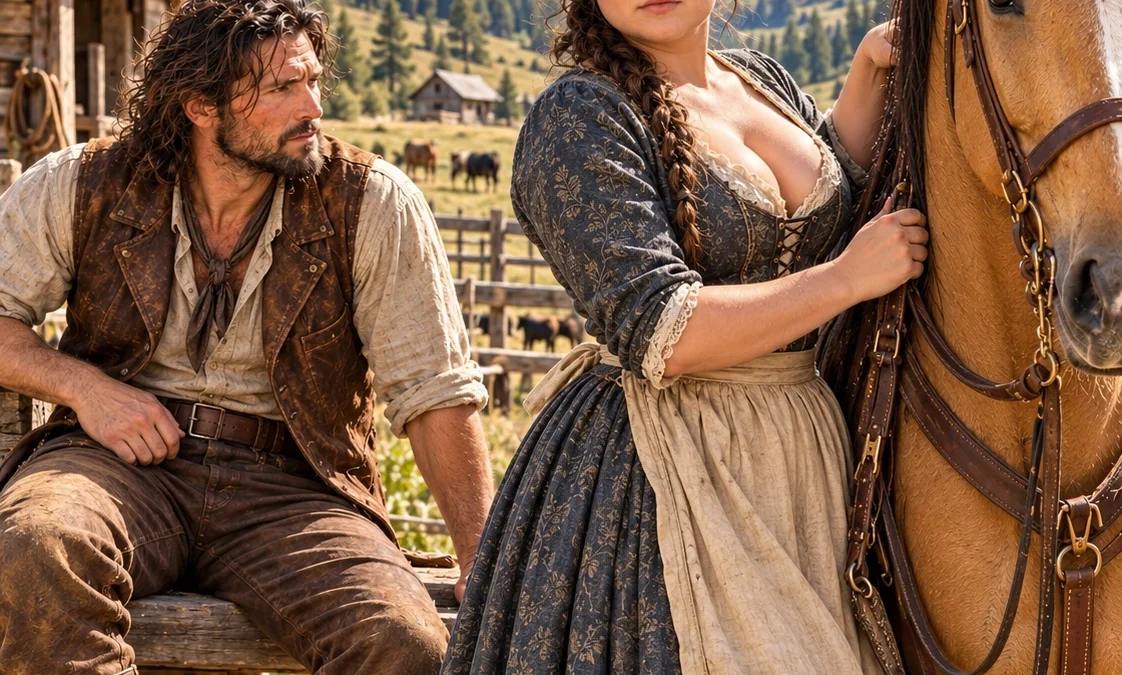
Every Household Threw Her Away for Her Size. Then One Wounded Rancher Discovered Why She Was the Only Person Who Could Save His Ranch 😱
Part 1
The horse was still standing, but only because Copper didn’t know what else to do.
For three days, the buckskin had paced the far side of the paddock with a hitched, wrong-angled gait that meant something inside him had broken. And every evening, Crane Ashford stood at the fence with a rifle in his hand, unable to lift it high enough to do what a man in that situation was supposed to do. 💔
Six weeks earlier, Crane had still believed stubbornness was a form of competence.
Most men who ran cattle in the Alberta foothills believed the same. The land selected for it. You kept moving through pain and weather and the endless grinding work, or the country swallowed you whole, and nobody came looking for the bones.
For eleven years he had run the Ashford ranch. Beck Prater, his foreman, had a face like old saddle leather. Yule was twenty-two and eager. Solmes was past sixty and had been everywhere and talked about none of it. Four men, two hundred and thirty head of cattle, twelve horses, on leased land east of the Crowsnest Pass.
It had always been enough.
Then the rockslide took out the north fence line on the same evening Crane was riding it alone. 🪨
He never heard it coming. The shale had been loosening all through the wet September, and when it let go, the ground beneath his horse simply wasn’t there anymore. Copper went sideways. Crane went with him. They hit the slope together. Copper scrambled up almost at once. Crane did not move for several minutes.
Four broken ribs on the right side, two of them clean through. His left knee swollen to twice its size from being trapped under the horse. Beck found him at dusk, led there by Copper standing at the fence line where Crane hadn’t come back from.
“You’re breathing,” Beck said.
“So far,” said Crane.
The doctor from Pincher Creek delivered the verdict with the bluntness Crane had always respected. “If you work through this the way I know you’ll want to, you’ll turn a recoverable injury into a permanent one. Six weeks of rest. Minimum.”
“I have cattle to move before the first hard freeze.”
“Then Beck will move them.”
“Beck is one man.”
“Then hire someone. You can argue with me, Crane, or you can heal. Those are the options.”
Crane sat in his kitchen long after the wagon left, in the silence of a man whose body had made a decision without consulting him. The first two weeks were the worst he had known since his wife Eleanor died. It was a different kind of bad. Smaller. More humiliating. The kind that came from helplessness rather than grief. 😔
Then Copper’s lameness began.
The fall had shaken the horse in ways nobody had looked at closely. By the third week he was favoring his right rear leg, wouldn’t eat properly, and stood at the far edge of the paddock with the absent, inward look of an animal dealing with something it couldn’t name. Every evening Crane went to the fence. Every evening Copper stayed at the far side and didn’t come.
Beck put out word for a cook, someone to manage the household so the men could stay on the work. The notice was honest: remote foothills ranch, hard conditions, a difficult employer, fair wages.
No one came. One woman rode as far as the yard, looked at the trail she’d just ridden, and turned around without dismounting. Another sent word that she’d heard about Crane Ashford and was not interested. A third decided the stove was a hazard and left before noon.
Then Beck set a folded letter on the table. A woman in Fort Macleod. Solid references.
“The hotel let her go after eight months,” he said. “The manager’s letter says she wasn’t the image they wanted for the dining room.” He paused. “She’s a large woman. You know how people are.”
Crane looked at him steadily. “Bring her up.”
Thomasine Old arrived on Friday in a borrowed wagon. The driver turned his horses around before she’d finished pulling her bag from the back. She stood in the yard in a gray wool dress, a canvas apron, and a coat mended at the left elbow, and she looked at the house, the barn, the paddock, the ridge to the west. It was the slow, comprehensive look of someone deciding whether a thing deserved serious attention.
She was thirty or thereabouts, broad through the shoulders and hips, dark hair braided and pinned. There was something settled about her. Not defeated, not resigned. Located.
She went straight to the kitchen doorway without waiting to be told. Then she turned and looked at the chair by the front window, the worn groove in the floor beside it, the clear sight line to the paddock. She looked at the way he stood, weight off his left knee, his right side braced.
“Which ribs?”
“Right side. Four.”
“You’re compensating wrong,” she said, without unkindness. “The way you hold that shoulder is pressing on the two lower ones. Your back will start giving you trouble.”
He stared at her.
“My uncle had the same injury. I spent a winter learning how they healed.” She looked toward the paddock. “That buckskin isn’t lame. His movement’s too even. Something’s still frightened in him.”
“That’s a lot to read from a hundred yards.”
“I pay attention to animals, Mr. Ashford. I’m applying to cook, but I don’t separate what I see.”
“The hotel,” he said. “Why’d they let you go?”
She met his eyes. “Because when they pictured their dining room, I wasn’t what they pictured. Before that, a wife who decided I was the wrong size to be around her guests. Before that, a family in Calgary who wanted someone younger.” Level and plain. “People decide things.”
“Eleven dollars a month, room and board.”
“Fourteen. The hotel paid eleven with three times the equipment.”
He decided not to argue. “Fourteen.”
“I can start now,” she said. “If you’ve been feeding four men Beck’s cooking for three weeks, now is considerably better than Monday.” 🍲
That night, Beck ate two helpings of stew and sat in silence for thirty seconds. Then he said quietly, “Lord.”
After supper, Crane went to the paddock fence. Thomasine came and stood beside him. Not close. Just where she could see what he saw.
“Animals remember the moment the ground went wrong,” she said. “He probably can’t separate you from that memory yet.”
“He doesn’t trust me the way he did.”
“Or he’s not right either,” she said. “And he doesn’t know if you’ve noticed.”
So Crane began to stand at the gate each evening and do nothing. And each night, Copper stood a little closer. In the weeks that followed, the house changed. The kitchen stayed lit after supper. Voices came from it. One night, Crane put his hand on Copper’s face for the first time since the fall, and felt something in his chest let go. 🕯️
Then, four days later, a rider came up the trail fast, which was never a good sign on a mountain road in November.
Roddy Spear ran cattle six miles south, and he leaned forward like a man carrying news he wished he weren’t.
“Three outfits hit in two weeks,” he said before he’d fully dismounted. “Turnbull lost his winter hay. Galloway lost four horses. Pringle’s supply shed was cleaned out.” He looked at Crane. “They’re working up the valley, south to north. You’re next in line.”
Beck had come around from the barn. The cold in the yard had nothing to do with the temperature.
“And Crane,” Roddy added, “everyone knows you’re laid up. Someone watching this valley knows your ranch is short-handed right now.”
At the corner of the house, Thomasine had heard every word. And she asked a question that made Crane’s blood run cold. 😨
Part 2
“How many horses did they take from Galloway?”
Crane looked at her. “Four. Two cutters and two mares.”
She was quiet. “They aren’t stripping ranches. They’re selecting. Quality hay, trained horses, breeding stock.” Her eyes found his. “That’s not a robbery, Mr. Ashford. That’s someone building inventory for a specific purpose.”
Beck stared at her. “She’s right.”
“I know,” Crane said. And as he said it, he was already thinking of a wagon that had come up the trail eleven days ago.
A man from Fort Macleod named Vance Ord, who ran a supply and trading operation, arrived with the ease of someone making a visit whose outcome he’d already decided. He offered to buy the Ashford lease at a price that wasn’t quite insulting, and nowhere close to what eleven years of work was worth. Crane had said no. Ord had smiled the patient smile of a man who expected to come back.
“A man named Vance Ord offered to buy me out,” Crane said slowly.
Thomasine went very still. “What did he say when you refused?”
“That the offer stood.”
“Do you know which ranches he’s bought in the last two years?”
He thought about it. “The Crest place. The old Hawking lease. Both had bad years before they sold.”
“A bad year,” said Thomasine carefully, “or a bad year made worse by someone taking things from them?” 🔍
The wind off the mountain filled the silence.
“That’s not evidence,” Crane said.
“No. But it’s a pattern. And now he knows you’re not selling, which means he’ll move sooner rather than later.”
That night, they gathered around the kitchen table, all of them. Thomasine made tea and set out bread and dried meat. She asked the kind of questions that moved a conversation from what they knew to what they needed to know. Where would someone take horses off this property quietly? Which animals would stay silent in the dark? How long to cover the ground between the barn and the northwest tree line?
Crane sat at the head of his own table and looked at the four people who had stayed for their different reasons and chosen to keep staying.
She said “all of us,” and you didn’t argue, Beck had murmured earlier. Crane hadn’t answered.
They did not come at night, as he’d expected.
They came at dusk. 🌆
Beck knocked twice fast on the barn wall, their signal. “Three men on the north approach. One on foot, checking the ground ahead.”
“Professional,” Crane said.
“They know this layout,” Thomasine said from behind them. She’d come without a sound. “If they’ve watched the valley, they know where the horses are.”
Crane moved. Not at a run. His ribs and knee had strong opinions about running. But fast and low, across ground he’d walked for eleven years without needing to see it. Beck and Yule went east to cut the fence line. Solmes moved along the back of the barn. Inside, the horses, moved two nights earlier on Thomasine’s suggestion, stood hard to reach.
He rounded the corner of the back barn and found a man already at the door, bigger than Crane, and still in the way of someone who’d done this before.
“Stop,” Crane said, rifle up.
The man looked at the rifle. He looked at Crane’s right side, at the one arm carrying most of the weight.
“You’re holding that left-handed.”
“I’ve been left-handed since October. Point still stands.” ⚡
Then a voice came from behind the man. Thomasine walked around the south side of the barn with Yule at her shoulder and a second man walking ahead of them with his hands raised. She carried the short-handled spade from her garden.
“He didn’t want to slow down,” she said simply.
The bigger man put his hands up.
“Where’s the third?” said Crane.
“Gone north on a horse,” Yule said.
Crane turned on the men. “You’ll tell me who sent you, now, or we ride to Fort Macleod in the morning and you tell someone with considerably less patience than I have.”
The younger one, frightened in a way the first wasn’t, looked at his boots.
“Ord,” he whispered. “Vance Ord. He said the rancher was laid up and it’d be clean work. He told us what to take and leave so it looked like different people. He said you were the last one. That once you sold, he’d own the whole middle of the valley.”
The Alberta night was completely still.
Thomasine stood at the edge of the lantern light, her face the face of someone watching a confirmation arrive.
“He’ll run when the third man tells him what happened here,” she said.
“Unless the third man doesn’t get there first,” said Beck from the dark. “Six miles, heavy going. Forty minutes.”
Crane looked at the horses visible through the barn door. Copper stood at the back of his stall, ears forward, alive in a way he hadn’t been in two months.
“Crane,” Thomasine said softly.
She didn’t say anything else. She handed him the barn lantern and stepped back.
Crane went into Copper’s stall, and put a saddle on a horse that hadn’t been ridden since the fall. 🐎
Could a man with four broken ribs, on a horse that had been afraid of him, ride into the dark and stop a man who’d already taken everything from his neighbors?
Part 3
Crane saddled Copper slowly, with great care, every movement deliberate, working around the protest of his right side. The horse stood completely still the whole time, as if he understood that this was not the moment to be anything but steady.
He got himself up with more effort than he’d have liked. Copper stood beneath him like ground, the solid, patient earth that had always been there. 🌄
He rode out of the barn.
Thomasine was waiting in the yard. She’d come out without a coat into the cold November dusk, and she looked up at him on the horse, and her face did the complicated thing. Not the practical face, not the careful one, but the real one underneath, the one she didn’t show easily.
“Your ribs are going to hurt tomorrow,” she said.
“Tonight they’ll manage.”
She held his gaze. Then she reached into her apron pocket and held up a folded piece of paper.
“I drew it this afternoon.”
He unfolded it in the lantern light. A clean, careful map. Ord’s supply post. The back road in from the northwest. The likely place he’d stage the horses to move them south. Galloway had mentioned an old hay camp two miles west of Ord’s post. That’s where they’ll be holding what they took.
He looked up. She had known. She’d had it ready before he’d even decided to ride.
“You were going to go yourself,” he said.
“If it came to that.”
She didn’t look away. He sat with that a moment. He had wanted to say something about being careful, about coming back. None of it came. What came instead was this.
“I see you. What you’ve done here. I want you to know that I see it.”
Her eyes were bright in the lantern light.
“You always have,” she said. “That’s why I stayed.” 🤍
He touched his heel to Copper’s flank. The horse moved clean and strong and willing into the dark.
They found Ord at the old hay camp with the stolen horses, two men, and the easy bearing of someone who’d believed he had more time than he did. Crane rode in from the north with Solmes behind him, the lamplight spilling from the old shed like an answer to a question.
When Ord looked up from the camp table and saw who stood in the doorway, he made the mistake of reaching for something on his belt.
“Don’t,” Crane said.
Ord froze.
One of his men bolted for the door. Solmes stepped into the frame and stopped that very efficiently. The third man, the one who’d ridden north, was already there with his hands raised, looking like someone who had made a catastrophic miscalculation in his choice of employer.
By the cold clean light of dawn, Beck and Yule were riding to Fort Macleod with five tied men, and the foothills lay very clear and very simple and very final in the morning. 🌅
That night, Crane sat at his kitchen table with his arm in the sling Thomasine had put him in without asking permission. His shoulder and ribs were having a conversation he was staying out of. The tea in front of him was exactly the right temperature, which she’d worked out somewhere in the second week without being told.
She sat across from him, hands around her own cup.
“You rode.”
“I rode.”
“How is Copper?”
“Better than before.”
She nodded. “That’s what I thought would happen.”
“Why did you draw that map?” he said. “Before I’d even decided.”
She was quiet a moment. “Because I’d watched you stand at that fence for three weeks. Choosing patience over the instinct to make something happen. And I thought that if you decided to ride, you should have everything you needed to do it right.”
He sat with that.
“When I hired you, I didn’t ask for someone who’d think about things I hadn’t asked for.”
“I know,” she said. “That’s what made it necessary.”
He almost laughed. He was not, he’d recently discovered, entirely immune to the urge. 😊
He put his left hand on the table. She looked at it. He turned it palm up.
She set her hand in his.
They sat in the warm light, with the mountains outside and the winter coming and the ranch still standing around them. And the silence was not the angry silence of a broken man alone with his failure, nor the careful silence of two people keeping professional distance. It was the silence of two people who had been honest through something hard and had arrived together on the other side of it.
“I need you to know something,” Thomasine said at last.
He waited.
“I have been told my whole life that what I am is too much. Too large, too direct, too certain of myself for other people’s comfort. I’ve been asked, more times than I can count, to make myself smaller, by households, by hotel managers, by people who hired me and then decided they’d hired the wrong thing.” She kept her eyes on his. “And I’ve spent a long time carrying the worry that they were right.”
Crane was still.
“They were not right,” he said. “I can tell you that with considerably more evidence than they had.”
She looked at him for a long moment, and her eyes were wet.
“I know,” she said. “That’s the other reason I stayed.” 💛
He turned his hand over and held hers properly. It was a simple thing and an enormous thing, and it was enough, and more than enough, and they both knew it.
Winter came the way Alberta winters do, without apology and without delay. But the Ashford place met it differently than it had met any winter before. Beck and Yule and Solmes worked through the freeze with the energy of men who were fed properly and had reason to believe in what they were doing. The hay was stacked, the cattle moved to the lower pasture, the fences mended, the barn banked against the cold.
Every morning, Crane saddled Copper with both hands, the right side improving slowly, the ache permanent as the doctor had promised, a souvenir of the slope. He rode out to the fence line and back, relearning the rhythm of the horse and the land and his own body in it.
In the evenings, Thomasine wrote in a notebook at the kitchen table. Room layouts. Supply lists. A calendar of seasonal produce. Notes on what travelers needed that was different from what ranchers needed.
“You’re thinking about something larger than this kitchen,” Crane said one night.
She looked up. “There’s a trail through here. Every summer, riders and drovers push past because there’s nowhere worth stopping.” She held his gaze. “If there were somewhere worth stopping…”
He sat down across from her. “The bunkhouse on the east side. It’s solid. Needs work, but the bones are there.”
She put her pen down. “It would be mine. The operation. My kitchen, my ledger, my decisions.”
“Yes.”
“And you would provide the infrastructure.”
“Yes.”
She studied his face. “Why?”
“Because I’ve watched you run this household with better instincts than I brought to building the ranch itself.” He met her eyes. “Because Galloway sent three riders up here in January to eat your stew, and they stayed two nights and paid without complaint. Because Solmes built you a shelf for your notebook without being asked.” He paused. “And because what you’ve built here belongs to you, and I want it to have your name on it.”
The kitchen was very quiet.
“My name,” she said.
“Yours. This place. What it becomes. Whatever you want to call it.”
She was silent a long moment, the held, particular quiet of winter going still before a change in the weather.
“Old Station,” she said.
He looked at her.
“That’s what I’d call it.”
He thought of his name on the land and hers on the work, and how those two things were not in competition. They were the same thing, looked at from different directions.
“That’s right,” he said. ✨
She picked up her pen. “I’m going to need a second stove.”
“Yes.”
“And proper shelving. Not what’s in there now.”
“Yes.”
Then she stopped, and looked at him again with the real expression, the one underneath all the practical ones, the one she’d been giving him more freely with each passing week.
“Crane. This is the first thing I have ever been offered that was given rather than extracted. I want you to know that I understand the difference.”
He looked at her across the table.
“So do I,” he said.
Outside, Copper moved easy in the paddock in the winter evening light. The mountains to the west held their snow against a sky gone the deep, clear blue that follows a hard cold spell. The foothills lay white and still in every direction, and beneath all that white, the ground waited, patient and certain, for a spring that was already decided even if it hadn’t yet arrived.
The things worth keeping were never the things that came without cost. They were the things two people built together in the hard season, when it would have been simpler for each of them to go, and they chose instead to stay, to be seen, and to show up for the work of being exactly who they were. 🌄
That was the ranch.
That was them.
That was enough.
This story is entirely fictional and created for entertainment purposes only. It does not represent any organization or individual, nor does it encourage inappropriate behavior. The content was generated with AI assistance.








