EVERYONE EXPECTED HER TO WEEP WHEN HE CAME HOME WITH A SECRET WIFE… BUT SHE SAID NOTHING, AND THE DUKE NOTICED HER HANDS WERE TREMBLING
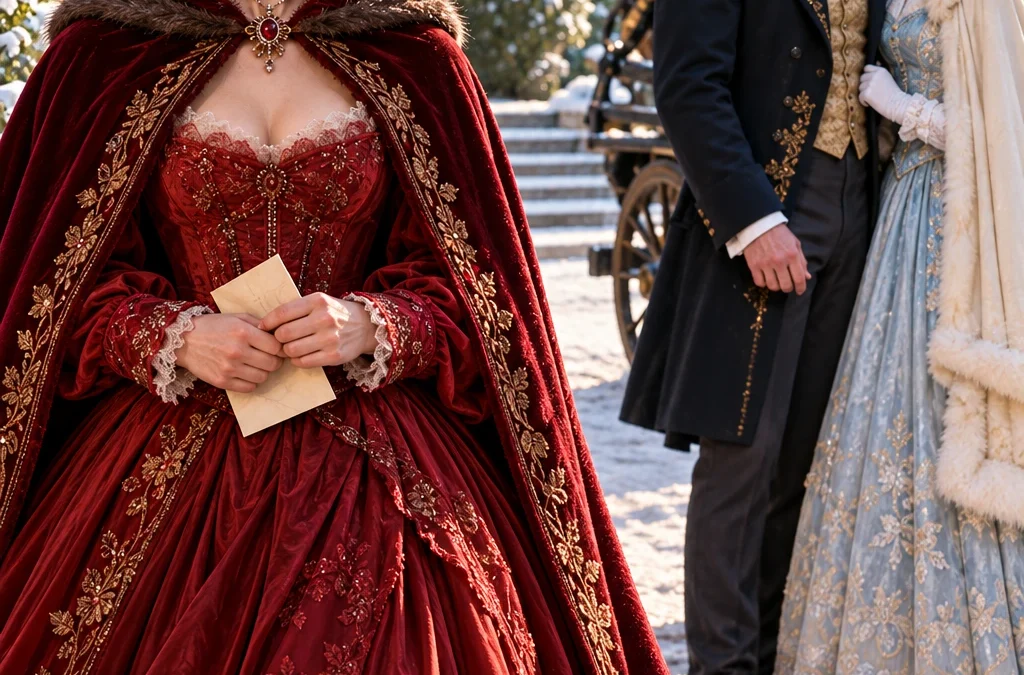
EVERYONE EXPECTED HER TO WEEP WHEN HE CAME HOME WITH A SECRET WIFE… BUT SHE SAID NOTHING, AND THE DUKE NOTICED HER HANDS WERE TREMBLING 😱
Part 1
Snow battered the windows of Ravensworth Hall the night Julian Whitmore came home.
He had been gone four years. He returned with a wife nobody knew existed.
Eighty guests fell silent. At the far end of the ballroom stood Eleanor Vale, the woman who had waited for him, written to him, and sacrificed her entire inheritance for his future.
Everyone expected tears. 💔
Some expected a scene.
Eleanor merely crossed the room, took the stranger’s freezing hands, and offered her a seat beside the fire.
But the Duke of Ravensworth noticed something nobody else did.
Beneath Eleanor’s perfect smile, her fingers were trembling.
Winter had come early to the north of England that year. By the second week of December, the lanes around Alderwick lay buried under a crust of white. The hedgerows had vanished into soft ridges, and the frozen fields stretched toward the moors like sheets of pale iron.
Ravensworth Hall stood above it all, its great hall blazing with candles, its tall windows rattling whenever the wind came down from the hills.
Inside, nearly eighty members of the local gentry crowded together for the Duke’s Christmas gathering.
Near one of the windows, a little apart from the warmth, stood Eleanor. She wore a gray wool gown that had already seen three festive seasons, mended so carefully at the cuffs that only a sharp eye would notice. Her hands were folded before her.
She was not wealthy. But every person in that room knew who she was.
She was the woman who had waited four long years for Julian Whitmore to come home.
The great doors opened at a quarter past nine. A gust of cold air scattered snowflakes across the polished floor, and Julian stepped through it as though he had never been away. Tanned. Handsome. Smiling the easy smile that had charmed half the county since boyhood.
On his arm was a young woman in a fur-trimmed traveling cloak, her cheeks reddened by the cold.
“My wife,” Julian said warmly. “Clara Whitmore.”
The hall went still.
Lady Beatrice Wickliff stopped her fan in midair. The vicar’s wife turned very slowly to look at Eleanor. Near the doors, someone whispered, and the whisper traveled the length of the room like a draft beneath a door.
No one had known Julian was married. And not a single person there imagined that Eleanor had known either.
At the head of the hall, beside the great hearth, stood Alaric Ashford, Duke of Ravensworth. Thirty-eight years old. Tall, dark-coated, a man known throughout the north for saying little and missing nothing.
He did not look at Julian.
He looked at Eleanor.
But Eleanor did not weep. She did not turn away. She did not fix Julian with a single reproachful glance. She crossed the long floor with her usual unhurried grace, curtsied to the young bride, and asked gently whether Mrs. Whitmore might like a seat closer to the fire after so cold a journey.
Clara thanked her with genuine relief.
Eleanor guided her to the warmest chair in the room, settled a shawl around her shoulders, and brought her a cup of hot spiced cider with her own hands.
Slowly, the conversation returned. Julian let out a long breath, convinced the worst had passed, and that Eleanor, being Eleanor, had smoothed everything over for him.
But the Duke saw what the others did not.
When Eleanor set the cup on the little table, her fingers trembled just once, so that the china chimed faintly against the saucer. 🕯️
Later that evening, Alaric drew Julian aside into the shadow of the gallery and asked quietly when the marriage had taken place.
“Nearly a year ago,” Julian admitted. “Letters were lost at sea. Circumstances abroad changed.”
“And no one told Eleanor?”
Julian shrugged. “Four years is a very long time.”
Alaric remembered another night, four winters earlier. Julian had sworn to return with eight thousand pounds, marry Eleanor at the church in Alderwick, and ask Alaric to stand beside him at the altar as his witness.
When the gathering broke apart near midnight, Eleanor fetched her cloak and prepared to walk home. Alaric stopped her at the door and ordered his carriage brought round. The road to Willow End ran more than a mile, he said, and every inch of it was ice.
She thanked him politely.
For one brief moment, beneath the swinging lantern on the steps, the composure slipped from her face. The Duke saw the full weight of the pain she had carried all evening.
Then it was gone, and she climbed into the carriage without another word.
Alaric remained on the steps long after the wheels had faded into the falling snow.
Eleven years earlier, his younger sister Margaret had stood on those very steps after her husband abandoned her. He had given her money. He had done nothing else.
Margaret had died alone, in a rented room far from home. 💔
That same night, the Duke summoned his steward, Tobias Mercer, and asked what he knew of Miss Vale’s affairs.
Mercer hesitated. Then he answered.
“Her inheritance, Your Grace. Nearly a thousand pounds. It was withdrawn in full, only days before Julian sailed.”
Alaric stared into the fire.
Eleanor Vale, he realized, might have lost far more than a promise.
And somewhere, a single sheet of paper might still exist that could prove it.
Part 2
A single sheet of paper might still exist.
The snow did not stop. Alaric did not sleep.
He thought about the Vale family. Nathaniel Vale had been the most honest solicitor in the district, a careful man who had drawn up half the property deeds between Alderwick and Briarford. He had died three winters ago. Since then, Eleanor had lived alone at Willow End, a small rented cottage at the edge of the village, earning what she could by copying legal documents.
Copying paid poorly. If her capital was gone, she had almost nothing to live on, and no one in the county seemed to have noticed.
In the morning, he sent for his attorney, Edmund Hargreaves.
“If a man received nearly a thousand pounds from a woman without any written agreement, could she recover it?”
“It would be very difficult, Your Grace. A court would ask whether it was a gift or a loan. Without paper, a charming man’s word often outweighs a quiet woman’s.”
Alaric nodded slowly. Then he asked another question.
“Nathaniel Vale was a lawyer to his bones. Is it truly possible he allowed his only daughter to hand over her fortune without a document?”
“Find out,” he said.
It took Hargreaves eleven days. On the eleventh of April, four years earlier, Eleanor had sold every investment and received nine hundred and forty pounds and sixteen shillings. Her father had been present at the counter. An elderly clerk remembered that Nathaniel had asked him to make a fair copy of a promissory note bearing the name of Julian Whitmore.
The original had vanished.
Hargreaves suggested a discreet search of Willow End. It could settle the matter in an afternoon.
Alaric refused.
“Power,” he said, “is not permission. A man who decided what was good for a woman, and took it from her drawers without asking, is not so different from the man who took her money with a smile.”
If the paper existed, Eleanor would decide what to do with it. Not him.
Instead, he did something else. The enclosure of Westmere Common had stalled, a tangled, four-hundred-and-eleven-page award riddled with errors from hurried copyists. He thought of a quiet woman who had grown up at her father’s elbow, reading deeds the way other girls read novels.
He rode to Willow End himself through the squeaking snow. Her fingers were stained black with ink. The front room was so cold he could see her breath.
“I have come to make you an offer of employment,” he said.
She told him, very calmly, exactly what the county would say. That the Duke had taken pity on the woman his oldest friend abandoned.
“This is real work,” said Alaric. “Work that no one else can do properly.”
She considered him. Then she named her conditions. A written contract. One week’s notice. Control over anything that touched her reputation.
He agreed to all of it.
She came to Ravensworth on a morning of light snow, and climbed a hundred and nine stone steps to the muniment room at the top of the old tower, carrying her pens and her father’s brass sand shaker. Within twenty minutes she was telling the Duke that the copies were wrong, and she wanted the original survey books.
Alaric looked at her and realized this woman was not the least bit afraid of correcting a duke.
In late January, she laid a finger on page 207. A widow named Edith Marsh, seventy-three, held an ancient right to cut turf for fuel on the common. It appeared in the manor rolls. It did not appear in the award. If approved as written, the old woman would lose the only means she had of keeping warm.
“The omission,” Eleanor added evenly, “is in the section Your Grace drafted yourself.”
He did not argue. He told her she was right.
She found a dozen more errors, including a fence line that, read literally, gave every farmer in the parish the right to drive cattle through the vicar’s kitchen garden. Alaric laughed, a deep, startled sound that rolled down the stairwell. On the landing, the old housekeeper stopped with a tray in her hands. She had not heard him laugh like that since before his sister died. 🕯️
But laughter carried. So did talk.
Within a month, all Alderwick knew that Eleanor climbed into a ducal carriage each morning. And Julian Whitmore began to say things about her that sounded, on the surface, very kind indeed.
In the taproom at Briarford, he declared he would not hear a word against Miss Vale. She was a delicate creature, easily wounded, deserving of compassion after all she had suffered.
He said it again at dinners. At the hunt.
No one had accused Eleanor of anything improper. But the more often Julian rose to defend her, the more people wondered what exactly he was defending her from.
A Briarford attorney stopped sending her work. A family cancelled her teaching. Then Mercer brought worse news: the owner of Willow End was considering ending her tenancy.
Alaric acted quietly. Through the parish charity, with his name appearing nowhere, he arranged a twenty-one year lease on the cottage.
Then, one spring afternoon, Julian’s young wife walked alone through the thawing mud to Willow End and knocked on the door.
“Did Julian once promise to marry you?”
“Yes.”
“And money?”
“Yes.”
Clara went pale. “Do I owe you anything?”
“You have done nothing wrong,” said Eleanor gently. “You did not know.”
And above, on the stairs of the corn exchange at Briarford, on the day Eleanor stood before a hundred and forty people to defend every page she had written, Clara would hear something that changed everything.
Julian caught Eleanor beneath the archway. He praised her lavishly. He said her father would have been proud.
“Never speak of my father again,” Eleanor said.
He asked for a private word.
“I understand exactly what an apology would give you,” she answered. “Relief. And exactly what it would cost me. One more afternoon of carrying your feelings for you. I am done being responsible for your peace of mind.”
She walked past him into the street.
Halfway up the staircase, half hidden in shadow, Clara Whitmore had heard every word.
Part 3
Three days later, Clara came to Ravensworth Hall alone.
She did not sit. She told the Duke that her father had been a merchant, and that she had grown up among ledgers and bonds. She knew how money moved between people, and how it was recorded.
“Julian told me many times that the nine hundred and forty pounds was a gift. But I do not believe a solicitor’s daughter would hand over nearly a thousand pounds without a single scrap of paper.” She looked straight at him. “Your Grace, was there a promissory note?”
Alaric chose his words with great care. “There might have been.”
Clara thanked him and left. All the way home, a single thought followed her. The husband she loved might have kept, somewhere in that house, a document proving he had been lying for four years.
Nine days later, Alaric went to Willow End, and this time he did not go alone. A junior clerk rode beside him with a writing case.
“I need to ask you one question,” he told Eleanor. “You have every right to refuse.”
“Did your father ever draw up a promissory note for Julian Whitmore?”
She was silent a moment. Then: “Yes.”
It had been dated the tenth of April, four years earlier. Nine hundred and forty pounds and sixteen shillings, payable on demand. Her father had insisted on every word. It was in a small tin box under the eaves, beside her mother’s marriage lines. Julian had signed it in her father’s own office, and a counterpart had been prepared so that both parties held a copy.
She still had Julian’s early letters too. Several mentioned the debt directly.
Alaric asked the clerk to record her statement and have her sign it. He did not want anyone, ever, to say that the Duke had bargained privately with Miss Vale over money behind a closed door.
Then he explained her position. She could sue. She would almost certainly win. Julian would likely have to sell part of his land.
Eleanor shook her head. “The county would not see a loan repaid. It would see a jilted woman collecting payment for a broken heart. They would turn my father’s careful paper into a price for my affections.”
“It sounds rather like pride,” Alaric said, before he could stop himself.
She went very still. Then she rose, thanked him for his concern, and asked him politely to leave her house.
The whispers grew louder. An unsigned letter reached the commissioners, suggesting the relationship between the Duke and his hired clerk was improper, and that any document produced under such circumstances ought to be regarded with suspicion.
A second letter followed.
Alaric locked both in his desk. He told himself it was strategy.
On the first of June, Eleanor climbed the hundred and nine steps without taking off her bonnet. She laid a folded sheet before him. Her notice. One week, exactly as the contract allowed.
“If I keep coming, the talk will keep growing, and it will hand the objectors a weapon against the commissioners, and against Mrs. Marsh. I will not let my presence become the thing that undoes my own work.”
He could find no flaw in it. He told her of a position, a family at Greyhaven, sixty-two miles south, who needed a governess.
She accepted without hesitation. Then she thanked him for the wage, for the fire that was always lit before she arrived, and most of all for standing up in a room full of people and admitting his own mistakes.
She picked up her leather case and her father’s sand shaker and walked to the door.
Alaric stood at the long table and listened to her footsteps descend the stone stairs, fainter and fainter, until he could hear them no more. 💔
Three days later, the award was approved, with Edith Marsh’s turf right preserved within it.
That night, in the gray hours before dawn, he finally made himself look at what he had done. Eleven years ago, he had given Margaret money and kept silent. This time he had given Eleanor work, a warm room, and a lease she did not know about. And still, he had let her be driven away by talk he had never once publicly challenged.
He had called it restraint. He had called it respect.
Silence, he understood now, was not always respect. Sometimes it was only a gentler way of standing aside.
Then, one morning in August, a carriage came up the drive bearing only one passenger.
Clara Whitmore entered the library holding a small packet wrapped in oilcloth against her chest.
“I have done a dishonorable thing,” she said, her voice barely steady. “I took the key to my husband’s private cabinet while he was out riding.”
She unfolded the oilcloth.
Inside was the counterpart of the promissory note. Alaric recognized Nathaniel Vale’s neat, sloping hand at once. Nine hundred and forty pounds and sixteen shillings. Payable on demand. Dated the tenth of April.
At the bottom, Julian’s signature.
“But what struck me most,” Clara said, “was the paper itself. The folds are worn soft, nearly through. It had been opened and refolded many, many times. Julian did not forget this debt, Your Grace. He took it out and looked at it again and again. And every time, he chose to deny it.” 📜
She could not live inside a marriage built on that kind of lie. Her father had left her eleven hundred pounds in her own name. She intended to use it to pay the debt in full.
Alaric warned her honestly that it might change things between her and Julian forever.
“I understand,” said Clara. “But the payment must go through attorneys. Julian must acknowledge the debt in writing, and there must be a clear receipt. I will not have it look like a secret gift, or a bribe, or charity. A debt is a debt.”
The war was fought on paper. Julian delayed as long as he could, but no one could deny the signature, in his own hand, on two copies held in two separate houses.
By the end of September, he formally acknowledged the loan.
On the sixth of October, the principal, together with interest and legal costs, was paid from Clara’s own property into a fund in Eleanor Vale’s name.
There was no trial. No public humiliation. Only a stack of lawful documents that no one could ever argue with again.
That autumn, Alaric reviewed the lease of Frostmere Valley, which Julian’s family had rented for three generations. Mercer’s audit was damning, and it had nothing to do with Eleanor. The drainage ditches had silted up. The lower fields lay half flooded every spring. Both mills had gone without repair.
Alaric declined to renew. He gave a notice period far longer than the lease required, so the tenants would have time to arrange their affairs.
Julian came to the hall white with anger and accused him of acting for Eleanor’s sake.
Alaric laid the audit reports before him, year by year. “These breaches were documented. I should have acted long ago. I did not, because you were my friend. That was my own failing.”
Julian’s anger collapsed into pleading. He begged him to remember twenty-two years.
“I do remember. I could forgive you weakness, foolishness, even cowardice. But you looked me in the eye and lied about a document that existed, knowing I would have defended your word before any court in England. That I cannot forgive.”
The friendship was over.
Then the Duke did something he had not done in eleven years.
He rode sixty-two miles south to Greyhaven. In a small schoolroom, he told Eleanor everything. Clara’s discovery. The correspondence. Julian’s acknowledgement. The payment. He placed the receipt in her hands.
When she understood that Clara had paid with her own inheritance, freely and unasked, her eyes filled.
“This is not money to buy my silence,” she said softly. “It is not compensation for a broken promise. It is simply a debt. Honestly paid at last.”
As he was leaving, she stopped him at the door. “Why did you come yourself? A letter would have done. Sixty-two miles is a long way.”
Alaric turned his hat in his hands.
“The last time a woman I was responsible for went away to a place like this, I did not come. I have regretted it every day for eleven years.” 🕯️
The news spread through the landed families of the north. Julian Whitmore had signed a formal acknowledgement of a loan, repaid with interest from his own wife’s fortune. There had been a promissory note all along.
Within weeks, every insinuation about Eleanor collapsed. Lady Beatrice Wickliff, who had carried more of the gossip than anyone, was heard to say at a card party that she had perhaps misunderstood the situation.
It was not an apology. But it was a retreat.
At the final meeting of the commissioners that winter, Alaric asked for a statement to be entered into the minutes. He set out Eleanor’s contribution to the award in precise detail. He stated that all rumors touching her dealings had been resolved by documents, signatures and full payment, and that every suggestion of impropriety had been without foundation. He stated, once more, the errors he himself had made, and how she had corrected them.
The room was silent. The clerk wrote every word.
It was the public correction he had never given Margaret. It had come too late for his sister.
It had not come too late for Eleanor. 💛
In the new year, a letter came from Sir Benedict Hawthorne. A new enclosure was beginning in a neighboring district, and its commissioners needed a clerk. He offered Eleanor the post at seventy pounds a year, resting entirely on what he had seen at Briarford. The Duke had no part in it.
She accepted. For two years she worked with the same precision, until surveyors and attorneys across two counties knew her as the clerk who did not make mistakes.
Then she came home to Alderwick on a raw spring afternoon, with three trunks and her father’s old writing desk strapped to the carriage. Willow End was waiting, the roof sound, the chimney drawing well. When she went to settle the rent, she discovered her lease ran for twenty-one years.
Within a week, she knew who had arranged it.
She wrote to the Duke, inviting him to tea. I have learned the difference between pity and the correction of an injustice. But if you wish to come, you must be prepared to be honest about everything you have done.
He came. In her warm little parlor, he told her all of it. The lease. The audit. The statement in the minutes, and the friends he had lost by making it. And Margaret, all of Margaret, the money he sent, the silence he kept, and the rented room where she died.
He did not soften any of it. He did not ask her to absolve him.
Then he told her the last thing. He had not spoken of his feelings while she worked for him, because she had depended on him for her wage and her warmth, and he would not be the second man to make her feel she owed him something.
“But now you have your own work. Your own income. Your own home and your own good name. None of it borrowed from me. May I call upon you, as a man who hopes one day to marry you?”
Eleanor looked at him for a long moment.
“Thursdays,” she said.
Every Thursday, the Duke of Ravensworth rode down to Willow End. By autumn, he had left the cushioned ducal pew and sat beside her on a plain bench near the drafty door of the church, so the whole village might see an open courtship, conducted in daylight, with nothing hidden.
More than once, he offered to settle money on her. Each time she refused. She needed to decide for herself when she was ready to accept help from anyone.
He did not press her. It was that respect, more than any gift, that slowly opened her heart.
On the twenty-first of March, they stood together at the edge of a field in Frostmere Valley, watching clear water run along the new drainage channels where stagnant pools had lain for years.
“Marry me,” Alaric said.
Eleanor turned to him. “That is not enough. Years ago, a man gave me a short promise, and I built my life around it. I will not do that again. If you wish to ask, you must say all of it.”
So he did.
He promised he would never vanish. He would never stop writing, wherever he was. He would never ask her to give up her work in exchange for a title. She would keep her income, her desk, her papers, and her right to tell him when he was wrong. Every provision would be written down, signed and witnessed, so she would never again have to rely on a man’s memory.
And then he said the most private thing of all.
“I want to climb the stairs to the muniment room every morning for the rest of my life, and find you sitting at the long table, ready to tell me I have got page 207 wrong.”
Eleanor laughed and cried at once.
“Yes,” she said. 💍
They were married in June at the parish church in Alderwick, with the doors standing wide to the summer air so that anyone in the village could come and see. Sir Benedict Hawthorne walked her up the aisle. Old Edith Marsh sat near the front, to watch the woman who had saved her winter fire become a duchess. Clara Whitmore sat on the bride’s side.
Julian did not come.
At the wedding breakfast, in the very same great hall where Eleanor had once stood by a cold window while the man she had waited for introduced his wife, Alaric rose before the assembled guests.
He spoke of the woman who had stood at the back of the room and kept her silence to protect her dignity while every eye in the county watched her.
“She will never stand there again. From this day forward, she stands beside me, at the head of the room.”
He paused.
“I did not rescue Eleanor. She never needed rescuing. What she did for me was harder. She taught me to admit when I was wrong, to act when it mattered, and to love someone without taking away her freedom.”
In the years that followed, Eleanor took up the management of the Ravensworth estate beside her husband, examining leases and accounts with the same unblinking care she had once given the Westmere award. Tenants learned that if they wanted a precise answer, they should ask the duchess. Alaric never once resented it when people praised his wife’s mind above his own.
They had thirty-one years together.
And every year, on the eleventh of April, Eleanor climbed to the muniment room and opened the small tin box that held the old promissory note and her parents’ papers. Alaric sat a little distance away by the window and gave her an hour with the past, without trying to comfort her out of it.
When she closed the lid, he would rise and ask whether she would come downstairs, where the fire had already been lit.
Snow fell beyond the windows of Ravensworth Hall.
Together, they walked down the hundred and nine steps. Below them, firelight filled the warm house.
And the woman who had once been abandoned in a crowded room now had a life built on respect, on love, and on choices that were entirely her own. ❄️❤️
THE END
This story is entirely fictional and created for entertainment purposes only. It does not represent any organization or individual, nor does it encourage inappropriate behavior. The content was generated with AI assistance.








