Everyone Laughed at the 34 Worthless Goats She Bought for $34 — Until They Uncovered a Secret Buried on Her Land for 88 Years
Part 1
The morning of the auction, the crowd had eyes only for the prime Angus bulls and sleek quarter horses.
Nobody paid the scruffy pen at the far end a second glance — except to snort or shake their heads.
There huddled 34 goats nobody wanted.
A dairy goat gone dry, a boar cross with ribs like a washboard, rangy Spanish yearlings with wild yellow eyes, and a dozen kids whose parentage was a county-wide mystery.
Their coats were matted with burrs, their hides stretched thin over bony shoulders.
They stood in mud that smelled of resignation, unwanted, unvalued, already written off.
The auctioneer, Rayburn, hadn’t even given them a proper lot number.
“Over here — the cleanup crew!” he called, and the men in clean boots and branded caps chuckled knowingly.
“Dog food on the hoof,” someone muttered.
“Walking funerals.
”
Into this scene walked Alera Hayes — 29, weary-eyed, fresh from a city life that had crumbled.
She’d come back to Burnt Fork Township not in triumph, but in retreat, to settle her grandparents’ estate.
What she’d inherited was hardly a fortune: 55 acres so choked with invasive honeysuckle, poison ivy, and thorny multiflora rose that the county assessor had marked it “agriculturally void.
” A sagging farmhouse with a roof like a swaybacked mare, a barn leaning like it was tired of standing.
A burden, everyone said — sell it fast.
But Alera didn’t head for the cattle pens.
She walked straight past the prize stock, past the clucking poultry and squealing hogs, right to the back pen.
For a long time, she just watched.
She didn’t see a mess — she saw individuals.
The old nanny with the cloudy eye standing quiet and dignified.
The wiry kid chewing thoughtfully on a fence post.
They moved not with panic, but with fluid, calculating intelligence.
The crowd noticed.
A young woman studying the dregs of the sale? Amusing.
When Rayburn finally got to them, he sounded bored.
“Who’ll give me a dollar a head to get them gone?” Silence thick enough to touch.
Then a booming voice cut through — Sterling Thorne, the county’s most successful, most confident farmer, whose family had worked Burnt Fork’s rich bottom land for a century.
“Fifty cents a head, Rayburn — if you load ’em straight into my dog’s bowl!”
Laughter rolled through the crowd.
That was when Alera raised her hand — slow, steady, unhesitant.
“One dollar a head.
”
Rayburn perked up.
“We’ve got $1 a head from number 117!” Sterling turned, disbelief spreading across his face like a slow sunrise.
He saw her — alone, quiet, obviously new to all this — and a patronizing grin took over.
He didn’t bid.
Nobody did.
The gavel cracked.
“Sold — to the young lady, 34 head for $34!”
As people drifted away, Sterling sauntered over, flanked by two friends.
“Ma’am, I’m Sterling Thorne.
” He tipped his hat like a performance.
“You must have some mighty hungry weeds to buy that whole pack of trouble.
”
“Something like that,” she said, calm as still water.
He chuckled darkly.
“Well, you just bought yourself 34 funerals.
Those things will find a way to die if you look at ’em wrong.
Mark my words — you’ll be lucky if half see winter.
” Then he turned to his buddies, loud enough for her to hear: “A fool and her money.
”
He meant it as a prediction of failure.
He had no idea it would turn out to be true — but not in the way he thought.
Alera drove her grandfather’s rusted pickup out to the 55 acres and her heart sank.
It wasn’t a farm.
It was a jungle.
Honeysuckle draped in thick, choking canopies, pulling down fences, swallowing trees, creeping over the farmhouse roof like green hands trying to pull it back into the earth.
Multiflora rose and poison ivy stood waist-high, a thorny, toxic wall.
The land felt primeval — as if it was actively erasing what humans had built here.
Instead of planning to sell, she walked.
For days, she wandered the overgrown paths, letting the city’s frantic noise drain away.
In her grandfather’s study — the “thinking office” — she found a locked oak desk.
She remembered his habits, felt under the drawer, and found a taped key.
Inside lay 12 leather-bound ledgers — his farm journals.
They weren’t just numbers.
They were observations: weather, frogs, crickets, which grasses grew where.
“The land remembers,” he’d written beside a clover sketch.
“You can’t force it.
Only persuade it.
” “Patience is a tool, not a virtue.
” And near the end — a passage that stopped her cold.
He’d written of the honeysuckle spreading from the abandoned land next door.
“A man with a tractor and a loan would try to tear it out.
He’d fail.
Roots run too deep.
He’d only anger the soil.
You must let the problem be the solution.
”
Beneath it, he’d drawn a plan — and mentioned goats.
“The poor man’s plow.
” They ate what nothing else would.
They turned brush to fertilizer.
Rotational grazing — move them often, let the land rest.
Cheap.
Patient.
Chemical-free.
Alera’s breath caught.
The 34 goats.
The ones everyone laughed at.
They weren’t a joke — they were exactly what her grandfather had been waiting for.
She visited her great-aunt Maeve, 91, sharp as flint, who knew goats better than anyone.
Maeve traced the familiar handwriting.
“Your granddad knew dirt,” she said, “but he didn’t know goats.
The weak hug the fence.
The bullies push the front.
The smart ones — the survivors — wait in the middle watching everything.
”
Alera smiled — her first real smile in months.
“I watched the middle ones, Aunt Maeve.
I chose them.
”
The work began the next day.
She used her last severance pay for solar fencing and polywire.
She hacked out small paddocks, moved the herd every three days, scattered native grass seeds behind them — switchgrass, bluestem, deep-rooted things that would hold the soil.
The goats ate honeysuckle, poison ivy, rose shoots — voracious, relentless, transforming problem into fuel.
Their manure fed the recovering earth.
At the feed store, Sterling saw her coming and boomed, “Well look — the Goat Queen! How’s that herd of yours — still breathing?” His friends laughed.
Alera just met his gaze steady.
“They’re eating.
” No defense, no argument — just fact.
It left them stumbling, the joke falling flat.
Weeks passed.
The goats thrived — glossy coats, strong bodies.
Then the nannies began to kid.
34 became 40, then 50.
The cleared patches turned green again — not uniform lawn-green, but rich, textured, alive.
One afternoon, after moving the herd near the property’s center, Alera noticed something beneath the stripped vines: a neat line of flat stones, too straight to be nature’s work.
She grabbed a shovel and began to dig…
Part 2
An hour later, she sat back on her heels, breath caught in her throat.
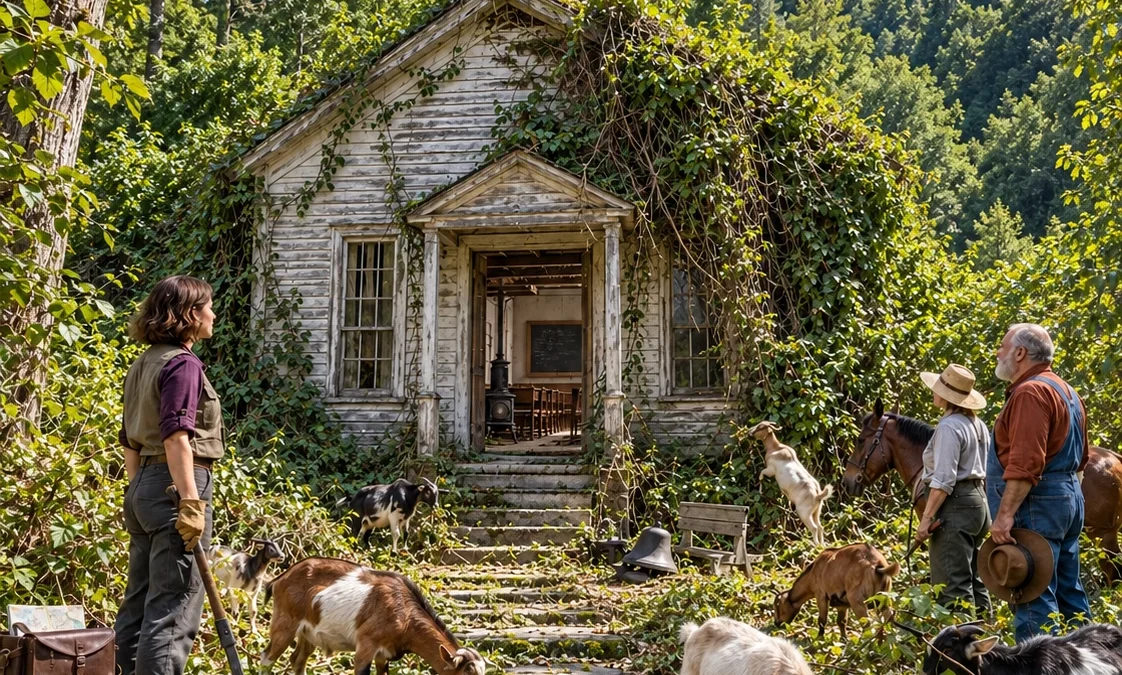
Before her lay the unmistakable outline of a building’s foundation — a perfect rectangle of hand-laid fieldstone, with a chimney base still standing three feet high, mortar crumbling but proud.
She hurried back to the house and spread out the old county map from Silas’s desk.
There, marked right where she’d been digging, was a small square symbol and faded words: Burnt Fork Schoolhouse — defunct 1938.
For nearly 90 years, it had been buried — hidden under the very thicket everyone said made the land worthless.
The goats hadn’t just cleared brush.
They had uncovered a piece of the community’s forgotten soul.
Word spread slow at first, but it spread.
A neighbor with choked woods bought three kids to turn loose; they worked so well he came back for more.
“Those honeysuckle goats” earned a reputation — tough, effective, exactly what the local land needed.
Burnt Fork Farm wasn’t a joke anymore.
Then July came — and the sky turned hard and metallic.
No rain fell for a week.
Then two.
Then three.
The rich bottom land farms — Sterling’s included — baked and cracked.
Corn curled yellow and brittle in the wind.
Ponds shrank to rings of mud.
The drought — the worst in living memory — had arrived.
Cattle herds were trucked away in droves, sold at a loss before the feed ran out.
The auction yard became a place of quiet desperation.
But as the county turned brown and dust-grey, something impossible happened: Alera’s 55 acres stayed green.
Deep-rooted native grasses held moisture that shallow-rooted crops couldn’t reach.
Rotational grazing had built a thick, spongy mat of organic matter that held dew and softened the sun’s blow.
The goats browsed woody plants that stayed green when grass died.
The old springhouse ran steady, its watershed no longer choked by thirsty vines.
People drove out just to stare.
They got out of their trucks and stood by the fence, blinking — a green island in a dying landscape.
Sterling came, too — alone, one evening in late August.
He got out of a dusty truck, hat in hand, and walked to the fence where Alera stood watching her herd.
He looked at the green fields, then at his own withered land beyond the rise.
“I was wrong,” he said, plain as a surveyor’s mark.
No smile, no swagger — just a man stripped of his certainties.
“I’m ruined.
Corn’s not worth cutting.
Sold two-thirds the herd for half what they cost.
Bank owns the tractors.
Chemical company owns the soil.
I did everything right — everything they told me — and I’m gone.
”
He looked at her — quiet, steady, built on nothing but old words and unwanted goats.
“You did everything wrong… and you’re the only one left standing.
”
The silence stretched, heavy as the heat.
Then he said something she never expected.
Part 3
He shifted his weight, twisting the brim of his hat between calloused fingers.
“I didn’t come just to say I was wrong.
I came to ask… can you teach me?”
Alera didn’t answer right away.
She studied him — the man who had laughed loudest, who had called her a fool and her herd a joke.
His pride was gone, replaced by something raw and genuine.
“I’ve got land,” he went on, gesturing toward his fields.
“Pasture that’s gone to brush — ground I’ve written off.
Will you lease it from me? And… will you sell me some of your goats? Your breeding stock?” He named a price — fifty times what she’d paid.
It wasn’t just a business deal.
It was surrender.
And it changed everything.
When word spread that Sterling Thorne — the face of “proper” farming — had gone to the Goat Queen for help, the dam broke.
Other farmers came, too — men in their 50s and 60s, faces lined with worry, some fighting to keep family land mortgaged against the future.
They didn’t come to laugh.
They came to learn.
Alera didn’t lecture.
She walked them the fields.
She showed them dark, living soil teeming with worms, compared it to pale, lifeless dirt from their own overworked rows.
She showed them Silas’s journals — his neat handwriting, his patient observations.
“The solution’s usually right in front of us,” she’d say quietly.
“We just have to see it different.
”
One afternoon, a quiet 16-year-old named Caleb showed up at her gate.
“Heard you might need help mending fences,” he said, hands in pockets.
He was the son of a struggling nearby farm.
Alera hired him.
He turned out to be a gift — hardworking, observant, a natural feel for the land.
He learned fast, watching the goats, watching Alera, asking sharp, quiet questions.
Before long, he was moving the herd, scattering seed, tagging new kids — carrying the work forward as if it were his own birthright.
Burnt Fork Farm grew — but not like the loud, fast farms.
Alera turned down loans and expansion offers.
“Debt is a man telling the future what it has to do,” Silas had written, and she meant to honor that.
Growth came from within — more kids each spring, more neighbors leasing her land for restoration, more farmers wanting her stock.
She expanded no faster than the earth could sustain.
Aunt Maeve lived to see the first full autumn of it.
On a crisp October afternoon, Alera drove her out to the schoolhouse foundation, now ringed by lush native grass, its stones respected and marked.
They stood together, watching more than a hundred goats graze peacefully on the hillside.
Maeve reached out a thin, trembling hand and touched Alera’s arm.
“Silas had the right ideas,” she whispered, “but you… you had the heart for the work.
”
She passed away peacefully that winter — the last of the older generation — and the mantle settled gently, firmly, on Alera.
Five years to the day after she’d walked into the auction yard alone, she walked back in — not as a buyer hiding at the edges, but as a seller standing tall at the front pen.
Beside her stood Caleb, now 21, steady and capable, running the farm’s daily operations like it was the most natural thing in the world.
In the pen were 15 sleek, strong yearlings — direct descendants of the original 34.
A hand-painted sign read: Burnt Fork Farm — Acclimated Stock.
Rayburn called the lot, his voice warm with genuine respect.
“Here’s what you’ve all been waiting for — Burnt Fork quality! You know what these goats do.
You know what this land does.
”
Bidding started instantly — fast, serious, competitive.
Alera watched the faces: men who once laughed now leaned forward, intent.
And near the front, bidding steadily, was Sterling Thorne.
He won the lot — at a price that made the crowd murmur in awe.
As he signed the slip, he caught her eye across the yard.
He didn’t smile.
He didn’t make a speech.
He simply nodded — slow, sincere, a salute between peers.
No one laughed that day.
The story had circled back, richer and deeper than anyone imagined.
Alera had learned — and taught her whole county — lessons as old as the hills they lived on: that what’s rejected is often most precious if you have eyes to see it; that deep, local knowledge beats borrowed wisdom every time; that attention beats force, and patience beats money; that the answer to a problem is often hidden inside the problem itself.
And worth — true worth — doesn’t need to shout.
It doesn’t need to argue or boast.
It simply proves itself.
This story is entirely fictional and created for entertainment purposes only.
It does not represent any organization or individual, nor does it encourage inappropriate behavior.
The content was generated with AI assistance.








