Everyone Laughed At The Family Living In An Old Brick Kiln — Then The Blizzard Arrived And Changed Everything
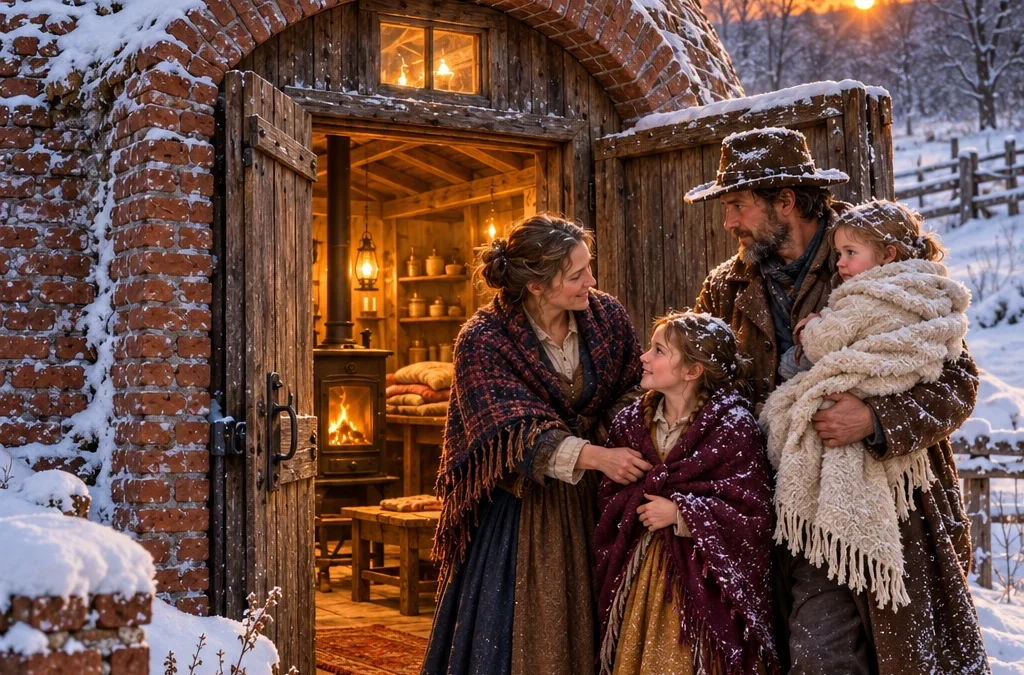
Everyone Laughed At The Family Living In An Old Brick Kiln — Then The Blizzard Arrived And Changed Everything ❄️😱
Part 1
The water appeared where no water should have been.
Adah Merritt lifted a folded blanket from her new floorboard — and watched dark dampness run between her fingers.
The roof was dry.
The rain had stopped hours earlier.
Yet beneath the boards, water pooled along the curved base of the old abandoned brick kiln.
It was September 1892 in Iowa.
Just weeks before, lightning had struck their rented timber home while they were out helping a neighbor — and in minutes, everything was gone.
They’d saved nothing but a kettle.
Since then, Adah, her husband Isaac, and their 14-year-old daughter Rose had crowded into a borrowed room behind the general store.
But the owner needed the space back by November.
Their savings wouldn’t build a new house before winter.
Then Adah remembered the kiln.
A massive dome of solid brick, standing alone on the edge of town — abandoned, forgotten, deemed worthless.
People laughed when she asked to lease it.
Live in a kiln? That’s for firing bricks, not raising a family.
Even the owner chuckled and named a low price, assuming she’d never actually follow through.
Adah knew the risks.
She sought out Samuel Dunn — the elderly man who’d helped build the kiln decades earlier — and asked him what she couldn’t see.
He inspected every wall, every arch, every hidden passage.
He found loose mortar, debris, places where weather had worn the brick — but the dome itself? Sound.
“You won’t heat this whole cavern with a kitchen stove,” Samuel warned.
“I know,” Adah said.
“We’ll build a smaller room inside it.
”
That was their plan: frame a tight, warm sleeping space right in the center, leaving the thick brick shell to block the wind.
Build a sheltered entryway that turned aside the gales.
Put in a proper stove and chimney.
Keep it simple — keep it safe.
Rose helped measure and mark.
Isaac cut timber salvaged from the old drying sheds.
Adah held boards and mixed mortar and cooked by lantern light.
But the jokes followed them.
“Gonna bake the supper along with the bread?” someone called.
Rose turned her scratched chest to the wall, stinging.
Adah told her quietly: “They don’t have to sleep here.
Neither do we — not yet.
”
Then came the water.
The floorboards hid an old, forgotten drainage channel that had choked with debris.
Rain wasn’t falling from above — it was seeping from beneath.
Adah realized with a cold drop in her chest: she’d looked up at the dome and imagined snow and wind — but she’d completely missed the water rising from the ground.
They pulled the floor apart.
Samuel helped them trace and clear the blocked channel.
Neighbor Cal Finch stopped by to mock — then saw the work they were doing, sighed, and set down his spade to help.
Days later, when the next rain fell, the ground beneath stayed dry.
They raised the floor supports, left space for air, and installed a removable inspection panel.
By late October, they moved in.
It wasn’t fancy — a table with a mended leg, a blanket strung as a cupboard door, boots lined up beneath the shelf — but it was theirs.
Rose slept with her boots beside her bed, still waking sometimes from dreams of fire.
Adah showed her the rear exit, the water inspection spot, exactly where to run if they ever needed to.
November brought frost.
The outer chamber turned icy — but inside their little room, the stove held a steady warmth.
Cal came by with a sack of potatoes, stamped his feet in the cold outer space, and stepped inside to find the air soft and golden with lamplight.
He held his hands around a warm cup and admitted: “It’s warmer than my place.
”
Adah surprised him.
“If anyone needs shelter this winter — we can make room.
”
He shook his head.
“You might regret saying that.
”
“I’d regret leaving someone outside more.
”
By early December, three families knew the way to the kiln — and both doors.
Then the storm arrived.
Wet, heavy snow fell all day, followed by a wind that tore roofs and flattened sheds.
As dusk deepened, someone knocked.
Cal and his wife Beth stood there with their seven-year-old son — their home’s window had blown in, the walls were giving way.
They’d walked through the gale to the only light they could see.
Then an hour later — another knock.
Samuel and Martha Dunn.
Their cabin roof was sagging under wet snow; they’d gotten out before it collapsed.
Eight people now filled the room built for three.
But the wind was rising to a howl outside.
Boards were tearing loose from the entrance passage.
And then — a third knock came, so soft it was almost lost in the gale — followed by a little girl calling Adah’s name.
Part 2
Adah opened the door.
Edmund Hale stood there in the turning passage, bowed against the wind.
Beside him were his two daughters — nine years old, and five.
The younger one was wrapped in a blanket that had frozen stiff along its outer folds.
Their roof had given way above their bedroom; they’d barely escaped through the kitchen before the passage was blocked.
They’d stumbled through blinding snow until they saw the faint glow of Adah’s window — the only light on that stretch of road.
Eleven people.
All crammed into a space built for three.
Rose moved her bedding instantly to make room.
Beth and Martha wrapped the girls in warm dry things.
Adah knelt to check the little one — she was shivering violently, but she answered when spoken to.
Edmund, overwhelmed with relief, nearly sank to the floor.
Then — CRACK.
A heavy piece of roofing slammed into the entrance passage.
The frame above the door shuddered.
The small glass pane split jaggedly across one corner.
Wind-driven snow blasted through the widening gap.
Isaac braced his shoulder against the door to hold it shut.
“The fastenings are tearing loose!” he called.
Samuel Dunn looked up — not at the timber frame, but at the great brick arch above it.
“The dome holds steady,” he said.
“It’s our work — the entrance — that’s failing.
”
Adah saw it clearly.
The kiln itself was solid as the day it was built.
Their timber entryway — the part they’d constructed — was taking the full force of the gale, and it wasn’t meant to bear this.
If it gave way completely, the storm would rush straight into their only warm room.
She looked at the children huddled on the bedding.
Then at the splitting wood above the door.
There was nowhere else to send them.
“Bring the spare boards!” she said.
Part 3
Cal fetched the stack of heavy boards they’d set aside for repairs — just as Samuel had advised them to do months before.
The wind struck in violent bursts.
Between gusts, they could work — then the timber would bow inward, and Isaac would have to lean his full weight against it to hold the gap closed.
They couldn’t take the door fully off its hinges; they couldn’t leave the children exposed even for a moment.
Adah positioned the first board.
Her arms burned with the effort to hold it steady.
Cal took the weight.
Isaac drove nails in short, sharp strokes while the frame shuddered.
Then a gust hit harder than any before.
The whole front wall buckled inward.
The gap above the board tore open wider.
Cold air swept in, making the stove flame dip.
The younger girl coughed.
Rose stepped forward with a thick folded cloth — the cover from her blanket chest.
“Here,” she said.
Adah stuffed it into the breach, sealing the worst of the draft while Isaac and Cal secured the second brace.
Edmund started to rise, ready to help, but Adah stopped him.
“Stay with your girls.
There’s work enough right here.
”
He sank back beside his daughters, holding the little one’s hand.
For agonizing minutes they worked — bracing, nailing, patching.
The wood groaned and strained — but held.
When the next gust roared through, the frame trembled — and stayed in place.
No snow drifted through.
The children remained warm and dry.
Isaac stepped back from the door, breathing hard.
Samuel lowered the lantern he’d held steady all the while.
For a moment, nobody spoke.
Inside that small room, eleven people listened to the wind howl against the brick — and felt nothing but warmth.
Beth lifted the soup kettle back onto the stove.
Rose reached for bowls.
Cal asked where to stack the extra firewood; Adah pointed to the sheltered corner.
The rear exit remained clear and ready — Isaac and Samuel double-checked it together.
No one was trapped.
They made their beds that night in every available space — the platform for the children, floor space for the adults, boots lined up over pans to dry, gloves strung on lines.
Martha laughed softly as she tucked the youngest in.
Cal’s boy fell asleep clutching a piece of bread.
Rose kept her boots right beside the girls, just as she always did.
The storm raged through the night, but the brick dome stood firm.
By mid-morning the next day, the wind had weakened.
Isaac and Cal ventured out to assess the damage.
The entrance passage would need rebuilding — but the kiln itself hadn’t shifted an inch.
Adah stayed inside, tending the fire, and when they returned, she didn’t say “I told you so.
” She poured hot coffee and set out bowls of stew.
They didn’t leave in a day.
They didn’t leave in two.
The storm had damaged nearly every exposed home in the valley.
Through the long, bitter weeks that followed, the families shared that warm little room inside the brick shell — wood, food, stories, strength.
When spring finally came, they built their own homes again — but not before sitting down together to plan something different.
They built their new houses with thick walls, sheltered entries, and stoves positioned to hold the heat.
They looked out for one another.
And whenever someone remarked on how foolish it had seemed — living in an old brick kiln — they remembered differently.
Adah never claimed the kiln was perfect.
She’d learned that early — water from below, wind from above, doubts from all sides.
But perfection hadn’t been what saved them.
It had been showing up, day after day, to fix what broke — and leaving space for anyone who needed a place to come in from the cold.
This story is entirely fictional and created for entertainment purposes only.
It does not represent any organization or individual, nor does it encourage inappropriate behavior.
The content was generated with AI assistance.








