Everyone Laughed When She Planted Dead Sticks In Mud — Then The Drought Hit & The Whole County Begged For Her Secret
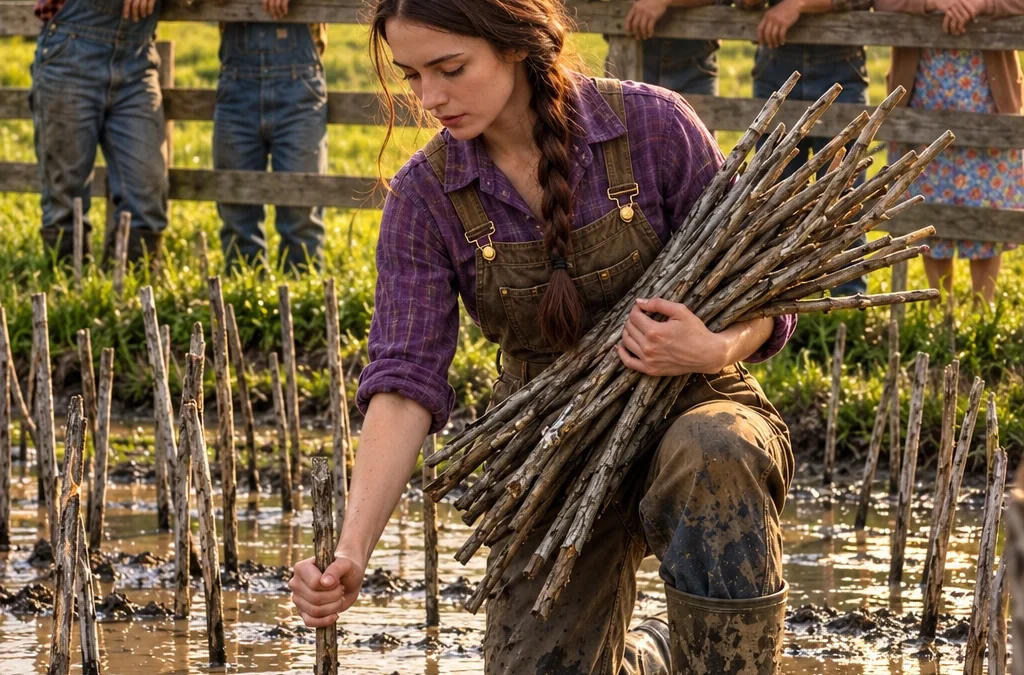
Everyone Laughed When She Planted Dead Sticks In Mud — Then The Drought Hit & The Whole County Begged For Her Secret 😱
Part 1
It was the spring of 1952 in Mercer County, and the rain just wouldn’t stop.
The Wabash River had swallowed cornfields whole, turning rich earth into brown, churning water.
Farmers stood at their fence lines, watching their livelihoods wash away — and none of them paid any mind to the slight, nineteen-year-old girl wading out into the lowest, wettest patch of land of all.
Clara Jennings was barely five foot two, with hands that had never held a plow, and everyone laughed.
They leaned on their fences, bellies shaking, eyes watering — those men in faded overalls and sun-burned faces, whispering to one another as she stepped barefoot through black mud and murky water.
Her own father turned his back and walked away without a word.
Even the county extension agent, Harold Vance, marched over with clipboard in hand and issued a formal warning: planting in standing water defied every rule of agricultural science.
It would rot.
It was impossible.
It was foolish.
But Clara didn’t stop.
She’d found the bundle of sticks tucked away in her grandmother Evelyn’s attic only days before — wrapped in oilcloth that still smelled faintly of rosemary, tied with twine so old it crumbled.
Evelyn had just passed away, leaving Clara forty acres of “drowned land” and a house the bank was already preparing to seize.
The note tucked beneath the twine was short, written in her grandmother’s spidery handwriting: “Plant these in the mud when the creek rises.
Trust the water.
”
No one else saw it that way.
To everyone else, Evelyn was the eccentric old woman who talked to plants, planted by the moon, and was called a witch behind her back — even if she did bake the best blackberry pie in three counties.
Clara was just a girl with dreams of becoming a teacher, dreams that had crumbled the moment her grandmother died and the bank came knocking.
She had sixty days to find the money for back taxes and mortgage payments — money she didn’t have.
Still, she soaked the sticks in rainwater for three days, just as the note instructed.
Then she carried them out to the field — two hundred of them, gray, leafless, lifeless — and pushed each one deep into the mud, six inches under the surface, rows winding wherever her feet led her.
She planted until her fingers went numb and her back ached, until rain mixed with tears on her face and no one could tell which was which.
Her father Ben found her there at dusk.
He’d spent twenty years working at the grain elevator, running from the very land that had broken his father and grandfather — and now his daughter was wading in a swamp planting dead wood like it could grow.
“Clara, what have you done?” he said, his voice tight.
“She left me instructions, Pa.
She said to plant them in the mud.
”
“Your grandmother was a good woman, but she had old ideas — superstitions! Those sticks are dead, Clara.
Dead wood in standing water only rots!”
“Then let it rot,” Clara had answered, her voice steadier than she felt.
“At least I tried something instead of just waiting for the bank to take everything.
”
He stared at her, and in his eyes she saw something worse than anger — the death of hope.
“You’re just like her,” he said, and it didn’t sound like a compliment.
Then he turned and walked back to his truck, and didn’t come near her for three long weeks.
Word spread fast.
The co-op shook its heads.
The church quilting circle whispered.
Children repeated what they heard at dinner tables.
Harold Vance returned, wading out in rubber boots, examining the sticks with a magnifying glass, scribbling furiously — then announced they were white willow cuttings with no living tissue left.
They would be dead within two weeks.
He advised her to tear them out before they spread disease.
Clara thanked him — and never touched a single one.
April turned to May.
The waters receded, leaving the sticks standing gray and bare, exactly as before.
No leaves.
No green.
Nothing.
The county moved on — until the first Saturday in May, when three men drove out to the property line.
Walt Henderson, the banker, in his sharp black suit.
Harold Vance, clipboard ready to prove he was right.
And Tom Blackwell, the richest farmer in the county — the man who’d been trying to buy this land for ten years.
They walked out into the field, smirking, pointing, mocking her “toothpick forest.
”
Tom Blackwell laughed loudest.
“Is that what you call farming? Your grandmother would be spinning in her grave!”
Vance knelt, scraped the bark, peered through his glass.
“Total failure.
Rot’s already setting in.
In a week they’ll be mush.
”
Henderson pulled an offer from his portfolio — low, insulting, final.
“Sell now, Clara.
Walk away while you still can.
”
But Clara wasn’t looking at the paper.
She was staring at the stick Vance had just examined.
At the very base, where bark met mud — there was something.
A tiny, pale swelling.
A thread of white, finer than spider silk, reaching down into the dark earth.
A root.
She pointed.
“Look.
”
Vance snorted — then bent closer.
He froze.
He looked at that stick, then the next, and the next.
His face drained of color.
The certainty melted away like frost in the sun.
“They’re rooting,” he whispered, so quiet Blackwell didn’t hear.
“They’re actually rooting.
”
And then — on three of the sticks, beneath dry gray bark — Clara saw it.
The faintest, tenderest flush of green.
Part 2
Green.
Not full leaves, not yet — just the first hint of life where nothing should have survived.
It was barely there, easy to miss if you didn’t know what you were looking for — but to Clara, it felt like a promise kept.
Vance stood frozen, magnifying glass still in hand, staring at the impossible.
“That shouldn’t be possible,” he muttered to himself.
“Not in this soil.
Not in these conditions.
” Henderson shifted uncomfortably, sensing the mood change.
Blackwell laughed louder — but it sounded hollow, forced.
“Roots? That’s mold! You’re seeing things!”
But Vance didn’t argue.
He straightened slowly, brushed mud from his knees, and looked at Clara with something new in his eyes — fear.
“I… I need to run more tests,” he said, backing away.
Henderson quickly tucked his paper back into his case.
“We’ll revisit this next month,” he said, suddenly in a hurry to leave.
And just like that, they were gone — leaving Clara alone in the field, touching those tiny green buds with trembling fingers, crying not from sadness, but from a hope so big it felt terrifying.
Over the next six weeks, the impossible became real.
The buds swelled and burst into slender silver-green leaves that shimmered in the morning light like scattered coins.
The sticks weren’t sticks anymore — they were saplings, reaching upward, two feet tall, then three, then four, drinking in sun and rain with a hunger that was almost visible.
But the true miracle wasn’t how fast they grew.
It was what they did to the land.
Clara noticed it first in early June, after a heavy storm.
Normally this field would have stayed flooded for days — thick clay holding water like a bowl.
But this time, the water was gone by dawn.
The soil was wet, yes — but open, breathing, crumbly.
She dug her hands in and found the clay was breaking apart, threaded through with willow roots spreading like underground hands, opening channels for air and water.
The mud was turning into earth — dark, rich, living earth.
She didn’t know the science — that willow roots release acids that break down hard clay, that their leaves return vital nutrients to the soil, that their shade keeps moisture locked in.
All she knew was that the drowned land was waking up.
By July, the willows stood shoulder-high, their canopies knitting together into a line of lush green where there had only been mud.
People stopped laughing — they stared.
They drove slowly past, craning their necks.
But not everyone was impressed.
Tom Blackwell returned alone one afternoon.
He walked into the grove where Clara was measuring growth in her grandmother’s old notebook, and his voice was smooth as oil — but sharp underneath.
“You’ve got something pretty here, Clara,” he said.
“But pretty doesn’t pay a mortgage.
Your father owes money.
The bank won’t wait forever.
Sell to me — today — and I’ll clear every debt.
Send you to college.
You walk away clean.
”
Clara didn’t look up.
“No.
”
His face hardened.
“You’re making a mistake.
This land always floods — and it always dries to dust.
When the drought comes — and it will — these trees will wither like everything else.
You’re riding luck, not magic.
Don’t come begging me when the leaves turn brown.
”
August arrived — and Blackwell was right about one thing: the drought did come.
The rain stopped completely.
The sky turned a hard, blazing blue.
The Wabash shrank to a trickle.
Cornfields curled and turned brown.
Pastures crisped underfoot.
Farmers hauled water from drying ponds, watching their crops die before their eyes.
Mercer County was burning up — and everyone waited to see Clara’s willows wither and die with the rest.
They didn’t.
While every other field turned to dust, the willows kept growing.
Their roots reached deep, tapping into hidden moisture no one knew existed.
Their leaves stayed silver-green and bright, casting cool shade over the ground beneath — ground that stayed soft and damp, sprouting clover and wildflowers that hadn’t been seen in the bottomland for decades.
They were building an oasis, pushing back the dead earth inch by inch.
By September, the crisis was total.
The corn crop was gone.
The soybeans were lost.
Families faced ruin.
And then — one by one — they started showing up at Clara’s door.
First it was Mrs.
Phelps, her hands twisting a handkerchief, asking for cuttings to plant along her drying creek bed.
Then the Hendersons.
Then the Larsons.
Then strangers — farmers who’d never spoken to her before — standing with hats in their hands, asking for whatever she could give them.
They didn’t laugh now.
They looked at her living grove and they saw the only hope Mercer County had left.
Harold Vance came last — at dawn on the very last day of September.
He stood at the edge of the field without his clipboard, wearing a simple Sunday suit, hat in hand, waiting for her to notice him.
The mist rose around the willows like something out of a dream, and the trees stood tall and strong — a living wall of green in a dying land.
He spoke softly, humbly.
“Miss Jennings… I owe you every apology.
I tested your soil.
The pH has shifted.
Organic matter has risen four percent.
Water drains through your land faster than my own high garden.
These trees aren’t just growing — they’re remaking the land.
I don’t understand it.
How did your grandmother know?”
Clara looked out over the swaying branches, catching the morning sun.
“She didn’t know the way you do,” she said.
“She just listened.
She watched what the land wanted to be, instead of forcing it to be something else.
”
Vance took a breath, steadying himself.
Then he said the words that would change everything.
“The county needs your help.
The drought has devastated us.
But your land is alive.
If these willows can grow here… they can grow anywhere.
Along every creek, every eroding bank, every dying field.
Will you teach us? Will you show us how to do what you did?”
Clara looked past him — and that was when she saw them.
Down the lane, stretching back toward the main road — a procession.
Trucks, wagons, people walking.
Farmers with weathered faces and calloused hands.
Mothers carrying children.
Old men who had laughed loudest in April, now walking slowly, carrying empty bundles, eyes fixed on the green grove ahead.
They reached the fence line and stopped.
No one jeered.
No one pointed.
They just looked — at the willow forest that had risen from dead sticks in the mud — and waited.
Part 3
Clara stood very still for a long moment, her pruning shears hanging loosely at her side, her grandmother’s note folded safe in her pocket.
Six months earlier, she had stood here alone — mocked, doubted, ready to lose everything.
Now the people who had turned away were coming to her, and the weight of it settled soft and steady on her shoulders.
She took a step forward, then another, walking down to meet them.
Her boots sank gently into the rich, dark earth her trees had made — earth that had been mud, that had been written off, that had refused to stay dead.
When she reached the fence, the crowd parted just a little, as if she carried something too precious to crowd.
“I don’t have all the answers,” she told them, her voice carrying clear across the quiet gathering.
“I’m not a scientist.
I’m barely a farmer.
But my grandmother left me instructions — and she left me these.
And if they can grow here… they can grow anywhere.
”
She showed them the note — the simple words that had started it all — and then she taught them.
She showed them which branches to cut: new growth, twelve inches long, straight and strong.
She explained how to soak them in rainwater for three days, how to plant them deep in wet earth or along creek banks, how to give them space and time and patience.
She told them what her grandmother had known: that some land isn’t meant to be forced into corn rows — that sometimes you have to meet the land where it is, not where you wish it would be.
They listened.
They took the cuttings.
They went home and planted them — in creek beds turned dry, along eroding banks, in low spots nothing else would grow.
And Clara kept planting too — expanding her grove, tending the saplings, watching them spread their shelter over more and more of the drowned land.
Tom Blackwell never came back to buy her out.
By winter, it was clear even to him that the old ways wouldn’t save Mercer County.
He struggled hard that year — and the next — but eventually, he too showed up at Clara’s gate, quiet and humbled, asking for cuttings to line the creek that ran through his own fields.
She gave them to him, no questions asked.
Harold Vance became her most devoted partner.
He studied the willows — their root systems, their soil-building power, their ability to find water where none seemed to exist — and wrote about them in bulletins that reached far beyond the county line.
He never forgot to say it was Clara who showed him, who taught him that science and observation go hand in hand with respect for the land.
The bank never took her home.
By the time the mortgage came due, the willows were already changing the value of the land — not for what it could produce in a single season, but for what it could become over years.
Neighbors stood with her at the bank, testifying to what was happening, and new arrangements were made.
Clara stayed.
She never did go away to teachers college — not the way she’d once imagined.
Instead, she taught right there, in the fields, generation after generation, showing people how to read the land instead of fighting it.
Years later, when visitors came to Mercer County, they would see it from miles away — the great green belt of willows tracing every creek and waterway, holding the soil fast, keeping the water clear, breathing life into ground that had been called dead for a century.
And they would hear the story — of the girl who planted sticks people said were dead, who trusted a note instead of the experts, who refused to laugh at the miracle right under her feet.
Clara lived to be an old woman herself, walking those rows every day, just as her grandmother had done.
She never became rich in gold or land — but she was wealthy in shade, in clean water, in children who ran through her willow groves and learned to plant their own dreams in the mud.
And sometimes, when the wind blew soft through the leaves, it sounded like voices — her grandmother’s, her grandfather’s, all those who’d come before — whispering the truth she’d carried all her life: Trust the water.
Trust the earth.
Trust the things that seem dead until they prove they’re only sleeping.
This story is entirely fictional and created for entertainment purposes only.
It does not represent any organization or individual, nor does it encourage inappropriate behavior.
The content was generated with AI assistance.








