Everyone Laughed When the “Plain” Spinster Walked Into the Duke’s Stable. Then She Pulled Something From the Horse That Proved a Murder Had Been Buried for 18 Months
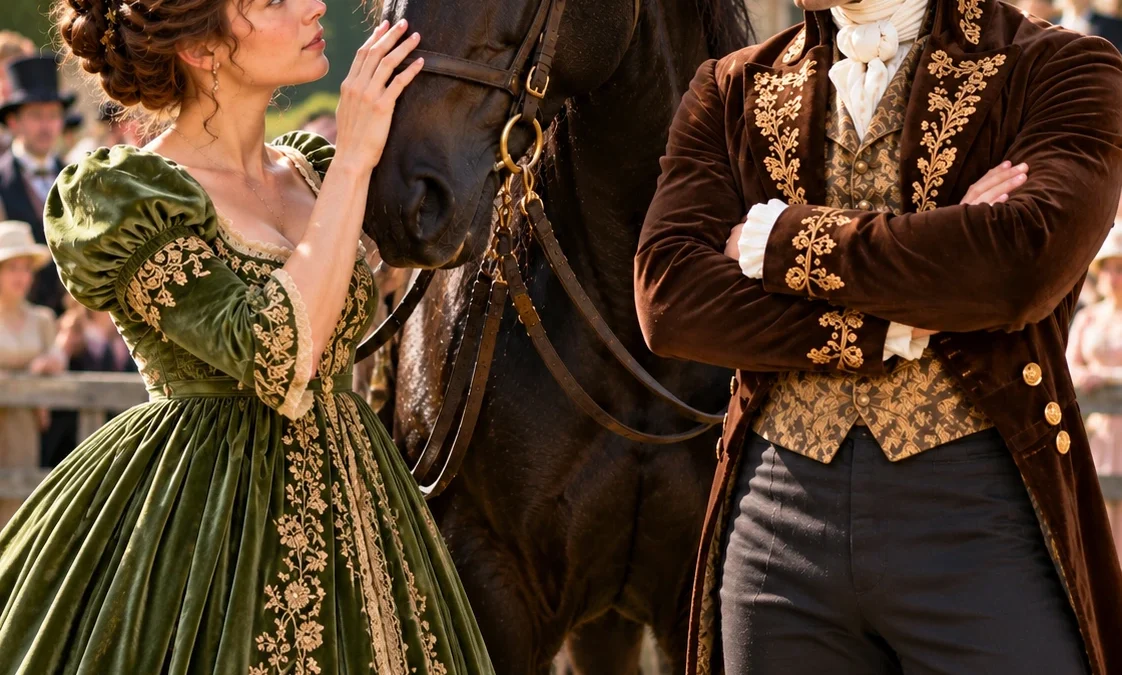
😱 Everyone Laughed When the “Plain” Spinster Walked Into the Duke’s Stable. Then She Pulled Something From the Horse That Proved a Murder Had Been Buried for 18 Months 🐎
PART 1
The notice was nailed to the church gate at Calverstone on the morning of the 14th of April, 1817, and by noon every soul in Wiltshire had read it twice.
£100 to any person who can sit the Duke’s black stallion unharmed before the 1st of May. 💰
Eleven gentlemen had already tried that week. All eleven had walked into the stable yard with a boast and walked out without a word. A hundred pounds was three years’ wages for a governess. And the Duke of Calverstone, thirty-three years old and the coldest man in the county, had signed the notice with a hand that did not look steady.
By ten o’clock, the yard was crowded. Gentlemen leaned on the fence. Ladies had driven out in their carriages for the entertainment. Everyone knew how the morning would end, though nobody could have explained why they were so eager to watch.
Then a woman stepped out from the back of the crowd, and the laughter began before she had spoken a word. 😬
Miss Harriet Penrose was twenty-nine, the daughter of a dead parson, and for three years the county had spoken of her in the soft voice people reserve for funerals. In the summer of 1814, at the Salisbury Assembly, the man she had expected to marry stood before two hundred guests and called her too plain, too odd, and fit only for the stable.
Nobody answered him. Not the matrons. Not the gentlemen. And not the young Marquess of Renford, who stood in the doorway that night with his eyes fixed on the floor.
That Marquess was the Duke now. He watched her cross the cobbles from the stable door.
“I will try,” Harriet announced.
A baronet’s wife covered her mouth. Someone by the fence called out, “Go home, Miss Penrose, before you shame yourself further!” The laughter rolled across the yard.
Harriet did not look at any of them. She owed eighty-six pounds to an apothecary and a corn merchant for her father’s last illness, and she had until midsummer to pay it or lose the only home she had ever known. Pride was a luxury she had stopped affording long ago. 🥀
Lord Percival Garrow, the Duke’s cousin, stepped forward with a smile as smooth as warm butter. “Alexander, surely you cannot permit this. Let me spare you the trouble. Put the animal down. One shot, and it is finished.” His voice dropped into something almost like kindness. “Your father would have wanted it. That horse is the reason he lies in the churchyard.”
The Duke flinched as though struck. For one moment he looked like a man being dragged back into a grave.
Harriet answered for him. “He did not kill anyone, Lord Garrow.”
Every head turned.
“I have stood at that fence ten minutes,” she went on, perfectly calm. “He is not wild. He shies only when a hand passes near his shoulder, and he does it the way you pull your fingers from a fire. That is not temper. That is pain.”
“A horse has no sense of mercy,” Garrow retorted.
“No. But it has an excellent memory for hurt.”
She walked to the stall. Inside, the black stallion trembled in the shadows, flanks dark with sweat, eyes rolling white. The crowd leaned in, waiting for her to scream and run. Harriet held out one open palm and said nothing at all.
The horse’s breathing slowed. His head came down. For the first time that morning, Mercury went quiet. 🖤
The Duke had crossed the yard without a sound. “Miss Penrose,” he asked, in a voice barely his own, “what do you see?”
“An animal that has suffered for a long time, Your Grace. And I do not think it is chance that no one in this yard has ever found out why.”
Across the cobbles, Garrow’s smile slipped. It lasted only an instant, and the crowd was watching the horse.
But the old housekeeper at the kitchen door, arms wrapped around a bread crock, was watching Garrow. Her knuckles had gone white. 👀
The Duke gave her until the first of May. For four hours, Harriet sat in the straw outside the stall and did nothing but hum an old Wiltshire reaping tune her father had used on mares frightened of thunder. By the fourth hour, the stallion let her rest her palm against his neck. Then she slid her hand up toward the withers, and he screamed.
It was not temper. It was the sound of an animal pressed with a hot iron.
Beneath the mane, she found heat, a swelling hard as a fist, and a faint sweet rot-smell her father had taught her never to forget. Fistulous withers. A deep abscess, months old at the very least.
She asked the Duke one question. “Who examined him before me?”
“Three farriers and a veterinary surgeon from Salisbury. None would stay. My cousin told me the horse nearly killed each of them.”
“Did you ask them yourself?”
He opened his mouth. Closed it. “No.”
He rode to Salisbury the next morning without telling anyone, and returned at dusk with a very strange look on his face. “Mr. Dacre, the surgeon, says he was never turned away by the horse. He was turned away by a letter under my signature. I never signed it. The three farriers were paid fifty pounds apiece to forget their visits. Percival told them it was my wish.”
Harriet let the silence answer. He did not like what it said. 😨
Then Lady Cecily, the Duke’s nineteen-year-old sister, pale as skimmed milk and silent since her father’s death, began creeping through the orchard every night with bread and hot tea. Harriet greeted her with the same four words: “There you are, then.” And Cecily, who had not laughed in two years, laughed until she had to lie down in the straw.
On the night of the 21st, over tin cups by lantern light, Cecily’s face went very still. “May I tell you something I have told no one? The morning my father died, the 9th of October, 1815, I woke before dawn and went to the window. I saw my cousin Percival come out of the tack room carrying a candle. His right hand was wrapped in a white handkerchief, spotted with blood.”
Harriet’s smile faded.
“He saw me watching. That afternoon he took my hands and said grief plays tricks on the mind. That I had dreamed it.” Her voice thinned. “I was seventeen and I wanted so badly for it to be a dream.”
“Say nothing to anyone,” Harriet whispered. “Give me a few more days.”
And on the night of the 23rd, at a dinner where twenty guests watched her over their glasses, Garrow raised his glass to Miss Penrose’s remarkable devotion, and wondered aloud whether a woman of nine-and-twenty, unmarried and in debt, might have designs larger than a reward.
Harriet looked at the Duke. She did not mean to. It was instinct, like glancing at a door when a fire starts.
He was staring at his plate. His mouth was slightly open. Nothing was coming out of it.
She saw it again, as clearly as if three years had never passed. The doorway of the Salisbury Assembly. The lowered eyes. 💔
She laid down her napkin. “Thank you for the pudding. I am afraid I must see to the horse.”
That night, she packed her bundle. And then she went to the stable anyway, because the swelling had gone soft at the center, and if she left it another day, the infection would kill Mercury by morning. She laid out her father’s lancet and whispered, “This will hurt. I am sorry.”
“Let me hold his head.”
The Duke stood in the doorway, unshaven, still in his dinner coat. “I did not come to stop you. I came to help.”
He took the halter in both hands, and Mercury sank against his chest. Harriet drew the blade across once, clean and deep. Foul matter poured into the bucket. Then the lancet scraped something hard.
She reached in with the forceps and drew out an object the length of her finger. It rang against the bucket. 🔩
A rusted iron nail, square-cut, snapped short, with a scrap of green baize still fused to its head. And caught in the baize, stamped into a shred of leather, small but perfectly legible: R. Hollis, Saddler.
The Duke’s face drained of color. “That is my father’s saddler. That is the pad from his saddle. The one he rode on the ninth.”
PART 2
The Duke stared at the nail as though it were a snake. 🐍
“It was driven through the pad, point down. When he mounted, it went into the horse. And when the horse threw him…” He stopped. “Percival had the saddle burned that same afternoon. Out of respect.”
“That is why Mercury screams whenever anything touches him,” Harriet said quietly. “The shaft snapped off in the wound. He has carried it for eighteen months.”
The Duke’s hands began to shake so badly the stallion shifted. “We quarreled that morning. I refused to ride, and my father took the horse in my place. I have believed for eighteen months that I killed him.”
“Alexander.” It was the first time she had used his name. “You did not. A man with a nail did.”
He bowed his head against the horse’s neck. Harriet did not touch him. She simply stood holding the lantern until the worst had passed.
When he straightened, his eyes were red but clear. “I failed you at dinner. I failed you in 1814. I will not fail you a third time.”
“Then say it where I was shamed,” she answered very low. “In front of the same people. That is the only apology I will accept.”
“I will say it before every soul who ever laughed at you. On the first of May.”
“Then I will stay until the first of May,” Harriet said, “and not a day longer.” 🕯️
She was halfway across the orchard at first light, bundle in hand, when someone stepped out from the trees. Cecily, barefoot in her nightgown, dew on her feet, holding a long, stiff, brown-stained strip of leather.
“You told me you liked me. Was it true, or only kindness?”
“Both,” Harriet admitted, setting down the bundle. “I am staying, as it happens.”
“Then stay for me, not for him. And take this.” It was a girth strap, severed along a line far too clean for wear. “Mrs. Whitlock gave it to me. She kept it in the bread crock for eighteen months. Her husband found it in the tack room the night before my father died, and went to tell the Duke, and Garrow caught him first. A month later, Thomas Whitlock was dismissed for stealing a snuffbox. By February, he was dead.”
Her voice cracked. “She told no one because she thought no one would believe her. But she watched you with Mercury. She said, that girl would not leave a horse in pain.” 🥹
Harriet’s eyes stung. “I have the nail.”
“Then it is three things. The nail, the strap, and me. I will stand in front of everyone and say what I saw.”
“You do not have to.”
“You made me capable. Now let me be capable.”
The week that followed was the longest of Harriet’s life. She flushed the wound twice a day, packed it with linen, and watched the heat go out of Mercury’s back by degrees. He ate. He slept standing with his chin on her shoulder. By the twenty-eighth, she could press her whole palm to his withers, and he only sighed.
Garrow grew restless. He summoned the estate trustees to Calverstone for the thirtieth and made a great show of ordering his pistols oiled. The Duke let him.
On the twenty-ninth, a hired chaise rattled up the drive, and out climbed a thin man in a black coat with a leather satchel and the look of someone who had been kept waiting far too long. Mr. Aldous Pell, family solicitor for thirty years. He carried the Duke’s letter in one pocket and, in the other, a paper he had guarded since October of 1815. 📜
The first of May dawned clear and warm. By ten o’clock, half of Wiltshire had gathered in the paddock. Every gentleman in the county had received a note in the Duke’s own hand: You laughed. Come and see what you were laughing at.
Garrow arrived last, in a dove-gray coat, a velvet case of pistols under his arm. “Your Grace, the trustees agree the animal must be destroyed. I have taken the liberty of bringing the means.”
“Put them away, Percival,” the Duke said. “You will not need them.”
Harriet stepped forward in her old blue gown, no gloves. She laid one hand against Mercury’s neck and began, very quietly, to hum.
She laid a folded blanket across his back, well behind the withers, where no wound remained to touch. He did not flinch. Then she set her foot in a groom’s cupped hands, swung up, and sat. 🐎
A sound ran around the paddock, not quite a cheer, not quite a gasp. A baronet dropped his quizzing glass. Harriet touched her heel to Mercury’s side, and the great black horse walked. She asked for more, and he trotted, easy and even, head high, ears pricked, all the way around the circuit. She brought him back and halted him in front of the Duke.
Nobody laughed.
The Duke walked into the middle of the paddock and turned to face the crowd. He was pale, but his voice carried to the last carriage.
“Three years ago at the Salisbury Assembly, a lady was insulted before two hundred of you. Her only offense was understanding horses better than gentlemen. I stood in the doorway and said nothing. Many of you laughed. I did not, but that is no credit to me. Silence is a kind of laughter, and I have been ashamed of mine ever since.” He turned. “Miss Penrose, I beg your pardon.”
The paddock held perfectly still.
“My father died on the ninth of October, 1815. You were told the horse killed him. That was a lie, and I let it stand because I could not bear the truth. Show them.”
Harriet slid from the saddle and opened her palm. The rusted nail caught the sun. A gasp passed through the crowd like wind through barley. 😮
“And this,” the Duke said, lifting the severed strap, “was found in the tack room by my head groom, Thomas Whitlock, on the eighth of October. He tried to warn me. He was dismissed within the month on a false charge and died in poverty the following February.”
Near the kitchen door, Mrs. Whitlock stood small and upright in her black dress, weeping without a sound.
“I have a witness,” said the Duke. “My sister.”
Cecily stepped out beside him. Her knees shook. Her knuckles were white. But she lifted her chin.
“At dawn on the ninth of October, 1815, I saw my cousin, Lord Percival Garrow, leave the tack room carrying a candle. His right hand was wrapped in a bloodied handkerchief.” Her voice began as a thread and strengthened with every word. “He told me I had dreamed it. I did not dream it. I was afraid, and I was seventeen. I am nineteen now.”
Garrow’s smile had gone stiff. “Absurd. A hysterical girl and a servant’s widow. Any man might have cut his hand.”
“You wore a glove on that hand for six weeks,” said Sir Hugh Alder, the magistrate, frowning from the fence. “You told the whole county a dog had bitten you.”
The thin man in black stepped forward with his satchel. 📜
PART 3
“Your Grace,” said Mr. Pell, “on the second of October, 1815, the late Duke wrote to me demanding a full audit of the Rowan marriage settlement, to be examined at Calverstone on the twelfth. He died on the ninth. Lord Garrow, as co-trustee, informed me the matter would be handled privately.”
He drew out a folded paper, then a ledger. “I kept the letter. I have spent the last two days with the books. The settlement was left to Lady Cecily in the sum of £18,000. There remain, at present, a little under four hundred.”
A low, ugly murmur rolled through the crowd. 😡
“A loan,” Garrow snapped, and the butter had gone out of his voice. “A temporary embarrassment. A run of ill luck. I would have restored every penny.”
“Eighteen thousand pounds,” said the Duke, “over nine years.”
“The old man meant to ruin me over a few thousand!” Garrow burst out. “Do you imagine I wished him dead? I wanted him delayed. A fall, a broken collarbone, a month in bed, long enough to put the accounts in order. And instead the fool broke his neck!”
He stopped. Too late.
The whole paddock had heard it. Nobody spoke. Garrow looked around at every face that had ever smiled at him, and each one now regarded him as something found under a stone. 🪨
Sir Hugh Alder was already moving through the crowd, two constables falling in beside him. They took Garrow away between them, and nobody breathed until the sound of his boots had faded.
The Duke turned toward the kitchen door. “Mrs. Whitlock, come here, if you please.”
She came slowly, wiping her face with her apron, her back very straight. “Thomas Whitlock served this house for twenty-six years,” the Duke told the crowd. “He was dismissed on a false charge. Before this county, I declare his name clean. You will have forty pounds a year for life, Mrs. Whitlock, and the cottage by the east wall, rent-free, for as long as you wish. Daniel Whitlock takes his father’s place as head groom. And above the stable arch, I will have his father’s name carved as the man who tried to stop it.”
Mrs. Whitlock covered her mouth with both hands. She bowed very low, and Daniel, red to the ears, came forward and took her arm. 🥹
The Duke turned back to Harriet with a small purse. “The reward, Miss Penrose. A hundred pounds. You earned every shilling.”
She weighed it in her palm and smiled, crooked and tired and astonished. “Thank you, Your Grace. I shall pay the apothecary.”
“I have one thing more to offer you, and it is not in a purse.”
He knelt in the dust of the paddock, before every lady and gentleman who had ever laughed at her. He took off his hat and looked up.
“I have been a coward about one thing in my life, and I would like to stop. Miss Harriet Penrose, I love you, and I believe I have since the morning you told me to stand at the far fence. Will you marry me?” 💍
Her heart was doing something dangerous. She had loved him since the night he held the horse’s head. But she looked down at him, and at the sea of watching faces, and her mouth quirked.
“Ask me again,” she told him, “without the county.”
A ripple of laughter ran through the crowd, warm this time. The Duke grinned helplessly, like a boy. He asked her again that evening at the stable fence, with only the horse and one very satisfied sister watching from the orchard.
And that time, she said yes. ❤️
The second of June, 1820. Mercury was ten years old now, glossy and sound, the pride of the Calverstone stud. His first foal, a bay colt with a white star, stood at the paddock rail, regarding the world with good-humored suspicion. The brass plate on the stall behind him read Thomas. On the arch above the stable, the stone said: Thomas Whitlock, Head Groom, Who Tried to Stop It.
Harriet, Duchess of Calverstone, thirty-two years old, stood at the fence with a little girl on her hip, two years old, in a white pinafore, with her father’s gray eyes and her mother’s stubborn chin. The Duke leaned beside them, one arm around his wife.
“Stand still,” Harriet whispered to the child as the colt came sniffing along the rail. “Very still. Let him come to you.”
The little girl stretched out one small, serious hand. The colt breathed on it. She shrieked with delight. 🐴
Behind them in the orchard, a wedding party was gathering. Cecily, twenty-two, in white muslin with apple blossom in her hair, was being scolded by Mrs. Whitlock for fidgeting. Beside her stood Daniel in a borrowed coat, ears glowing, a book sticking out of his pocket.
Cecily caught Harriet’s eye across the paddock and blew her a kiss. And the Duke, holding his wife and his daughter and the most unlikely family in Wiltshire, began very quietly to hum an old reaping song. 🎶
💬 Now tell me in the comments: who was your favorite character, and why? Harriet, with her patience and her father’s lancet? Cecily, who learned to be brave? Mrs. Whitlock, who kept a secret in a bread crock for eighteen months? Or the Duke, who finally broke his silence? I read every comment. 👇
Disclaimer: This story is entirely fictional and created for entertainment purposes only. It does not represent any organization or individual, nor does it encourage inappropriate behavior. The content was generated with AI assistance.








