Everyone Mocked Him For Putting 200 Chickens In The Dying Orchard — Then 3 Months Later They All Came Back Quietly
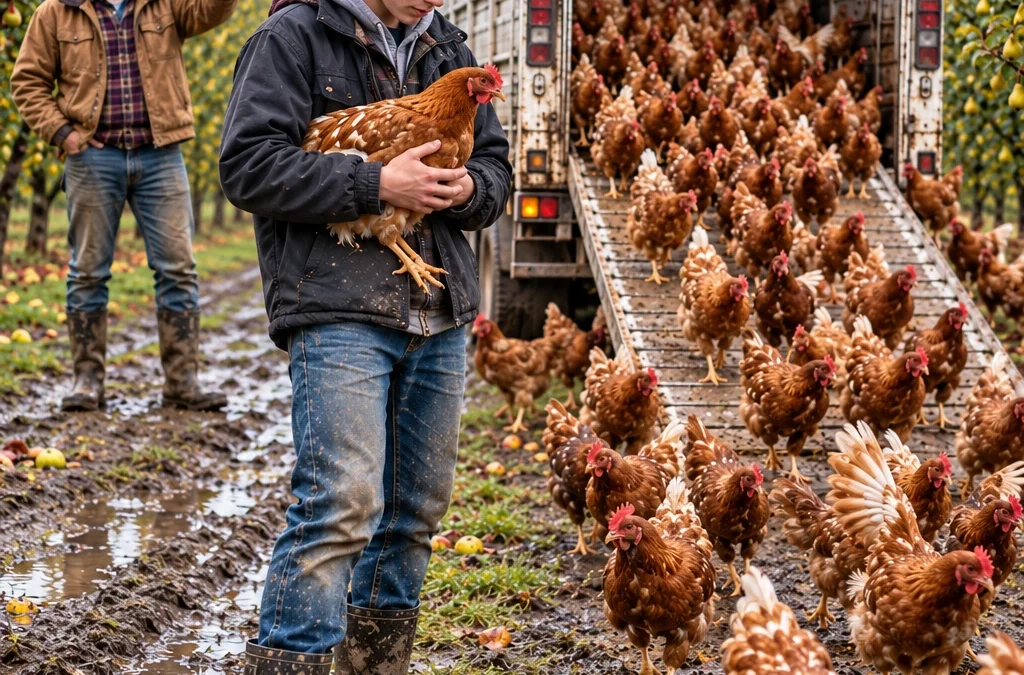
Everyone Mocked Him For Putting 200 Chickens In The Dying Orchard — Then 3 Months Later They All Came Back Quietly 😱🐔
Part 1
It was a cold April morning in rural Michigan when fifteen-year-old Toby Mercer swung open the wire gate and guided two hundred scruffy, unwanted laying hens straight into the heart of his family’s failing apple orchard.
His father Daniel had told him not to.
The neighbor across the road had already called it foolish.
And when Harlan — the agricultural consultant who’d spent twenty years selling orchard programs across the county — climbed out of his truck and saw what Toby had done, he laughed so hard he had to lean against the door.
Harlan wasn’t laughing because chickens were strange in an orchard.
He laughed because Toby had picked the absolute worst possible moment to try it.
The previous harvest had been destroyed by insects.
The trees were already stressed.
The family had less than a month to decide whether to borrow twelve thousand dollars for the chemical treatment Harlan was pushing.
Toby knew all of that.
What Harlan didn’t know was that Toby had spent the previous three weeks studying what lived beneath the fallen leaves.
And the chickens weren’t there for the reason everyone assumed.
He wasn’t watching what they ate.
He was watching what they uncovered.
Long before that morning, Toby had marked every section in his notebook — which rows had suffered the worst damage, which still held the pests he was tracking, and which areas he’d leave completely untouched so he could compare them later.
If he was wrong, his father would lose more than three months of work.
They could end up taking that huge loan anyway — with even less time and money left to recover.
So when Harlan wiped his eyes and told the co-op manager standing beside him that Toby was building an all-you-can-eat buffet for coyotes, the boy didn’t argue.
He just looked down at the ground where one hen had scratched through the leaf litter.
Something small and pale was moving in the exposed soil.
Toby crouched down.
And for the first time that morning, he smiled.
Daniel stood silent, watching.
He’d spent his life tending these trees.
He knew exactly how much had already been lost — the fruit rejected by buyers, the bills piling up, the twelve-thousand-dollar price tag hanging over everything.
Borrowing that much could save them one bad year — or lose the orchard entirely.
Toby had grown up doing the jobs no one else really noticed: filling feeders before school, mending fences, hauling water, walking the rows at harvest.
He wasn’t a scientist.
He just paid attention.
He’d watched chickens tear through pest-ridden debris near the barn.
He’d watched how the farm treated every problem separately — pests here, fallen fruit there, fertility somewhere else — and wondered why they couldn’t help each other.
He’d asked his father once.
“Chickens are chickens.
Apples are apples,” Daniel had said gently.
“This orchard is too valuable to gamble.
”
So Toby read his grandfather’s old books.
He studied what happened when birds worked the soil.
He realized it wasn’t about replacing chemicals overnight — it was about whether chickens could chip away at several problems at once: pests, cleanup, fertility, all in one.
He asked for only one section to test.
He’d keep records.
He’d move the birds himself.
He’d stop if it wasn’t working.
Daniel hesitated — then gave permission.
Not confidence.
Just a chance to prove him wrong.
The hens weren’t fancy.
They were the ones no one wanted — past their prime, thin, culled from other flocks.
That was exactly why Toby chose them.
He wasn’t sinking money into stock.
He was taking something written off and asking if it still had work to do.
He built simple movable pens from salvaged lumber and old wire.
Nothing looked professional.
But it was sturdy.
It was light enough for him to handle alone.
Now, as the flock scattered beneath the trees, Harlan shook his head and got back in his truck.
“Three months,” he called out the window.
“Come July, we’ll see who’s laughing then.
”
Toby didn’t look up.
He was already making his first note in the book.
By the end of the first month, things had gone wrong exactly as everyone predicted.
A predator tore through the fence and several hens vanished.
Rain turned the ground to mud; the pens sank; moving them became backbreaking labor.
The birds over-scratched one patch, damaging the soil.
Daniel watched his son drag heavy water buckets at dawn and dusk and asked — honestly — if this was actually saving anything, or just creating another job.
Toby didn’t have an answer.
Then Harlan heard.
“I told you,” he said.
“Livestock only makes more work.
”
Those words changed everything.
Toby stopped just observing — and started measuring.
He counted every bird lost.
He logged every hour of labor.
He tracked feed costs, egg income, insect numbers, everything — side by side with the untouched sections for comparison.
By early summer, the deadline for the loan was approaching fast.
Daniel gave him a final, quiet warning: they couldn’t wait forever.
Toby asked for just a few more weeks.
Just enough to finish the numbers.
That was when he made the discovery that would turn everything upside down — and it wasn’t what anyone expected.
😱
Part 2
It wasn’t one big miracle.
It was all the small things added together.
Toby realized he’d been asking the wrong question all along.
He wasn’t trying to prove chickens could replace pesticides.
He was trying to prove they could reduce several separate costs at once.
Less pest pressure in certain sections.
Less manual cleanup.
Fewer hours spent clearing debris.
Eggs bringing in steady small income.
Manure feeding the soil so less fertilizer was needed.
None of it dramatic on its own — but together, it changed the math completely.
Three months to the day after the hens walked into the orchard, Harlan returned.
The co-op manager sat beside him.
Daniel had delayed signing the loan longer than anyone thought reasonable.
They came ready to end the experiment.
Instead, when they walked through the gate, Harlan slowed to a stop.
The orchard wasn’t magically perfect.
Toby made sure to show them that first.
Some rows still had visible damage.
One corner remained untouched because the soil had stayed too wet.
There were places where the hens had stayed too long and done more harm than good.
He didn’t hide any of it.
But the trees were holding strong.
The ground beneath the managed rows was cleaner, looser, alive in a way it hadn’t been the year before.
And the difference between those sections and the untouched ones was impossible to miss.
Harlan pointed to a spot where insects were still clearly active.
“This is it?” he challenged.
“Your great solution?”
Toby nodded.
“It didn’t work there.
I rotated too late.
The birds couldn’t reach deep enough.
”
He didn’t defend the failures.
He explained them.
That was when he pulled out his notebook — pages crammed tight with dates, counts, hours, weather notes, side-by-side comparisons.
He walked them through the numbers honestly.
Forty-three hens lost.
Feed and repairs cost more than planned.
Some areas showed almost no improvement.
But then he turned to the other side — the savings: fewer pests, less cleanup labor, egg income offsetting feed, fertility building naturally.
When he reached the final calculation, the co-op manager leaned in.
The chickens hadn’t replaced the chemical program.
But the combined savings — month after month — added up to enough that they wouldn’t need the twelve-thousand-dollar loan at all.
Silence stretched long across the orchard.
Harlan stared at the figures.
Then he looked up at Toby — and for the first time in three months, he wasn’t smiling.
He wasn’t mocking either.
He just looked… stunned.
Then he asked the question that stopped everyone cold.
Part 3
Toby didn’t flinch.
He’d asked himself that same question every single night.
He pointed to the rows the hens had never touched — the control sections he’d set aside from day one.
He showed them last year’s records.
He explained which results he was confident about — and which ones he still wasn’t.
“I can’t promise it’ll work the same way next year,” he said plainly.
“Different weather, different pests, different predators — I’d need another season to know for sure.
But these numbers? They’re what happened here.
”
That honesty caught Harlan more than any impressive figure could have.
He flipped through the notebook again, slower this time.
He saw where Toby had crossed out assumptions and replaced them with what he’d actually observed.
He saw where he’d admitted mistakes instead of erasing them.
“Maybe,” Toby said.
“But not exactly like this.
Every farm’s different.
You’d have to test it yourself.
”
No one was cheering.
No one called him a genius.
But the laughter was gone completely.
Later that evening, after the men had driven away, Daniel walked out to where Toby was mending a loose panel.
The sun was dipping low, gilding the leaves.
The hens scratched quietly in the dappled shade.
“I didn’t laugh at you that first day,” Daniel said quietly.
“I was scared.
”
Toby stopped and looked at him.
“Scared you’d find out how fragile this all is,” his father went on.
“That we can work dawn to dusk and still barely hold on.
Scared you’d pour your heart into something and watch it fail.
Mostly… scared you’d see that I don’t always have the answers.
”
He gestured toward the rows.
“You didn’t prove me wrong, Toby.
You showed me something I stopped looking for — that the pieces of this farm don’t have to be separate.
That what we already have can help us in ways we haven’t tried yet.
”
That was the real breakthrough.
Not the chickens.
The connection.
For years they’d treated problems as isolated — pests, cleanup, fertility, feed costs — each with its own bill.
Toby had simply asked what happened when those pieces worked together.
Word spread slowly at first.
Other growers began stopping by.
Some skeptical, some curious.
Toby showed them the notebook.
He showed them the failures alongside the successes.
He didn’t promise miracles.
He invited them to test it themselves.
By autumn, the orchard looked much the same from the road — same trees, same rough fencing, same boy hauling water and moving pens at dawn.
But the difference was real.
They hadn’t gotten rich.
They hadn’t transformed overnight.
But they’d survived without crushing debt.
They’d bought themselves time.
And Toby? He was still the same kid doing chores.
He hadn’t suddenly become an expert.
If anything, he was more careful now — more aware of how much he still didn’t know.
One afternoon as they walked the rows together, Harlan pulled up beside them.
He didn’t laugh.
He leaned against the fence and watched the hens work the leaf litter for a long moment.
“I still think you’re missing things,” he said.
Toby nodded.
“I probably am.
”
“Good,” Harlan said.
“Means you’re looking.
”
He drove away, but he left something behind — a list of questions to test next season.
The following spring, the loan papers sat unsigned in a desk drawer.
The pens went out earlier.
More sections got rotated.
Neighbors brought their own notebooks.
And somewhere in the middle of it all, Toby smiled — not because he’d proven everyone wrong, but because they were finally looking together.
The chickens hadn’t saved the orchard.
They’d just been the key that unlocked a different way of seeing it.
And that was the lesson everyone missed at the start: the best solutions aren’t always the ones you buy.
Sometimes they’re the ones you already have — waiting for someone to notice how they fit together.
This story is entirely fictional and created for entertainment purposes only.
It does not represent any organization or individual, nor does it encourage inappropriate behavior.
The content was generated with AI assistance.








