Fifteen Men Were Bleeding From the Mouth on the Trail, and the Only Cure Came From the Woman Their Cook Had Secretly Married… and Left Behind for Fifteen Years
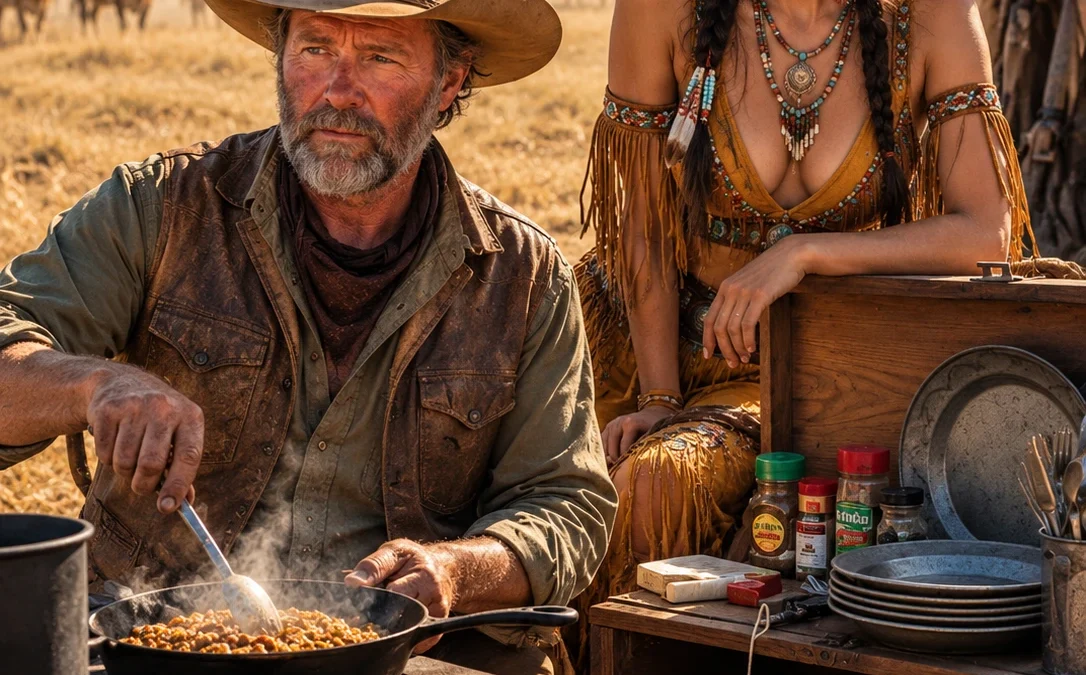
Fifteen Men Were Bleeding From the Mouth on the Trail, and the Only Cure Came From the Woman Their Cook Had Secretly Married… and Left Behind for Fifteen Years 😱🔥
PART 1
Eight weeks into the drive, the first man complained about his gums. By the end of the week, the whole crew was bleeding. 🩸
Samuel “Cookie” Crawford had spent fifteen years believing the worst thing on the cattle trail was a stampede.
He was wrong.
It began quietly. Tom Martinez, one of the swing riders, winced over his morning coffee. His gums hurt. Cookie waved it off. Tobacco, probably. But the next morning two more men said the same thing. By the end of the week, it wasn’t complaints anymore.
It was blood. 😨
Gums swollen and purple. Mouths that bled at the lightest touch. And then the part that frightened Cookie most: old scars, healed for years, began splitting open on their own, oozing fresh blood, as if the men’s bodies were quietly coming apart from the inside.
Cookie threw everything in his chuck box at it. Whiskey, to “purify the blood.” Calomel, a toxic mercury compound that mostly poisoned them faster. He even made men drink raw beef blood for strength.
Nothing worked.
Sixteen-year-old Billy, the youngest drag rider, collapsed while gathering cow chips and couldn’t stand back up. That evening the trail boss pulled Cookie aside, his voice low and grim.
“If this doesn’t stop, we lose the herd. We might lose the men.”
Cookie knew he was right. They were three weeks from Kansas. At this rate, half the crew would be in the ground before they ever saw a railroad.
He was the cook. The doctor. The judge of the prairie. These men’s lives sat in his hands, and his hands were empty. 💔
Then, as if by providence, the outfit reached a Cherokee settlement near the Kansas border.
While the trail boss traded for fresh horses, Cookie limped through a small trading post, desperate. The old longhorn wound in his thigh had left him with a limp that never healed, and today every step felt like a prayer. Women were bartering vegetables and leather for flour and coffee.
One of them stopped him cold.
She was older, silver threading through her dark hair, and she moved with a quiet authority that made people step aside without realizing they were doing it. She carried a basket of dried herbs. Cookie noticed her hands first, strong and steady, hands that had mended a great many broken things.
Her eyes met his for the briefest instant.
Something flickered there. Gone before he could name it.
Cookie removed his hat. “Men sick,” he said, pointing to his mouth, miming blood. He pushed up his sleeve and showed her an old scar, then traced how it had reopened.
She listened carefully. Then she spoke in Cherokee to a young man nearby, her son, Sequoia.
“My mother says she knows this sickness. She has seen it in hard winters, when our people had no fresh food. It comes from eating only old meat for too long.”
Cookie’s heart leapt. “Can she cure it?”
“She can show you the medicine. But you must follow her instructions exactly, or the medicine becomes poison.”
Her name, Sequoia added, was Ayita.
It meant first to dance.
Cookie’s breath stopped in his chest.
He knew that name. He had carried it for fifteen years like a stone in his pocket, worn smooth from turning it over in the dark. He had whispered it into a ceramic jar of sourdough on freezing nights, tucked against his heart.
But she gave no sign of knowing him. She nodded once, as if he were a stranger, and led him toward a grove of pine trees at the edge of the settlement.
Her face was a locked door. And Cookie, who had learned to read every cowboy on that trail, could not tell what was behind it. 😶
As she gathered handfuls of young green needles, Sequoia translated her warning.
“Not all evergreens are safe. The yew tree, with flat dark needles, is death. Even a little stops a man’s heart. The ponderosa will make cattle lose their calves. Use only white pine, spruce, or fir. Only the youngest needles at the tips. The old ones are too bitter.”
Then came the instruction that mattered most. Ayita mimed boiling water, then shook her head firmly when she reached for the needles.
“Never boil the needles. Heat destroys the medicine. Boil the water first, take it off the fire, then add the crushed needles. Let them steep like tea.”
Cookie listened with every muscle in his face. His crew’s lives depended on remembering every word.
Back at the chuck wagon, he followed her instructions exactly. He sent the healthier men to gather young needles and crushed them between rocks to release their oils. He brought the water to a rolling boil, pulled the pot from the fire, and threw the needles in. Fifteen minutes later he had a pale yellow-green liquid with a thin film of oil on top. It smelled like Christmas. It tasted like liquid lumber.
He added molasses and lined up the sick men.
“It tastes like turpentine,” Cookie growled. “But the Cherokee woman says it’s the cure. Drink.”
The cowboys gagged. They cursed. They accused him of poisoning them. But they drank, because when Cookie gave an order about food or medicine, you obeyed.
Within two days, the bleeding stopped.
Within three, men who could barely sit a horse were riding full shifts. Within a week, even the reopened scars began to close. Young Billy was back to eating dust and complaining, the surest sign of life.
What Cookie couldn’t have known, what nobody in the 1870s could have known, was that those humble pine needles held several times more vitamin C than oranges. A woman with no university and no medical license had just saved fifteen lives with knowledge that white doctors had never learned. 🌲
When the outfit prepared to move on, Cookie sought her out. He brought fifty pounds of flour, five pounds of sugar, and his own wool blanket. A fortune on the trail.
“Tell her she saved my crew,” he said to Sequoia. “Tell her I owe her my life.”
Ayita listened to her son’s translation. Then she spoke, and for the first time, Cookie caught something in her voice that wasn’t a stranger’s at all.
“My mother says the trade is not equal,” Sequoia said slowly. “You have given things she can buy. She has given knowledge that cannot be bought. If you wish to repay her, take me with you. Teach me to cook for the cowboys. Pay me a helper’s wages. I will return before winter with money for my family.”
Cookie agreed. But as the boy turned away to pack, Ayita stepped closer, so close that only Cookie could hear her.
She spoke in English. Careful. Broken. Unmistakable.
“You kept the bread alive.”
Cookie went white.
Because there was only one way she could know that. The ceramic keg on his wagon looked like any other. No one had told her what lived inside it.
“Fifteen winters, Samuel,” she whispered. “And you never once let it die.”
He had spent fifteen years rehearsing this moment. He had imagined her crying. Imagined her angry. Imagined her forgiving him.
He had never imagined what she said next.
“The boy you are taking with you,” Ayita said, her voice breaking at last. “Sequoia. You need to know who he is. And you need to know what I never told you.”
PART 2
Cookie couldn’t breathe.
He stood frozen beside the pine grove, his crew’s lives saved, his whole past standing in front of him in a Cherokee shawl.
“What did you never tell me?” His voice cracked.
Ayita glanced toward her son, who was loading the helper’s pack onto the wagon, out of earshot.
“Not here,” she said. “Tonight. When the camp sleeps. Come to the river.”
That evening, after the sick men finally slept the deep sleep of the healing, Cookie limped down to the water. His heart pounded the way it had at twenty-two, when he’d bought a pair of moccasins he didn’t need, paying too much just to see a girl smile.
Ayita waited on the bank, the moon silvering her hair.
For a long time neither spoke.
“I saw you at the trading post,” she said finally. “I knew you in one heartbeat. The limp. The way you take your hat off. But there were white cowboys watching. If they knew a trail cook had a Cherokee wife, they would have made your life hard. I have protected your name for years, Samuel. That was my gift to you.”
“Ayita…”
“Let me finish.” She drew a breath. “When you left that first spring, you did not know I was carrying a child. I did not tell you because I knew you would stay. And we would have starved.” Her eyes shone. “So I let you go. And I raised him alone. Sequoia is your son.”
The words landed like a stone dropped into still water. 😭
Cookie sank to his knees in the grass. The boy he’d just hired. The boy who had translated his gratitude, who had stood by him at the pine grove, who had the same straight-backed way of standing that Cookie’s own father had.
“He knows?” he whispered.
“He has always known. But he asked me to wait. He wanted to see what kind of man you were before he claimed you.”
Behind them, a footstep crunched on the gravel.
Sequoia stood at the edge of the firelight, his face unreadable.
“I have watched you for three days,” he said quietly. “You cooked for fifteen men who could barely stand. You carried water on a bad leg. You took medicine from my mother without pride getting in the way. You listened.” His voice trembled. “I came to the trading post expecting a stranger. I think I found a father.”
Cookie opened his mouth. Nothing came out.
The old cook who had faced stampedes and river crossings and rattlesnakes could not find a single word.
Then Sequoia stepped forward and held out his hand. Not for a handshake. Palm up. The way you’d offer something to a frightened animal.
“Teach me to cook,” he said. “And teach me how to be your son.”
Cookie grasped the hand in both of his, shaking, tears running down his weathered face.
But the moment broke when Ayita spoke again, very softly.
“There is one more thing, Samuel. Something about the winter. Something about why I waited fifteen years to tell you the truth.”
She reached into her shawl and drew out a small leather pouch. Her fingers trembled.
“This is why I let you leave,” she said. “And this is why I am afraid to let you come home.”
She opened it.
PART 3
Inside the pouch lay a small, worn ceramic shard, the broken piece of a jar.
Cookie recognized it instantly. His throat closed.
“That’s from the starter jar,” he whispered. “The one you gave me. I thought it was…”
“Not the same jar.” Ayita turned the shard over. Scratched into the glaze with a needle were three tiny marks. “My grandmother’s jar broke the winter after you left. The sourdough lived because I saved it. But I kept the pieces. I carved a mark on this one for every winter you came home.”
Cookie stared. Fifteen marks. Fifteen winters.
And one more, set apart from the others, small and deep, scratched with a different hand.
“That one is not mine,” Ayita said. “That one is Sequoia’s. He added it the year he turned twelve. He said it was for the winter he decided he would forgive you.”
Cookie’s shoulders began to shake.
“I was afraid,” Ayita continued, her own voice finally breaking, “that if I told you everything, you would stay. You would leave the trail, take the poverty, and watch our children go hungry. I decided I would rather wait fifteen winters alone than watch the man I loved be crushed by a life that had no room for him.” She wiped her eyes. “I decided it for you. And I was wrong to. You should have been given the choice.”
“No.” Cookie took her hands. “You gave me something else. You gave me a reason to come back every single year. A man who has nothing to return to stops riding home. I never stopped, Ayita. Not once. Because of you.”
She laughed through her tears. “You are getting old, husband.”
“So are you, wife.”
And for the first time in fifteen years, they didn’t say goodbye.
They rode north to Kansas together, the outfit and the boy and the woman who had saved them, because Ayita would not hear of Cookie making the last leg of the drive alone. The cowboys, once suspicious of a medicine woman on the wagon, fell quiet around her. Men who had cursed her pine needle tea now brought her their blistered hands and their sorest ribs, sheepish as schoolboys. Billy, still pale but grinning, carried her water without being asked.
Three days from the railhead, as they crested a low ridge, they saw something that made the trail boss rein in hard.
Smoke on the horizon. Thick and black.
A prairie fire, racing across dry grass directly toward the herd. 🔥
For a moment, nobody moved. Three thousand longhorns. Two weeks of dry weather. One spark and a hundred thousand dollars of cattle, and every life on that wagon, would vanish.
The trail boss started shouting orders. Riders scattered. And in the chaos, Cookie did something no one expected. He grabbed a wet blanket from the water barrel, limped as fast as his bad leg allowed to the edge of the camp, and shouted for the cooks’ coals to be dumped.
“Backfire!” he yelled. “We burn a break before it reaches us!”
It was a trick he’d learned from Ayita’s people, years ago, in a winter hearth. Burn the grass in front of the flames so the fire has nothing left to eat. Dangerous. Insane. The only thing that could work.
Sequoia was at his side in a heartbeat. Together they dragged burning cow chips from the fire pit and lit a thin line of flame along the edge of the trail, controlling it with wet blankets, beating back sparks with their hats. Ayita and the healthy cowboys joined them, forming a line, passing water hand to hand.
The wall of fire roared closer. The heat singed Cookie’s eyebrows. His thigh screamed with every step.
But the backfire held.
When the main blaze reached the burned ground, it stalled, choked, and bent away from the herd, sweeping harmlessly around them like a river around a stone. 🌅
For a long, ringing moment, nobody spoke.
Then the trail boss tipped his hat to Cookie.
“Fifteen years, Crawford, and you’ve never once let me down.”
“Wasn’t me,” Cookie said, gasping, his face blackened with soot. He gestured to Ayita and Sequoia. “Wasn’t just me.”
They reached the Kansas railhead three days later with every man alive and every steer accounted for. The cowboys scattered to saloons and barbershops. Cookie went to the cashier’s window, collected his wages, and counted out Sequoia’s share.
“Twenty-five dollars. Take it home to your mother.”
“No,” Sequoia said, smiling. “We are all going home.”
Ayita looked at Cookie, a question in her dark eyes.
He hesitated only a moment. He thought of fifteen springs of riding away. Fifteen autumns of riding back. Three children raised on stories of a father who was always leaving.
“This was my last drive,” he said quietly. “My leg is done. It’s been done for years. I just wasn’t ready to say it out loud.”
“Samuel…”
“I’m coming home, Ayita. Not for the winter. For good.”
She pressed her hand against his cheek, and the tears she had held back for fifteen years finally came.
When they rode into the Cherokee settlement in the first light of October, the whole village came out to greet them. Two young women ran toward the wagon, calling for their father. A boy with a new horse waved wildly from the corral.
Cookie, who had once ridden away from this place with nothing but a promise, climbed down from the wagon, limping, and opened his arms.
His children ran into them.
That evening, they ate bread from the sourdough starter at a table crowded with family. The same living yeast, still bubbling, still fed. Cookie held up a loaf and told the story of the keg, the freezing nights, the blankets wrapped around it, and how every cowboy on the trail had teased him for loving it more than any woman.
“They didn’t know how right they were,” he said, smiling at Ayita. “And how wrong.”
The children laughed. Sequoia raised a cup of coffee, and the old cook looked around the table at faces he had carried in his heart through fifteen years of dust and rivers and cold nights, and finally let himself be home.
They had twelve more years together before he passed peacefully in his sleep, his hand in hers, his family around him. Their son became a respected ranch foreman, using what he’d learned from both his father and his mother. Their daughters learned Ayita’s medicine and married men who honored it. And the sourdough starter lived on, handed from generation to generation, still bubbling in a kitchen somewhere in Oklahoma, fed daily by a great-great-grandchild who knows the story.
No monuments were ever raised to Cookie and Ayita. No history books mention their names. But the West was never built by lone riders vanishing into the sunset. It was built by families that bridged worlds, by women who held everything together, and by men who rode home every fall because someone was waiting.
And that, in the end, is legacy enough. 🕊️
THE END
💬 What moment hit you hardest: the pine needle tea, the fifteen marks on the shard, or Sequoia’s open hand? Tell me in the comments, and share this with someone who still believes love is worth waiting for. 👇
Disclaimer: This story is entirely fictional and created for entertainment purposes only. It does not represent any organization or individual, nor does it encourage inappropriate behavior. The content was generated with AI assistance.








