Five Funerals in Two Years. Every Time, She Sat in the Front Pew and Gave Money to the Church. Then a Doctor Looked at a Dying 19-Year-Old and Refused to Write “Bad Luck”
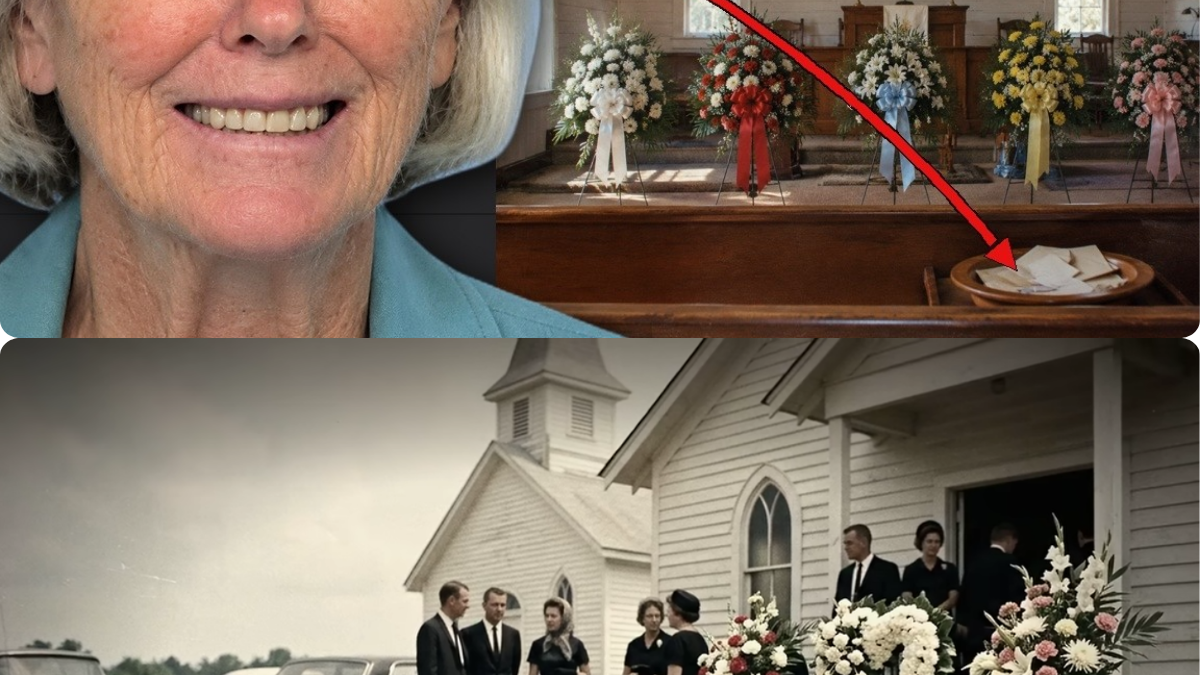
Five Funerals in Two Years. Every Time, She Sat in the Front Pew and Gave Money to the Church. Then a Doctor Looked at a Dying 19-Year-Old and Refused to Write “Bad Luck” 😨
Part 1
Ruth Ellen Mabry stood in the front pew of Mount Calvary Baptist Church five times in less than two years.
First her husband. Then her youngest son. Then her middle son. Then her newborn grandson.
And finally, the last of her children.
Five funerals. Five ordinary explanations on five official documents. And each time, the whole congregation of a small Georgia farming town wrapped its arms around the most faithful woman they knew. 🕯️
After every loss, she gave a share of the insurance money to the church.
People called her a saint.
She ran a daycare out of her own home, where as many as twenty-five children came on a busy week. Mothers trusted her completely. She taught, she cooked for church suppers, and she showed up for every family in need.
For seventeen years, that was not a mask at all. It was simply her life.
She was born on Christmas Day, 1932, in the depths of the Depression, the fifth child of a large family in a farming town where everyone went to church on Sunday and everyone knew everyone’s business.
At seventeen she married an electrician named Walter Mabry. By her own later account, it was not a particularly happy marriage, but from the outside it looked exactly the way the town expected. They had three sons: Daniel, Calvin, and Thomas.
Then, in the winter of 1965, Walter fell ill.
For a while he seemed to improve. Ruth Ellen visited him faithfully. Then he grew worse. In January 1966, he died. Doctors blamed liver disease. No one looked further.
She later told people that before he died, Walter had told her to prepare to be alone.
At the time, it sounded like the last words of a dying husband.
Looking back, it sounds like something else.
The church rallied around the young widow and her three boys. Neighbors brought casseroles. And when Walter’s insurance paid out, she gave a share to the church to thank them for their kindness.
Here is what no one in that congregation knew.
In the months that followed, Ruth Ellen took out life insurance policies on her sons.
In the rural South of the 1960s, that was not unusual. Agents went door to door selling small policies for pennies a week, and many families insured every member just to be sure of a funeral. No one at the insurance office would have looked twice at a widow insuring her boys.
If anything, it looked responsible. 🌙
In the summer of 1966, eight months after his father’s death, thirteen-year-old Thomas fell sick.
He was taken to a hospital ninety miles away. The doctors were puzzled. He died at the end of August. His death was blamed on liver trouble, possibly hepatitis. Perhaps, they wondered, he had inherited a liver condition from his father.
It almost made sense. A father and son. A similar illness. A family tragedy.
Once again the church filled. Once again Ruth Ellen sat in the front pew. And once again, when the insurance paid, she gave a large share to the church.
Two sons were left. Daniel, who had married that summer at eighteen, and Calvin, sixteen, who still lived at home.
That winter, Calvin began to feel unwell. He saw one doctor, then another, then another. No one could say what was wrong. In January 1967, he died in a third hospital. The cause was recorded as a rare muscular disorder.
Think of what it was like for the people around her. Each loss arrived with its own heartbreak, mourned by people who saw only one piece of the story. The grief was too close, too constant, for anyone to step back and look at the whole.
Three funerals in a single year. A husband and two teenage sons.
No one placed those losses side by side and asked whether so much tragedy in one house could truly be chance.
Why would they? Who would ever imagine it?
By the summer of 1967, Ruth Ellen had one son left. Daniel was nineteen, married, and about to become a father. After everything his mother had suffered, he and his young wife did something kind.
They moved in with her, so she wouldn’t be alone.
In early September, their baby boy was born. They named him Ronnie. Ruth Ellen was a grandmother. Friends said she seemed overjoyed.
About a month later, the baby fell seriously ill.
He was rushed to a children’s hospital in a faraway city. On October 9, 1967, he died.
He was barely five weeks old.
And within days, Daniel himself began to feel unwell. This time, the young man was taken to a doctor who did not stop at the first explanation.
Part 2
The doctor’s name was Dr. Edward Pruitt.
He did not know this family. He had never set foot in their church. He knew only one thing: a healthy nineteen-year-old does not simply fade like this.
And he knew something more. Nineteen days earlier, the young man’s baby son had died.
Daniel’s death, on October 28, 1967, was not the second in that family.
It was the fifth.
His father. His youngest brother, thirteen. His other brother, sixteen. His baby boy. And now him. Five members of one small household, gone in twenty-one months. Each death had been put down to a different natural cause. Liver disease. Hepatitis. A rare muscle disorder.
Every explanation was different. Every death had happened in a different hospital, in a different town.
Four doctors in four towns had each written down an ordinary reason.
Dr. Pruitt was the first to ask the question no one had asked.
Why?
He sent samples to the state crime laboratory. 🕯️
The results came back with a word no one in that family had ever imagined.
Arsenic.
A large amount of it.
Daniel had not died of a mystery illness. And once the laboratory knew what to look for, the five deaths no longer looked like five separate tragedies. By some accounts, Daniel’s young widow pushed for answers too. In the space of three weeks, she had lost her baby and her husband. She wanted to know why.
Investigators in the county began working backward through every earlier death. Beginning with the father, the same answer came back each time.
Five family members. One household. One cause.
And only one person who had been at every bedside and every funeral, and who had collected on the insurance every single time.
On December 25, 1967, Ruth Ellen Mabry was arrested.
It was Christmas Day. It was also her thirty-fifth birthday. 🌙
Only two months earlier, her church had held two funerals in three weeks. Now, on the holiest day of the year, deputies came to take her away.
By January, newspapers carried the story across the country. A church woman charged in the deaths of her own family.
In town, it was impossible to believe. The congregation that had grieved beside her for two years now had to accept that the woman in the front pew had been present at every one of those funerals for a reason.
Mothers who had left their children at her daycare that very year had to sit with what that meant. Parents went back over every day their sons and daughters had spent in her home.
As far as anyone has ever found, none of the children in her care were harmed.
But that did not quiet the fear. Or the question of how a woman like that could live among them for so long without anyone noticing anything at all.
Under questioning, she eventually gave investigators a long written statement. At first she denied what had happened to her son. Then, in the end, she admitted all of it.
Her husband. Her three sons. Her grandson.
As for why, her answer was never fully clear. Prosecutors pointed to the insurance money, and to the attention and sympathy each loss had brought her. Her defense would later argue something very different.
And then the case took a turn no one in town expected.
Part 3
Before Ruth Ellen Mabry could be tried, the court first had to ask whether she was sane.
In January 1968, at her lawyers’ request, a judge ordered psychiatric testing at a hospital in a nearby city. In early February she was returned to the county jail, then examined again under court order at another hospital.
The reports went before a jury.
On February 7, 1968, that jury considered a special plea of insanity and agreed.
Ruth Ellen was found mentally unfit to stand trial. She was sent to the state psychiatric hospital.
And there, for the next several years, she worked in the hospital kitchen as a cook.
It is one of the details of this case that people find hardest to believe. A woman accused in the deaths of five members of her own family spent years cooking in a hospital kitchen. To the staff, she was a quiet, cooperative patient who was good in a kitchen. As far as anyone knows, no one there was ever in danger.
But when the story later reached the newspapers, it was the detail everyone remembered. For the families who had buried five members of that household, it was almost unbearable.
There was no trial. No verdict. Only a hospital, and years of silence.
Then, in 1974, doctors concluded that Ruth Ellen was competent after all.
She was returned to the county, and new indictments followed. Her case went all the way to the state’s highest court on the question of whether she could be tried at all.
The court ruled that she could.
Her trial opened in the spring of 1976, nearly nine years after her arrest. 🌙
The prosecution told jurors they would hear her own written statement, many pages long, describing what she had done.
The defense told a different story. She was mentally ill, they argued. She had come to believe she herself was going to die, and in some confused way had wanted to spare her family the pain of losing her. They pointed to her life before 1965 as proof. A devoted church woman. A trusted caregiver. Not the kind of person, they said, who plans something like this.
The prosecution answered with the insurance policies taken out after her husband died. And a doctor from the state hospital testified that, after more than a year of evaluating her, he believed she was sane.
For several days, the courtroom heard the story of the family again, one funeral at a time. Doctors described the illnesses. Church members described the services. Insurance records were read into evidence.
And the jurors looked at the woman at the defense table, now in her forties, who had once been the most trusted mother in town.
The jury sided with the prosecution.
Ruth Ellen Mabry was found guilty on all five charges and sentenced to five consecutive life terms, one for each member of her family.
Even then, the legal fight was not over. Her lawyers argued in federal court that her rights had been violated by the long years between her arrest and her trial. In 1978, a federal judge rejected those arguments. Her conviction stood.
She served her sentence at the state women’s prison. In 1992, a newspaper photographer was allowed to photograph her there: a gray-haired woman in prison clothes who by then had spent more of her adult life in custody than as the church mother of her town.
Staff described her as a model prisoner. Quiet. Cooperative.
Every time she came up for parole, she was denied, because of what she had done, and to whom.
In 1999, after more than thirty years in custody, she was diagnosed with Parkinson’s disease. Because of her illness, she was released into the care of her sister. She spent her final years in a nursing home, where she died on February 7, 2010, at seventy-seven.
Legally, she was held responsible for all five deaths.
But the deepest question in this case was never answered in a courtroom.
Was she a mother who broke under a mental illness no one noticed? Or a woman who discovered that every funeral brought money, sympathy, and a place of honor in her church, and kept going?
The doctors disagreed. The jury decided. And Ruth Ellen herself never gave an explanation that satisfied anyone.
Think back to the offering plates at that church. After every funeral, a share of the insurance money went into them. The congregation saw generosity. They saw a grieving mother giving back to those who had comforted her.
It was the most convincing part of the mask, because it looked exactly like faith.
And think of Dr. Pruitt. He did not know this family. He only knew that a healthy nineteen-year-old should not die like that.
Four doctors in four towns had each written down an ordinary explanation. He was the first to ask why.
That single question is the only reason anyone ever learned the truth.
Without it, the story of this family would have ended the way it began. Five headstones in a small Georgia cemetery. Five ordinary explanations. And a devoted church woman still running her daycare, still sitting in the front pew, still comforted by everyone who knew her. 🌙💔
This story is based on a real criminal case. Names, places, and some details have been changed. It is written for awareness and does not represent any real individual or organization. It was generated with AI assistance.








